


Ragged, yellowing grass tips often signal that a cutting edge has lost its keenness, turning a routine weekend mow into a frustrating chore. Learning how to sharpen a lawnmower blade with a grinder allows property owners to restore dull cutting bevels without relying on expensive shop visits or constantly ordering new steel. Maintaining a clean edge on standard, high-lift, or mulching blades reduces strain on your mower deck while ensuring an even, manicured turf. When you keep your cutting surfaces true, you also prepare your machine for cutting thick grass cleanly across the entire growing season.
Bench grinders and dedicated blade grinding stations provide the controlled speed and stable tool rests needed to remove stubborn nicks from hardened steel. While some minor burrs yield to basic hand tools, motorized grinders remove metal evenly across the original factory bevel without ruining blade balance. Knowing the right grinding angles, wheel grits, and quench routines prevents the steel from overheating and losing its factory temper. Exploring proper grinding techniques also helps you decide when a worn edge can be refurbished safely versus when browsing replacement mower blade options is the smarter, safer path for your lawn equipment.
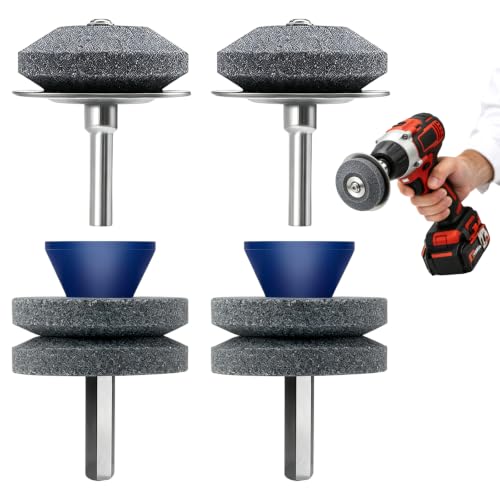
Pros
- Fast 10-second chuck installation works with standard drill chucks
- Double-layer corundum grinds steel evenly with minimal pressure
- Four-pack setup delivers excellent spare backup value for the shop
- Lightweight and compact enough to store inside any field tool tote
Cons
- Guide disc can get scored if pressed too aggressively against sharp metal
- Not intended for heavily gouged, warped, or cracked commercial blades
- Requires high drill RPM to achieve smooth, chatter-free grinding
The Bneykrir 4-Piece Lawn Mower Blade Sharpener is a specialized drill attachment designed to take the headache out of seasonal lawn equipment maintenance. Instead of wrestling blades on a heavy stationary bench grinder or risking uneven hand-filing, this tool uses a double-layer corundum wheel that mounts right into your drill chuck. It is aimed squarely at homeowners, DIYers, and small-property groundskeepers who want clean, healthy grass cuts without spending shop fees on blade balancing and sharpening.
In practical workshop use, setting up the sharpener takes only a few seconds. Chuck the metal shaft into an 18V or 20V cordless drill, clamp your lawn mower blade securely into a bench vise, and bring the drill up to speed. The abrasive corundum stone cuts through mild surface oxidation, dull bevels, and small turf nicks smoothly. The plastic guide disc rests along the flat underside of the blade, keeping the abrasive angled against the factory bevel without demanding pinpoint freehand steadying.
Build quality is suited well for light to medium maintenance runs. The corundum material holds up to standard lawn tractor and push mower steel, though users should avoid leaning too heavily into the work. Applying steady, moderate passes keeps heat buildup low and avoids burning the temper on thin steel. The four-pack arrangement is practical, giving you plenty of abrasive material to work through multiple seasonal tune-ups, tiller blades, and utility yard tools.
There are a few trade-offs to keep in mind. The plastic collar can wear down if it drags forcefully against jagged metal edges, and deep gouges from rocks will still require an angle grinder with a flap disc first. That said, for routine seasonal maintenance and quick edge touch-ups, this four-piece kit provides straightforward functionality and solid value for any home garage.
Routine edge touch-ups on standard residential walk-behind and riding lawn mower blades.
Cleaning and sharpening curved garden tools, rototiller tines, sickle cutters, and axes.
Pre-season garage tune-ups where removing the blade for quick bench vise work is preferred.
Home toolkits where space or budget does not justify a dedicated stationary grinder.

Pros
- Powerful 700W motor handles tough blade restoration quickly.
- Integrated dust collection keeps metal shavings contained for a cleaner workspace.
- Includes three grit sandpapers for complete sharpening stages.
- Heavy steel base provides stability and reduces vibration during use.
Cons
- No blade holder or guide included, requiring careful hand positioning.
- Some assembly and setup may be needed before first use.
The WEWEAL 7-Inch Lawn Mower Blade Sharpener is a benchtop grinder designed specifically for restoring dull, chipped, or damaged mower blades to a sharp edge. Unlike manual files or angle grinders, this dedicated sharpener offers a more controlled and efficient process, making it a valuable tool for homeowners who prefer to maintain their own equipment. With a 700W motor, built-in dust collection, and a set of three sandpaper grits, it aims to simplify blade maintenance while keeping your workspace clean.
This sharpener is best suited for homeowners, lawn care enthusiasts, and gardeners who regularly mow their lawns and want to keep their blades cutting cleanly. It's also a practical option for budget-conscious shoppers who prefer to sharpen blades themselves rather than pay for professional sharpening or replace blades frequently. The product description highlights compatibility with a wide range of blade types, including high lift, low lift, gator, and flat designs, so it should work with most standard walk-behind mowers and some riding mower blades.
In terms of real-world performance, the 700W motor provides ample power for grinding through hardened steel. The included 60-grit disc handles coarse grinding on heavily damaged edges, while the 120-grit refines the edge, and the 320-grit produces a smooth finish. The hook-and-loop system allows quick sandpaper changes, which is convenient when moving between stages. The built-in dust collection case captures most metal shavings, reducing mess and making cleanup easier. According to the manufacturer, it captures up to 99% of particles, which is a significant advantage over open bench grinders.
Build quality appears solid with a heavy-duty steel base that adds stability and helps minimize vibration. The ceramic wheel is designed for longevity and consistent sharpening. The detachable dust box is a thoughtful feature that allows you to empty shavings without stopping work. The overall dimensions (13 x 9.3 x 10.4 inches) mean it will occupy a permanent spot on your workbench, but it's not overly large.
Ease of use is straightforward: mount the sharpener on a stable surface, attach the desired sandpaper disc, and guide the blade along the wheel. However, there is no included blade guide or holder, so you'll need to manually control the angle and pressure. This requires a steady hand, especially for beginners. Maintenance of the sharpener itself is minimal: occasional cleaning of the dust box and replacement of sandpaper discs as they wear. The product does not include a blade holder, which some users may find as a limitation.
Realistic limitations include the price point, which is higher than manual sharpening tools but lower than industrial-grade sharpeners. Also, the sharpener is not designed for very wide blades or those with complex profiles. For most standard mower blades, it should work well. Overall, if you value a clean workspace, consistent results, and have multiple blades to maintain, the WEWEAL 7-Inch Lawn Mower Blade Sharpener is a worthwhile investment for your lawn care toolkit.
The WEWEAL sharpener uses a 700W motor to drive a ceramic wheel at high speed, allowing it to grind through steel efficiently. The three included sandpaper grits (60, 120, 320) cover the full sharpening cycle: coarse grinding to reshape the edge, medium sharpening to refine it, and fine finishing to polish. The hook-and-loop attachment makes switching between grits quick, so you can move through the stages without delay. The dust collection system is a standout feature, capturing most metal particles and keeping your bench clean. For homeowners who sharpen blades seasonally, this system reduces cleanup time significantly.
The sharpener features a reinforced steel base that adds weight and stability, reducing vibration during operation. The ceramic wheel is durable and resists wear, maintaining its shape over many sharpening sessions. The housing appears to be impact-resistant, and the detachable dust box is made of sturdy plastic. Overall, the build quality seems designed for regular use in a home workshop. The product dimensions are compact enough to fit on most benches, and the base has mounting holes if you want to secure it permanently. The manufacturer provides a standard warranty, though the exact length is not specified in the product data.


Pros
- Powerful brushless motor runs quietly and delivers consistent torque for efficient sharpening.
- Lifetime motor warranty provides peace of mind and reduces long-term ownership costs.
- Adjustable speed control offers versatility for different blade materials and conditions.
- Includes multiple sanding discs and angle guides for accurate, repeatable results.
- Simple assembly and intuitive operation make it user-friendly for beginners and experienced users.
Cons
- Currently has no customer reviews, so real-world reliability is unconfirmed.
- Designed specifically for lawn mower blades; not suitable for sharpening other tools like axes or chisels.
- Additional sanding discs may be needed for frequent heavy use, adding to ongoing costs.
The SporGain Lawn Mower Blade Sharpener is a dedicated tool for keeping your mower blades in top condition. It features a brushless motor that delivers strong, quiet performance with adjustable speed up to 3000RPM. This sharpener is best suited for homeowners, landscapers, and DIY enthusiasts who want a reliable machine for routine blade maintenance in their workshop or garage.
In real-world use, the brushless motor provides consistent power without the noise and wear of brushed motors. You can dial in the speed to match the blade's condition, using lower speeds for rough grinding and higher speeds for fine sharpening. The included 60-grit and 180-grit sanding discs cover both stages, and the 30-degree and 45-degree blade guides help maintain proper angles for different blade profiles. Assembly is straightforward, and operation is simple enough that you can start sharpening within minutes of unboxing.
Build quality is solid with a matte black finish and compact dimensions (13.58 x 8.86 x 3.46 inches) that fit easily on a workbench. The lifetime motor warranty adds confidence, though the product is new to market with no reviews yet. The sharpener handles high lift, low lift, gator, and flat blades, making it versatile for most residential and commercial mowers.
One realistic limitation is that this tool is purpose-built for mower blades, so don't expect it to sharpen other workshop tools. Also, while the kit includes 63 discs, heavy users may need to restock sanding discs more frequently. The lack of customer feedback means you're relying on the manufacturer's claims, but the specs and warranty are encouraging.
Overall, the SporGain Lawn Mower Blade Sharpener is a smart purchase for anyone who wants to keep their mower blades sharp without the hassle of manual filing or trips to a sharpening service. It's easy to use, backed by a strong warranty, and delivers the performance needed for consistent, precise results. If you maintain multiple mowers or just want a dedicated workshop tool, this is a solid choice.
Color: Matte Black
Dimensions: 13.58 x 8.86 x 3.46 inches
Motor: Brushless
Speed: Adjustable up to 3000RPM
Warranty: Lifetime motor warranty
Product Group: Lawn & Patio
3 x 60-grit sanding discs for grinding
60 x 180-grit sanding discs for fine sharpening
30-degree blade guide
45-degree blade guide

Pros
- Dedicated blade sharpener with preset angle guides speeds up the process for common mower blades.
- Ceramic grinding wheel stays cool and resists loading, making it suitable for frequent use.
- Included balancer is a practical addition that helps prevent vibration related engine damage.
- Solid build with a low vibration footprint once mounted to a bench.
- Simple to operate with minimal learning curve for DIYers.
Cons
- Limited to lawn mower blades only, not versatile for other shop grinding tasks.
- At 26.7 pounds, it's not portable for mobile sharpening services without a dedicated cart.
- The 1/3 HP motor is adequate for residential blades but may struggle with very thick or hardened commercial blades in continuous use.
The VEVOR Lawn Mower Blade Sharpener is a purpose-built tool that fills a specific gap in many home workshops and small engine repair shops. Instead of wrestling with a general purpose bench grinder and trying to hold a mower blade at the correct angle, this unit gives you a dedicated rest and preset angle stops for 30 and 40 degrees. That alone saves time and produces more consistent edges across multiple blades.
For the DIY homeowner who sharpens blades once or twice a season, this might feel like a specialized luxury. But for anyone maintaining several mowers or offering blade sharpening as a side gig, the VEVOR makes sense. The 7-inch ceramic grinding wheel is a nice upgrade over standard wheels. It runs cooler and resists glazing, which means you can sharpen several blades in a row without worrying about overheating the edge and ruining the heat treat. The 1/3 HP motor is quiet and has enough torque for typical residential and light commercial blades, though it will slow down if you push too hard on thick, hardened steel.
Build quality is solid for the price point. The base is heavy enough to stay planted on a workbench, and the included balancer is a practical addition that many general grinders lack. After sharpening, you pop the blade on the cone balancer and see if it tips. This step is often overlooked but it's critical for reducing mower vibration and preventing premature spindle bearing wear. The tool rest is adjustable and the miter gauge helps you repeat the same angle blade after blade. Setup is straightforward, and the manual covers the basics clearly.
On the downside, this is a single-purpose machine. You won't be using it for drill bits, chisels, or any other shop tools. And at nearly 27 pounds, it's not something you'll toss in a truck bed for mobile sharpening without a dedicated cart or mount. The motor, while adequate, isn't built for continuous commercial duty cycles. If you're sharpening dozens of blades daily for a landscaping business, you might want a heavier duty model. But for the serious DIYer, small engine mechanic, or part-time sharpener, this VEVOR unit delivers consistent results without the hassle of angle guesswork.
Overall, the VEVOR Lawn Mower Blade Sharpener is a practical investment for anyone who values a sharp, balanced blade and wants to avoid the cost and turnaround time of sending blades out. It's straightforward, well featured for the price, and the ceramic wheel is a genuine plus. If you maintain multiple mowers or just want your own blades done right every time, this sharpener earns a spot on the bench.
Motor: 1/3 HP, 110V AC
Grinding Wheel: 7 inch diameter, ceramic abrasive
Sharpening Angles: 30 degrees and 40 degrees preset
Blade Types: High lift, low lift, gator, and flat blades
Dimensions: 13.39 x 12.4 x 9.65 inches
Weight: 26.72 pounds
Color: Gray
Includes: Blade balancer, tool rest, miter gauge, grinding wheel
Homeowners with multiple mowers or a riding mower who want to sharpen blades themselves and ensure proper balance.
Small engine repair shops that sharpen customer blades as a service.
Landscapers who maintain a fleet of push mowers and want a dedicated sharpening station in their shop.
DIYers who prefer doing their own maintenance and want consistent edge geometry without guesswork.
The VEVOR Lawn Mower Blade Sharpener comes with a 7-inch ceramic grinding wheel pre-installed, a blade balancer for checking balance after sharpening, an adjustable tool rest, and a miter gauge for setting sharpening angles. The unit is ready to use out of the box after mounting to a stable work surface.
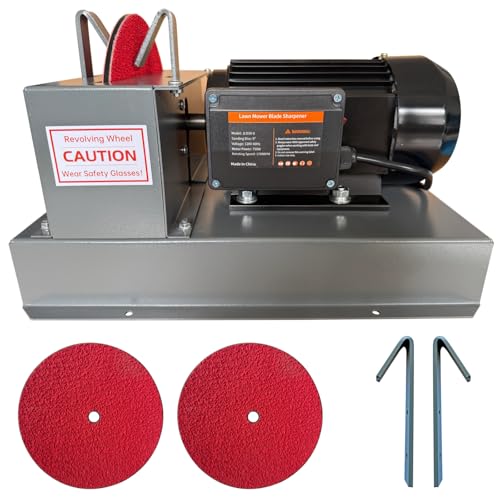
Pros
- Powerful 750W motor handles tough, dull blades quickly without bogging down
- 9-inch ceramic grinding wheel stays sharp longer and produces a smooth edge
- Sturdy steel base and brackets keep the grinder stable during operation
- Easy to set up and use; clear instructions and included accessories simplify the process
Cons
- May require a dedicated workspace or bench mounting for optimal stability
- Ceramic wheel may need occasional dressing to maintain flatness over heavy use
- Price point is higher than manual sharpening tools, but offers professional-grade results
The Goldsand Lawn Mower Blade Sharpener is a dedicated bench grinder designed specifically for restoring the cutting edges on mower blades. Unlike general-purpose grinders, this unit focuses on the unique geometry and hardness of lawn mower blades, making it a practical addition for any homeowner or landscaping professional who prefers to maintain their equipment rather than replace it.
This sharpener is best suited for suburban homeowners with medium to large lawns, rural property owners who maintain multiple mowers, and lawn care enthusiasts who value a crisp, clean cut. It also appeals to budget-conscious shoppers who want to extend blade life and avoid frequent replacements. For apartment dwellers with small yards, the grinder may be overkill unless they service shared equipment or are serious about DIY maintenance.
In real-world use, the 1HP motor and 9-inch red ceramic grinding wheel deliver noticeable sharpening efficiency. Dull blades that previously tore grass or left ragged edges can be restored to a sharp, even edge in minutes. The adjustable blade guide allows you to match the original bevel angle, which helps maintain cutting performance across high-lift, low-lift, gator, and flat blades. Many users report that after sharpening, their mowers cut cleaner and require less effort, especially in thick or damp grass.
Build quality is a strong point. The integrated steel base and blade fixing brackets provide a solid platform that resists vibration during operation. This stability is crucial for achieving consistent results and reducing the risk of overheating the blade. The grinder includes mounting hardware for permanent installation on a workbench, and the included replacement grinding discs add long-term value.
Setup is straightforward: attach the base, mount the motor, and install the grinding wheel. The instructions are clear, and most users can complete assembly in under 30 minutes. Maintenance is minimal, though the ceramic wheel may occasionally need dressing to keep it flat. The sharpener's compact footprint (16.9 x 12.6 x 9.6 inches) fits well on most workbenches, and its gray and red finish is practical for a shop environment.
One realistic limitation is that this tool is designed for blade sharpening only; it does not balance blades or remove deep nicks. For severely damaged blades, you may still need to replace them. Additionally, the price point is higher than manual files or inexpensive grinders, but the power and precision justify the investment for those who sharpen multiple blades per season. Overall, the Goldsand blade sharpener is a smart purchase for anyone serious about lawn care maintenance, offering professional-grade results that help keep your mower performing at its best.

Pros
- Robust 500W (2/3 HP) motor with an aluminum housing and sturdy steel base
- Comes with dedicated 30-degree and 40-degree brackets for consistent bevel angles
- Complete maintenance package includes a blade balancer, six center-hole adapters, and extra abrasives
- Accommodates flat, high-lift, low-lift, and gator mower blade designs
Cons
- Substantial 35-pound listed weight requires dedicated bench space and limits casual portability
- Fixed angle bracket choices are limited to 30 degrees and 40 degrees without micro-angle adjustments
- Sharpening heavily curved or complex commercial blade profiles may require extra operator technique
The Holdwell S Lawn Mower Blade Sharpener is a dedicated 2/3 HP (500W) bench-style grinding machine engineered specifically for maintaining lawn mower cutting edges. Featuring a black finish, an integrated aluminum motor housing, and a solid steel base, this unit is tailored to handle routine lawn tractor, zero-turn, and walk-behind mower blade upkeep. It is best suited for DIY homeowners, groundskeepers, and lawn-care maintenance buyers who want to eliminate manual hand-filing while maintaining repeatable edge angles.
Driven by a 500W electric motor, the grinder utilizes a 7-inch 60-grit ceramic grinding wheel designed for quick and controlled steel removal. A key practical feature is the inclusion of dedicated angle brackets, featuring a pre-installed 30-degree bracket and an interchangeable 40-degree bracket. These fixed guides assist operators in maintaining the appropriate bevel angle across standard flat blades, high-lift bagging blades, low-lift discharge blades, and toothed gator mulching blades without freehand guesswork.
Beyond the grinder itself, the kit addresses complete blade servicing by providing six center-hole adapters to support different blade mount configurations. This helps lock various center-hole dimensions firmly into place to reduce slip during sharpening passes. The package also includes extra replacement sandpapers, a screwdriver for the straightforward three-step assembly, and an essential static blade balancer, which allows users to verify balanced blade weight before reattaching blades to mower spindles.
In terms of workshop footprint, the machine measures 15.7 by 12.4 by 9.4 inches and carries a listed weight of 35 pounds. That heavy steel base helps isolate vibration during grinding, but it also means the unit is best assigned to a permanent workbench rather than transported frequently. While the dual 30-degree and 40-degree guides cover the most common manufacturer bevel specifications, buyers with atypical edge angles or extreme contour curves should note that the bracket architecture does not feature continuous micro-adjustability.
For residential and commercial property maintenance owners seeking an all-in-one sharpening station, the Holdwell S grinder delivers substantial value through its motor power and complete accessory bundle. Verifying blade balance with the included balancer and checking center-hole adapter fit prior to operation ensures safe, effective maintenance. As with any workshop power tool, operators should disconnect power before changing brackets or wheels and adhere to manufacturer guidance for safe grinding and blade inspection.
The Holdwell S blade grinder package is notably complete right out of the box. It includes the core 500W motorized sharpener unit fitted with a 7-inch 60-grit ceramic wheel, as well as a pre-installed 30-degree bracket and an interchangeable 40-degree bracket for setting edge bevels.
To support proper blade mounting during grinding, the package supplies six different blade hole adapters designed to accommodate a range of center-hole sizes. Maintenance and setup hardware include extra replacement sandpapers, an assembly screwdriver, a user manual, and a dedicated blade balancer to check balance after grinding.
The sharpener is designed to service a wide array of rotary mower blades used on residential lawn tractors, commercial zero-turn mowers, and walk-behind units. The grinding geometry supports standard flat blades, low-lift side-discharge blades, high-lift bagging blades, and stepped or toothed gator-style mulching blades.
Operators should select the bracket angle that matches their blade manufacturer recommendation, using the 30-degree bracket for typical factory cuts or the 40-degree bracket for steeper bevel requirements. The included adapters help steady blades with various center-hole diameters against the guide during sharpening.

Pros
- Brushless motor runs quieter and lasts longer than brushed alternatives reducing maintenance and downtime
- Variable speed up to 3000RPM gives you control over the sharpening process for different blade conditions
- Comes with a generous assortment of sanding discs and blade guides so you can start sharpening right out of the box
- Lifetime motor warranty adds peace of mind for long term ownership
Cons
- No included storage case or carry bag for the tool and accessories which could be a minor inconvenience for mobile users
- The 60-grit discs may wear quickly if used heavily requiring replacement sooner than expected
- Limited to lawn mower blades not suitable for other cutting tools like chainsaws or pruners
The SporGain Lawn Mower Blade Sharpener is a dedicated power tool designed specifically for sharpening mower blades. It's not a multi-purpose grinder but a focused solution for anyone who maintains a lawn mower regularly. Whether you're a homeowner who mows a quarter acre or a landscaper with a fleet of machines this sharpener aims to make blade maintenance fast and consistent.
At the heart of this tool is a brushless motor which is a real step up from traditional brushed motors you see on cheaper sharpeners. Brushless motors run cooler, quieter, and last significantly longer. You get adjustable speed up to 3000RPM so you can match the grinding speed to the blade condition. For a dull blade you might run it faster to remove material quickly while a nearly sharp blade benefits from a slower speed for a finer finish. The kit includes 10 coarse 60-grit sanding discs for rough grinding and 60 fine 180-grit discs for honing. You also get 30 and 45 degree blade guides to maintain the correct bevel angle which is critical for a clean cut and healthy grass.
Assembly is straightforward and the tool is simple to operate. It sits on a workbench or can be mounted for more stability. The compact dimensions 12.01 x 7.48 x 11.81 inches mean it won't dominate your workspace. Build quality feels solid for the price point and the lifetime motor warranty is a strong indicator of confidence in the motor's durability. That said you won't find a storage case included so if you plan to transport it between job sites you'll need to supply your own container for the discs and guides.
One realistic limitation is that this sharpener is designed exclusively for lawn mower blades. It won't handle chainsaw chains, pruners, or other cutting tools. Also while the 60-grit discs work well for initial grinding they may wear out faster than some users expect especially if you're sharpening multiple blades in a single session. Having extra discs on hand is a good idea. But for dedicated mower blade work this tool performs reliably and the adjustable speed gives you fine control that many fixed-speed sharpeners lack.
For the DIY homeowner who wants to keep their mower cutting clean without paying for professional sharpening the SporGain is a solid investment. Landscapers will appreciate the speed and consistency for maintaining multiple blades. The brushless motor and lifetime warranty support long-term value. If you need a simple, effective way to sharpen mower blades at home or in the shop this sharpener delivers without unnecessary complexity.
Color: Black
Dimensions: 12.01 x 7.48 x 11.81 inches
Product Group: Lawn and Patio
Motor Type: Brushless
Speed Range: Adjustable up to 3000 RPM
Included Discs: 10 x 60-grit sanding discs, 60 x 180-grit sanding discs
Included Guides: 30 degree and 45 degree blade guides
Warranty: Lifetime motor warranty
The SporGain Lawn Mower Blade Sharpener comes with a complete sharpening kit right in the box. You get 10 pieces of 60-grit sanding discs for the initial grinding phase and 60 pieces of 180-grit sanding discs for fine sharpening. Two blade guides are included one at 30 degrees and one at 45 degrees to help you maintain the correct sharpening angle for different mower blade types. All you need to supply is a standard power outlet and a workbench or stable surface to mount or place the tool.

Pros
- Sharpens a wide variety of single-edge garden tools quickly
- Reversible blades extend product life
- Safe ergonomic design reduces hand fatigue
- Dishwasher safe for convenient cleaning
- Compact and portable for easy storage
Cons
- Only suitable for single-edge tools, not serrated blades or knives
- Coarse grit may not produce a polished edge for fine cutting tools
- Handle may feel small for users with very large hands
The AccuSharp Garden Tool Sharpener is a straightforward manual sharpener designed to handle the dullest garden tools. It is not a power tool, but an essential workshop accessory for anyone who works with lawn mowers, pruners, shears, hoes, or shovels. Whether you are a homeowner maintaining your own yard or a professional landscaper, this tool saves you time and money by quickly restoring sharp edges without any electricity or complex setup.
Best suited for DIY homeowners, gardeners, and even contractors who need a reliable way to keep their tools in peak condition. The diamond-honed tungsten carbide blade is exceptionally hard, allowing you to sharpen very dull or damaged blades with just a few strokes. The reversible blade feature doubles its useful life, making it a long-term investment for your workshop. Users report getting 5 to 10 years of regular use before needing to replace the blade.
Build quality is solid, with a comfortable ergonomic handle that fits either hand and includes a guard to protect your fingers. The compact size (5 inches) and lightweight design (1.4 ounces) make it easy to store in a drawer or take along on jobs. It is dishwasher safe, so cleaning off residue from sharpening is hassle-free. However, keep in mind that this sharpener works only on single-edge tools; serrated blades or fine knives require a different tool. Also, the coarse grit is great for fast material removal but won't produce a polished, mirror-like finish.
Overall, the AccuSharp Garden Tool Sharpener is a practical, durable addition to any workshop or tool shed. Its ease of use, safety features, and long-lasting performance make it a smart buy for anyone who wants to keep their garden tools working like new without spending much time or money.

Mastering Lawnmower Blade Sharpening With a Grinder
Sharpening a lawnmower blade with a grinder requires maintaining the existing factory bevel while removing just enough steel to create a clean cutting edge. Motorized grinders provide the fast material removal necessary to dress out stone nicks and gouges, but controlled passes are crucial to prevent overheating the steel. By following a steady sweep along the cutting face and verifying balance on a dedicated balancer, anyone can restore dull blades safely. This practical guide outlines the complete mechanical process from initial mower preparation to final edge dressing.
Safety Disconnect and Safe Blade Removal
Disconnecting all power sources represents the most critical first step before touching any cutting hardware. For gasoline mowers, disconnect the spark plug wire and secure it away from the plug terminal to eliminate any risk of accidental compression starting. Cordless battery mowers require removing the safety key and pulling the main battery pack out of the machine entirely. Never tilt a gas mower with the carburetor or air filter facing downward, because crankcase oil can seep into the cylinder and saturate the filter element.
Securing the blade firmly prevents sudden deck spinning when loosening stubborn center mounting hardware. Clamp a heavy wood block against the inside deck skirt to wedge against the blade’s trailing wing, stopping rotation during torque application. Use a six-point socket wrench that matches the blade bolt or spindle nut precisely to avoid rounding off the bolt shoulders. Once the fastener is loose, note the orientation of any cupped washers, adapters, or splined spindle flanges so they go back together properly.
Labeling the grass-facing side of the blade with a permanent marker prevents dangerous upside-down reinstallation later. Many cutting blades feature stamped labels indicating the bottom surface, but years of debris and surface rust can obscure those markings. Lay the hardware in a clean tray and wipe away grass buildup around the spindle shaft to inspect for seal leaks. Taking extra care during blade removal sets up a smooth workflow and keeps all mounting parts organized.
Inspecting the Blade for Structural Integrity Before Grinding
Thorough inspection determines whether a mower blade can safely take a fresh edge or belongs in the scrap bin. Scrape away hardened clippings and caked soil using a wire brush or putty knife so the underlying steel becomes completely visible. Look closely along the center mounting hole and the outer lift wings for hairline cracks or spiderweb stress fractures. Blades with visible cracks must never be ground or reused, because centrifugal forces during mowing can cause catastrophic structural failure.
Checking straightness across the length of the blade reveals bends caused by striking buried rocks, stumps, or hidden metal pipes. Lay the blade flat on an open workbench or against a known straightedge to verify that both wings sit on an even plane. If one cutting tip sits noticeably higher than the opposite side, the blade is bent and cannot maintain a level cut. Attempting to bend high-carbon steel back into alignment weakens its crystalline structure and creates severe vibration during operation.
Measuring the remaining thickness along the cutting face and lift sail helps identify blades that have exceeded their usable lifespan. If aggressive past sharpenings have ground the cutting edge back into the curve of the lift sail, the blade cannot generate proper air velocity. Blades that become excessively thin along the sail can break apart under heavy discharge stress, especially when handling thick thatch. When wear reaches these physical limits, swapping in fresh hardware is the only safe path forward.
Choosing Between Bench Grinders, Angle Grinders, and Dedicated Machines
Selecting the right grinding tool directly influences edge precision, user control, and overall workshop safety. Standard bench grinders equipped with adjustable tool rests and ceramic or aluminum oxide wheels offer exceptional stability for single-pass sharpening. Dedicated mower blade grinders, such as the WEWEAL 7″ Bench Grinder or the RFRYZE 800W bench unit, incorporate pre-set angle brackets that guide the blade automatically. Handheld angle grinders equipped with flap discs provide portable versatility, but they require a steady hand to maintain uniform angles.
Dedicated blade grinders often feature 700W or 800W motors and ceramic grinding wheels that run cool while removing stubborn gouges efficiently. Units like the Goldsand Lawn Mower Blade Sharpener utilize wide ceramic wheels and fixed mounting brackets that hold high-lift and flat blades securely during each stroke. Handheld flap discs on an angle grinder work reasonably well in field settings, but freehand grinding increases the risk of creating a wavy cutting bevel. Bench setups with solid steel bases minimize motor vibration, which helps you produce a straight, consistent cutting line.
Grinding disc grit selection plays an equally vital role in surface finish and material removal rates. Coarse 60-grit ceramic wheels quickly grind down chipped edges and blunt impacts without requiring excessive downforce from the operator. Following up with 120-grit or 180-grit sanding discs refines the edge bevel and removes micro-grooves that could catch tough stems. Clean finishes are especially noticeable when maintaining equipment for electric mulching lawn mower care, where clean cutting edges reduce motor drag significantly.
Establishing and Maintaining the Correct Cutting Edge Bevel
Matching the original factory bevel angle preserves cutting efficiency while retaining enough metal thickness to withstand small yard impacts. Most commercial and residential mower blades feature factory bevel angles between 30 and 35 degrees, though some heavy-duty commercial blades use 40 degrees. Sharpening at too steep an angle leaves a blunt edge that tears grass blades instead of shearing them crisply. Conversely, grinding too shallow of an angle creates a fragile, razor-thin edge that folds over the moment it strikes a twig.
Adjustable angle brackets on modern sharpeners make dialing in precise 30-degree or 40-degree bevels simple and repeatable. Sharpeners like the VEVOR Lawn Mower Blade Sharpener and the Holdwell S unit feature dual-angle brackets designed specifically for high-lift and flat profiles. If using a conventional bench grinder rest, use a simple angle gauge or align the existing bevel flush against the wheel face before turning on the motor. Consistency across the entire cutting length matters more than matching an arbitrary theoretical fraction of a degree.
Preserving the flat underside of the blade is essential for clean grass shearing and proper deck aerodynamics. Never grind a secondary bevel into the flat bottom surface of the mower blade during the sharpening process. The bottom face must remain completely flat so clippings shear squarely against the turf canopy without creating downward turbulence. You only need to touch the bottom face lightly with a fine hand file or stone to knock off grinding burrs.
Step-by-Step Grinding Technique and Heat Management
Executing smooth, continuous passes across the grinding wheel prevents uneven gouging and localized heat accumulation. Hold the blade firmly with both hands, using your body’s momentum to guide the cutting edge across the abrasive surface from heel to tip. Never pause the blade in one spot against the spinning wheel, as stationary grinding cuts deep ruts and ruins bevel geometry. Apply moderate, consistent pressure so the wheel removes steel steadily without bogging down the electric motor.
Managing friction heat prevents burning the steel and ruining the manufacturer’s heat treatment. High-carbon mower steel turns yellow, then blue, and finally black when friction elevates temperatures beyond its temper threshold. Blued steel becomes soft and brittle, losing its ability to hold an edge after only a few mowing sessions. Keep a container of cool water beside your grinding station, dipping the blade edge frequently to dissipate excess thermal buildup.
Aiming for a butter-knife edge rather than a razor edge ensures optimal durability under real lawn conditions. A cutting edge sharpened down to a razor-thin wire edge dulls instantly upon striking sandy soil or small acorns. Leaving a blunt cutting flat approximately one sixty-fourth of an inch thick provides ample sharpness while resisting immediate chipping. Once the main passes are finished, stroke a deburring stone along the flat bottom to remove the thin wire burr cleanly.
Handling Different Blade Geometries From High-Lift to Mulching Wings
Different blade types feature unique contours that require specific adjustments to your grinding technique. Standard flat blades present a straightforward, straight cutting face that tracks easily across a standard bench grinder wheel. High-lift blades feature prominent curved sails on their trailing edges designed to generate upward suction for bagging or long-distance side discharge. Take care not to grind into the upward curve of the lift sail, focusing metal removal strictly on the front cutting flat.
Mulching blades often feature stepped cutting planes, curved transitions, or serrated gator teeth along the back of the wing. These undulating cutting edges cannot be sharpened in a single straight pass on a wide, rigid grinding wheel. Using smaller contact wheels, specialized angle brackets, or a rotary drill sharpener allows you to follow curved contours without removing excessive steel. Never grind down the serrated mulching teeth on gator blades unless the original manufacturer documentation explicitly calls for dressing those teeth.
Understanding how blade geometry affects airflow helps you avoid altering wing angles that keep clippings circulating properly inside the deck. When cutting conditions involve uneven turf or hidden debris, maintaining correct sail contours is critical for steady lift. Mowing routines that involve mowing rough or uneven terrain place added shock on blade wings, making structural integrity paramount. Altering the aerodynamic profile of your blade reduces discharge velocity and increases the risk of deck clogging in heavy damp turf.
Checking Dynamic and Static Balance After Grinding
Balancing the blade after grinding is mandatory to prevent destructive engine vibration and premature deck spindle bearing failure. An unbalanced blade spinning at three thousand revolutions per minute exerts violent orbital forces on the spindle housing and mower frame. Even a few grams of excess metal remaining on one wing will shake the mower handlebars and accelerate wear on deck belts. Checking balance takes only a few minutes and protects expensive internal mower components over the long run.
Static cone balancers and precision magnetic wall balancers provide simple, reliable ways to verify weight distribution across both wings. Slip the center mounting hole over the stepped cone of the balancer and ensure the assembly rests on a completely level table. If one wing immediately tips downward, that heavy side contains excess steel that must be removed before installation. Always remove corrective metal from the back of the heavy wing or trailing edge, never by grinding away the newly sharpened cutting bevel.
Adapting the balancer to fit non-standard center holes ensures accurate readings without wobble or false tilting. Many modern zero-turn and tractor blades utilize star, splined, or oversized circular mounting holes that require matching adapters. Sharpeners like the JLD and Holdwell S kits include multi-size blade hole adapters specifically to seat various center hole geometries on cone balancers. Continue light grinding passes on the heavy wing until the blade remains level horizontally on the balancer cone.
Proper Reinstallation and When Replacement Is Necessary
Reinstalling the sharpened blade correctly ensures safe operation and restores proper cutting height across your lawn. Clean any grass build-up from the spindle flange before slipping the blade onto the shaft with its cutting bevel facing upward toward the deck. Hand-thread the center mounting bolt along with any cupped washers, making sure the concave washer side faces the blade surface. Use a torque wrench to tighten the fastener to the manufacturer’s specified foot-pound rating, preventing over-tightening or dangerous loosening.
Knowing when to retire an old blade is just as important as knowing how to dress an existing cutting edge. Discard any blade that exhibits excessive thinning, severe gouges deeper than a quarter-inch, or signs of metal cracking around the center hole. If previous sharpening sessions have shortened the overall blade length, the cutting tip clearance will change and create uncut grass streaks. Investing in a fresh replacement blade is far safer and more economical than running compromised steel at high rotating speeds.
Regular blade sharpening with a grinder keeps your lawn looking neat while reducing mechanical stress on your mower’s engine and drive components. Dressing the cutting edge every twenty-five to fifty mowing hours ensures crisp clipping cuts and promotes healthy turf recovery throughout the summer. By maintaining consistent bevel angles, controlling heat exposure, and verifying balance every time, you preserve your cutting hardware for seasons to come.


Write Your Review
No reviews yet. Be the first to share your experience!