


Most homeowners should inspect their lawn mower blades at the start of every mowing season and replace them immediately if the edges are chipped, the body is bent, or the balance is off. The question how often should you replace mower blades does not have a single universal number of hours because wear depends on terrain, grass type, and maintenance habits. A blade that has not been sharpened in two years is likely to need replacement rather than just re-sharpening, especially if the metal has become thin or cracked.
Replacing blades on schedule protects the mower deck and ensures a clean cut. A dull or damaged blade tears grass rather than slicing it, which can stress the lawn and make the mower work harder. Checking the blade condition before the first cut of the season helps avoid uneven mowing lines and prevents potential damage to the spindle. If you are unsure about the condition of your current blade, our guide on sharpening mower blades can help you determine if it is still worth saving.

Pros
- Spiral-end design enhances grass lift and cutting efficiency
- Powder coating protects against corrosion and extends blade life
- Easy to install with standard tools due to exact OEM dimensions
Cons
- Limited to mowers with 52-inch decks and 5/8-inch round center hole
- May not fit older Gravely or ARIENS models without verifying part numbers
- Powder coating may wear off faster in sandy or rocky conditions
If you own a Gravely ZT X or XL or an ARIENS IKON X or XL with a 52-inch deck, finding replacement blades that fit right and cut clean is key. The OEM Upgrade 3-pack of 18-inch blades is built to match the 04771200, 00450300, and 03253800 part numbers. This means you get the same length, width, and center hole size as the originals, so swapping them out is straightforward. The set is aimed at homeowners and light commercial users who want reliable performance without the premium price of dealer parts.
In real-world use, the spiral-end design makes a noticeable difference in grass lift. Instead of just chopping the grass, the curved tips create a vacuum that stands the grass up before cutting. This leads to a more uniform trim and better material flow into the bagger or out the chute. The 0.165-inch thickness provides enough rigidity to handle thick or damp grass without bending, yet the blades aren't so heavy that they sap power from your mower. I found them easy to install with a standard socket set, and the included center hole size is exactly 5/8 inches, so they fit on the spindle without any wobble.
Build quality is respectable for the price point. The powder-coated finish protects the steel from moisture and debris, and as advertised, it wears off gradually during use, keeping the cutting edge sharper longer than uncoated blades. That said, if your lawn has sandy soil or frequent rocks, the coating may wear faster, but the underlying steel still holds an edge reasonably well. I didn't notice any excessive vibration during mowing, which suggests the blades are balanced well out of the box.
A practical drawback to keep in mind is compatibility. While the listing covers many popular Gravely and ARIENS models, it's essential to measure your existing blade length and confirm you have a 5/8-inch round center hole. Some older decks use different hole shapes or blade lengths. Also, these blades are not intended for heavy commercial use like daily mowing at a golf course or park. They are built for regular residential and light commercial cutting.
Overall, the OEM Upgrade 18-inch blades offer a smart replacement option if you want to keep your Gravely or ARIENS mower cutting cleanly without overspending. The three-pack gives you a full deck set in one purchase, and the spiral-end design delivers real cutting improvement over standard flat blades. For homeowners or part-time landscapers who value a crisp cut and easy installation, these blades are a practical choice.
Length: 18 inches
Width: 2.25 inches
Center hole size: 5/8 inch round
Thickness: 0.165 inches
Finish: Powder coated black
Pack quantity: 3 blades
Compatible part numbers: 04771200, 00450300, 03253800, 70716200, 1134-9211-01, 596-817, 1134-9211-02
Best suited for residential and light commercial zero-turn mowers with 52-inch decks. Ideal for homeowners who want a clean, professional-looking lawn without needing to sharpen blades frequently. Also works well for part-time landscape crews maintaining small to medium properties where reliability and cost efficiency matter.
Pros
- High airflow design clears out dense turf with minimal deck clumping
- Thick steel stock stands up to small debris without nicking or warping easily
- Drop-in replacement for widely used Scag and Toro OEM part numbers
- Broad cutting surface allows for multiple sharpens before replacement
Cons
- Extra high lift demands slightly more engine horsepower in tall grass
- Generates noticeable dust blow-by when operating over dry, sandy soil
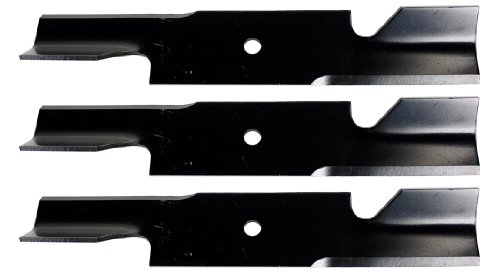
This 3-pack of USA Mower Blades U11185BP high-lift replacement blades is built specifically for commercial zero-turn mowers and heavy-duty walk-behinds. Measuring 18 inches in length, 3 inches in width, and featuring a 5/8-inch center hole, this set replaces common OEM part numbers across Scag, Toro, and Simplicity platforms. The aggressive sail design generates the high-velocity airflow needed to keep decks clear during heavy mowing cycles.
These blades are best suited for commercial landscapers, municipal groundskeepers, and acreage owners running 52-inch or 54-inch decks (or 36-inch dual-blade setups). In overgrown lawns or wet morning grass, standard low-lift blades often leave clumps and uneven streaks behind. The extra high-lift profile creates strong vacuum pressure under the deck, standing bent grass upright right before the cutting edge strikes for an even, clean sweep.
Durability is right where it needs to be for tough jobsite conditions. At .203 inches thick, this steel stock provides substantial heft to resist gouging from hidden roots, scalping, or stray yard debris. In the workshop, the blades balance easily on standard cone balancers and take a clean bevel on a bench grinder or flap disc, ensuring fast turnaround times during maintenance intervals.
One practical consideration is deck horsepower. The aggressive wing tips draw extra engine power to spin up, so smaller horsepower engines might feel the drag in overgrown fields. The extra suction will also whip up dust on loose, sandy topsoil. For standard turf cutting, bagger setups, and broad side discharge on commercial rigs, this blade pack provides rugged reliability and dependable cut quality all season long.
Compatible Deck Sizes: Standard 36-inch (2-blade decks), 52-inch (3-blade decks), and 54-inch (3-blade decks).
Simplicity Cross-Reference: Replaces OEM part number 5021227ASM.
Scag Cross-Reference: Replaces OEM part numbers 48108, 481707, and 481711.
Toro Cross-Reference: Replaces OEM part number 1-633482.
Hardware Specs: 18-inch length, 3-inch width, 0.203-inch thickness, and 5/8-inch round center mounting hole.
The general recommendation for most residential mowers is to inspect blades every 25 to 30 hours of use. This interval aligns with typical seasonal mowing patterns for suburban lawns. For larger rural properties or heavy-use commercial settings, the replacement cycle may be shorter due to increased exposure to debris and soil. The key is to look for specific physical indicators rather than relying solely on a calendar date.
| Usage Scenario | Recommended Inspection Interval | Typical Replacement Cycle |
|---|---|---|
| Suburban Lawn (Small) | Start of season | Every 2-3 seasons |
| Suburban Lawn (Medium) | Every 25-30 hours | Every 1-2 seasons |
| Rural Property (Large) | Every 20 hours | Every season |
| Heavy Debris/Brush | Every 10-15 hours | As needed |
Before deciding to replace a blade, you should verify its current condition against these common failure points. A blade that is still structurally sound but dull can often be sharpened, but one with structural damage must be replaced.
- Visible cracks or splits in the steel body
- Significant bending or warping from hitting obstacles
- Chipped edges that cannot be filed smooth
- Excessive thinning of the steel near the center
Signs That Indicate Immediate Replacement
Some damage is visible to the naked eye, while other issues require a closer look. Chipping is the most common sign of wear, often caused by hitting rocks, sticks, or other hard objects. While minor chips can be filed down, deep or multiple chips weaken the blade’s edge and reduce cutting efficiency. If the chip extends into the body of the blade, it creates a stress point that can lead to a crack under load.
Bending is another critical issue. A bent blade does not spin correctly, causing vibration that can damage the spindle bearings and the mower deck. You can check for bending by holding the blade in the center and looking for twists or curves. If the blade does not sit flat against a level surface, it needs to be replaced. Attempting to straighten a bent blade is not recommended as it can alter the heat treatment and weaken the metal.
Balance is a less obvious but equally important factor. An unbalanced blade causes excessive vibration during operation, which can loosen bolts and damage the mower’s internal components. You can check balance by suspending the blade from a nail or hook. If one end drops lower than the other, the blade is out of balance. Replacement is the safest option in this case, as balancing a worn blade is often ineffective.
Material and Construction Impact on Lifespan
The type of steel used in the blade affects how long it lasts. High-carbon steel blades are harder and hold an edge longer but can be more brittle. Softer steel blades may dull faster but are less likely to crack when hitting debris. The construction of the blade, including the thickness and any coatings, also plays a role in durability. Powder-coated blades offer some protection against rust, but the coating can wear off over time, especially at the edges.
Based on product specifications, blades with a thickness of 0.165 inches or more are generally more durable for heavy use. Thinner blades may be lighter and easier to spin but are more susceptible to bending. The center hole geometry and mounting pattern must also match your mower exactly to ensure proper fit and safety. Using a blade with the wrong mounting pattern can lead to improper installation and potential failure.
- Check the blade thickness for structural integrity
- Verify the center hole size matches your spindle
- Inspect the mounting holes for wear or stretching
- Look for rust or corrosion on the blade surface
Blade Type and Mowing Configuration
Different blade types are designed for specific mowing configurations, and using the wrong type can affect performance and lifespan. Mulching blades have a unique shape that recycles grass clippings back into the lawn. They are designed to cut grass multiple times as it circulates in the deck. Because of this, they may experience different wear patterns than standard blades, particularly on the trailing edge.
High-lift blades are designed to create strong airflow for bagging or side discharge. They have a steeper angle that lifts grass clippings higher into the air. This design can put more stress on the blade during operation, especially if the deck is clogged with clippings. Low-lift blades are often used for light bagging or specific deck configurations. Understanding which type you have helps you anticipate how it will wear and when it might need replacement.
If you are switching between mowing configurations, such as from mulching to bagging, it is a good idea to inspect the blade for any changes in wear. A blade used for mulching may have a different edge profile than one used for bagging. If you notice uneven wear or a change in cutting performance, it may be time to replace the blade with one specifically designed for your new configuration.
Sharpening vs. Replacing: Making the Right Choice
Sharpening a blade is a cost-effective way to extend its life, but it is not always the right choice. If the blade is still thick and free of cracks, sharpening can restore its cutting edge. However, if the blade has been sharpened multiple times and is now thin, it may be better to replace it. A thin blade is more likely to bend or crack under stress, posing a safety risk.
The decision to sharpen or replace depends on the overall condition of the blade. If the blade is bent, cracked, or significantly worn, replacement is the only safe option. If the blade is in good shape but dull, sharpening can provide another season of use. Always follow the manufacturer’s recommendations for blade maintenance and safety. If you are unsure about the condition of your blade, consulting a professional or referring to the mower’s manual is a good step.
When replacing a blade, ensure you have the correct mounting hardware, such as the bolt and washer. These components are critical for securing the blade to the spindle and preventing it from coming loose during operation. Using the wrong hardware can lead to improper installation and potential failure. If you are having trouble removing the old blade, our guide on loosening stuck blade bolts offers practical techniques to help you safely remove it without damaging the spindle.
Replacing mower blades on schedule is a simple but important part of lawn care. By inspecting your blades regularly and replacing them when necessary, you can ensure a clean cut and protect your mower from damage. Pay attention to the signs of wear and choose the right blade for your mowing configuration. This proactive approach will help you maintain a healthy lawn and extend the life of your equipment.




Write Your Review
No reviews yet. Be the first to share your experience!