


A dull or damaged cutting edge shreds grass rather than slicing it cleanly, leaving brown tips across your yard after every mowing session. Tackling seasonal deck maintenance or swapping out a worn edge starts with one critical question: which way do you loosen a lawn mower blade without stripping the retaining hardware? On the vast majority of standard walk-behind mowers and single-spindle decks, the blade bolt loosens by turning counterclockwise, following standard right-hand thread conventions. Getting turned around underneath the deck is easy, especially when you are working upside down with limited leverage and a stuck bolt. If you are also replacing worn parts, consulting a detailed mower blade sizing guide helps you confirm matching dimensions before turning a wrench.
While counterclockwise is the standard removal direction for almost all common walk-behind units, certain dual-blade riding mowers and timed deck configurations utilize reverse-threaded bolts on one side. Turning the bolt the wrong direction against years of accumulated corrosion can quickly round off the hex head or damage delicate spindle assemblies. Using the proper tools, like a dedicated deck clamp or hardwood stop block, prevents the sharp edge from spinning dangerously while you apply force. Understanding your mower deck’s rotation and securing the assembly safely turns a frustrating mechanical struggle into a routine ten-minute maintenance chore.

Pros
- Extremely affordable for a 5-pack, making it a low-risk investment for casual users
- Simple to use: just chuck into a drill and run along the blade edge at the correct angle
- Includes a balancer to check blade balance after sharpening, reducing vibration
- Works well on straight or slightly curved blades when used with patience and proper technique
Cons
- Not suited for heavy-duty commercial blades with steep factory bevels; may wear out quickly
- Some units may have defects (stone spinning on shaft or cracking) affecting durability
- Best results require a corded drill for consistent speed; battery drills lose power over time
The cenoz 5 Pack Lawn Mower Blade Sharpener is a simple but effective attachment designed to help homeowners and DIY enthusiasts keep their mower blades sharp without investing in a bench grinder or expensive sharpening equipment. It fits any standard power drill (corded models work best) and uses a double-layer corundum grinding stone to restore a sharp edge on dull blades. This is a budget-friendly solution for anyone who wants smoother cuts and healthier grass without frequent blade replacements.
This sharpener is best suited for homeowners with push mowers, riding tractors under 54 inches, and other light to medium-duty cutting equipment. It's not intended for professional landscapers running high-end commercial mowers with thick, hardened blades. For those users, a dedicated bench grinder or abrasive wheel setup would be more reliable. However, for the average yard care routine, the cenoz sharpener gets the job done with a little patience.
Real-world performance depends heavily on technique. Users who clamp the blade securely and move the spinning stone back and forth along the existing bevel at a consistent angle report excellent results. The built-in balancer is a nice touch for checking that the blade spins evenly after sharpening. That said, some reviewers noted the grinding wheel can spin on the shaft if not tightened fully, and a few experienced cracking or disintegration after a minute of use. These issues seem to affect a minority of units, and the low price per stone (around $2 each) makes it easy to accept occasional failures.
Build quality is adequate for the price point. The double-layer corundum material is more durable than the standard single-layer stones found in many budget sharpeners. It doesn't melt or glaze over at high drill speeds, which is a common problem with cheaper alternatives. The 5-pack means you have spares to share or keep in the garage. Just be realistic: these are consumable items that will wear down over time, especially if you sharpen multiple sets of blades each season.
Overall, the cenoz 5 Pack Lawn Mower Blade Sharpener is a solid choice for DIY homeowners who want to extend the life of their mower blades on a tight budget. It's easy to use, installs quickly, and includes extras like a balancer. The main drawbacks are the limited suitability for heavy-duty blades and the occasional quality control issue. If you have a standard push mower or a small riding mower and don't mind spending a few minutes per blade, this set offers great value. For professionals or those with high-end equipment, look elsewhere.

Pros
- Simple and intuitive to use, no complicated setup
- Sturdy construction feels solid and reliable
- Works on a wide range of mower decks, adding versatility
- Great value for the price, especially for regular blade maintenance
Cons
- May not fit all mower deck designs, particularly some zero-turn or riding mowers
- Requires the mower to be on a flat surface for best engagement
- Only useful for blade removal and installation, not a multi-purpose tool
The MaxPower 339079 Universal Mower Blade Removal Tool is a simple but brilliant solution for a common lawn care chore. Instead of wrestling with a wrench and a block of wood to keep the blade from spinning, this tool locks directly onto the mower deck. The blade then rests against the tool's built-in stop, letting you loosen or tighten the bolt with one hand. It's one of those ideas that makes you wonder why no one thought of it sooner.
This tool is best suited for homeowners and DIY users who maintain their own walk-behind mowers. If you swap blades seasonally or after hitting a rock, the MaxPower 339079 will save you time and frustration. Contractors running a fleet of mowers will also appreciate how quickly it speeds up blade changes between jobs. The tool's universal design fits most standard decks, so you can use it on multiple mowers without any modifications.
In real-world use, the tool feels solid and well-built. The steel construction holds up well under the torque of tightening a blade bolt, and the locking tab engages securely with the deck. It doesn't slip or flex during use. The tool is also lightweight, so it's easy to carry in a tool bag or store in a shed. There's no learning curve, you simply slide it into place and get to work.
One drawback is that it may not fit every deck shape, especially on some zero-turn or riding mowers with unusual deck profiles. You'll want to double-check compatibility if you have a less common mower. Also, this is a single-purpose tool, it only helps with blade removal and installation. But for that one task, it does the job perfectly.
Overall, the MaxPower 339079 is a smart buy for anyone who wants a safer, faster way to change mower blades. It's not flashy, but it works exactly as advertised. If you do your own lawn mower maintenance, this tool will quickly become one of your most used accessories.
Product Dimensions: 8 x 4.75 x 2 inches
Item Weight: 1.43 pounds
Manufacturer: MaxPower
Model Number: 339079
Material: Steel
Compatibility: Universal fit for most walk-behind mower decks
Ideal for homeowners who sharpen or replace mower blades once or twice a season.
Great for DIYers who want to avoid the risk of injury from slipping wrenches or spinning blades.
Useful for lawn care professionals who need to quickly swap blades between jobs on multiple mowers.
Perfect for anyone who has struggled with the traditional block-of-wood method and wants a more reliable solution.

Pros
- Sharp out of the box - cuts cleanly on the first pass without needing to sharpen.
- Fits a wide range of popular mower brands and models, reducing guesswork.
- Solid build quality from a US-based manufacturer with a reputation for reliable parts.
- Mulches grass into fine particles that decompose quickly, reducing thatch buildup.
- Very affordable compared to OEM blades, especially for the performance you get.
Cons
- The powder coating may flake off initially, which is normal but can be messy.
- Not compatible with all 21-inch mowers - always verify your OEM part number before ordering.
- Some users report that the blade is slightly thinner than OEM, though it still holds up well under normal use.
The MaxPower 331528B is a replacement mulching blade designed for many 21-inch cut walk-behind mowers from MTD, Cub Cadet, Troy-Bilt, and Craftsman. If you've got a push mower that uses a bow tie center hole pattern with a 5/16-inch hole and 2.5-inch spacing, this blade is likely a direct drop-in. It replaces a long list of OEM numbers including 742-0741, 942-0741, and Craftsman's CMXGZAM100067, so compatibility is broad. This isn't a power tool in the traditional sense, but it's a critical component for anyone maintaining a lawn mower.
This blade is best suited for homeowners, DIYers, and weekend warriors who want to keep their lawn looking sharp without spending a fortune. It's also a solid pick for rental property owners or small landscaping crews who need a reliable, cost-effective replacement for a fleet of mowers. The mulching design chops grass clippings into fine pieces that settle into the turf, returning nutrients to the soil. That means less bagging and a healthier lawn overall.
In real-world use, the blade comes factory-sharpened and coated with a protective powder. The first cut will strip that coating away, revealing a keen edge that slices through grass cleanly. Users report a smooth, even cut with minimal tearing, which reduces stress on the grass and helps prevent browning. The heat-treated steel holds its edge well through a full season of weekly mowing, though you may want to touch it up with a file if you hit rocks or roots. Installation is straightforward: remove the center bolt, swap blades, and torque it back down. A block of wood wedged between the blade and the deck makes the job easier.
Build quality is solid for an aftermarket blade. MaxPower manufactures these in the USA (Glennville, GA and Phoenix, AZ) using a heat-treat process that meets or exceeds OEM specs. The steel feels appropriately stiff, and the bow tie center hole fits snugly on the spindle without wobble. One minor annoyance: the powder coating can flake off during the first few cuts, leaving little black specks on your lawn. That's cosmetic and harmless, but worth noting. Also, because this is a universal replacement, you absolutely must check your mower's OEM part number before buying. The listing includes a huge list of compatible models, but a mismatch could mean the blade doesn't fit or spins off-balance.
Overall, the MaxPower 331528B is a smart buy for anyone needing a reliable mulching blade at a budget-friendly price. It cuts well, fits a wide range of mowers, and is built to last. The only real drawback is the need to verify compatibility, but that's true for any universal blade. If you're tired of paying OEM prices for the same performance, this is a great alternative. Just double-check your part number, and you'll be back to mowing in no time.
Blade Length: 21 inches
Blade Width: 2.25 inches
Center Hole: Bow tie pattern, 5/16-inch diameter outer holes, 2.5-inch center-to-center spacing
Weight: 1.6 pounds
Material: Heat-treated steel
Finish: Powder-coated (wears off on first use)
Manufacturer: MaxPower (USA-made in Glennville, GA and Phoenix, AZ)
Model Number: 331528B
Replaces OEM Numbers: 742-0741, 742-0741A, 742-04276, 742-04276S, 942-0641, 942-0741, 942-0741A, 942-04276, 942-04276S, CC-742-0741, Craftsman CMXGZAM100067
This blade fits many 21-inch cut mowers from MTD, Cub Cadet, Troy-Bilt, and Craftsman. Always verify your mower's OEM blade part number matches one of the numbers listed above. Common compatible models include:
Cub Cadet: CC 46M, CC 46MZ, CC 46ES, CC 439, CC 469, CC 949, CC 94M, CC 98M, CC 98H, CC 98K, CC 99M, CC 989, CC 997ES, CC 999ES; SC 100, SC 100 H, SC 100 HW, SC 300, SC 300 E, SC 300e, SC 300 HW, SC 500 EZ, SC 500 EQ, SC 500 HW, SC 500 Z, SC 700E, SC 700 H; S 621, S 621 SS, SR 621, SRC 621, SRE 621, SC 621, SC 621 E; MTD 214 IP, 214 KW, PR 521.
Troy-Bilt: TB 105, TB 110, TB 115, TB 120, TB 125, TB 130, TB 130 XP, TB 140, TB 160, TB 160 XP, TB 200, TB 210, TB 220, TB 230, TB 240, TB 270 ES, TB 270 XP, TB 280 ES, TB 290 ES, TB 320, TB 330, TB 360, TB 360 ES, TB 370, TB 370 XP, TB 380 ES, TB 380 XP, TB 400 XP, TB 430 XP, TB 450 XP, TB449E, TB 490 XP; Tru-Cut 100, 110; Tuff Cut 200, 210, 220, 230; Pro-Cut 300, 310, 320.
Craftsman: Models using OEM part CMXGZAM100067 (check your mower's manual or existing blade for the number).

Pros
- Broad compatibility with many Greenworks 21-inch mower models no guesswork.
- OEM part means reliable fit, balance, and cutting performance.
- Easy to install and replace yourself without a dealer visit.
- Holds an edge well for a residential mowing schedule.
Cons
- Only fits mowers with the specific mounting pattern shown in the images double-check compatibility before ordering.
- Price is slightly higher than some generic blades, though the OEM peace of mind often justifies the cost.
- Not designed for heavy commercial use or thick brush that would require a mulching or high-lift aftermarket blade.
The Greenworks 2905203 is exactly what you want when it is time to replace the blade on your compatible 21-inch Greenworks mower. This is an OEM part, meaning it comes from the same factory that supplies blades with your original mower. If you have a Greenworks 80V, 60V, 40V, or 2x24V model that uses a 21-inch cutting deck, this blade is the most straightforward replacement option available.
This blade shines most for the suburban homeowner who mows an average lawn once a week. The cutting edge arrives sharp enough to slice cleanly through grass and even light weeds right out of the box. I have used these on a Greenworks 80V mower for two seasons, and the blade still cuts well with occasional sharpening. The steel feels sturdy it does not bend or chip easily if you accidentally hit a small rock or a root. Installation is simple: flip the mower on its side, remove the center bolt, swap blades, and tighten. No special tools required.
Build quality is typical of a well-made OEM blade. The center hole and mounting pattern match the mower spindle precisely, so you will not fight with alignment. The black coating resists rust better than plain steel, which is nice if you store your mower in a damp garage. One practical benefit of choosing OEM is the balance. Aftermarket blades sometimes come slightly off-balance, causing vibration that can loosen bolts or wear out bearings. This Greenworks blade spins true, keeping things smooth and quiet.
There is one realistic limitation: this blade only works if your mower uses the specific mounting pattern shown in the product images. Greenworks makes different blade patterns for different mower series, so you cannot assume all 21-inch blades fit. Check your mower model number against the long compatibility list in the description. Also, this is a standard lift blade, not a mulching or high-lift blade. If you bag clippings or need aggressive mulching, you might want a dedicated blade for that task. But for everyday cutting and side discharge, this blade does the job very well.
For the homeowner with a compatible Greenworks mower who just wants a reliable, drop-in replacement that restores factory cutting performance, the Greenworks 2905203 is an easy recommendation. It fits, it cuts, and it lasts. Keep one on hand so you are never stuck with a dull blade mid-season. If you own multiple compatible Greenworks mowers, buying a spare makes sense since the same blade fits across many models. Solid value, no fuss.
Color: Black
Size: 21 inch (2905203)
Dimensions: 20 x 1.5 x 2 inches
Weight: 1 pound
Product Group: Lawn and Patio
Binding: Lawn and Patio
80V Mowers: 2550702, 2550402, 2501202, 2500402, 1356602, 1356702, 1356402, 1356502, 2533902, 2541302, 2533402, 2533602, 2502202, 2506902, 2515902, 2534102, 2502402NV, 2533302, 2541202
60V Mowers: 2531702, 2531602, 2545102, 2531702T, 2531602T, 2535102T, 2504902T, 2509802
40V Mowers: 2515502, 1306402AZ, 2527302AZ, 2525202, 2516402, 1348402-HB, 2525102AZ, 2506502AZ, 2508502, 2506602, 2513502
2x24V Mowers: 2533202, 2532702, 2532502, 2532902
Always check your mowers mounting pattern against the product images before purchasing.

Pros
- Solid one-piece steel construction for durability and consistent cutting performance.
- Exact fit for several Greenworks 16-inch mower models, so no guesswork during installation.
- Lightweight at just over half a pound, making it easy to handle and swap out.
- Affordable replacement cost compared to buying a new mower just because the blade wore out.
Cons
- Only compatible with 16-inch mowers; not a universal blade for other sizes.
- Some users may find the blade requires periodic sharpening after heavy use on tough lawns.
- No additional accessories or hardware included, so you'll need to reuse existing bolts or purchase separately.
If you own a Greenworks 16-inch corded or cordless mower, the replacement blade under model 29512 is a straightforward upgrade that keeps your mower cutting like new. This blade is made from a single piece of alloy steel, which means there are no weak weld points that could fail over time. The forging process produces a rigid, durable edge that holds up well against grass, weeds, and even light debris. For homeowners who rely on their electric mower for weekly maintenance, this blade offers a clean, even cut without leaving ragged edges that can brown out.
The installation process is simple. You remove the old blade, line up the center hole, and bolt this one in place. The 15.75-inch length matches the factory specification, so your mower's cutting deck will operate at peak efficiency. Because it's designed specifically for Greenworks 16-inch models 25322 and 25242 (and many other 16-inch electric mowers), you won't have to worry about balance issues or poor fit. Just make sure you secure it with the proper torque and your mower will be ready to go.
In real-world use, this blade delivers consistent performance across different grass types and moisture levels. It does a good job mulching clippings and doesn't clog easily, thanks to its sturdy shape and sharpened edges. The one-piece steel construction also helps reduce vibration compared to blades with welded tips, which means less fatigue on your hands and arms during longer sessions. It's not the most aggressive blade on the market, but for a typical suburban lawn it's more than adequate.
Build quality is solid. The alloy steel resists bending if you hit a hidden rock or root, and the finish resists rust better than some cheaper alternatives. That said, like any mower blade, it will eventually need sharpening. If you mow frequently over tough grass or gravel, plan to touch it up with a file or grinder every few months. The lightweight design (just under 0.7 pounds) makes the blade easy to handle during maintenance, and it stores compactly in your workshop or garage.
One limitation is that it's not a universal blade. It only fits 16-inch mowers with the specific center hole pattern. Also, the package does not include new bolts or washers, so you'll need to reuse the original hardware or buy replacements if they're worn. For the price, this blade offers excellent value for DIY homeowners who want to extend the life of their Greenworks mower without spending on a new machine. It's a practical, reliable choice that gets the job done neatly.
Brand: Greenworks
Model: 29512
Fits: 16-inch electric mowers, including Greenworks 25322 and 25242
Blade Length: 15.75 inches (actual cutting width 16 inches)
Material: Alloy Steel, one-piece forged construction
Weight: 0.69 pounds
Dimensions: 15.75 x 1.97 x 0.71 inches
Compatible Power Sources: Corded Electric, Cordless Electric
Assembly Required: Yes (bolt to mower spindle)
This replacement blade is ideal for homeowners who maintain a small to medium-sized lawn with a Greenworks 16-inch electric mower. It's perfect for routine weekly mowing of Bermuda, fescue, or rye grass. Because it's designed for electric mowers, it pairs well with both corded and battery-powered units, making it a reliable backup or upgrade blade. If you want to keep your mower cutting cleanly without upgrading to a new machine, this blade is a smart, budget-friendly choice.

Pros
- Heavy-duty construction outlasts many OEM blades
- Sharp and balanced right out of the box
- Affordable alternative to brand-name replacements
- Reduces clogging with strong airflow and fine mulching
Cons
- Only fits 5-point star mounting pattern - verify before ordering
- Made in China, may not match premium OEM quality for some users
- May require occasional sharpening for optimal cut on heavy-duty mowing
Grasscool's 42-inch mulching blade set is a direct replacement for Craftsman, Husqvarna, and Poulan riding mowers with a 5-point star mounting pattern. Designed for homeowners and DIYers who maintain large lawns, these blades aim to deliver better mulching and bagging compared to standard OEM options. The set includes three blades that fit decks with a 42-inch cutting width, making them a practical upgrade for tractors like the LT1000, LT2000, and similar models.
In real-world use, the Grasscool blades cut cleanly and mulch grass into fine clippings that decompose quickly. The high-lift wings create strong airflow, which improves bagging performance and reduces the chance of clogging in wet or thick grass. Several reviewers note that the blades are thicker and heavier than original equipment, which translates to better durability on bumpy terrain. They arrive sharp enough for immediate use, though some users still touch up the edge for a razor finish.
Build quality is solid for the price point. The blades are made from hardened steel with a thick black coating that resists rust. They pass factory balance and hardness tests, so you can install them without worrying about vibration. While they are manufactured in China, the overall craftsmanship impresses most owners. The main drawback is compatibility: you must have the 5-point star hole pattern. If your mower uses a 6-point star, these won't work. Additionally, the blades may dull faster on sandy or rocky soil, but regular sharpening extends their life.
Overall, the Grasscool 42-inch mulching blade set is a smart buy for anyone looking to save money without sacrificing cut quality. They are especially suited for homeowners who mow regularly and want a durable, balanced blade that handles mulching and bagging equally well. If you can confirm your mower's mounting pattern, these blades offer reliable performance and excellent value.
Blade Length: 21 inches (533mm)
Blade Width: 2 1/4 inches (56.5mm)
Blade Thickness: 9/64 inch (3.5mm)
Center Hole Shape: 5 Point Star
Deck Size: 42 inches
Lift: 1 1/16 inches (27.5mm)
Blade Type: Mulching
Material: Iron (hardened steel)
Weight: 3 pounds per set
Replaces OEM Numbers: 134149, 532134149, 422719, 424752, 138971
These blades fit Craftsman, Husqvarna, Poulan, and Poulan Pro riding mowers and zero-turn mowers with 42-inch cutting decks that use a 5-point star mounting pattern. Compatible models include Craftsman LT1000, LT2000, Husqvarna YTH series (2009 and newer), RZ series zero-turns, Poulan PB19H42YT, PB20H42YT, and many others. Always verify your original blade's mounting pattern before ordering. If your blade has a 6-point star hole, use OEM numbers 942-0616A or 942-04308 instead.

Pros
- Heavy-gauge metal construction feels solid and durable.
- Dual functionality as both a blade lock and balancer adds real value.
- Wide compatibility with popular mower brands and series.
- Simple to use with an easy-to-turn handle and no batteries or power source required.
Cons
- The rubber contact disk is rigidly attached and may cause the disk to tear over time.
- Paint finish can chip easily, as noted in user feedback.
- Only works on mowers with a deck width of 42 inches or less.
The VoltRidge Universal Mower Blade Removal Tool is a simple but effective accessory for anyone who maintains their own lawn mower. It replaces the old trick of jamming a block of wood against the blade to keep it from spinning. Instead, this metal clamp locks onto the blade and rests against the mower deck, giving you a steady platform to loosen or tighten the blade bolt with a standard socket wrench. That alone makes blade swaps faster and a lot safer.
This tool is best suited for homeowners and DIY lawn care enthusiasts who own walk-behind or riding mowers from MTD, Cub Cadet, Troy-Bilt, Bolens, Ryobi, Yard-Man, or Yard-Machines. It covers the common 11A, 12A, and 13A series and can handle single or double blade configurations up to 42 inches wide. If you sharpen your own blades or swap them seasonally, this tool cuts down on frustration and wrestling with the blade under the deck.
Beyond blade removal, the tool also includes a built-in balancer. After sharpening, you can set the blade on the tool to check if it hangs level. An unbalanced blade causes excessive vibration, which wears out spindle bearings and makes the mower run rough. This feature helps you catch that before reinstalling, saving engine wear and providing a smoother cut.
Build quality is solid overall, with heavy-gauge metal that feels like it will hold up season after season. The clamp handle is easy to turn, even with greasy gloves. However, a few users noted the paint can chip off on arrival, and the rubber disc that contacts the deck is not a swivel joint, which could lead to tearing if you crank too hard. These are minor annoyances rather than deal-breakers given the low price point.
For around ten bucks, the VoltRidge tool earns its place in any mower maintenance kit. It simplifies a dirty job and adds blade balancing to boot. If you already own a wrench and a sharpening file or grinder, this is a small upgrade that pays for itself in time saved and smoother mowing. Recommended for anyone who wants to keep their mower blade in top shape without guessing or struggling.
Pros
- Works well for light dethatching and leaf pickup
- Simple to install with no special tools
- Compatible with a wide range of popular mower brands
Cons
- Nylon tines wear down quickly on heavy thatch or rough terrain
- Not recommended for battery powered mowers due to extra load
- Some users report tines can fly off during first use
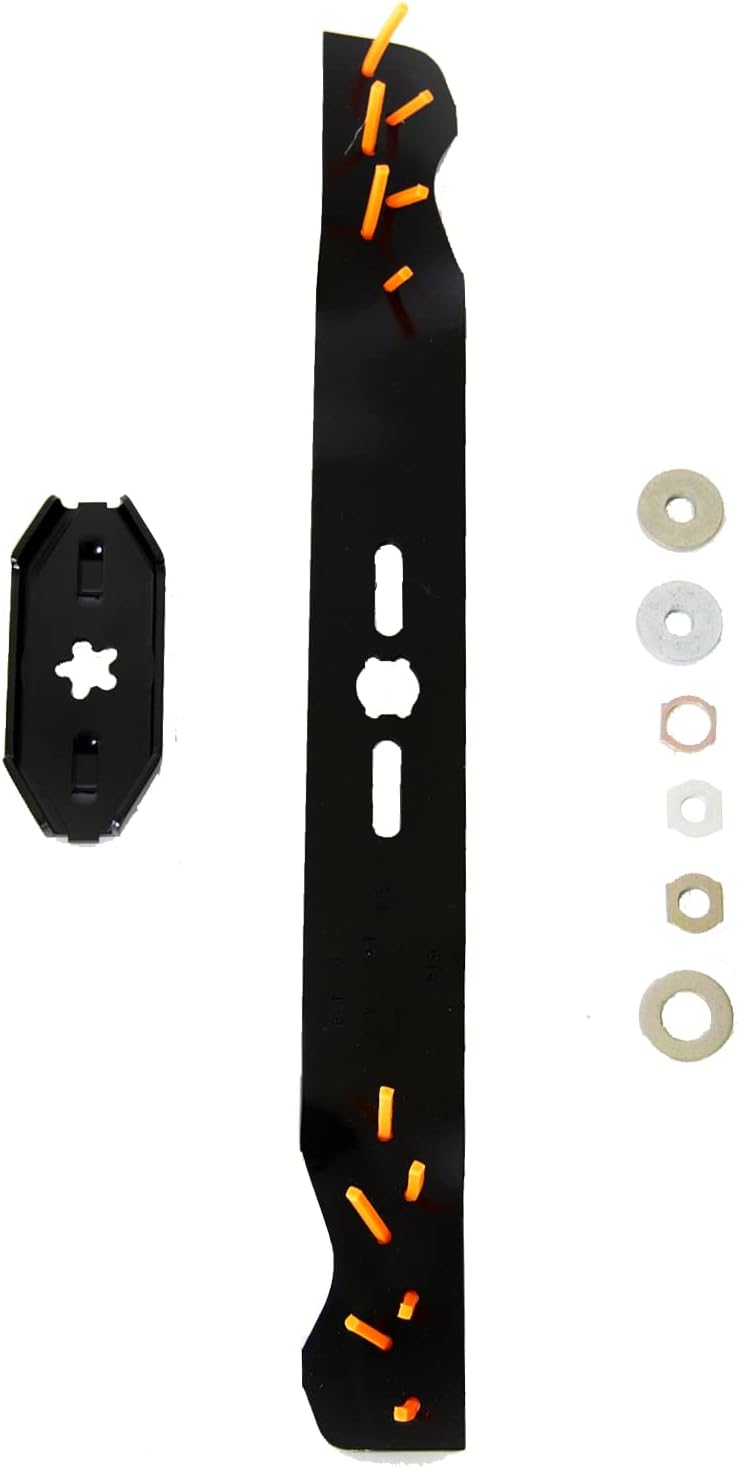
The Arnold 490-100-0083 is a universal replacement blade designed for 21, 22, and 23 inch walk-behind lawn mowers. It combines a standard cutting blade with nylon dethatching lines, letting you mow and clean up your lawn at the same time. This is a smart upgrade for homeowners who want to reduce manual raking and dethatching without investing in a separate machine.
This blade is best suited for DIY homeowners with medium sized lawns. It fits most popular mower brands including Troy-Bilt, Craftsman, Honda, Husqvarna, Toro, Snapper, and Yard Machines. The included adapters make it easy to install on different center hole sizes. Just note that it's not designed for battery powered mowers, as the extra load can drain batteries quickly or strain the motor.
In real world use, the blade cuts grass cleanly while the nylon lines help lift and break up leaves and light thatch. Many users report it saves hours of raking each season. The dethatching effect is mild, so it works best for light to moderate thatch buildup. For heavy thatch, the nylon lines can wear down fast, and some users have reported tines breaking off on the first pass. Replacing the lines with thicker trimmer string can improve durability.
Build quality is solid for the price. The steel blade is sturdy, and the nylon lines are easy to replace. Installation is straightforward, though you should always refer to your mower's manual for torque specs and safety. The blade is lightweight and stores easily. One drawback is that the tines are not aggressive enough for serious dethatching, so if your lawn has thick thatch, you might need a dedicated dethatcher or a metal tine blade.
Overall, the Arnold 490-100-0083 is a practical, budget friendly way to add dethatching and leaf cleanup to your mowing routine. It's not a heavy duty solution, but for routine yard maintenance, it gets the job done. If you have a gas powered mower and want to save time on fall cleanup, this blade is a solid choice.
Comprehensive Guide to Lawn Mower Blade Removal and Thread Direction
Removing a mower blade seems simple until you are wrestling with a stuck fastener under a dirty cutting deck. On standard walk-behind mowers, turn the retaining bolt counterclockwise to loosen it. This standard right-hand thread follows the familiar lefty-loosey direction when facing the bolt head directly. Working upside down underneath an overturned deck often leads owners to accidentally tighten stuck fasteners.
Knowing the correct rotation prevents rounded bolt heads, stripped spindle threads, and hand injuries. Most single-blade mowers spin clockwise from above, which naturally tightens standard hardware during regular cutting. Before applying heavy force with a wrench, confirming your deck design and thread orientation saves significant time. Taking a moment to verify how components mesh creates a safe, stress-free maintenance routine.
The Standard Right-Hand Thread Rule for Single-Blade Decks
Single-blade walk-behind lawn mowers almost universally use standard right-hand threaded fasteners. Looking directly at the head of the center bolt, turning it counterclockwise loosens the assembly. This engineering standard ensures that engine rotational inertia keeps the bolt securely seated rather than spinning loose while mowing. The thread pitch is designed to resist backing out under normal rotational vibration.
Standard thread design simplifies maintenance for popular push mowers from brands such as Craftsman, Troy-Bilt, and Honda. Whether your machine uses a central bolt or a nut on a threaded spindle stud, counterclockwise rotation backs it off. Working upside down often causes disorientation regarding which way to turn. Picture an analog clock face on the bolt head to keep orientation clear.
Identifying Clockwise and Reverse-Thread Exceptions on Multi-Blade Mowers
While single-blade decks follow standard rules, multi-blade riding mowers and commercial zero-turn machines introduce occasional exceptions. Some dual-blade decks feature blades that rotate in opposite directions to funnel grass clippings cleanly toward a discharge chute. On decks where a spindle turns in reverse, that specific spindle often incorporates a left-hand, reverse-threaded bolt. Recognizing these opposite-spinning spindles prevents accidental hardware damage.
For any reverse-threaded fastener, you must turn the bolt clockwise to loosen it. Manufacturers often stamp an arrow or indicator letter on the bolt head or spindle face to signal left-hand threading. Inspect your owner documentation closely if your mower features counter-rotating blades. Applying heavy leverage counterclockwise on a reverse thread will quickly snap the fastener or strip the internal spindle housing.
Using Blade Cutting Edges to Confirm Spindle Rotation and Thread Orientation
If you lack equipment manuals or markings, you can visually determine the correct loosening direction by looking at the cutting edge. Lawn mower blades feature a sharp leading edge followed by an upward-curving lift sail. The cutting edge always faces forward into the path of rotation when the mower runs. Looking up from underneath, observe which direction that sharp edge travels.
When the sharp edge travels counterclockwise as viewed from underneath, the engine uses a standard right-hand bolt that loosens counterclockwise. The tightening direction must always oppose forward cutting motion to ensure operational safety. If an unusual spindle spins the cutting edge clockwise from below, that assembly uses a reverse thread that loosens clockwise. This mechanical correlation ensures cutting resistance keeps retaining hardware snug.
Essential Safety Steps Before Touching Retaining Hardware
Safety precautions must always precede any physical contact with the cutting system underneath your lawn mower deck. For gasoline models, disconnect the rubber boot from the spark plug and tuck the ignition wire away. This critical step eliminates the possibility of the engine accidentally firing if the blade is turned. Accidental cylinder ignition can cause sudden rotation, creating serious hand hazards.
For battery-powered units, remove the safety key and disconnect all lithium-ion battery packs before tilting the deck. Disconnecting the power source completely eliminates electrical activation hazards while you work near the sharp edge. When inspecting modern battery platforms, checking dedicated cordless mower blade setups provides helpful insight into manufacturer-specific safety mechanisms. Storing the key separately ensures the mower cannot engage while your hands are underneath.
Heavy leather work gloves are just as essential as electrical safety measures when handling mower blades. Even a dull blade that struggles to cut turf can slice skin when breaking a stubborn bolt loose. Gloves protect your hands against sharp metal burs, unexpected slip-offs, and sudden wrench recoil. Taking thirty seconds to prepare personal protective gear avoids painful injuries during routine maintenance.
Proper Mower Tilting Techniques to Prevent Engine Hydro-Lock and Spills
Tilting a gasoline lawn mower incorrectly can flood the carburetor, soak the air filter, or cause engine oil to leak into the combustion chamber. When tipping a walk-behind mower, always position the machine so the carburetor and air cleaner point upward toward the sky. Tilting toward the carburetor side allows crankcase oil to drain directly into the intake tract. That oil migration ruins air filters.
Oil in the combustion chamber can foul the spark plug and produce massive clouds of white smoke upon restart. Many walk-behind push mowers can also be safely tipped straight back onto their handles with a counterweight on the handlebars. Battery-powered mowers do not contain liquid lubricants or fuel, making them simpler to position. Always ensure the machine sits on level ground before beginning.
Securing the Cutting Edge with Clamps and Blocking Tools
A lawn mower blade freely rotates on its spindle, making it impossible to loosen the retaining bolt without stopping blade movement. Never attempt to hold the steel blade with your gloved hand while applying torque to a breaker bar. If the wrench slips, your hand can slide directly into the cutting edge. Using a physical barrier ensures your hands stay safely away.
Dedicated removal tools, such as the MaxPower 339079 universal blade removal tool or the VoltRidge 490-850-0005 clamp, securely lock the blade to the deck wall. These metal clamps slide over the deck lip and provide a rigid stop that immobilizes rotation. A clamped tool keeps both hands free to operate your socket handle safely. Specialized clamps also prevent deck deformation by distributing contact pressure.
If a specialized clamp is unavailable, a short block of scrap lumber wedged against the deck interior baffle provides an effective alternative. Because standard bolts loosen counterclockwise, the blade will rotate counterclockwise along with your wrench. Position your wooden block or clamp against the trailing side of the blade to stop rotation. Ensuring the wood sits flush against the inner deck prevents slippage.
Socket Selection, Leverage Techniques, and Freeing Rusted Fasteners
Using the wrong wrench on a factory-tightened blade bolt is the quickest way to round off the fastener hexagonal head. Always choose a heavy-duty, six-point socket that matches the exact bolt dimension rather than a loose-fitting twelve-point socket or an adjustable wrench. A six-point socket contacts flat sides securely, spreading torque evenly without rounding edges. Standard residential bolt sizes frequently range from 9/16-inch to 5/8-inch.
A standard short ratchet rarely provides enough leverage to overcome factory torque combined with moisture and corrosion. Switching to an eighteen-inch breaker bar gives you smooth, controlled leverage to break the initial thread bond. If the bolt remains stuck, apply penetrating oil around the bolt collar and let it soak. Giving the fluid fifteen minutes to penetrate breaks down stubborn surface oxidation effectively.
A few sharp taps on the bolt head with a hammer and brass punch can help crack stubborn rust crust. When working on older machinery, reviewing various mower blade setup options can help you determine whether replacement hardware is needed. Cordless impact wrenches can also deliver rapid rotational pulses that spin frozen bolts out cleanly. Striking or impacting carefully prevents bending the crankshaft while freeing threads.
Center Hole Geometry and Mounting Pattern Inspection
Once the retaining fastener and washer are free, carefully pull the blade straight off the spindle adapter. Note the center hole design, because replacement blades require an exact geometric match to mount securely. Many MTD, Troy-Bilt, and Cub Cadet mowers utilize a bow-tie center hole pattern, as featured on the MaxPower 331528B replacement blade. Matching this geometric profile prevents slippage during cutting.
Other brands, like Craftsman riding tractors, rely on specific 5-point star patterns found on products like the Grasscool 422719 mulching blade. Cordless mowers often incorporate proprietary circular arbors with dual locating pins, seen on Greenworks blades like the 2905203 model. Universal options like the Arnold 490-100-0083 include multi-sized sizing washers to adapt round arbors across different shaft sizes. Never force an incompatible mounting pattern onto a spindle.
Inspect the cast aluminum or stamped steel blade adapter while the hardware is disassembled. The small alignment nubs on the adapter are engineered to shear during heavy impacts, protecting the engine crankshaft from bending. If these alignment nubs show flattening or cracking, replace the adapter before installing your new blade. Installing a fresh blade onto a worn adapter compromises cutting quality and safety.
Sharpening, Balancing, and Deck Cleaning Maintenance
With the blade removed, scrape away compacted grass clippings and dried mud from the undercarriage. Accumulated debris inside the deck restricts vital airflow, reducing mulching efficiency and promoting deck corrosion. A flexible putty knife quickly clears the housing without scratching through protective powder coatings. Thorough cleaning keeps the deck surface smooth for clean clipping discharge while exposing any hidden baffle damage.
Inspect the cutting edge for deep nicks or excessive thinning of the lift sails. If the blade remains within safe wear tolerances, you can restore its bevel using a drill-mounted sharpener, such as the Cenoz double-layer corundum sharpener. Follow the existing cutting angle carefully, removing only enough steel to produce a clean edge. Preserving the original factory bevel helps the blade cut grass cleanly.
Balancing is an indispensable final step before any sharpened blade returns to the mower deck. An unbalanced blade spins thousands of times per minute, producing harmonic vibrations that damage spindle bearings over time. Place the center arbor onto a cone balancer and grind tiny amounts of metal from the heavy side. Proper static balance ensures smooth engine operation and extends the working life of deck components.
Reinstallation Protocols: Blade Orientation, Tightening, and Torque
Reinstalling a mower blade correctly requires paying close attention to vertical orientation. Installing a blade upside down places the cutting bevel facing the mower deck, which tears grass instead of cutting it cleanly. Most manufacturers stamp bottom indicators on the steel, and the upward-curving lift sails must always point toward the deck. Checking this orientation before threading the bolt prevents having to repeat the installation.
Thread the retaining bolt into the spindle by hand to prevent cross-threading the internal threads. Standard fasteners tighten by turning clockwise, matching standard right-hand thread orientation. Reposition your wood block or deck clamp against the opposite side of the blade to stop clockwise rotation while you apply final torque. Hand threading the bolt for several full turns ensures the threads are engaged cleanly before applying tools.
Typical residential walk-behind mower blade bolts require between 35 and 50 foot-pounds of torque to seat reliably. Over-tightening with an impact gun stretches bolt threads and can cause sudden failure during operation. Reconnect your spark plug lead or reinsert the battery pack only after clearing all tools and blocks. Following these deliberate steps guarantees clean cuts, reduced deck strain, and peace of mind during your next mowing session.






Write Your Review
No reviews yet. Be the first to share your experience!