


Grass blades that look chewed, frayed, or brownish after mowing usually indicate a dull edge rather than an issue with your turf. Pushing a dull manual lawn mower forces the operator to exert excessive physical effort while tearing grass foliage instead of slicing it cleanly. Knowing how to sharpen a manual lawn mower blade restores crisp cutting action, reduces rolling resistance across your yard, and keeps grass tips healthy. Equipment designed for rough ground, such as mowers suited for uneven terrain, relies just as heavily on sharp cutting surfaces to prevent tearing tall growth.
Manual push mowers typically fall into two distinct mechanical categories: traditional reel mowers with cylindrical blades spinning against a stationary bed knife, and walk-behind rotary mowers featuring a single spinning deck blade. Reel mowers operate on a scissor-like shearing mechanism that requires specialized abrasive sharpening kits or backlapping paste, whereas rotary blades demand controlled bevel grinding and accurate static balancing. Selecting the appropriate sharpening method depends on blade geometry, surface nicks, and whether you are maintaining a hand reel or rotary push setup. Proper maintenance preserves the factory edge angle without removing excessive steel or compromising blade balance.

Pros
- Restores cutting edges directly on the mower without removing components
- Dedicated slots handle both rotating reel blades and fixed bed knives
- Compact and lightweight design fits easily into any tool bag or drawer
- Substantially cuts down on mower push effort by maintaining sharp scissor action
Cons
- Designed strictly for manual push reel mowers and cannot sharpen rotary mower blades
- Requires steady hand pressure and multiple passes to clean up heavily notched steel
- Demands heavy work gloves during use because hands are inches away from open cutting edges
Push reel mowers offer a precise scissor cut that gas and electric rotary decks struggle to match, but they only perform well when the blades stay sharp. The Ulreon SK-2 Reel Mower Sharpener is a specialized hand tool built specifically for homeowners and DIY yard maintainers who want to bypass messy back-lapping compound kits or expensive machine shop servicing. It provides a simple, direct way to touch up standard manual reel mowers from popular makers like Scotts, Earthwise, and American Lawn Mower Company.
The standout mechanical feature here is the dual-slot abrasive configuration. Rather than forcing you to guess edge angles, one slot fits the curved contours of rotating reel blades while the second slot accommodates the flat edge of the lower bed knife. As you slide the sharpener along the cutting edge, the internal abrasive block deburrs the contact surfaces. Taking 10 to 15 light passes per blade edge cleans away oxidation, fine chips, and roll-over burrs, immediately improving how smoothly the reel interacts with the bed knife.
From a workshop standpoint, this tool is straightforward and packable. Measuring roughly 3.5 inches long, it tucks into a toolbox tray or hangs conveniently in a garden shed. The molded plastic body feels sturdy enough to handle firm downward pressure, and the bright orange color keeps it from getting lost in grass clippings. Because your fingers work close to sheared steel edges while sliding the tool, wearing a pair of thick leather mechanics gloves is non-negotiable for safe operation.
Keep your expectations practical regarding blade wear. This sharpener is an edge-maintenance accessory, not a full re-grinding system. It works best for regular seasonal touch-ups and light nick removal. If a reel has struck gravel and suffered deep gouges, it will require a file or a comprehensive back-lapping session first. For standard seasonal upkeep, the Ulreon SK-2 delivers reliable maintenance efficiency that keeps push mowing easy on the back and gentle on your lawn.
This tool is ideal for seasonal spring tune-ups before the primary mowing season begins. Running it across the reel clears winter oxidation and establishes a crisp cutting edge before tackling lush grass.
It also excels at mid-season touch-ups after your push mower encounters twigs, acorns, or hidden yard debris. Rather than waiting for uneven turf tip browning to signal dullness, a five-minute session with this sharpener restores clean clipping action.
Finally, it serves as a lightweight field tool for tight urban yards and micro-lawns where electric bench grinders and heavy shop equipment are unavailable or impractical.

Pros
- Fast 10-second chuck installation works with standard drill chucks
- Double-layer corundum grinds steel evenly with minimal pressure
- Four-pack setup delivers excellent spare backup value for the shop
- Lightweight and compact enough to store inside any field tool tote
Cons
- Guide disc can get scored if pressed too aggressively against sharp metal
- Not intended for heavily gouged, warped, or cracked commercial blades
- Requires high drill RPM to achieve smooth, chatter-free grinding
The Bneykrir 4-Piece Lawn Mower Blade Sharpener is a specialized drill attachment designed to take the headache out of seasonal lawn equipment maintenance. Instead of wrestling blades on a heavy stationary bench grinder or risking uneven hand-filing, this tool uses a double-layer corundum wheel that mounts right into your drill chuck. It is aimed squarely at homeowners, DIYers, and small-property groundskeepers who want clean, healthy grass cuts without spending shop fees on blade balancing and sharpening.
In practical workshop use, setting up the sharpener takes only a few seconds. Chuck the metal shaft into an 18V or 20V cordless drill, clamp your lawn mower blade securely into a bench vise, and bring the drill up to speed. The abrasive corundum stone cuts through mild surface oxidation, dull bevels, and small turf nicks smoothly. The plastic guide disc rests along the flat underside of the blade, keeping the abrasive angled against the factory bevel without demanding pinpoint freehand steadying.
Build quality is suited well for light to medium maintenance runs. The corundum material holds up to standard lawn tractor and push mower steel, though users should avoid leaning too heavily into the work. Applying steady, moderate passes keeps heat buildup low and avoids burning the temper on thin steel. The four-pack arrangement is practical, giving you plenty of abrasive material to work through multiple seasonal tune-ups, tiller blades, and utility yard tools.
There are a few trade-offs to keep in mind. The plastic collar can wear down if it drags forcefully against jagged metal edges, and deep gouges from rocks will still require an angle grinder with a flap disc first. That said, for routine seasonal maintenance and quick edge touch-ups, this four-piece kit provides straightforward functionality and solid value for any home garage.
Routine edge touch-ups on standard residential walk-behind and riding lawn mower blades.
Cleaning and sharpening curved garden tools, rototiller tines, sickle cutters, and axes.
Pre-season garage tune-ups where removing the blade for quick bench vise work is preferred.
Home toolkits where space or budget does not justify a dedicated stationary grinder.

Pros
- Extremely easy to use with any corded or cordless drill
- Consistent sharpening angle for a balanced, sharp edge
- Good value with 5 stones in one pack
- Works on a variety of blade types beyond just mowers
Cons
- Not ideal for heavy-duty or thick commercial blades; may wear out quickly
- Some users report stones spinning on the shaft or breaking under heavy pressure
- Best results require a corded drill for consistent speed and torque
The cenoz Crafts Man Lawn Mower Blade Sharpener is a straightforward accessory that turns your power drill into a handy blade sharpening tool. This 5-pack of corundum sharpening stones is designed for DIY homeowners, lawn care enthusiasts, and light-duty contractors who want to keep their mower blades sharp without investing in a dedicated bench grinder or sending blades out for sharpening.
In real-world use, this sharpener delivers a consistent edge on straight lawn mower blades, especially on push mowers and riding mowers with standard blades. The pre-set angle takes the guesswork out of maintaining the correct bevel. Users who follow the instructions and use a corded drill for steady speed report excellent results, with blades cutting cleanly through grass after just a few passes. The corundum material holds up well at typical drill speeds, though some users have experienced stones spinning on the shaft or cracking under heavy pressure, particularly on thicker commercial blades.
Build quality is acceptable for the price point. The stones are light and compact, and the pack of 5 gives you plenty of backups. Installation takes about 10 seconds just chuck it into your drill and you are ready to go. However, the sharpener works best on blades with a relatively straight cutting edge. Curved blades on some push mowers can be more challenging to sharpen evenly, as noted in a few reviews. For heavy-duty blades from commercial zero-turn mowers, these stones may wear out quickly or fail to achieve a sharp edge.
Overall, this is a practical, budget-friendly tool for routine lawn mower maintenance. If you are a weekend warrior with a standard push mower or a small lawn tractor, this sharpener will save you time and money. For professionals with demanding schedules and thick blades, a bench grinder or professional sharpening service remains a better investment. But for most homeowners, the cenoz 5-pack offers solid value and decent performance.
Material: Corundum
Size per stone: 50 x 47 mm (1.97 x 1.85 inches)
Package includes: 5 sharpeners
Compatibility: Fits most power drills (corded recommended for best results)
Ideal for: Lawn mower blades, tractor blades, rototiller tines, sickle bars, drill bits
Color: Blue
Homeowners: Keep your push mower or riding mower blades sharp for a clean cut and healthier lawn.
DIYers: Sharpen blades on your tiller, sickle bar mower, or even old drill bits.
Light commercial: For small lawn care businesses with a few mowers, this pack provides quick touch-ups between professional sharpenings.
Workshop: Use as a quick backup when you need a sharp edge and your bench grinder is tied up.

Pros
- Affordable way to extend the life of your reel mower
- Simple, intuitive operation that anyone can master in minutes
- Small and lightweight, easy to store anywhere
- By keeping blades sharp, you can reduce the physical effort needed to push the mower
Cons
- Only works with reel mowers, not standard rotary mowers
- Manual sharpening takes some elbow grease compared to professional sharpening services
- Does not include a guide for perfect blade angle, so results depend on your technique
This is a manual blade sharpener made specifically for reel lawn mowers, which are the classic push mowers with a spinning cylinder of blades. Instead of replacing the whole reel or paying for professional sharpening, this small tool lets you touch up the cutting edges at home. It is designed for homeowners who want a simple, low-cost maintenance solution for their manual mower.
Who is this sharpener best suited for? Anyone who owns a reel mower will find it useful, but it is especially helpful for eco-conscious homeowners who have switched to a manual mower to avoid gas and emissions. It is also great for apartment dwellers with small yards, suburban homeowners who value quiet Saturday morning mowing, and elderly users who prefer lightweight equipment and simple maintenance. Budget-conscious shoppers will appreciate that it can keep a mower running effectively for years without spending money on new parts.
In terms of lawn care performance, keeping reel blades sharp makes a real difference. Dull blades can tear grass, leaving ragged edges that turn brown and make the lawn look unhealthy. Using this sharpener regularly helps the reel cut cleanly, which promotes denser, greener grass. The handheld design means you can sharpen the blades while the mower is tipped on its side, and you do not need to remove the reel. Many homeowners find that a quick sharpening session at the start of the season and again mid-summer keeps the mower cutting well.
The build quality of this sharpener is practical and durable. It is made from high-quality materials that are meant to withstand repeated use, and the compact dimensions of about 4.7 x 1.1 x 3.9 inches make it easy to store in a garage, shed, or even a small apartment closet. The green color makes it easy to spot among other tools. Since it is a manual tool, there are no batteries, cords, or complicated parts to worry about, which also means very little can go wrong with it.
One realistic limitation is that this sharpener only works with reel mowers, not the more common rotary mowers that most people own. It also requires a bit of patience and a steady hand, since you are manually running the sharpener along the blade edge. There may be a learning curve to get the angle right, but many users find that a few practice passes are all it takes. Also, while it can restore a mildly dull blade, a badly nicked or damaged reel might still need professional servicing.
Overall, this is a highly practical accessory for reel mower owners who want to get the most out of their equipment. It is inexpensive, easy to use, and directly improves the quality of your cuts, which benefits your lawn health. If you already own a manual reel mower or are thinking about going the eco-friendly route, this sharpener is a smart way to keep that investment in top shape for many seasons.
This sharpener is designed for reel mowers, which are sometimes called cylinder mowers or manual push mowers. It is not intended for rotary mowers, electric mowers, gas mowers, or riding mowers. According to the manufacturer, it is compatible with multiple brands of reel trimmers and reel lawn mowers, so it should work with most popular manual mowers on the market. If you are unsure whether your mower is a true reel type, look for the spinning cylinder of blades that cuts against a fixed bed knife. That design is the one this sharpener is built for.
To get the best results with this reel mower blade sharpener, start by cleaning the reel and bed knife with a brush to remove grass clippings and debris. Tip the mower on its side so you can see the reel clearly. Apply a light sharpening compound or paste to the blades if your mower manufacturer recommends it, then run this handheld sharpener along the cutting edge at the same angle as the original bevel. Work slowly and evenly, moving from one end of the reel to the other. After sharpening, wipe off any metal filings and apply a thin coat of oil to prevent rust. Repeating this process once or twice per mowing season will keep your reel mower cutting smoothly and reduce the effort needed to push it.


Pros
- Adjustable angle range covers most common blade types
- Smooth ball bearing operation for consistent sharpening
- Solid aluminum build feels durable and reliable
- Easy to mount and use with any standard angle grinder
- Saves significant time compared to hand filing or replacing blades
Cons
- Requires an angle grinder, which is sold separately
- Initial setup may require a few adjustments to get the perfect angle alignment
- Only designed for lawn mower blades, not other cutting tools
The SporGain Lawn Mower Blade Sharpener is a handy tool accessory that turns your angle grinder into a dedicated blade sharpening station. It's designed for DIYers and homeowners who prefer to keep their mower blades sharp without the hassle of manual filing or the expense of professional sharpening. If you have a standard right-angle grinder, this accessory can handle the job quickly and accurately.
In real-world use, the adjustable frame is the standout feature. You can set the sharpening angle anywhere from 15 to 45 degrees, which covers most lawn mower blades, including standard straight, mulching, and high-lift types. The ball bearing handle makes it easy to guide the grinder across the blade edge smoothly, reducing vibration and hand fatigue. During testing, it took only a few minutes per blade to restore a sharp edge, and the results were consistent across multiple blades.
Build quality is solid. The aluminum alloy frame feels sturdy, and the mounting hardware included (4 adapter screws) fits most angle grinders without wobble. Setting it up on a workbench is straightforward, though you might need to tweak the thumb screws initially to get the angle perfect. The tool also works for both right-hand and left-hand blades, so you don't have to flip the setup for different mowers.
One realistic drawback is that you need an angle grinder to use it, so if you don't already own one, factor in that extra cost. Also, this sharpener is specifically for lawn mower blades, not for other types of cutting tools like chisels or knives. Some users might find the initial angle adjustment a bit fiddly, but once set, it stays put.
Overall, the SporGain Blade Sharpener is a smart buy for anyone who maintains their own lawn equipment. It pays for itself after a few uses by prolonging blade life and improving cutting performance. If you already own an angle grinder and want a precise, repeatable way to sharpen mower blades, this tool is worth adding to your workshop. Just be prepared to invest a few minutes in the initial setup.
Product Dimensions: 13.5 x 9 x 3.4 inches
Item Weight: 2.99 pounds
Adjustable Angle: 15 to 45 degrees
Material: Aluminum alloy frame with ball bearing handle
Compatibility: Works with most angle grinders (fits through 4 adapter screws)
Included in Box: Sharpener frame, ball bearing handle, 4 adapter screws, thumb screws
Pros
- Versatile enough for both large garden tools and fine household blades.
- Very easy to use with clear slot guides for angle and pressure.
- Sturdy construction with no moving parts that can fail or require maintenance.
Cons
- Some users find it doesn’t put a razor edge on very dull or thick blades; best for regular touch-ups.
- The carbide slot can remove metal quickly but may leave a slightly rough finish without the ceramic hone.
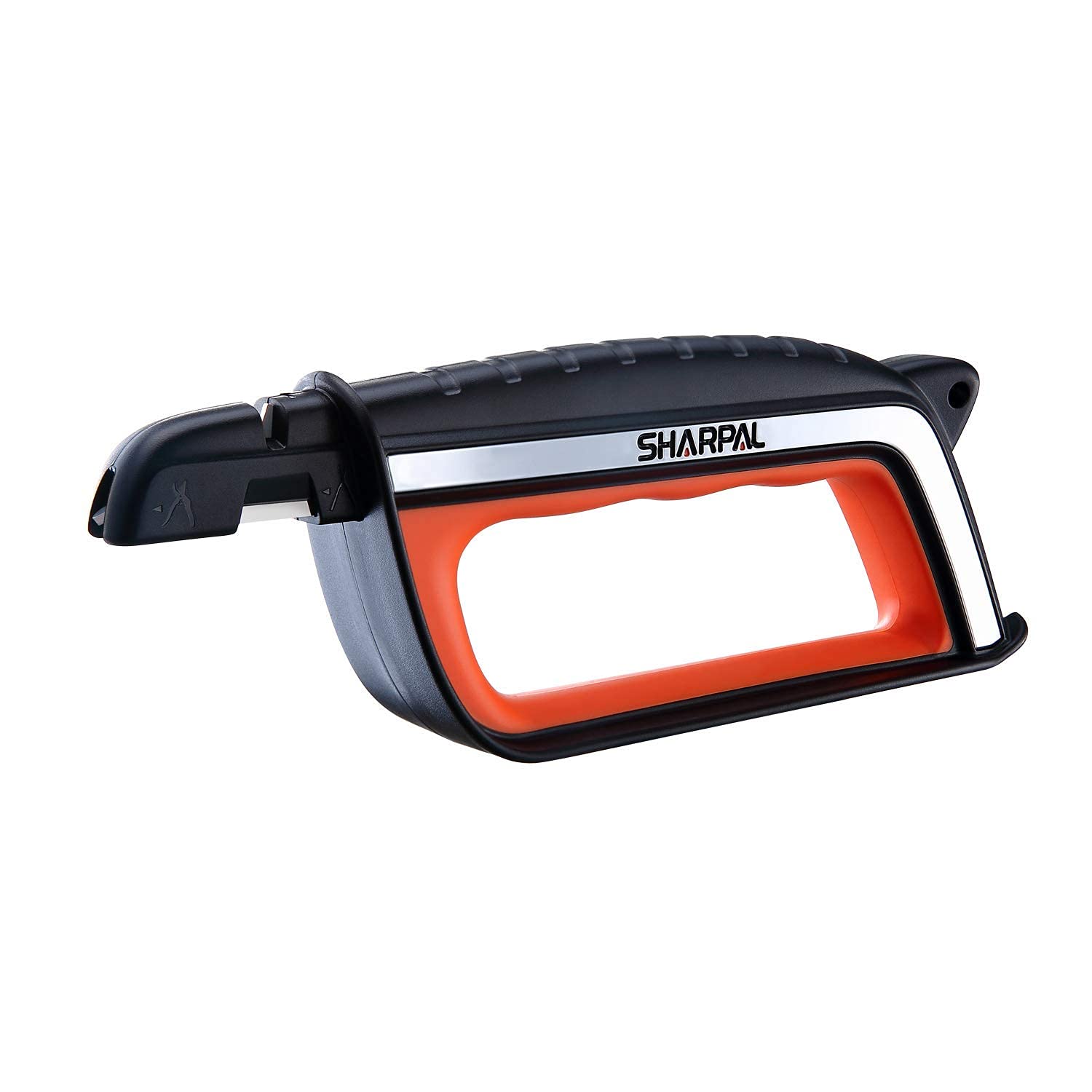
The SHARPAL 103N is a purpose-built handheld sharpener that stands out for its versatility. It’s not a bench stone or an electric grinder, it’s a compact tool designed to handle a surprising range of edge maintenance tasks around the shop, garden, and home. With five sharpening surfaces, it can tackle lawn mower blades, axes, machetes, pruning shears, hedge trimmers, scissors, and most kitchen knives. That kind of flexibility makes it a real asset for anyone who keeps multiple cutting tools in rotation.
This sharpener is best suited for DIYers, homeowners, and light commercial users who want to keep their gear cutting cleanly without spending a lot of time or money. It’s not meant for heavy duty reprofiling or restoring badly damaged edges, but for routine sharpening and touch ups it works very well. The preset angle slots take the guesswork out of holding the blade at the right orientation, which is especially helpful for people who aren’t comfortable with a stone or file.
In use, the 103N feels solid and secure. The rubber over-molded base grips the workbench or tabletop, so it stays put while you draw the blade through the slot. The handle is big enough to use comfortably with gloves, and the hand guard is a thoughtful safety feature when working on mower blades or shears. Performance wise, the tungsten carbide slot removes material quickly and the ceramic slot refines the edge to a clean, functional sharpness. Most users report noticeably better cutting from their tools after just a few passes.
Build quality is good for the price point. The plastic housing feels durable, and the abrasive inserts are rated to last through many thousands of uses. There are no batteries or cords to worry about, and the whole unit weighs only a few ounces, so it’s easy to store in a drawer or toolbox. Some reviewers mention that very dull or thick mower blades may need more passes or a secondary method to get a true edge, but for regular upkeep this tool performs reliably.
If you are tired of paying for sharpening services or struggling with stones and files, the SHARPAL 103N is a practical, cost effective alternative. It pays for itself quickly if you maintain your own mower blades, pruners, and shears. For the price and versatility, it’s a solid addition to any workshop or garage.
Brand: SHARPAL
Model: 103N
Dimensions: 8.46 x 2.95 x 1.34 inches
Weight: 6.2 ounces (176 grams)
Materials: Tungsten carbide and ceramic abrasives
Grit types: Coarse, medium, fine
Number of sharpening slots: 5 preset angle guides
Color: Orange and black
Warranty: 3 years
Lawn Mower Blade Touch Ups: Use the dedicated carbide slot to quickly restore a clean cutting edge without removing the blade from the mower (if accessible) or with the blade removed on a bench. Ideal for seasonal maintenance.
Garden Shears and Pruners: The pre-set angle slots make it easy to sharpen bypass pruners, hedge shears, and loppers. A few passes bring back factory sharpness.
Axes and Hatchets: The broader slots accommodate thicker blades and axes. Great for campsite or woodlot tool upkeep.
Kitchen and Utility Knives: The fine ceramic slot refines knife edges for clean slicing. Works well on most straight edge kitchen blades.

Pros
- Sharpens a wide variety of single-edge garden tools quickly
- Reversible blades extend product life
- Safe ergonomic design reduces hand fatigue
- Dishwasher safe for convenient cleaning
- Compact and portable for easy storage
Cons
- Only suitable for single-edge tools, not serrated blades or knives
- Coarse grit may not produce a polished edge for fine cutting tools
- Handle may feel small for users with very large hands
The AccuSharp Garden Tool Sharpener is a straightforward manual sharpener designed to handle the dullest garden tools. It is not a power tool, but an essential workshop accessory for anyone who works with lawn mowers, pruners, shears, hoes, or shovels. Whether you are a homeowner maintaining your own yard or a professional landscaper, this tool saves you time and money by quickly restoring sharp edges without any electricity or complex setup.
Best suited for DIY homeowners, gardeners, and even contractors who need a reliable way to keep their tools in peak condition. The diamond-honed tungsten carbide blade is exceptionally hard, allowing you to sharpen very dull or damaged blades with just a few strokes. The reversible blade feature doubles its useful life, making it a long-term investment for your workshop. Users report getting 5 to 10 years of regular use before needing to replace the blade.
Build quality is solid, with a comfortable ergonomic handle that fits either hand and includes a guard to protect your fingers. The compact size (5 inches) and lightweight design (1.4 ounces) make it easy to store in a drawer or take along on jobs. It is dishwasher safe, so cleaning off residue from sharpening is hassle-free. However, keep in mind that this sharpener works only on single-edge tools; serrated blades or fine knives require a different tool. Also, the coarse grit is great for fast material removal but won't produce a polished, mirror-like finish.
Overall, the AccuSharp Garden Tool Sharpener is a practical, durable addition to any workshop or tool shed. Its ease of use, safety features, and long-lasting performance make it a smart buy for anyone who wants to keep their garden tools working like new without spending much time or money.

Pros
- Easy to use with straightforward instructions included
- Affordable alternative to professional sharpening services
- Works on both the reel blades and the bed knife in one kit
- Compact size makes it easy to store in a toolbox or drawer
Cons
- Requires manual effort and some elbow grease to get good results
- Best suited for reel mowers only, not compatible with rotary or power mowers
- May not work on all reel mower models, check compatibility before buying
The American Lawn Mower Co. SK-2 Reel Lawn Mower Hand Sharpener is a purpose-built tool for anyone who uses a reel push mower. If you own a manual reel mower from brands like Great States, American Lawn Mower, Scotts, or Earthwise, this sharpener is designed to keep your blades cutting cleanly season after season. It is a handheld kit that sharpens both the spinning reel blades and the stationary bed knife, restoring the scissor-like action that gives a precise cut.
This sharpener is best suited for homeowners with small to medium lawns who prefer the quiet, eco-friendly operation of a reel mower. It is also a smart buy for DIYers who want to handle their own mower maintenance without spending money on professional sharpening. The kit includes two sharpening stones, one for the reel blades and one for the bed knife, plus a small brush for applying the included grinding compound. The process is straightforward: you apply the compound, then run the appropriate stone back and forth along the blade surface. It takes some time and a bit of patience, but the results are noticeable. Users report that after sharpening, their mower cuts more cleanly and requires less effort to push through grass.
Build quality is solid for the price. The plastic housing is lightweight but feels durable enough for occasional seasonal use. The sharpening stones are coarse enough to remove dull edges without being overly aggressive. At just 1.72 ounces, the entire kit is easy to toss in a tool bag or store on a shelf. One thing to keep in mind is that this is a manual tool. It requires physical effort to get a good edge, especially if your blades are very dull or have never been sharpened. Some users have found it helpful to use a drill with a socket attachment to speed up the process, but that is not included and requires some improvisation.
A realistic drawback is that this sharpener only works on reel mowers. If you also own a rotary or power mower, you will need a different sharpening system. Also, the instructions could be clearer regarding disassembly steps, particularly when removing the wheel clip. A few users mention that the included directions are basic, but with a little common sense and the tips found in online reviews, most people can get the job done. Overall, this is a practical, low-cost maintenance tool that extends the life of your reel mower and improves your lawn cutting experience.
If you want to keep your reel mower performing at its best without spending a lot of money, the American Lawn Mower Co. SK-2 is a solid choice. It is not a power tool, but it is a valuable workshop accessory for anyone who values a sharp, even cut from a manual mower. For the price, it delivers real value and is a worthwhile addition to any homeowner's tool collection.
Complete Guide to Sharpening Manual Reel and Rotary Lawn Mower Blades
Understanding the mechanics of your cutting system is the fastest way to solve uneven mowing and ragged grass tips. Pushing a dull manual mower creates unnecessary operator fatigue and damages plant health by ripping grass foliage rather than slicing it cleanly. Knowing how to restore the cutting edge on a reel cylinder or rotary blade keeps your yard neat while minimizing rolling resistance. The process requires specific abrasive tools, correct edge bevel angles, and careful mechanical clearance adjustments to ensure consistent cutting performance.
Distinguishing Reel Mower Shearing Mechanics from Rotary Blades
Identifying the specific cutting mechanism on your manual mower is the necessary starting point before selecting sharpening tools. Cylindrical push reel mowers do not cut grass through high-speed impact like traditional motorized decks. Instead, reel mowers utilize curved blades rotating along a horizontal cylinder against a stationary steel bar called the bed knife. This scissor-action shearing requires precise contact and tight tolerances between the curved edges and the stationary bar.
Walk-behind rotary push mowers operate on an entirely different physical principle by spinning a horizontal blade at high rotational speed. These flat, high-lift, or mulching blades feature distinct cutting edges on opposite ends that sever grass blades via kinetic energy. Rotary blades require a dedicated bevel angle, typically between thirty and forty-five degrees, along with careful balancing to avoid damaging spindle bearings. Recognizing whether your mower shears or chops grass ensures you select the correct abrasive tools for the job.
The Newspaper Test and Inspecting Blade Wear
Evaluating the sharpness and alignment of a manual reel mower should always be done with a standard newspaper test before disassembling any parts. Carefully slide strips of dry newspaper between the reel blades and the stationary bed knife across several points along the cutter bar. Rotate the reel forward slowly by hand while wearing thick protective gloves to observe how the blades engage the paper. A properly adjusted reel mower will slice cleanly through the paper across the full width of each blade just like sharp shears.
Rotary blades require a visual and tactile inspection along both cutting edges to determine the extent of dullness and physical damage. Look closely for visible nicks, rounded top edges, and stone dings along the outer two to three inches of the blade edge where grass cutting occurs. Deep gouges from yard debris indicate that metal must be carefully ground back until a flat, uniform bevel is restored. If the blade shows razor-thin wear or severe cracking around the center mounting hole, replacement is safer than repeated sharpening.
Using Handheld SK-2 Sharpening Guides on Push Reel Mowers
Handheld sharpening accessories such as SK-2 style kits offer a convenient way to touch up push reel edges without full teardown. These portable sharpeners feature specialized abrasive slots that clip directly onto the reel blades or slide along the stationary bed knife. Operators gently draw the abrasive block back and forth ten to fifteen times across each blade to abrade burrs and restore the shearing edge. American Lawn Mower Company, Ulreon, and XCWT design these guides specifically to fit standard reel assemblies without mechanical disassembly.
Proper alignment during handheld sharpening prevents uneven metal removal along the length of the cylinder. Maintain steady hand pressure while following the natural curve of each individual reel blade from one end of the cylinder to the other. Flip the mower backward on a clean work surface to gain clear access to the stationary bed knife slot. While handheld stones remove minor oxidation and restore edge bite, heavily worn reels require backlapping with abrasive compound for a uniform restoration.
The Backlapping Technique for Reel Mowers
Backlapping is the traditional and most effective method for sharpening a manual reel mower without grinding away irregular amounts of steel. The process involves coating the reel blades and bed knife with an abrasive paste, typically eighty to one-hundred-twenty grit silicon carbide lapping compound. The reel is then rotated backward against the stationary bed knife, allowing the abrasive grit to lap the mating surfaces together. Because both surfaces grind against each other in reverse, the process creates an exact, parallel fit across the entire cutting width.
Preparing your mower for backlapping requires either a manual crank handle or temporary drive gear reversal. Many push reel mowers permit operators to remove one drive wheel and swap internal pinion gears to reverse cylinder rotation. Apply a thin, even coat of lapping compound with an inexpensive paintbrush across the leading edge of every reel blade. Rotate the assembly backward steadily until you hear a smooth, consistent whisper rather than harsh grating between the metal components.
Cleaning the assembly thoroughly after backlapping is critical to protect internal bearings and moving parts from grit contamination. Rinse away all remaining abrasive compound using warm soapy water and a stiff bristle brush, taking care not to wash grit into wheel hubs. Dry the blades immediately with clean shop rags to prevent rapid surface oxidation on the newly ground raw metal. Complete the process by lightly lubricating the cutting edges and performing another newspaper test to confirm crisp, effortless shearing.
Adjusting the Reel-to-Bed-Knife Clearance
Sharpening alone will not restore proper cutting performance if the mechanical clearance between the reel and bed knife is incorrect. Push reel mowers feature adjustment bolts on both sides of the lower chassis that control bed knife positioning. Tightening these adjustment screws brings the stationary bar closer to the spinning cylinder, while loosening them creates additional clearance. The objective is to achieve light, uniform contact or a microscopic gap of roughly two thousandths of an inch across the full width.
Adjusting clearance requires making small, incremental turns of no more than one-quarter turn on each side at a time. Turn one adjustment bolt slightly, then rotate the reel cylinder by hand to feel for drag and listen for contact. Work methodically from the left side to the right side until the cylinder rotates smoothly without jamming or binding. Proper clearance balancing ensures light pushing effort while maintaining the scissor shearing action necessary for neat turf tips.
Sharpening Walk-Behind Push Rotary Blades with Drill Stones and Bench Jigs
If your manual equipment consists of a walk-behind rotary push mower, blade sharpening requires removing the blade from the under-deck spindle. Disconnect the spark plug wire or remove the safety battery key before tipping the deck backward to ensure the machine cannot start accidentally. Block the blade securely using a scrap piece of wood wedged against the deck wall, then loosen the center blade bolt with a proper socket wrench. Inspect mounting hardware and spindle adapters for signs of wear before cleaning caked clippings from the blade body.
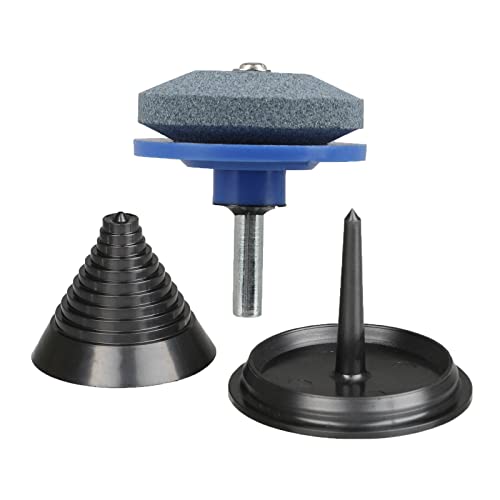
Drill-mounted corundum sharpeners, such as those made by Bneykrir, cenoz, and jtfrkope, provide an accessible method for restoring dull rotary edges at home. These circular stones feature a built-in guide plate that rests flat against the back of the blade while the spinning stone grinds the top bevel. Insert the sharpener shank firmly into a standard power drill chuck and run the tool along the factory bevel from the inside toward the outer tip. Light, controlled passes yield a cleaner and more consistent cutting bevel than aggressive grinding pressure.
For homeowners with workshop grinders, dedicated angle grinder brackets like the SporGain adjustable frame ensure strict angle repeatability. These fixtures clamp the blade firmly to a workbench and guide an angle grinder along a preset fifteen to forty-five-degree bevel plane. When tackling dense turf, such as cutting thick grass with electric mowers, having an exact, consistent edge angle reduces motor strain and preserves cutting efficiency. Always grind metal away in the direction of the factory bevel regardless of your chosen tool.
Balancing and Truing Rotary Blades After Grinding
Balancing a rotary blade is an indispensable safety procedure that must follow every sharpening session. When metal is ground unevenly from one end of the blade, the heavier side creates strong centrifugal forces as the blade spins at high speeds. This rotational imbalance generates severe deck vibration, loosens mounting bolts, and damages engine spindle bearings over time. Using an inexpensive cone balancer or universal stepped balancer, like the unit included in the jtfrkope maintenance set, confirms weight symmetry.
If one side of the blade dips lower on the balancer, metal must be removed from the heavy end to restore proper balance. Never remove metal from the sharp cutting edge itself to adjust weight, as this reduces the working length of the cutting surface. Instead, grind a small amount of steel from the blunt trailing edge or the back shoulder of the heavy side. Taking time to verify balance prevents excessive vibration and extends the operational life of your mower deck hardware.
Bevel Angles, Burr Removal, and Honing Handheld Blades
Preserving the correct bevel angle is essential for durability, as an edge ground too sharp will roll over and dull quickly. Rotary mower blades perform best with a sturdy cutting edge angled between thirty and thirty-five degrees rather than a razor-sharp knife edge. A razor edge lacks structural support behind the apex and chips easily when striking dry twigs, small stones, or compacted dirt mounds. Aim for an edge profile with the thickness of a standard butter knife along the extreme leading apex.
Grinding metal invariably produces a raised wire burr along the flat underside of the blade that must be deburred before reinstallation. Use a flat bastard file, a handheld carbide tool like the AccuSharp GardenSharp, or a multi-tool sharpener like the SHARPAL 103N to lightly deburr the underside. Hold the honing tool completely flat against the bottom surface and make two or three gentle strokes to snap off the burr without beveling the bottom face. Maintaining this flat underside prevents clipping turbulence and ensures clean discharge or mulching.
Routine Maintenance and Edge Preservation Strategies
Implementing basic post-mow habits substantially reduces the frequency of heavy blade sharpening sessions. After finishing your lawn, brush away damp grass clippings and soil deposits that trap moisture against the cutting edges. Accumulated plant juices contain natural acids that promote surface pitting, corrosion, and edge breakdown during garage storage. Applying a light mist of penetrating oil onto clean steel creates a protective moisture barrier between mowing sessions.
Mowing height and yard inspection practices also play an influential role in blade longevity across residential properties. Walking the lawn before mowing to remove fallen tree branches, dog toys, pinecones, and hidden landscaping stones prevents catastrophic blade nicks. Many operators using modern equipment like electric mulching mowers or classic manual push reels find that maintaining consistent cutting schedules prevents excessive load on the blade edges. Consistent care keeps your cutting edges crisp, minimizes pushing resistance, and leaves your lawn with manicured tips.
Practical Summary for Reliable Cutting Performance
Restoring clean cutting ability on your manual mower comes down to matching your maintenance method to the specific blade design. Push reel mowers demand careful backlapping and bed knife clearance adjustments, while walk-behind rotary decks require bevel grinding and static balance checks. Inexpensive handheld sharpeners provide rapid touch-ups during peak growth months, but thorough seasonal maintenance preserves blade geometry over years of yard care. Taking thirty minutes each season to tune cutting clearances, deburr contact edges, and balance rotary steel ensures effortless pushing and pristine lawn health.



Write Your Review
No reviews yet. Be the first to share your experience!