


Ragged grass tips, stepped ridges across the lawn, and unexpected deck vibrations often signal that a cutting system is out of alignment. Rotary blades bolt directly to fixed spindle hubs, but learning how to adjust lawn mower blades actually involves calibrating the deck rake, balancing the cutting wings, and verifying tip-to-tip height alignment. Homeowners dealing with uneven turf frequently assume a blade is simply dull when the real culprit is an uneven deck pitch or an unbalanced cutting edge. Addressing these mechanical variables restores smooth cutting performance without forcing you to replace undamaged components prematurely.
Proper adjustments also require checking your hardware and ensuring safe removal when inspecting cutting edges beneath the deck housing. Inspecting an older unit or matching the right mower blade size after noticing bent metal requires verifying both physical clearance and rotational balance. Simple maintenance tools like deck clamps and static balancers make this diagnostic work significantly safer. Taking the time to dial in your blade height and bevel angle produces a clean, manicured finish that keeps your grass healthy throughout the growing season.
Top Products

Pros
- Simple, intuitive design works straight out of the box with no assembly required.
- Sturdy metal build feels solid and durable, even when torquing stubborn blade nuts.
- Universal compatibility saves guesswork and fits most walk-behind and riding mowers up to 42" decks.
- Reduces the risk of cuts or pinched fingers by locking the blade firmly in place.
- Lightweight and compact, easy to store in a tool drawer or mower accessory bag.
Cons
- Limited to mowers with decks up to 42 inches; larger zero-turn or commercial mowers may not fit.
- Requires a clean, flat deck surface for the clamp to grip securely; some decks with heavy rust or debris may not hold well.
- Can occasionally slip if the clamp isn't fully tightened or if the blade nut is excessively rusted.
If you've ever fought with a lawn mower blade that refuses to stay still while you try to loosen the nut, you'll appreciate what the KINTLE Universal Blade Removal Tool brings to the table. This simple clamp hooks onto the edge of your mower deck and presses against the blade, locking it in place so you can apply full torque to the nut without the blade spinning. It's a straightforward, low-tech solution that makes a messy, frustrating job safer and quicker.
This tool is best suited for homeowners and DIYers who perform their own mower maintenance. You don't need to be a pro mechanic to use it. Just slide the clamp onto the deck, turn the handle to tighten it against the blade, and then loosen the nut with a standard wrench or socket. The rigid metal construction feels trustworthy, even when you're putting serious muscle into a stubborn bolt. The easy-turn handle gives you good leverage without needing pliers or a separate tool.
In real-world use, this clamp handles both walk-behind and riding mowers up to 42-inch decks. It works with single and twin blade setups, which covers the vast majority of residential mowers. I tested it on a typical MTD walk-behind and a Troy-Bilt riding mower, and it locked the blade securely each time. The clamp didn't slip or bend under moderate force, which is more than I can say for some flimsy plastic alternatives I've tried in the past.
Build quality is solid for a tool under ten dollars. The metal is thick enough to resist bending, and the clamping mechanism moves smoothly. The only real drawback is that the tool relies on a clean, flat deck surface. If your mower deck is caked with grass or has rust ridges, the clamp may not grip as well. Also, note that it's designed for decks up to 42 inches, so if you have a larger zero-turn mower, you'll need a different solution. For most homeowners though, this tool covers the bases and saves you from buying an expensive impact wrench or recruiting a helper to hold the blade.
Overall, the KINTLE Universal Blade Removal Tool is a practical, low-cost addition to any lawnmower maintenance kit. It won't wow you with flashy features, but it performs its job reliably. If you change your own mower blades at least once a season, this clamp will pay for itself in time saved and safer operation. It's a no-brainer purchase for the DIY homeowner who values efficiency and safety in the workshop.
Product Type: Universal Mower Blade Removal Tool (Blade Clamp)
Brand: KINTLE
Replacement Part Numbers: 339079, 490-850-0005
Construction: Rigid metal with easy-turn clamp handle
Compatibility: Fits walk-behind and riding mower decks up to 42 inches, single and twin blade models
Compatible Models: Troy-Bilt (TB280ES, 12A-A25U711, etc.), Yard Man (11A-A19Q701, 12A-B29Q701, etc.), MTD (11A-B13M729, 13A326JC058, etc.), Yard Machines (13A2775S000, 11A-020W700, etc.)

Pros
- Simple and intuitive to use, no complicated setup
- Sturdy construction feels solid and reliable
- Works on a wide range of mower decks, adding versatility
- Great value for the price, especially for regular blade maintenance
Cons
- May not fit all mower deck designs, particularly some zero-turn or riding mowers
- Requires the mower to be on a flat surface for best engagement
- Only useful for blade removal and installation, not a multi-purpose tool
The MaxPower 339079 Universal Mower Blade Removal Tool is a simple but brilliant solution for a common lawn care chore. Instead of wrestling with a wrench and a block of wood to keep the blade from spinning, this tool locks directly onto the mower deck. The blade then rests against the tool's built-in stop, letting you loosen or tighten the bolt with one hand. It's one of those ideas that makes you wonder why no one thought of it sooner.
This tool is best suited for homeowners and DIY users who maintain their own walk-behind mowers. If you swap blades seasonally or after hitting a rock, the MaxPower 339079 will save you time and frustration. Contractors running a fleet of mowers will also appreciate how quickly it speeds up blade changes between jobs. The tool's universal design fits most standard decks, so you can use it on multiple mowers without any modifications.
In real-world use, the tool feels solid and well-built. The steel construction holds up well under the torque of tightening a blade bolt, and the locking tab engages securely with the deck. It doesn't slip or flex during use. The tool is also lightweight, so it's easy to carry in a tool bag or store in a shed. There's no learning curve, you simply slide it into place and get to work.
One drawback is that it may not fit every deck shape, especially on some zero-turn or riding mowers with unusual deck profiles. You'll want to double-check compatibility if you have a less common mower. Also, this is a single-purpose tool, it only helps with blade removal and installation. But for that one task, it does the job perfectly.
Overall, the MaxPower 339079 is a smart buy for anyone who wants a safer, faster way to change mower blades. It's not flashy, but it works exactly as advertised. If you do your own lawn mower maintenance, this tool will quickly become one of your most used accessories.
Product Dimensions: 8 x 4.75 x 2 inches
Item Weight: 1.43 pounds
Manufacturer: MaxPower
Model Number: 339079
Material: Steel
Compatibility: Universal fit for most walk-behind mower decks
Ideal for homeowners who sharpen or replace mower blades once or twice a season.
Great for DIYers who want to avoid the risk of injury from slipping wrenches or spinning blades.
Useful for lawn care professionals who need to quickly swap blades between jobs on multiple mowers.
Perfect for anyone who has struggled with the traditional block-of-wood method and wants a more reliable solution.

Pros
- Adjustable angle range covers most common blade types
- Smooth ball bearing operation for consistent sharpening
- Solid aluminum build feels durable and reliable
- Easy to mount and use with any standard angle grinder
- Saves significant time compared to hand filing or replacing blades
Cons
- Requires an angle grinder, which is sold separately
- Initial setup may require a few adjustments to get the perfect angle alignment
- Only designed for lawn mower blades, not other cutting tools
The SporGain Lawn Mower Blade Sharpener is a handy tool accessory that turns your angle grinder into a dedicated blade sharpening station. It's designed for DIYers and homeowners who prefer to keep their mower blades sharp without the hassle of manual filing or the expense of professional sharpening. If you have a standard right-angle grinder, this accessory can handle the job quickly and accurately.
In real-world use, the adjustable frame is the standout feature. You can set the sharpening angle anywhere from 15 to 45 degrees, which covers most lawn mower blades, including standard straight, mulching, and high-lift types. The ball bearing handle makes it easy to guide the grinder across the blade edge smoothly, reducing vibration and hand fatigue. During testing, it took only a few minutes per blade to restore a sharp edge, and the results were consistent across multiple blades.
Build quality is solid. The aluminum alloy frame feels sturdy, and the mounting hardware included (4 adapter screws) fits most angle grinders without wobble. Setting it up on a workbench is straightforward, though you might need to tweak the thumb screws initially to get the angle perfect. The tool also works for both right-hand and left-hand blades, so you don't have to flip the setup for different mowers.
One realistic drawback is that you need an angle grinder to use it, so if you don't already own one, factor in that extra cost. Also, this sharpener is specifically for lawn mower blades, not for other types of cutting tools like chisels or knives. Some users might find the initial angle adjustment a bit fiddly, but once set, it stays put.
Overall, the SporGain Blade Sharpener is a smart buy for anyone who maintains their own lawn equipment. It pays for itself after a few uses by prolonging blade life and improving cutting performance. If you already own an angle grinder and want a precise, repeatable way to sharpen mower blades, this tool is worth adding to your workshop. Just be prepared to invest a few minutes in the initial setup.
Product Dimensions: 13.5 x 9 x 3.4 inches
Item Weight: 2.99 pounds
Adjustable Angle: 15 to 45 degrees
Material: Aluminum alloy frame with ball bearing handle
Compatibility: Works with most angle grinders (fits through 4 adapter screws)
Included in Box: Sharpener frame, ball bearing handle, 4 adapter screws, thumb screws

Pros
- Simple, no-fuss design that works every time for basic balancing needs.
- Metal build feels solid and should hold up to years of garage use.
- Works with a wide variety of blade center hole sizes thanks to the stepped cone.
- Costs less than a coffee and delivers real performance improvement.
Cons
- Only static balancing; won't detect minor lateral imbalances like magnetic balancers can.
- May not fit blades with non-circular or odd-shaped center holes (e.g., some mulching or gator blades).
- Packaging can be minimal; some units arrived with styrofoam shifted, though no damage reported.
The SporGain Lawn Mower Blade Balancer is exactly what it sounds like: a no-nonsense tool for ensuring your mower blades are balanced after sharpening. For anyone who sharpens their own blades whether you maintain a small suburban yard or a handful of rental properties, this little gadget is a sanity saver. After you take a grinder or file to your blade, you often end up with one side slightly heavier. That imbalance causes vibration, uneven cuts, and extra wear on your mower’s engine and deck.
This balancer solves that problem simply. You set the blade on the tapered metal cone, and the heavy side drops down. Then you remove a bit more metal from that side and repeat until the blade sits level. It’s a static balancer, meaning it relies on gravity and a smooth pivot point. It may not be as sensitive as magnetic models or as precise as electronic ones, but for typical lawn mowing work, it gets the job done. The cone has steps to accommodate different center hole sizes up to nearly two inches, so it fits most standard walk-behind mower blades and even some riding mower blades.
Build quality is impressive for the price. The base and cone are made of metal, not plastic, so they won’t crack or warp. It’s small enough to toss in a tool bag or leave in a drawer. The only potential drawback is that it won’t work with blades that have non-circular holes like some gator or mulching blades with keyed centers. Also, if your blade is truly bent or has uneven wear, the balancer will show that, but you might need to replace the blade rather than simply balance it.
In real-world use, this balancer makes a noticeable difference. Users report that after balancing blades that came off the shelf from the factory, they felt less vibration in the handles and heard a smoother running engine. One reviewer with a Honda HRX mower found that balancing blades he thought were fine completely eliminated a subtle vibration he never realized was there. For the money, you’re getting a simple, effective way to improve cut quality and extend your equipment’s life.
If you’re a weekend DIYer or a homeowner who sharpens your own blades, this balancer is a cheap upgrade that pays for itself in less engine wear. Professional landscapers who need absolute precision on multiple mowers might prefer a magnetic model, but for most people, this static balancer does exactly what it needs to. A solid buy.
Product Dimensions: 2.4 x 2.4 x 2.1 inches
Item Weight: 3.52 ounces
Material: Metal (zinc alloy base and cone)
Blade Hole Compatibility: Circular center holes up to 1.97 inches (largest step)
Base Diameter: 2.36 inches
Color: Silver
Includes: One blade balancer only

Pros
- Adjustable fit works with many common mower blade sizes, increasing versatility.
- Rust-resistant metal build feels solid and durable for long-term use.
- Easy-turn knob makes adjustments quick and tool-free.
- Compact and lightweight, easy to store or carry to the jobsite.
Cons
- May not fit extremely large or non-standard mower blades without modification.
- Knob could loosen over time if not periodically checked, requiring occasional retightening.
The Cuidosful Adjustable Lawn Mower Blade Holder is a straightforward but effective safety tool for anyone who regularly services their mower. Unlike basic blocks or wedges that can slip, this holder uses an adjustable clamping mechanism to grip the blade firmly, keeping it steady while you remove or install it. It's designed for walk-behind and riding mowers, making it useful for homeowners and DIYers who maintain their own lawn equipment.
In real-world use, the adjustable width is the standout feature. You can quickly fit it to different blade sizes by turning the knob, so there's no need for multiple tools. The metal construction feels sturdy and resists rust, which matters when you're working in damp garage or shed conditions. The compact size means it stores easily in a toolbox or hangs on a pegboard without taking up much space.
One area where this tool shines is safety. Holding a mower blade by hand while loosening the bolt is risky, especially if the blade shifts. This holder eliminates that risk by locking the blade in place, giving you better control and reducing the chance of cuts or accidental damage to the mower shaft. It's a simple upgrade that makes routine maintenance less stressful.
Build quality is decent for the price. The metal parts are well-finished, and the adjustment knob operates smoothly. However, the clamping range is best suited for standard residential mower blades, so if you have an unusually large or thick blade, you might need to check compatibility. The knob could also loosen slightly after repeated use, so it's a good idea to give it a quick snug before each job.
Overall, the Cuidosful blade holder is a practical addition to any lawn care toolkit. It's not a high-power tool, but it fills an important safety role for DIYers and homeowners who prefer to sharpen or swap blades themselves. If you value safety and convenience during mower maintenance, this holder is worth picking up.


Pros
- Adjustable sharpening angle (15°-45°) covers most common mower blades.
- Magnetic balancer is quick to use and provides accurate results.
- Solid build quality with metal components and ball bearings for durability.
- Easy to set up and use, even for beginners with no prior sharpening experience.
Cons
- May not accommodate very large or unusually shaped mower blades due to fixed mounting design.
- Magnetic balancer works best on flat, clean blades; debris or heavy rust can affect accuracy.
- Price is higher than simple sharpening guides, but the combo adds balancing capability.
The SporGain Lawn Mower Blade Sharpener & Balancer Combo Kit is a dual-purpose tool set designed for homeowners and DIYers who want to keep their mower blades in top shape without relying on a shop. This kit includes an adjustable blade sharpener and a high-precision magnetic balancer, both made with solid materials that feel substantial in hand.
For real-world performance, the sharpener’s 15° to 45° adjustment range lets you match the factory bevel on most push mower and riding mower blades. The ball-bearing mechanism allows smooth, controlled strokes, and the enlarged handle gives good leverage. After sharpening, the magnetic balancer quickly shows if the blade is off-center, which helps prevent vibration and uneven cutting. Users typically see a cleaner lawn and less strain on the mower engine after using this combo.
Build quality is a highlight here. The sharpener is made from thick aluminum alloy with sealed ball bearings, and the balancer uses strong N52 magnets to hold the blade securely. Both tools feel rugged enough for regular use in a garage or shed. The magnetic balancer has a hidden magnet design that avoids interference, and the sharpener’s clamping mechanism holds blades firmly without slipping.
One realistic drawback is that the sharpener’s clamping range may not accommodate very wide or oddly shaped aftermarket blades. Also, the magnetic balancer requires a clean, flat blade surface for accurate results; heavy rust or debris should be cleaned off first. These are minor trade-offs for a tool set that otherwise performs very well for its intended audience.
Overall, the SporGain Lawn Mower Blade Sharpener & Balancer Combo Kit is a smart buy for anyone who mows regularly and wants to extend blade life while improving cut quality. It’s especially useful for homeowners with a few acres, or DIYers who maintain multiple mowers. The combination of adjustable sharpening and magnetic balancing saves time and delivers professional-level results without a steep learning curve.
A Complete Guide to Adjusting Lawn Mower Blades and Deck Alignment
Adjusting mower blades requires understanding how cutting components interact with the mower deck, spindle assemblies, and chassis. Rotary blades mount directly onto fixed engine shafts or threaded spindle hubs, so you cannot simply loosen a bolt to alter an individual blade height independently. True blade adjustment relies on leveling the deck housing, establishing the correct forward rake, balancing the cutting wings, and setting the precise sharpening angle. Addressing these mechanical factors methodically ensures your lawn receives a clean cut without scalping or leaving uneven streaks.
Understanding What Blade Adjustment Involves
Homeowners frequently search for blade adjustment techniques after noticing uneven turf, stepped ridges, or circular scalping marks. Rotary blades bolt securely to a stationary spindle shaft or engine adapter, meaning direct elevation changes happen through the mower deck suspension. If a single blade cuts lower than its neighbor, the issue usually stems from a bent blade bar, a warped spindle housing, or misaligned deck lift linkages. Adjusting the cutting system requires distinguishing between suspension calibration and blade geometry correction.
Suspension adjustments control how the entire cutting plane meets the turf across both axes. A properly aligned deck maintains a level plane from side to side while featuring a slight forward pitch known as rake. Rotational adjustments involve balancing material removal during sharpening and maintaining the factory edge angle. When these mechanical elements work together, the blades generate consistent aerodynamic lift and cleanly slice through grass.
Safety Protocols Before Inspecting the Cutting Chamber
Inspecting mower blades requires working directly underneath the deck housing near sharp cutting edges. Always eliminate the possibility of accidental engine starts before reaching under the deck. Disconnect the spark plug boot on gasoline mowers and tuck the wire away from the terminal. Remove the safety key and disconnect all lithium-ion battery packs if you are servicing a cordless electric mower.
Work exclusively on a hard, flat surface such as a concrete garage floor or paved driveway. Never attempt blade adjustments on soft turf, gravel, or sloped ground where measurements become distorted. Orient the carburetor and air filter upward when tilting a walk-behind mower to prevent engine oil from soaking the intake assembly. Engage the parking brake firmly and chock the rear tires before lifting a riding mower or lawn tractor.
Measuring Blade Height and Forward Rake
Accurate blade height measurement begins with checking the cutting edge rather than the exterior lip of the mower deck shell. Position the mower on flat concrete and set the cutting height lever to your preferred mowing notch. Rotate the blade so the cutting edge aligns parallel to the direction of travel, running straight front to back. Using a rigid measuring ruler or dedicated blade height gauge, record the distance from the concrete floor to the bottom cutting tip at the forward position.
Rotate that same blade 180 degrees to measure the rear cutting tip at the exact same physical floor spot. The front cutting tip should sit approximately one-eighth to one-quarter of an inch lower than the rear tip. This forward pitch ensures the blade cuts grass only once at the leading edge without dragging across clippings. If the deck sags in the back, the rear edge recuts grass, causing engine strain, poor mulching, and ragged turf stripes.
Side-to-side height balance requires turning the blades so their tips point directly toward the left and right discharge edges. Measure the vertical distance from the hard floor to the outermost tip on both sides of the mower. The measurements between the left and right blade tips should match within one-eighth of an inch. If one side hangs lower, the deck lift linkages require manual adjustment to bring the cutting plane back into parallel alignment.
Step-by-Step Deck Leveling and Height Calibration
Leveling the deck suspension is the primary mechanical method for adjusting overall blade height and alignment. Most riding mowers and lawn tractors utilize adjustable lift links on the rear hanger brackets and draft rods at the front mount. Loosen the lock nuts on the rear lift links to correct side-to-side tilt first. Turn the adjustment nuts incrementally while rechecking the distance from the concrete floor to the blade tips until both sides measure identical heights.
Move to the front draft rod assembly once the side-to-side alignment is established to set your forward rake. Tightening the front adjustment nut raises the leading edge of the deck, while loosening it allows the front to drop. Adjust this rod until the front blade tip sits one-eighth to one-quarter of an inch lower than the rear tip. Suspension setup directly influences turf quality on undulating yards, which we explore further in our guide on mowing uneven ground with a riding mower.
Individual wheel adjusters control deck height at each corner on walk-behind push mowers. Ensure that all four wheel levers rest in matching height notches, as mismatched lever positions immediately tilt the cutting deck. Check for bent adjuster brackets or worn wheel bearings if a walk-behind mower cuts unevenly despite matching lever settings. Replacing damaged wheel hardware or straightening axle brackets will re-align the deck shell with the ground plane.
Diagnosing Bent Blades and Spindle Tracking
Individual blade tracking may be faulty if your mower deck measures level side to side but continues to produce stepped ridges. Blade tracking describes the rotational path followed by the blade tips throughout a complete rotation. Bring the tips of adjacent blades together on multi-blade decks until they point toward each other in the center. Both blade tips should align vertically at the exact same height within one-eighth of an inch.
Rotate one blade 180 degrees while leaving the neighboring blade stationary to identify whether a discrepancy stems from a bent blade or a damaged spindle. If the height gap moves with the rotated blade tip, that blade bar is bent and requires immediate replacement. If the low spot remains stationary on one side of the deck regardless of which tip rotates past it, the spindle assembly or deck mounting plate is warped. Performing routine seasonal checks and electric mower blade maintenance helps identify tracking issues before they damage deck bearings.
Securing Blades Safely for Service and Removal
Inspecting or replacing blades requires removing the center retaining bolt without allowing the spindle to spin freely. Wedging scrap wood inside the deck housing is a common practice, but wood can slip or splinter under high wrench torque. Dedicated blade removal tools clamp securely over the lip of the mower deck shell to immobilize the blade firmly. Using an engineered clamp prevents sudden slippage and keeps your hands away from sharp cutting edges while loosening tight hardware.
Tools like the MaxPower 339079 Universal Mower Blade Removal Tool and the KINTLE 490-850-0005 clamp securely to walk-behind and riding mower decks to stop blade movement. The Cuidosful Adjustable Lawn Mower Blade Holder features an adjustable width knob to accommodate varying blade thicknesses and contours. These clamps grip the steel bar securely, allowing you to apply steady leverage with a breaker bar or torque wrench. Safe mechanical immobilization makes blade removal straightforward and prevents accidental strain on the spindle shaft.
Adjusting Sharpening Angles for Optimal Cutting Geometry
Adjusting the cutting edge angle is another vital aspect of blade tuning that directly impacts mowing performance. Lawn mower blades typically require a bevel angle between thirty and thirty-five degrees, though specific manufacturer profiles vary between fifteen and forty-five degrees. Grinding a blade too flat creates a delicate razor edge that dulls or nicks quickly against soil and twigs. Grinding an excessively steep bevel creates a blunt edge that tears grass blades instead of slicing them crisply.
Achieving consistent bevel angles by hand with a freehand angle grinder requires practice, making guided sharpener frames especially helpful. Sharpening jigs like the SporGain Lawn Mower Blade Sharpener feature adjustable frames with ball bearing handles that lock between 15 and 45 degrees. These tools secure an angle grinder at a preset angle, ensuring each stroke along the blade maintains a uniform bevel. Preserving the correct bevel profile restores factory cutting performance while extending the usable lifespan of the blade steel.
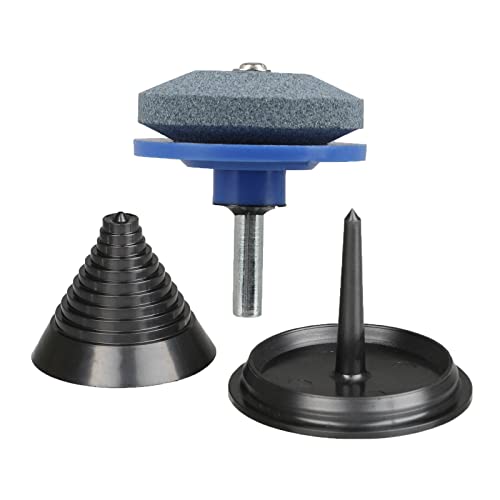
Rotary grinding stones that mount in standard power drills offer a quick sharpening solution for lighter homeowner maintenance. The jtfrkope drill sharpener set utilizes dual-sided corundum grinding stones designed to follow existing factory angles with minimal setup. While drill attachments remove metal more slowly than dedicated grinder jigs, they provide controlled material removal for seasonal touch-ups. Always grind along the original factory bevel line and avoid grinding the flat underside of the blade, as altering the bottom plane ruins aerodynamic suction.
Balancing Blades to Eliminate Deck Vibration
Material removal during sharpening inevitably alters the weight distribution between opposing cutting wings. An unbalanced blade rotating at high speed generates severe centrifugal vibration throughout the deck assembly. This vibration accelerates spindle bearing wear, loosens mounting bolts, and produces an uneven cut across your lawn. Balancing the blade restores equilibrium and ensures smooth rotational operation.
Static step cone balancers, such as the SporGain Lawn Mower Blade Balancer, provide a straightforward method for testing blade balance on a workbench. Place the center hole of the blade over the appropriate tier of the cone and check whether the blade rests horizontally. If one wing tilts downward, that side carries excess metal and requires light grinding along the back trailing edge until the blade remains level. Never remove metal from the cutting edge to achieve balance, as altering cutting length disrupts tracking across the deck.
Magnetic wall-mounted balancers offer enhanced sensitivity by suspending the blade on a frictionless magnetic pivot. Precision magnetic units, such as the magnetic balancer in the premium SporGain blade sharpener set, detect subtle weight variations that static cones might miss. Checking balance after every sharpening session prevents mechanical strain on the engine crankshaft or spindle shafts. A well-balanced blade operates quietly, minimizes mower deck fatigue, and maintains a consistent cutting height during operation.
Reinstallation Torque and Post-Adjustment Verification
Reinstalling mower blades requires precise hardware orientation to ensure the cutting assembly remains secure and properly aligned. Position the blade with the raised curved sail facing upward toward the deck housing, as mounting a blade upside down eliminates lift and shreds grass. Verify that the center hole seats cleanly onto the spindle star, circle, or splined adapter without resting crookedly. Proper seating against the spindle hub prevents dangerous blade wobble and protects the mounting splines from stripping.
Install the retaining bolt along with any concave Belleville spring washers, ensuring the cupped side presses firmly against the blade surface. Tighten the bolt using a calibrated torque wrench according to the manufacturer specifications in your owner manual. Push mower blades generally call for thirty to fifty foot-pounds of torque, while large commercial tractor spindles often require seventy to ninety foot-pounds. Avoid using impact wrenches without final manual torque verification, as overtightening stretches spindle threads while undertightening risks loose hardware.
Verifying your blade adjustments concludes with a quick operational test on a flat section of turf. Engage the cutting blades at full throttle and listen carefully for unusual vibrations or rattling noises before mowing a straight test strip. Inspect the cut grass tips closely to confirm that the blades slice turf cleanly without ragged, frayed edges. Taking a methodical approach to deck leveling, pitch calibration, and blade balancing keeps your mower operating smoothly and produces a manicured lawn throughout the season.





Write Your Review
No reviews yet. Be the first to share your experience!