


Ragged grass tips, frayed brown lawn patches, and bogged-down mower engines often trace directly back to improper cutting edges under the mower deck. While many homeowners assume that grinding steel down to a razor-like edge will deliver cleaner cuts, rotary mower blades operate under brutal rotational impact where extreme sharpness quickly backfires. Learning whether can a lawn mower blade be too sharp helps protect both lawn health and cutting equipment from unnecessary damage. When pairing edge upkeep with proper deck fitment, consulting a Craftsman lawn mower blade sizing guide or checking your specific mower manual ensures you start with the correct steel profile before maintenance begins.
A standard walk-behind or riding mower spins its cutting wing at tip speeds often exceeding one hundred and fifty miles per hour. At those velocities, a razor-thin cutting edge lacks the structural backing needed to survive impacts with stray twigs, sand, or hidden lawn debris. The metal simply rolls over, chips, or dulls far faster than a properly beveled edge designed specifically for impact cutting. Understanding the balance between sharpness, durability, and blade balance keeps your turf green while extending the working life of your mower deck components.

Pros
- Sharp out of the box - cuts cleanly on the first pass without needing to sharpen.
- Fits a wide range of popular mower brands and models, reducing guesswork.
- Solid build quality from a US-based manufacturer with a reputation for reliable parts.
- Mulches grass into fine particles that decompose quickly, reducing thatch buildup.
- Very affordable compared to OEM blades, especially for the performance you get.
Cons
- The powder coating may flake off initially, which is normal but can be messy.
- Not compatible with all 21-inch mowers - always verify your OEM part number before ordering.
- Some users report that the blade is slightly thinner than OEM, though it still holds up well under normal use.
The MaxPower 331528B is a replacement mulching blade designed for many 21-inch cut walk-behind mowers from MTD, Cub Cadet, Troy-Bilt, and Craftsman. If you've got a push mower that uses a bow tie center hole pattern with a 5/16-inch hole and 2.5-inch spacing, this blade is likely a direct drop-in. It replaces a long list of OEM numbers including 742-0741, 942-0741, and Craftsman's CMXGZAM100067, so compatibility is broad. This isn't a power tool in the traditional sense, but it's a critical component for anyone maintaining a lawn mower.
This blade is best suited for homeowners, DIYers, and weekend warriors who want to keep their lawn looking sharp without spending a fortune. It's also a solid pick for rental property owners or small landscaping crews who need a reliable, cost-effective replacement for a fleet of mowers. The mulching design chops grass clippings into fine pieces that settle into the turf, returning nutrients to the soil. That means less bagging and a healthier lawn overall.
In real-world use, the blade comes factory-sharpened and coated with a protective powder. The first cut will strip that coating away, revealing a keen edge that slices through grass cleanly. Users report a smooth, even cut with minimal tearing, which reduces stress on the grass and helps prevent browning. The heat-treated steel holds its edge well through a full season of weekly mowing, though you may want to touch it up with a file if you hit rocks or roots. Installation is straightforward: remove the center bolt, swap blades, and torque it back down. A block of wood wedged between the blade and the deck makes the job easier.
Build quality is solid for an aftermarket blade. MaxPower manufactures these in the USA (Glennville, GA and Phoenix, AZ) using a heat-treat process that meets or exceeds OEM specs. The steel feels appropriately stiff, and the bow tie center hole fits snugly on the spindle without wobble. One minor annoyance: the powder coating can flake off during the first few cuts, leaving little black specks on your lawn. That's cosmetic and harmless, but worth noting. Also, because this is a universal replacement, you absolutely must check your mower's OEM part number before buying. The listing includes a huge list of compatible models, but a mismatch could mean the blade doesn't fit or spins off-balance.
Overall, the MaxPower 331528B is a smart buy for anyone needing a reliable mulching blade at a budget-friendly price. It cuts well, fits a wide range of mowers, and is built to last. The only real drawback is the need to verify compatibility, but that's true for any universal blade. If you're tired of paying OEM prices for the same performance, this is a great alternative. Just double-check your part number, and you'll be back to mowing in no time.
Blade Length: 21 inches
Blade Width: 2.25 inches
Center Hole: Bow tie pattern, 5/16-inch diameter outer holes, 2.5-inch center-to-center spacing
Weight: 1.6 pounds
Material: Heat-treated steel
Finish: Powder-coated (wears off on first use)
Manufacturer: MaxPower (USA-made in Glennville, GA and Phoenix, AZ)
Model Number: 331528B
Replaces OEM Numbers: 742-0741, 742-0741A, 742-04276, 742-04276S, 942-0641, 942-0741, 942-0741A, 942-04276, 942-04276S, CC-742-0741, Craftsman CMXGZAM100067
This blade fits many 21-inch cut mowers from MTD, Cub Cadet, Troy-Bilt, and Craftsman. Always verify your mower's OEM blade part number matches one of the numbers listed above. Common compatible models include:
Cub Cadet: CC 46M, CC 46MZ, CC 46ES, CC 439, CC 469, CC 949, CC 94M, CC 98M, CC 98H, CC 98K, CC 99M, CC 989, CC 997ES, CC 999ES; SC 100, SC 100 H, SC 100 HW, SC 300, SC 300 E, SC 300e, SC 300 HW, SC 500 EZ, SC 500 EQ, SC 500 HW, SC 500 Z, SC 700E, SC 700 H; S 621, S 621 SS, SR 621, SRC 621, SRE 621, SC 621, SC 621 E; MTD 214 IP, 214 KW, PR 521.
Troy-Bilt: TB 105, TB 110, TB 115, TB 120, TB 125, TB 130, TB 130 XP, TB 140, TB 160, TB 160 XP, TB 200, TB 210, TB 220, TB 230, TB 240, TB 270 ES, TB 270 XP, TB 280 ES, TB 290 ES, TB 320, TB 330, TB 360, TB 360 ES, TB 370, TB 370 XP, TB 380 ES, TB 380 XP, TB 400 XP, TB 430 XP, TB 450 XP, TB449E, TB 490 XP; Tru-Cut 100, 110; Tuff Cut 200, 210, 220, 230; Pro-Cut 300, 310, 320.
Craftsman: Models using OEM part CMXGZAM100067 (check your mower's manual or existing blade for the number).

Pros
- Extremely easy to use, no setup or power required.
- Safe design minimizes risk of cuts or slips.
- Versatile enough for mower blades, axes, and machetes.
- Affordable and built to last with replaceable carbide.
Cons
- Not suitable for severely nicked or damaged blades; may need filing first.
- Requires manual effort and multiple passes for a sharp edge.
- Wire brush bristles can bend easily with heavy use.
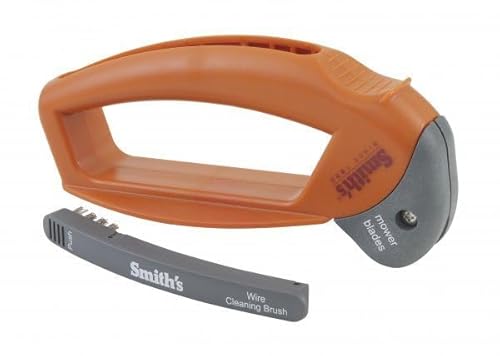
The Smith's 50603 Handheld Lawn Mower Blade Sharpener is a manual sharpening tool designed for quick and safe blade maintenance. It uses a preset carbide blade to restore a sharp edge on lawn mower blades in just minutes, without the need for electricity or complicated setups. This sharpener is best suited for DIY homeowners, gardeners, and occasional users who want to keep their mower blades in good shape without investing in expensive power tools or professional sharpening services.
In real-world use, the Smith's 50603 delivers on its promise of simplicity. Just pull the sharpener along the blade's cutting edge a few times, and you'll see a noticeable improvement. The oversized handle and large finger guard make it comfortable to use even with thick work gloves, and the preset angle ensures you get the correct bevel every time. It also works well on axes, machetes, and hatchets, making it a versatile addition to any workshop or garage.
Build quality is decent for the price. The plastic head is durable enough for occasional use, and the replaceable carbide blade means you can keep the tool working for years. The integrated wire brush is handy for cleaning rust or debris off blades before sharpening, though the bristles can bend if you're too aggressive. On the downside, if your mower blade is heavily nicked or damaged, you'll need to file it down first before using this sharpener. It's also a manual tool, so you'll need to put in some elbow grease for a truly sharp edge.
Overall, the Smith's 50603 is a practical, affordable solution for maintaining lawn mower blades and other single-bevel tools. It's not a replacement for professional sharpening on heavily worn blades, but for regular upkeep, it's hard to beat for the price and ease of use. If you're a homeowner looking to keep your mower cutting cleanly without the hassle of removing the blade, this sharpener is a smart buy.
Brand: Smith's
Model: 50603
Material: Durable plastic head with replaceable carbide blade
Dimensions: 7.34 x 2.15 x 2.77 inches
Weight: 0.38 pounds
Grit Type: Coarse (carbide)
Included: Sharpener with wire brush stored in handle
Lawn Mower Blades: Ideal for quick sharpening without removing the blade from the mower.
Axes & Hatchets: Works well on single-bevel edges for camping or firewood prep.
Machetes & Pruning Tools: Great for field sharpening when you need a fast edge.
DIY Homeowners: Perfect for seasonal blade maintenance to keep your lawn looking clean.

Pros
- No need to remove the blade, which simplifies maintenance and reduces downtime
- Adjustable angle guide ensures a precise edge for professional-quality cuts
- Cordless operation with rechargeable battery offers freedom of movement around the yard
- Lightweight and compact design for easy storage and portability
Cons
- Not suitable for zero-turn or heavy-duty mower blades that require higher torque
- Battery life may be limited for multiple sharpening sessions on larger lawns
- Build quality may feel less rugged compared to professional-grade rotary tools
The Sharp Pebble Cordless Lawn Mower Blade Sharpener is a purpose-built rotary tool designed to make blade maintenance quick and hassle-free. Unlike traditional sharpening methods that require removing the blade, this tool lets you sharpen in place, saving you the time and frustration of disassembly. It's an ideal solution for DIY homeowners and weekend gardeners who want to keep their mower blades sharp without investing in expensive professional equipment.
Performance wise, the adjustable angle guide (20-40 degrees) is a standout feature. It allows you to set the exact angle for your blade type, ensuring a consistent edge that promotes cleaner cuts and healthier grass. The variable speed control (5,000-30,000 RPM) gives you the flexibility to handle different blade conditions, from light touch-ups to more aggressive sharpening. The included replaceable sharpening wheels are effective and easy to swap out when they wear down.
Build quality is decent for the price point. The tool feels lightweight and well-balanced, with an ergonomic grip that reduces fatigue during extended use. The cordless design with a rechargeable battery adds convenience, letting you move freely around the yard without being tethered to an outlet. However, the battery life is adequate for a few blades but may require a recharge for larger mowing setups. The tool is best suited for standard mower blades; it lacks the torque needed for zero-turn or heavy-duty commercial blades.
In terms of practicality, this sharpener is a time-saver. You can quickly touch up the blade between mows, ensuring optimal cutting performance without the downtime of removal and reinstallation. Safety features like the ergonomic grip and speed control help maintain control during operation. The compact size makes it easy to store in a toolbox or garage drawer.
One realistic drawback is that the tool may not satisfy users who need to sharpen multiple blades in one session, as the battery could run out. Additionally, the build quality, while adequate for occasional use, may not withstand heavy daily use by professionals. Overall, the Sharp Pebble Cordless Lawn Mower Blade Sharpener is a practical, affordable choice for DIYers and homeowners who value convenience and precision. If you're looking for a quick way to maintain your mower blade without the hassle of removal, this tool delivers solid performance for the price.
Product Dimensions: 8 x 2.8 x 1.2 inches
Item Weight: 1.37 pounds
Manufacturer: Mighty Dreams
Model Number: SPMower2024
Battery: 1 9V battery included
Best Sellers Rank: #56,427 in Patio, Lawn & Garden, #212 in Lawn Mower Accessories
This sharpener is best for standard residential lawn mower blades. It is ideal for DIY homeowners who mow their own lawns and want to keep blades sharp without removing them. Use it for quick touch-ups between mows or to restore a dull blade to a clean cutting edge. Not recommended for commercial zero-turn mowers or heavy-duty blades that require higher torque.
Pros
- Simple pull-through action makes sharpening fast and easy for beginners
- Integrated wire brush keeps blade clean for better sharpening results
- Oversized handle and safety guard improve comfort and protection when using gloves
Cons
- Manual operation requires physical effort and multiple passes for very dull blades
- May not achieve the same precision as a bench grinder or professional sharpening service
- Limited to lawn mower blades; not designed for other cutting tools or kitchen knives
Smith's Lawn Mower Blade Sharpener is a straightforward manual tool designed to keep your mower blades sharp without the need for power equipment or removing the blade. It targets the typical homeowner who wants a quick and easy way to maintain cutting performance during the mowing season. While it sits in the Knife Sharpeners category on Amazon, its specific design for mower blades sets it apart for lawn care duty.
In real-world use, you simply place the sharpener over the blade and pull it back and forth a few times. The durable head guides the abrasive surface against the edge, restoring a functional sharpness that improves cut quality. The integrated wire brush is a nice touch - you can clean off grass residue right before sharpening, which helps the tool work more effectively. The oversized handle is genuinely comfortable even with thick work gloves, and the large safety guard gives you confidence while pulling.
Build quality is what you would expect at this price point: functional and lightweight. The plastic body holds up fine for occasional use, but it does not feel like a heavy-duty shop tool. Keep in mind that this sharpener is meant for touch-ups and maintenance, not for reshaping heavily damaged or nicked blades. If your blade has significant wear, you might need several passes or a more aggressive method. Also, it only works on lawn mower blades, so it is not a multi-purpose tool.
The biggest limitation is the manual effort involved. For someone sharpening multiple blades or dealing with tough steel, a bench grinder would be faster and more consistent. However, for the DIYer who wants to spend five minutes refreshing a blade before mowing, this tool delivers good value. It stores easily in a tool bag or shed, and there are no cords or batteries to worry about.
Overall, Smith's Lawn Mower Blade Sharpener is a practical, no-nonsense addition for any homeowner with a reel or rotary mower. It will not replace professional sharpening or power tools, but it offers an accessible, low-cost way to keep your cuts clean and your lawn healthy. If you are looking for a straightforward maintenance tool that does not require a workshop setup, this is a solid choice.
Color: Black
Size: One Size
Dimensions: 7.34 x 2.15 x 2.86 inches
Weight: 0.47 pounds
Product Group: Kitchen
Best suited for DIY homeowners who want to maintain reel or rotary mower blades between professional sharpenings. Ideal for quick touch-ups in the garage or on the lawn before mowing. Not recommended for commercial mowing operations or for blades with severe damage.

Pros
- Incredibly easy to use – just chuck it in a drill and run along the blade edge.
- Stainless steel base adds durability and resists melting from friction heat.
- Versatile – sharpens a wide range of garden blades beyond just mowers.
- Great value for the price, especially with five sharpeners in one pack.
Cons
- Requires a steady hand and consistent drill speed to avoid overheating the blade.
- Not designed for heavy-duty or industrial use; best for regular home maintenance.
- Some users report the abrasive can wear down faster than expected on very hard blades.
The cenoz Lawn Mower Blade Sharpener 5 Pack is a simple yet effective tool accessory that turns your electric drill into a quick blade sharpener. If you're tired of lugging a bench grinder outside or paying for sharpening services, this little attachment offers a convenient alternative. It's built with a corundum abrasive disc bonded to a stainless steel base, which addresses a common issue with cheaper plastic-based sharpeners that can warp or melt under high-speed friction.
This product is best suited for homeowners and DIYers who mow their own lawns and want to keep their blades sharp without a big investment. It's also handy for small-scale contractors who need a quick touch-up on the jobsite. The 5-pack gives you plenty of spares or lets you keep one in the shed, one in the truck, and a few for friends. Installation is as easy as inserting the included hex shaft into your drill chuck and running the rotating stone along the blade bevel at the correct angle.
In real-world use, this sharpener works surprisingly well for removing nicks and restoring a decent edge on standard mower blades. It won't give you a mirror finish like a professional grinder, but it'll get the blade sharp enough for a clean cut. The built-in balancer is a nice touch – you can mount the blade on the center hole and see if one side is heavier, then remove a bit more material from that side. Just remember to wear eye protection and gloves, as sparks and metal filings will fly.
Build quality is decent for the price. The stainless steel base feels sturdy, and the corundum stone holds up for several sharpenings. However, you need to be careful not to apply too much pressure or run the drill at max speed for too long, or you could overheat the blade edge and ruin its temper. The 5-pack means you can replace the stone easily if one wears out. Downsides? This isn't a tool for sharpening very dull or damaged blades – you'd still need a grinder for major reshaping. Also, the stone can load up with metal particles, so you'll need to clean it occasionally with a dressing stick.
Overall, the cenoz Lawn Mower Blade Sharpener 5 Pack is a smart buy for anyone who wants a fast, affordable way to maintain their mower blades without a dedicated sharpening station. It's not a heavy-duty pro tool, but for routine maintenance on residential mowers, it gets the job done. If you value convenience and are okay with a bit of manual effort, this is a solid addition to your workshop or shed.
Brand: cenoz
Model: Lawn Mower Blade Sharpener 5 Pack
Material: Corundum abrasive with stainless steel base
Size per sharpener: 50 x 47 mm (1.97 x 1.85 inches)
Package includes: 5 sharpeners, 1 packing box
Compatibility: Works with any power hand drill with a standard chuck
Weight: 1.04 pounds (package)
Home Lawn Mowing: Ideal for keeping residential push mower and rider blades sharp throughout the season.
Garden Maintenance: Also works on sickle bars, rototiller tines, and hedge trimmer blades for quick touch-ups.
DIY and Hobby Use: Perfect for homeowners who want to save money on blade replacements or sharpening services.
Workshop Standby: Keep a pack in your tool drawer for those times you notice a blade is dull right before mowing.

Pros
- Affordable 6 pack offers great value for frequent sharpening needs.
- Works with any standard drill, no special equipment required.
- Aluminum oxide construction holds up well against repeated use.
- Simple to use with a guide piece that automatically sets the correct sharpening angle.
- Versatile for various blade types beyond just lawn mowers.
Cons
- Requires a vise to hold the blade securely during sharpening, which may not be available to all users.
- Sharpening by hand with a file is still an option, but this drill attachment may not produce as fine an edge as a dedicated sharpening system.
- No included instructions or guides for specific drill types, so users must follow general safety and technique guidelines.
The S SATC 6 Pack Lawn Mower Blade Sharpener is a simple, cost-effective tool that turns any standard power drill into a blade sharpening station. Designed for DIY homeowners, small engine mechanics, and anyone who maintains a lawn, this set of six aluminum oxide stones allows you to quickly restore a sharp edge to mower blades, tractor blades, rototiller tines, and even sickle bar cutters. It is a practical addition to any workshop or garage where lawn equipment is serviced.
In real-world use, the sharpener performs well for its intended purpose. The stones are 1.97 inches in diameter and 1.85 inches tall, with a beveled edge that matches the typical 45-degree angle of mower blades. The flat guide piece helps maintain consistent contact, so you don't have to guess the angle. Clamp the blade in a vise, insert the sharpener into your drill, and run it back and forth along the blade edge. After a few passes, you will notice a clean, sharp edge that cuts grass cleanly rather than tearing it. The process is fast and requires minimal effort compared to filing by hand.
Build quality is decent for the price. The aluminum oxide material is hard and durable, and the stones hold up well after multiple sharpenings. The 6 pack means you have plenty of replacements on hand, which is useful if you frequently sharpen several blades or if you drop and break a stone. The compact size allows you to work in tight spaces, and the spinning balance is good enough to avoid excessive vibration. However, the stones are not as aggressive as some higher-end sharpeners, so heavily nicked blades may require more passes or a preliminary filing.
One realistic limitation is that you need a vise to hold the blade securely. If you don't have one, you may find it difficult to apply consistent pressure. Also, the included instructions are generic; you will need to follow standard safety precautions like wearing eye protection and disconnecting the spark plug. For most DIYers, this is not a dealbreaker, but it is something to keep in mind.
Overall, the S SATC 6 Pack Lawn Mower Blade Sharpener is a solid value for anyone who wants to maintain sharp blades without spending a lot of money. It is best suited for homeowners with a few mowers or small tractors, or for hobbyists who work on small engines. If you already own a drill and a vise, this set is a no-brainer for keeping your lawn equipment cutting cleanly. Just be aware that it is a basic tool and not a replacement for professional sharpening services on extremely damaged blades.
Understanding Mower Blade Sharpness, Edge Geometry, and Maintenance
Rotary lawn mower blades do not cut grass the same way a razor blade shaves hair or a kitchen knife slices culinary produce. Yes, a lawn mower blade can certainly be too sharp, and grinding an edge down to razor thinness actually harms cutting performance over the course of a mowing session. An overly sharpened edge rapidly folds over, chips, and dulls when rotating at commercial tip speeds under normal yard conditions. Knowing how to shape, balance, and maintain a durable cutting profile prevents grass damage and keeps yard equipment operating smoothly throughout the entire growing season.
The Mechanics of Rotary Cutting: Why Razor Edges Rapidly Fail
Rotary mowers function by swinging a heavy bar of heat-treated steel through turf at tremendous rotational velocity. Unlike reel mowers that shear grass between two moving metal edges like scissors, rotary blades rely on high-speed impact and aerodynamic lift to sever grass blades. When steel contacts grass blades at hundreds of feet per second, it does not need a surgical edge to achieve a clean separation. The rotational speed alone provides more than enough kinetic energy to slice through plant fibers crisply.
Honing a blade to a razor-thin edge removes vital steel that provides structural backing directly behind the cutting face. Without sufficient steel mass behind the leading edge, the metal becomes brittle and vulnerable to microscopic flexing under heavy load. Even microscopic obstacles such as sand granules, dried acorn hulls, and tiny twigs will bend or roll that fragile edge on the very first pass across the lawn. Once the razor edge rolls over, the blade behaves like a blunt, burred gouge, tearing grass blades instead of cutting them cleanly.
The Butter-Knife Rule: Establishing the Proper Bevel Profile
Lawn equipment manufacturers and turf management specialists consistently recommend sharpening rotary mower blades to the sharpness of a standard butter knife. This means the leading cutting edge should feature a flat or slightly radiused land measuring roughly one sixty-fourth to one thirty-second of an inch thick. Leaving this tiny blunt surface preserves substantial metal right behind the cutting zone where impacts occur. The resulting edge resists chipping when encountering dense turf, dusty soil, or small lawn debris.
Maintaining the correct bevel angle is equally critical for edge longevity and proper clipping discharge. Most standard lawn mower blades utilize a factory bevel ground between thirty and thirty-five degrees off the horizontal plane. Grinding an angle shallower than thirty degrees creates a fragile edge that dulls quickly in routine lawn care. Conversely, grinding an angle steeper than forty degrees creates an overly blunt wedge that requires excessive engine power and tends to tear grass rather than cutting it cleanly.
Why New Replacement Blades Feature Blunt and Powder-Coated Edges
Homeowners unpacking a new replacement blade are frequently surprised to find that the cutting edge feels surprisingly blunt to the touch. Products like the Maxpower 331528B Mulching Blade for some 21 Inch demonstrate this intentional factory engineering approach. MaxPower coats its replacement blades with a protective powder layer during the manufacturing process to guard against rust and corrosion during warehouse storage and transport. The manufacturer explicitly notes that this protective powder coating wears off during the first cut to reveal a precision-sharpened blade.
Even after the protective coating wears away, the underlying steel edge is intentionally ground to a durable commercial bevel rather than a sharp knife profile. Matching exact replacement blades to specific mower decks remains crucial, as seen with the bow-tie center hole pattern on the 21-inch MaxPower model that replaces OEM part numbers like 742-0741 and 942-0741 on compatible Cub Cadet, MTD, and Troy-Bilt mowers. Attempting to grind brand new blades down to razor sharpness immediately after unboxing voids the engineered balance and weakens the factory edge. Similar durable finish principles apply across various blade categories, such as black mower blade setup options engineered with tough protective coatings for routine maintenance.
Turf Symptoms Caused by Blades That Are Ground Too Thin
When a mower blade has been ground too thin, several distinct lawn symptoms quickly emerge across your turf. The most immediate sign is rapid edge deterioration, often visible after just twenty to thirty minutes of active mowing. The micro-thin edge folds backward under soil friction, creating an irregular burr along the bottom face of the blade. This curled burr tears turf blades rather than severing them, leaving frayed whitish tips across the entire lawn surface within forty-eight hours.
Torn grass blades also leave open, ragged plant wounds that invite common fungal diseases into the turf canopy. In addition to aesthetic damage, an over-sharpened blade that has curled or chipped forces the mower engine to work harder to push through thick grass. The engine RPM may drop audibly in tall turf because a rolled edge creates drag rather than smooth cutting action. If you notice clipping dispersal becoming clumped and uneven, inspect the cutting bevel for rolled edges or chipped steel.
Handheld Pull-Through Sharpeners for Safe Edge Maintenance
Handheld manual tools provide a controlled method for touching up cutting edges without the danger of accidentally removing too much steel. Devices such as the Smith’s 50603 Handheld Lawn Mower Blade Sharpener utilize preset carbide cutting inserts to scrape a consistent edge profile in just a few quick pulls. The tool incorporates an oversized handle that accommodates work gloves alongside a wide safety guard to keep fingers clear of the cutting edge. A built-in wire cleaning brush stored directly inside the handle makes it easy to scrub caked grass clippings away before sharpening begins.
The compact Smith’s Lawn Mower Blade Sharpener operates on a similar preset carbide principle, making it convenient for quick mid-season maintenance in the garage or shed. Because manual carbide sharpeners rely on fixed blade angles, they naturally prevent users from creating overly thin, fragile razor edges. Homeowners simply draw the sharpener across the top bevel with steady, moderate downward pressure following the natural contour of the blade. These manual sharpeners remove only small metal shavings, preserving blade mass while restoring a functional cutting face without overheating the steel.
Drill Attachments and Dedicated Rotary Sharpening Tools
Power-assisted rotary tools offer faster stock removal when restoring heavily nicked or neglected mower blades. Multi-pack sharpening stones designed for power drills, such as the cenoz Lawn Mower Blade Sharpener with Steel, feature durable corundum wheels mounted onto stainless steel backing plates. The steel base plate prevents the excessive heat wear and base cracking that frequently afflicted older single-layer plastic-backed sharpening stones. These stones chuck into standard hand drills within seconds, automatically resting against the blade bevel to clean up minor gouges quickly.
Universal drill attachments like the S SATC 6 Pack Lawn Mower Blade Sharpener Universal also utilize high-quality corundum wheels sized at fifty by forty-seven millimeters for versatile yard maintenance. When using drill attachments, maintaining light pressure and continuous smooth movement prevents localized overheating that can destroy steel temper. For users seeking specialized control, dedicated units like the Sharp Pebble Cordless Lawn Mower Blade Sharpener provide an adjustable angle guide ranging from twenty to forty degrees. Its variable speed control, spanning 5,000 to 30,000 RPM, allows operators to tune the grind precisely while sharpening standard blades without removing the blade assembly.
The Critical Relationship Between Blade Sharpening and Rotational Balance
Every time metal is ground away from a lawn mower blade, the balance between both cutting wings changes slightly. Removing more steel from one end creates a dynamic weight imbalance when the blade spins at thousands of revolutions per minute under the deck. An unbalanced blade produces noticeable vibration through the operator handle, causes uneven cut heights, and places intense stress on deck spindles and engine bearings. These balance considerations become especially crucial when maintaining equipment built around brushless electric mower blade considerations, where excessive motor vibration can harm sensitive electronic controllers and battery mounts.
Checking blade balance takes only a few seconds using a clean nail mounted on a wall or an inexpensive stepped cone balancer. Support the blade horizontally by its center mounting hole on the balancer cone or nail head in a draft-free workspace. If one cutting wing dips downward, that side is heavier and requires additional metal removal along the non-cutting portion of the sail or bevel. Never grind metal from the extreme outer tips or the center mounting hole itself to correct rotational balance. Continue making light passes with your sharpener until the blade rests completely level on the balancing pivot before reinstalling it.
Mulching Versus Standard Blades: Differences in Edge Profiling
Mulching blades feature complex curves, raised cutting sails, and extended cutting edges designed to chop clippings multiple times before dropping them into the turf. Because mulching blades recirculate grass inside the deck chamber, their cutting surfaces experience continuous abrasion from swirling debris. Grinding a mulching blade too sharp makes those extended curved edges especially susceptible to curling under constant grass-and-dirt sandblasting. Maintaining a robust thirty-degree bevel with a blunt leading land ensures the multiple cutting surfaces hold up under severe chamber turbulence.
Standard high-lift and side-discharge blades, by contrast, feature straight cutting edges focused on generating vertical airflow to eject clippings out the chute or into a collection bag. While these blades have simpler linear edges that are easier to sharpen, creating a razor edge remains equally detrimental. High-lift wings generate intense suction that pulls soil particles, small rocks, and twigs upward toward the cutting surface. A razor-sharp edge strikes these airborne particles at high speed, resulting in immediate micro-nicks that degrade cut quality across the entire cutting path.
Safe Mower Blade Servicing and Proper Reinstallation
Servicing a lawn mower blade requires strict adherence to safety protocols to prevent personal injury and equipment damage. Always disconnect the spark plug boot on gas mowers or remove the safety key and battery pack on cordless electric models before reaching beneath the deck. Tilt walk-behind gas mowers with the carburetor and air filter pointing upward to prevent engine oil and gasoline from draining into the intake system. Wedge a sturdy block of scrap wood between the blade and the deck wall to lock the blade firmly in place while loosening the mounting hardware with a breaker bar or socket wrench.
During reinstallation, verify that the blade is oriented correctly with the cutting edge facing the direction of rotation and the curved lift wings pointing upward toward the deck underside. Inspect mounting hardware including blade bolts, Belleville washers, and spindle adapters for thread wear, corrosion, or distortion. Always torque blade bolts to the specific rating published in your equipment operator manual rather than relying on guesswork. Never use an impact wrench to drive blade bolts home, as overtightening can stretch bolt threads or crack the spindle housing under rotational strain.
When to Sharpen Versus When to Replace an Aging Blade
Routine lawn maintenance typically calls for sharpening mower blades after every twenty to twenty-five hours of active mowing, or roughly twice per season for typical suburban lawns. However, there comes a clear threshold where continued sharpening compromises safety and performance, making full replacement the only sensible path. If the curved lift wing at the rear of the blade has thinned to less than half its original thickness from sand erosion, the blade can fracture under high-speed operation. Deep gouges, cracks near the center mounting hole, or notch damage that extends past the cutting bevel also require immediate blade replacement rather than aggressive grinding.
Bent blades caused by striking hidden tree roots, buried survey markers, or landscape pavers must always be replaced rather than straightened with a hammer or vise. Cold-bending metal introduces microscopic stress fractures into the steel matrix, which can cause catastrophic blade failure and severe deck damage at full throttle. When purchasing replacements, match manufacturer specifications precisely, paying close attention to blade length, width, thickness, and center-hole geometry like the bow-tie shape on MTD decks. Keeping a spare, properly beveled blade on your workshop shelf ensures you can swap blades instantly whenever sharpening or maintenance is required.
Maintaining a lawn mower blade at the correct sharpness level protects your grass, your mower engine, and your seasonal maintenance budget. Striving for a durable butter-knife bevel between thirty and thirty-five degrees avoids the brittle failure of an over-sharpened edge while delivering clean, healthy turf cuts week after week. Whether you select a manual pull-through carbide tool, a corundum drill stone, or a dedicated cordless rotary sharpener, take conservative passes to preserve structural steel mass. Always verify rotational balance on a cone or nail before torquing the blade back onto the spindle assembly to keep your mowing setup operating safely.



Write Your Review
No reviews yet. Be the first to share your experience!