


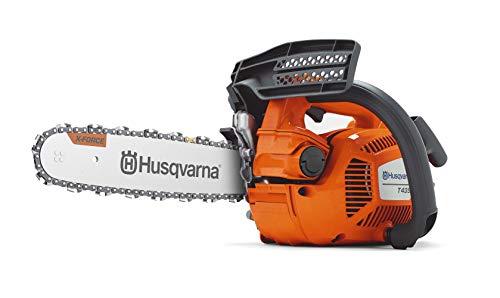
Operating outdoor power equipment at elevation presents unique mechanical and ergonomic challenges that ground-based timber cutting rarely encounters. Tree care workers and property owners often ask whether are top handle chainsaws dangerous when compared to conventional rear-handle forestry tools. The compact layout of an aerial saw shifts the primary grip directly above the engine center of gravity, altering how rotational cutting torque and reactive forces transfer into the operator’s hands. While traditional platforms like classic utility chainsaws prioritize maximum leverage through widely separated handles, top-handle powerheads trade stabilizing spread for agility in dense tree crowns.
This compressed grip configuration significantly narrows the physical barrier between high-speed cutting teeth and the user’s upper body. A sudden rotational kickback event leaves almost no distance for an operator to arrest upward bar travel before the guide bar contacts the torso or face. Understanding the mechanical behavior of these climbing saws, including models like the Holzfforma 35.2cc G111 Top Handle Gasoline Chain powerhead, requires evaluating why handle placement changes cutting control so drastically. Anyone considering these compact tools must recognize how specialized powerhead balance, chain brake activation angles, and one-handed operation risks dictate safe working protocols.

Pros
- Lightweight and compact for easy handling in tree trimming and pruning tasks
- Compatible with common MS200T and 020T parts, simplifying repairs and upgrades
- 35.2cc engine provides enough power for limbing and small log cutting
- Top-handle design is ideal for one-handed use in tight spaces
- Good value for homeowners and arborists needing a dedicated pruning saw
Cons
- Power head only - requires separate purchase of bar, chain, and safety gear
- Top-handle saws may have a steeper learning curve for beginners
- Gas engine requires regular maintenance and proper fuel mixing
The Holzfforma G111 is a 35.2cc top-handle gas chainsaw power head built for users who need a lightweight, maneuverable saw for tree trimming, pruning, and storm cleanup. Designed to be compatible with MS200T and 020T parts, this power head offers flexibility for homeowners, arborists, landscapers, and property owners who already own compatible bars, chains, and accessories. It's a practical choice for those who want a dedicated limbing saw without the bulk of a full-sized gas chainsaw.
In real-world use, the G111 delivers reliable cutting power for limbs up to 8-10 inches thick, making it well-suited for pruning, clearing fallen branches after storms, and light firewood cutting. The 35.2cc engine provides enough torque to cut through hardwood limbs without bogging down, while the top-handle design allows for better control during overhead cuts. Many homeowners and arborists may appreciate the saw's ability to handle repetitive limbing tasks with less fatigue compared to heavier rear-handle saws.
Build quality appears solid for its price point, with durable housing and a design that mirrors the popular MS200T platform. The power head features an automatic oiling system to keep the chain lubricated during use, and the chain tensioning is straightforward once you pair it with a compatible bar and chain. While the saw does not include a bar or chain, its compatibility with widely available MS200T/020T parts means you can easily find replacements and upgrades at many outdoor power equipment retailers.
Setup involves mounting your own bar and chain, adjusting tension, and mixing fuel at a 50:1 ratio. For experienced chainsaw users, this is a quick process, but beginners should carefully follow the manual to ensure safe operation. The top-handle design requires extra caution, as these saws are intended for trained users or those comfortable with one-handed cutting techniques. Always use appropriate safety gear, including chaps, helmet, and eye protection.
One realistic limitation is that the G111 is a power head only, so you will need to budget for a bar, chain, and possibly a carrying case. Additionally, gas engines require regular maintenance such as air filter cleaning, spark plug checks, and fuel stabilization during storage. This saw is best suited for users who already have some chainsaw experience or are willing to learn proper maintenance and safety practices.
Overall, the Holzfforma G111 is a solid option for homeowners, arborists, and property owners who need a lightweight, parts-compatible top-handle saw for tree trimming, pruning, and storm cleanup. Its combination of portability, power, and compatibility makes it a practical addition to any yard or farm tool collection, especially for those who value the ability to customize and maintain their equipment over time.
The Operational Dynamics and Safety Profile of Top Handle Chainsaws
Top handle chainsaws present significantly higher operational risks than conventional rear-handle designs when used outside of specialized aerial tree work. Professional arborists rely on these compact powerheads because their reduced overall length allows maneuvering between tight branch unions inside a tree canopy. However, the physical configuration that makes an aerial saw agile aloft creates severe handling hazards for untrained operators on the ground. When evaluating whether are top handle chainsaws dangerous, the answer centers directly on mechanical leverage, user positioning, and the rapid physics of rotational kickback.
Rear-handle forestry chainsaws position the operator’s hands roughly twelve to eighteen inches apart, providing substantial mechanical leverage to counter reactive forces. In contrast, a top-handle configuration clusters both hands close together on top of the powerhead chassis. This narrow stance drastically reduces the user’s ability to resist sudden guide bar movements when cutting teeth bind or strike foreign objects. Misunderstanding these geometric forces frequently leads to catastrophic control loss, making specialized training and strict operational protocols essential before handling this class of equipment.
Handle Geometry and the Physics of Rotational Kickback
Rotational kickback occurs when moving cutters in the upper quadrant of the guide bar tip strike solid wood or foreign debris without shearing through cleanly. The rotating chain suddenly transfers kinetic energy directly into the guide bar, hurling the entire powerhead backward and upward toward the operator. On a standard rear-handle saw, the wide physical spacing between the front handlebar and rear throttle handle acts as a stabilizing lever. That wider stance allows the operator’s extended left arm and shoulder musculature to absorb and deflect the upward pivot before the saw reaches the upper body.
Top-handle chainsaws alter this mechanical relationship by moving the rear throttle directly above the engine block, adjacent to the front handlebar. Because the pivot point aligns almost directly with the operator’s dominant wrist, upward rotational kickback generates extreme angular acceleration with virtually zero resisting leverage. The saw tends to pivot around the wrist joint like a hammer rather than pivoting between two widely spaced hands. Even experienced operators cannot physically overpower this rotational velocity through grip strength alone once a severe kickback event initiates.
The Severe Hazard of One-Handed Operation
The single most dangerous practice associated with top-handle chainsaws is single-handed operation. Novice users and casual cutters often observe aerial arborists maneuvering these tools and mistakenly assume that one-handed operation is acceptable or intended. In reality, industry safety standards from both OSHA and ANSI B175.1 strictly prohibit operating any gasoline chainsaw with only one hand. Using a single hand deprives the operator of directional control, making it impossible to guide the saw through wood grain variations without binding.
Single-handed cutting also completely disables the primary passive safety mechanism built into the powerhead. The front hand guard connects to an inertia-activated chain brake designed to trip forward against the operator’s left wrist when the bar rotates upward. If an operator releases the front handle to hold a branch or steady a ladder, the left wrist is no longer positioned behind the brake guard. A kickback event under these conditions sends an active, high-speed cutting chain directly into the user’s face, neck, or free arm without engaging the safety brake.
Powerhead Engineering and the Holzfforma G111 Platform
Engine displacement and powerhead weight directly influence how an aerial saw balances in dynamic cutting environments. The Holzfforma 35.2cc G111 Top Handle Gasoline Chain illustrates the core engineering philosophy behind modern climbing saws. Featuring a 35.2cc two-stroke gasoline engine, this powerhead is designed to deliver rapid throttle response and high chain speed within a compact, lightweight chassis. Saws in the 35cc displacement bracket generate substantial rotational torque capable of pulling guide bars through dense hardwoods, yet their compact size makes them feel deceptively manageable to inexperienced operators.
Interchangeability represents a prominent consideration for operators maintaining specialized climbing powerheads. The Holzfforma G111 powerhead is notable because all parts are compatible with MS200T and 020T chainsaw models, which represent classic professional climbing saws known throughout the tree care industry. Accessing reliable replacement chainsaw parts allows owners to maintain critical subassemblies, such as carburetors, ignition coils, and clutch drums, over extended service lives. Proper mechanical maintenance directly impacts operator safety by preventing engine stalls mid-cut or erratic idle speeds that cause unexpected chain rotation.
Powerhead balance must be checked whenever mounting different guide bar and chain combinations to an aerial chassis. An unbalanced top-handle saw creates unnecessary wrist fatigue, causing the nose of the bar to dive downward or tilt sideways during extended cutting sessions. Because the 35.2cc Holzfforma G111 engine delivers high rotational power in a lightweight package, pairing it with an appropriately matched guide bar ensures neutral balance between the front and rear handles. Operators must also verify that clutch engagement releases cleanly at idle so the saw chain remains stationary when the throttle trigger is released.
Ground Bucking Hazards Compared to Rear-Handle Platforms
Using a top-handle chainsaw for ground-level firewood processing or trail maintenance is fundamentally inefficient and hazardous. When an operator stands over a log on the ground, a top-handle layout forces the wrists into extreme downward flexion to orient the bar toward the wood. This posture compromises grip strength and pulls the user’s face and upper torso directly over the cutting plane. Standard rear-handle platforms, including rugged legacy tools like vintage professional chainsaws, were engineered with extended rear grips precisely to keep the operator’s body behind the powerhead during ground-level bucking.
Ground-level cutting also increases the risk of contacting the soil or hidden stones with the guide bar tip. When an active chain touches dirt, rock, or metal fencing, dulling occurs instantly, and violent tip kickback frequently follows. Because the operator’s hands are crowded together on top of the saw, deflecting an unexpected upward bounce at knee or shin level is nearly impossible. Many ground-cutting accidents involve the bar jumping out of a kerf and contacting the user’s lower extremities before the chain brake can activate.
Guide Bar Sizing and Chain Cutter Compatibility
Selecting the proper guide bar length is critical for controlling reactive cutting forces on compact engines. Top-handle powerheads in the 30cc to 36cc bracket generally function best with twelve-inch to fourteen-inch guide bars, with sixteen inches representing the absolute upper operational boundary. Installing an oversized bar on a 35.2cc engine bogs down the powerhead, slows chain speed, and shifts the center of gravity far forward. Low chain speed increases the likelihood of cutter teeth catching on wood fibers rather than severing them cleanly, dramatically increasing kickback frequency.
Saw chain selection plays an equally vital role in managing powerhead safety and cutting efficiency aloft. Most top-handle machines run 3/8-inch low-profile chain with a .043-inch or .050-inch gauge, which produces a narrow kerf that reduces rotational drag on the engine. For casual operators or non-commercial settings, low-kickback chains equipped with bumper drive links or ramped depth gauges are strongly recommended. These bumper features restrict the bite size of cutter teeth as they round the guide bar nose, substantially dampening the violent rotational impulse generated during accidental tip contact.
Inertia Chain Brakes and Active Safety Hardware
The chain brake serves as the primary barrier against life-threatening kickback injuries on any modern chainsaw. On top-handle powerheads, the front hand guard is connected to an internal steel brake band that clamps tightly around the clutch drum to halt chain movement in milliseconds. This system functions through two distinct actuation modes: manual activation via physical wrist contact and inertia activation triggered by rapid rotational acceleration. Because the distance between the front handlebar and hand guard is compact, proper hand placement is essential for the guard to trip cleanly during an emergency.
Inertia activation occurs automatically when the powerhead whips upward with sufficient violent force, even if the operator’s hand does not physically strike the guard. Inside the brake mechanism, a weighted trip lever resists the sudden upward motion through inertia, releasing the heavy spring that cinches the brake band. Regular inspection of this mechanism is mandatory because sawdust, dried bar oil, and resin buildup can impede the trip latch. Secondary components, including the chain catcher pin and throttle trigger lockout, must also be inspected regularly to maintain dependable defense against thrown chain loops.
Crucial Protective Equipment and Aerial Operating Standards
Operating a top-handle saw demands a specialized suite of personal protective equipment designed for close-quarter cutting risks. Traditional loose chainsaw chaps are unsafe for tree climbing because straps can snag on branches, leading arborists to utilize form-fitting chainsaw protective pants instead. These trousers incorporate specialized cut-retardant fibers, such as Kevlar or Dyneema, that instantly jam the drive sprocket and stall the chain upon contact. Steel-toe climbing boots with high ankle support, heavy cut-resistant gloves, and an arborist helmet featuring an integrated chin strap and face screen complete the essential protective ensemble.
Aerial work standards require climbers to establish two independent points of secure attachment before starting a chainsaw in a tree. A primary climbing line paired with a wire-core flipline or secondary positioning lanyard prevents catastrophic falls if an unexpected branch shifts during cutting. Starting the powerhead while aloft requires setting the chain brake, holding the front handle firmly, and pulling the recoil starter smoothly without drop-starting. Drop-starting, which involves pushing the saw away with one hand while pulling the cord with the other, is an extremely dangerous technique that frequently leads to loss of control.
Cutting above shoulder height should never be attempted with an aerial saw, whether standing in a bucket or positioned on climbing spurs. When the saw rises above chest level, the operator loses visual contact with the cutting chain and cannot maintain downward mechanical pressure. Furthermore, falling limbs cut from above can strike the guide bar, deflecting the running chain directly into the climber’s harness or support ropes. Maintaining cutting zones between the waist and mid-chest ensures steady balance, full tool visibility, and reliable two-handed grip control throughout every cut.
Practical Guidelines for Choosing the Right Powerhead Class
Determining whether a top-handle powerhead belongs in your equipment shed depends entirely on the specific cutting tasks you perform. If your primary work involves felling small trees, bucking logs on the ground, or clearing fallen storm debris, a standard rear-handle chainsaw is indisputably safer and more effective. Rear-handle tools offer the wide grip stance, superior leverage, and ergonomic posture required for safe ground-level woodcutting. Homeowners and landowners should resist the temptation to purchase top-handle saws merely for their compact size, as the safety trade-offs far outweigh any weight benefits for ground work.
For certified arborists and trained tree service professionals working aloft, top-handle saws like the Holzfforma G111 platform remain indispensable industry tools. Their agile powerhead design, when combined with rigid two-handed discipline, proper climbing rigging, and complete personal protective gear, allows precise branch removal in restricted canopy spaces. Treating these high-revving machines with the caution their reduced leverage demands ensures that tree care operations remain productive without sacrificing operator safety.







Write Your Review
No reviews yet. Be the first to share your experience!