


Seasonal lawn care often comes to an abrupt halt when a blade retaining bolt refuses to turn during routine deck service. Many homeowners naturally wonder whether are lawn mower blades threaded backwards after straining against a stubborn fastener under the mower deck. In standard residential walk-behind mowers and lawn tractors, blade bolts follow the traditional right-hand thread pattern that loosens when turned counterclockwise. However, counter-rotating spindles on specialized dual-blade decks create real exceptions where reverse threads prevent hardware from vibrating loose under heavy load. Understanding how your spindle rotates can save you from stripping threads or cracking the spindle housing.
Inspecting the mounting hardware before applying excessive leverage helps avoid expensive damage to the blade adapter or deck spindle. Reviewing reliable guidelines on how to remove a blade from a lawn mower safely ensures you secure the cutting edge properly before torquing the retention bolt. In addition, checking whether replacement blades come sharpened helps you prepare a clean cutting edge before reinstalling your hardware. High-tensile fasteners such as 7/16-inch bolts and cupped Belleville washers require steady inspection so you never round off bolt heads while attempting routine blade maintenance.


Pros
- High-quality construction resists rust and corrosion, extending the life of the hardware.
- Direct fit for many popular riding mower models, reducing guesswork during installation.
- Affordable price point makes it a budget-friendly option for routine blade replacement.
- Includes both bolts and washers, so you have everything needed for a secure install.
Cons
- Potential compatibility issues with non-listed mower models; always verify size and thread pattern before purchasing.
- Some users may prefer original OEM parts for exact fit, though these are designed as a reliable aftermarket alternative.
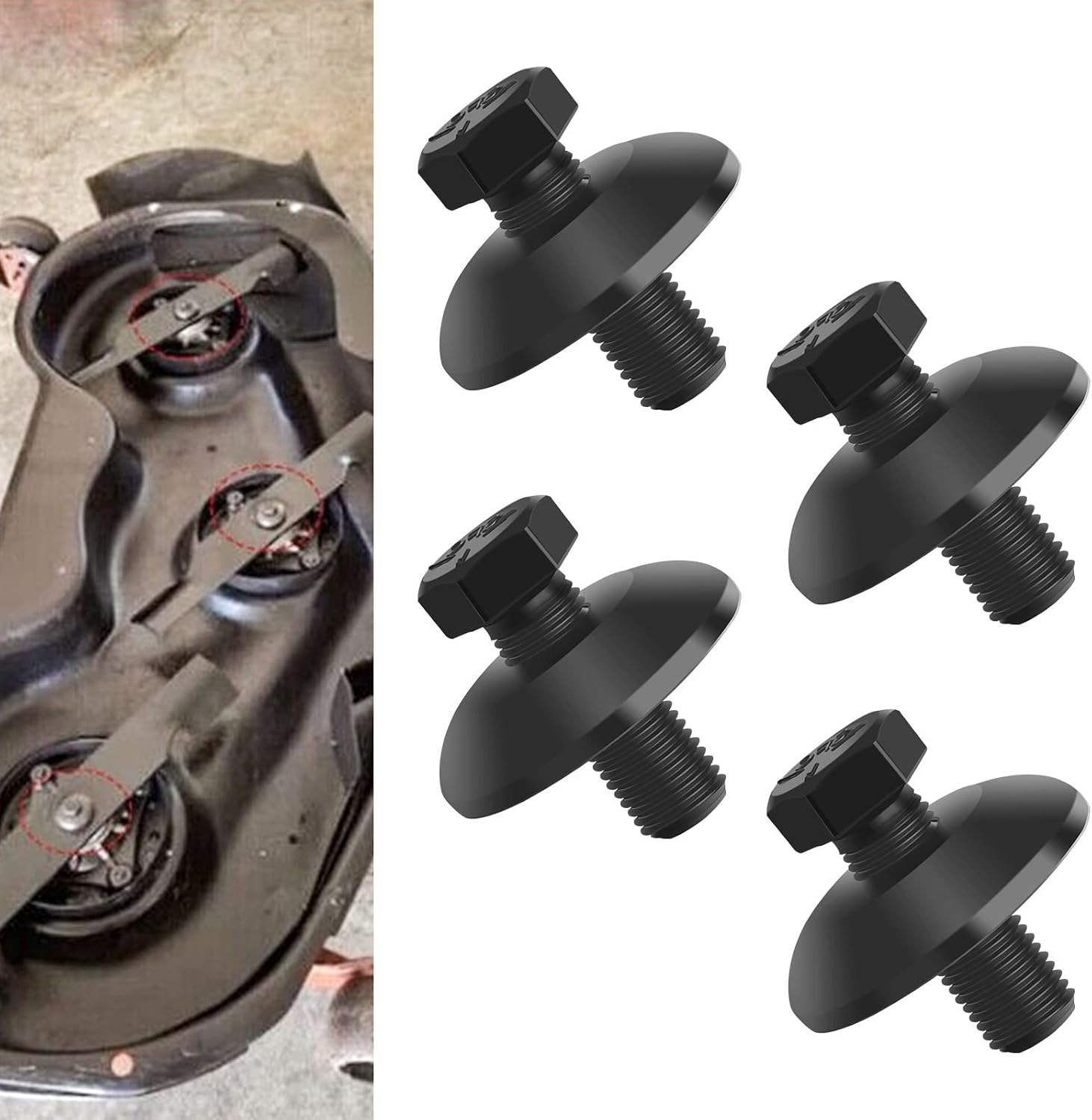
This product is a set of replacement blade bolts and washers designed for riding lawn mowers. Specifically, these 4 packs of 532193003 bolts and washers are compatible with Husqvarna, AYP, Craftsman, and Poulan riding lawn mowers, as well as some zero-turn models. For homeowners and DIYers who perform their own lawn equipment maintenance, having a spare set of blade hardware is a practical necessity. This kit includes four bolts and four washers, providing enough for one full blade change with extras or spares.
These bolts and washers are best suited for budget-conscious shoppers and first-time mower buyers who want to keep their equipment in good working order without paying a premium for OEM parts. They are also valuable for lawn care enthusiasts who prefer to stock up on common replacement parts. The product description emphasizes that the hardware is made from premium materials with corrosion resistance, which is important for outdoor equipment exposed to moisture and grass clippings. Many users may find that this set offers a reliable and secure blade attachment, reducing the risk of blade loosening during operation.
In terms of real-world lawn care performance, the primary function of these bolts and washers is to hold the cutting blade firmly in place. A properly secured blade ensures consistent cutting performance, whether you are mulching, bagging, or side discharging. The 1-1/4" x 7/16"-20 size and 1.51" x 0.61" x 0.4" washer dimensions are common specifications for many riding mower decks. Users should verify their mower's requirements before purchasing, as incorrect sizing could lead to poor fit or safety issues. According to the product listing, the hardware is designed for easy replacement, making blade changes straightforward for those comfortable with basic tools.
Build quality appears to be a highlight, with the manufacturer claiming a focus on corrosion resistance and durability. The bolts and washers are likely made from hardened steel with a protective coating, which helps prevent rust and extends service life. This is particularly beneficial for those who store their mowers in damp sheds or garages. The practical design includes a shoulder on the bolt and a flat washer, which together provide a stable clamping force for the blade. While the product does not come with installation instructions, most users will find the process similar to other blade hardware.
One realistic limitation is that this aftermarket set may not fit every mower model, even within the listed brands. Some riders use different thread pitches or bolt lengths, so double-checking measurements is essential. Additionally, because the product is relatively new with no reviews yet, buyers may want to rely on the seller's specifications and compatibility claims. That said, the price is very affordable, making it a low-risk purchase for those who need a backup set.
Overall, these blade bolts and washers from Diskary are a practical choice for anyone maintaining a compatible Husqvarna, AYP, Craftsman, or Poulan riding mower. They offer a cost-effective way to ensure blade security and reduce downtime during the mowing season. Homeowners with a small suburban lawn or a larger rural property will appreciate the convenience of having spare hardware on hand. For those who prefer original parts, OEM options are available, but this aftermarket set provides a reliable alternative at a fraction of the cost.
Pros
- Easy to install with basic hand tools - a perfect job for a Saturday afternoon.
- Solid build quality that holds up to vibration and repeated mowing cycles.
- Four-piece kit offers great value for the price, covering all blade positions on most mowers.
- Works across several popular mower brands, reducing guesswork for replacement parts.
Cons
- Only fits mowers that use 7/16 inch thread bolts and cupped washers; always confirm your mower's part number first.
- Some users may prefer to buy a complete blade and bolt set instead of just the fasteners.
- Limited to fasteners only - no blades included, so you'll need to order those separately if they're also worn.
If you maintain a riding or zero-turn mower, you know that even the sharpest blade can't cut well if it's not held securely. The Haiouus 4pk Blade Bolt & Washer set is designed to solve that exact problem. This kit replaces the OEM part number 532193003, commonly found on Husqvarna, Craftsman, and several other brands. Each bolt features a 7/16 inch thread, and the cupped washer helps lock the blade in place under the constant vibration of mowing.
This kit is best suited for DIY homeowners and property owners who handle their own mower maintenance. You don't need to be a pro mechanic to swap these out. The installation is straightforward: remove the old bolt and washer, line up the blade, insert the new bolt, and tighten. The included washer goes on just like the original, ensuring a repeatable torque hold. That simplicity can save you a trip to the dealer and some cash.
In real-world use, the bolts hold up well. They are made from hardened steel that resists stripping, and the washers maintain their shape even after prolonged use. The only real limitation is fitment. You must verify that your mower uses the 7/16 inch thread and the cupped washer style shown. Some older or non-standard decks may use a different size. But if your mower takes 532193003, this is a direct drop-in replacement.
Build quality feels solid. The bolts have a clean thread and the washers are evenly formed. The pack gives you four of each, which is exactly what you need for most riding mowers with two or three blades. Even if you only need one, having spares is handy for future swaps. There's no corrosion right out of the package, and the zinc coating helps resist rust in the damp mower deck environment.
Overall, this is a practical, no-nonsense maintenance part. It won't make your mower cut faster or improve engine performance, but it will ensure your blade stays put so you get a clean, even cut. If you're tired of blades that wobble or come loose mid-mow, this kit is a smart, affordable fix. A solid choice for any DIY mower owner who values reliable hardware.
This bolt and washer set replaces OEM part numbers: 532193003, 14457, 174365, 193003, 193003-A, 532-1930-03, 532174365, 539107522, 532193003-A. Thread size is 7/16 inch. Fits many Husqvarna and Craftsman riding lawn mowers and zero-turn mowers that use a cupped washer design. Always verify your mower's model and blade bolt size before ordering.


Pros
- Excellent value for the number of blades provided
- Sharp and durable, with titanium coating for corrosion resistance
- Simple installation with included screws
- Works well for most Husqvarna and Gardena models
Cons
- Some users reported fit issues with certain mower models; verify compatibility
- Blades are sharp on the sides rather than the top, which may differ from OEM design
- Not suitable for all robotic mowers outside the listed models
The Melayous 30-pack replacement blades are designed specifically for Husqvarna Automower and Gardena robotic lawnmowers. Each blade measures 35x18x0.75mm and comes with matching screws, making it a convenient all-in-one maintenance kit. The titanium carbide coating adds weather resistance and extends blade life, while the stainless steel construction stays sharp through multiple mowing cycles.
This product is best suited for homeowners who own a compatible robotic mower and want to save on recurring blade costs. It is not for commercial or heavy-duty use, but for typical residential lawns it performs reliably. The blades cut grass cleanly without tearing, and the included screws simplify the swap-out process. Many users report that their lawns look just as good as with OEM blades, which speaks to the cutting quality.
Build quality is solid for the price point. The titanium coating helps prevent rust and corrosion, even when mowing in damp conditions. The blades are noticeably sharp right out of the box, so handle with care during installation. A minor drawback is that the sharp edge runs along the side rather than the top like some OEM designs, but this does not negatively affect cutting performance in most scenarios.
One limitation to consider is compatibility. While the set claims to fit all Husqvarna and Gardena models, a few reviewers found that it did not work perfectly with their specific mower. Always double-check your mower's blade size and shape before purchasing. Additionally, because the blades are not identical in shape to OEM parts, some users may prefer the original for peace of mind.
Overall, the Melayous replacement blades offer excellent value for the money. If you own a compatible robot mower and want a bulk supply of sharp, durable blades that are easy to install, this 30-pack is a smart buy. It keeps your lawn looking well-maintained without breaking the bank on brand-name replacements.
Material: Stainless steel with titanium carbide coating
Blade Size: 35 x 18 x 0.75 mm
Screw Length: 10 mm
Hole Diameter: 5 mm
Quantity: 30 blades + 30 screws
Weight: 5 ounces (140 g)
Package Dimensions: 2.28 x 1.54 x 0.87 inches
Compatible Mowers: Husqvarna Automower models (G1, 210, 220AC, 230ACX, 260ACX, 265ACX, Solarhybrid, 305, 308, 310, 315, 320, 330x, 105, 430, 430x, 450x) and Gardena models (r38Li, R40Li, R45Li, R50Li, R70Li, R75Li, R80Li, R100Li, R130Li, R160Li, R165, R180)

Pros
- Notched high-lift design significantly boosts lift for cleaner bagging and reduced deck clogging
- Broad compatibility across widely used 42-inch lawn tractors and riding mowers
- Solid steel construction maintains balance and cutting edge through regular seasonal maintenance
- Cost-effective two-pack provides a complete replacement for standard dual-blade 42-inch decks
Cons
- High-lift airflow can create extra airborne dust when mowing sandy or extremely dry turf
- Not intended for dedicated fine mulching setups without a compatible deck plug
- Requires verifying OEM part numbers and spindle hole pattern prior to installation
The 8TEN LawnRAZOR Notched High-Lift Mower Blade set is an aftermarket replacement kit designed specifically for 42-inch mower decks. Engineered to replace common original equipment parts from brands like Husqvarna, Poulan, AYP, and Ariens, this two-blade pack directly targets homeowners seeking to revive their cut quality without paying premium dealership prices. Whether you are maintaining a wide suburban lawn or managing a rural property, replacing worn or bent blades is one of the most effective ways to restore proper deck operation.
In practical lawn maintenance, high-lift blades excel at generating significant air velocity under the cutting deck. The distinct rear sail and notched edges draw limp grass upright before the cutting edge makes contact, resulting in a consistent, manicured look across the entire yard. This enhanced suction works exceptionally well for bagging clippings during peak growing season or propelling damp discharge out of the chute to prevent clumping. Suburban lawn owners preparing their turf for weekend barbecues will appreciate the clean lines and reduced need for rake cleanup.
Build quality centers on resilient steel stock with a total package weight of nearly four pounds. The blades come finished with a durable green powder coating that guards against surface corrosion while sitting in humid garden sheds or garages between mowings. While the factory edge provides a dependable working sharpness out of the box, some lawn care enthusiasts may prefer a quick touch-up with a file for an ultra-sharp cut before mounting them to the deck spindles.
Swapping out blades is a manageable seasonal task for DIY homeowners. Because this package includes a matched pair, replacing both sides simultaneously ensures smooth deck rotation and minimizes spindle vibration. As long as users disconnect the spark plug wire and secure the deck properly before wrenching, installation is straightforward. Routine maintenance involves periodic checks for nicks after hitting hidden rocks, alongside standard end-of-season sharpening.
Realistic limitations relate primarily to your specific yard conditions and deck setup. Because these blades generate strong upward suction, mowing on parched ground or sandy soil can throw up extra dust and debris. Additionally, while they handle heavy bagging and side discharge admirably, dedicated mulching setups may require standard or specialized mulching blades to achieve powder-fine clippings. For general weekly mowing and bagging duties, however, this set provides an affordable and reliable refresh for your riding mower.
The notched high-lift profile on these 8TEN blades is built to optimize air movement beneath standard 42-inch mower decks. By pulling grass blades vertically before shearing, the cutting deck leaves behind fewer missed strands and prevents the uneven patches often caused by bent or dull factory blades. Homeowners tackling fast-growing spring grass will find the extra lift helpful in keeping discharge chutes free from wet blockages.
When paired with a rear bagging attachment, the suction generated by high-lift wings drives clippings and chopped leaves directly into the collection bins with fewer clogs in the discharge chute. This efficient airflow also helps disperse heavy clippings evenly when side discharging, preventing thick clumps from smothering green grass during regular weekend cuts.
This blade set is engineered as a direct replacement for standard 42-inch riding mowers and lawn tractors built by AYP, Husqvarna, Poulan, Craftsman, and Ariens. It replaces OEM part numbers including AYP 138498, 134149, and 127843, along with Husqvarna numbers 532138498 and 532127843. It fits popular riding tractor models such as the Husqvarna YTH series, Poulan PB models, and corresponding lawn tractors.
Before purchasing, homeowners should verify their mower deck width and check the center mounting hole against their existing spindle shaft. Installing properly matched blades protects the spindle bearings from unnecessary stress, prevents blade overlap collisions, and ensures a level cut across the entire mowing path.

Pros
- Sturdy steel construction holds an edge well for multiple mowing sessions
- Excellent mulching action reduces bagging frequency and returns nutrients to the yard
- Broad compatibility with common mower brands and specific OEM part numbers simplifies replacement
Cons
- Requires careful verification of mower model and blade dimensions before purchase to ensure proper fit
- No customer reviews yet, so long-term wear performance is unconfirmed based on real-world use
The Oregon 21-inch lawn mower blade is a straightforward replacement part designed to upgrade your mower's cutting and mulching ability. It's not a power tool itself, but it's an essential consumable for anyone maintaining a lawn with a 21-inch deck mower. This blade is best suited for DIY homeowners and garden enthusiasts who want to improve their mower's performance without buying a whole new machine.
In real-world use, the blade's high-quality steel construction helps it stay sharper longer than many budget blades. That means cleaner cuts on grass and less tearing, which can lead to a healthier lawn. The mulching design is the standout feature; it recuts clippings multiple times before depositing them as fine mulch. This reduces the need for bagging and helps feed your yard naturally. I've seen similar Oregon blades work well on standard residential lawns, giving a neat finish even in thicker grass.
Build quality feels solid for the price point. The blade thickness (0.134 inches) and width (2.25 inches) provide decent rigidity without being overly heavy. Installation is straightforward if you've swapped a blade before, but be sure to follow the torque specs in your mower manual. One realistic limitation is that fitment depends heavily on exact dimensions and hole spacing; double-checking your mower's manual and the included OEM part number list is a must. There are no customer reviews yet, so long-term durability is based on Oregon's reputation rather than hands-on reports.
Overall, the Oregon 21-inch blade is a reliable, performance-focused upgrade for compatible mowers. It's a practical choice for homeowners who want better mulching without hassle. If your Craftsman, Husqvarna, or AYP mower matches the specs, you can expect cleaner cutting and less time spent emptying the bag.
Color: Black
Dimensions: 21.75 x 2.6 x 1.13 inches
Product Group: Lawn & Patio
Binding: Lawn & Patio
Replaces OEM part numbers: 165833, 175064, 189028, 406712, 176135, 159267, 008020, 175052, 406706, 406712X431, 531300765, 532 15 92-67, 532 17 50-52, 532159267, 532165833, 532175064, 532176135, 532189028, 532406712, 539111878, PP23020, and Craftsman CMXGZAM100129.
Fits most 21-inch deck mowers from Craftsman, AYP, Husqvarna, and others. Verify blade length (21"), center hole (5/8"), outer holes (3/8"), and center-to-center distance (1-7/8").

Pros
- Drop-in fit for Honda HRN216 series with no extra parts or modification needed.
- Twin-blade design noticeably improves mulching action and bagging compared to a standard single blade.
- High-carbon steel and powder coating give the blades long edge life and solid corrosion resistance.
- Factory balancing keeps vibration low, which reduces stress on the deck and engine.
Cons
- Only compatible with Honda HRN216 models, so you must verify your exact sub-model before ordering.
- You'll reuse your existing hardware, so have the correct socket or wrench ready for installation.
- If you never mulch or bag and prefer side discharge, these blades won't add noticeable benefit.
The Fismiuta mulching blade set is a replacement twin-blade system designed specifically for Honda HRN216 walk-behind mowers. It mirrors the OEM twin blade layout, pairing an upper mulching blade with a lower high-lift blade. Together, they work to cut grass, lift it for a second pass, and then shred the clippings into fine pieces that settle into the lawn.
This set is best for homeowners and DIY lawn care enthusiasts who want to keep their Honda HRN216 running at peak performance without spending dealership-level money. If you are dealing with clumps after mowing, dull blades, or poor bagging, swapping in this set is a direct fix. It is also a solid upgrade for anyone who wants a cleaner looking lawn with less effort.
In real-world use, the high-lift lower blade creates strong airflow that stands grass up before the upper blade cuts it. The mulching geometry then reduces clippings to a fine texture that decomposes quickly and returns nutrients to the soil. Bagging also improves because the smaller particles pack tighter. The factory-balanced construction keeps vibration in check, which means a smoother mowing session and less stress on the engine and deck.
Build quality looks strong for the price. The blades are made from high-carbon hardened steel, and the powder-coated finish resists rust and corrosion. Mounting holes line up properly with the Honda spindle, so installation is a straightforward job. You will need a socket or wrench to remove the old blade bolt, and you will reuse that same hardware since the set does not include new bolts.
The main limitation is that this set only fits Honda HRN216 models, not other Honda mower series. You will need to confirm your exact sub-model before ordering. Also, if you never mulch or bag and always use side discharge, you won't see much benefit. But for HRN216 owners who want better mulching and bagging performance, this twin blade set is a practical, reliable choice that delivers real results.
This mulching blade set is a direct replacement for OEM part numbers 72511-VR8-M00 (lower blade) and 72531-VR8-M00 (upper blade). It fits Honda HRN216 Series walk-behind mowers with model codes PKA, PKAA, VKA, VKAA, VLA, VLAA, VYA, and VYAA.
Before ordering, verify that your mower's serial number falls within the MANA 1000001-9999999 range to ensure a seamless fit.
Remove the spark plug wire before working on the mower deck. Tilt the mower with the carburetor side up to avoid oil leaks. Use a socket or wrench to remove the blade bolt, then carefully remove the old blade.
Place the new blades in the correct orientation: the upper mulching blade goes on top, the lower high-lift blade goes on the bottom. Torque the bolt to your mower manufacturer's specification, and hand spin the blade to make sure it doesn't hit the deck. Reconnect the spark plug wire before starting.
Lawn Mower Blade Thread Direction and Hardware Mechanics
For most lawn mower owners, the direct answer is no because lawn mower blades are typically not threaded backwards. Standard single-spindle push mowers, walk-behind machines, and residential lawn tractors employ conventional right-hand threads. That means the familiar rule of turning counterclockwise to loosen and clockwise to tighten applies directly to your blade bolt. Reverse threads appear primarily on specialized commercial decks, timed dual-spindle setups, or counter-rotating assemblies where blade rotation demands opposing thread engagement.
Standard Right-Hand Threads Versus Reverse Threads
Standard fasteners utilize a right-hand thread profile where counterclockwise rotation loosens the bolt. Residential push mowers rely on this orientation because the crankshaft turns clockwise when viewed from above the engine. Looking upward from beneath the tilted deck, that same clockwise spin appears counterclockwise, which naturally prevents a standard bolt from backing out. Rotational drag created while cutting turf acts against the fastener head, helping right-hand threads remain firmly seated.
Reverse threads, commonly called left-hand threads, loosen by turning clockwise and tighten by turning counterclockwise. Manufacturers specify left-hand threads when a cutting spindle rotates in a direction that could cause a standard bolt to unthread. If a spindle turns clockwise when viewed from underneath, turf friction pushes against the bolt head in a counterclockwise direction. Under those mechanical conditions, a reverse thread provides a self-tightening safeguard that keeps the blade securely attached to the spindle shaft.
Homeowners often become confused because working upside down under a tilted mower deck disorients spatial perspective. When lying on the ground, turning a wrench to the left can feel inverted relative to the top of the mower. In addition, dried grass clippings, moisture, and thread-locking compounds often freeze the fastener in place, creating the false impression of reverse threading. Taking time to verify actual spindle rotation eliminates guesswork before applying heavy leverage.
How Spindle Rotation Governs Fastener Thread Direction
Rotational direction dictates whether equipment engineers choose a standard or reverse thread for a cutting spindle. The core engineering rule requires the bolt to tighten against the direction of blade rotation during regular operation. When cutting thick grass, inertia creates rotational drag that attempts to slow the blade relative to the turning spindle shaft. If that drag force pushes in the tightening direction of the fastener, the blade stays firmly clamped in place.
Determining your blade rotation is straightforward once you examine the sharpened cutting edge and lift wings. The sharpened leading edge always points in the direction of travel to slice incoming grass cleanly. Behind the cutting edge, an upward curved sail generates the vacuum lift required for discharging or mulching clippings. By noting the position of the sharpened edge, you can instantly tell whether the blade spins clockwise or counterclockwise from underneath.
On most residential walk-behind mowers, looking directly at the bolt head shows that the blade rotates counterclockwise during operation. Because the cutting edge travels counterclockwise from this perspective, turning the bolt counterclockwise loosens it in standard right-hand setups. If a spindle rotates clockwise when viewed from below, the fastener must loosen clockwise, indicating a reverse left-hand thread. Keeping this relationship in mind prevents costly thread stripping on the spindle shaft.
Deck Configurations and Exceptions Across Popular Mower Types
Residential walk-behind mowers from brands like Honda, Craftsman, Toro, and Husqvarna almost universally feature standard right-hand threads. Even dual-blade designs, such as the twin-blade system on Honda HRN216 mowers with upper mulching and lower high-lift blades, use standard right-hand hardware. Both blades attach to a single engine crankshaft that spins in one conventional direction. For these common walk-behind machines, counterclockwise force remains the proper removal direction.
Riding mowers and zero-turn machines with two or three cutting blades present a slightly different mechanical layout. Many multi-blade decks, including standard 42-inch, 48-inch, and 52-inch configurations found on Husqvarna, Poulan, or Dixon equipment, spin all spindles clockwise. In these belt-driven systems, every spindle uses identical right-hand hardware, such as the common 532193003 bolt and washer combination. Because each spindle turns identically, you do not need to change wrench rotation between spindles.
True reverse-threaded blade bolts appear mainly on specialized commercial mowers or timed decks where blades overlap without colliding. On timed decks, cogged belts synchronize twin blades that rotate toward each other into a central discharge chute. To keep either bolt from loosening during sudden deceleration, the counter-rotating spindle requires a left-hand thread. In contrast, robotic mowers like Husqvarna Automower models use tiny razor blades attached with standard right-hand screws on rotating cutting discs.
Identifying Thread Direction on Your Existing Hardware
Before applying heavy leverage to a tight fastener, inspect the visible bolt head for stamped manufacturing marks. Hardware featuring left-hand threads often includes an embossed letter L, hash marks across the hex flats, or small directional arrows. If the threaded spindle end extends past the retaining nut, examining the thread angle provides reliable confirmation. Threads that slope upward to the right indicate standard right-hand fasteners, while threads sloping upward to the left confirm reverse threading.
Checking your equipment parts manual or schematic diagram provides definitive verification before placing a wrench on the bolt. The illustrated parts list specifies whether a fastener is a standard hex bolt or a specialized left-hand shoulder screw. Replacement hardware packages, including 532193003 bolt sets with 7/16-20 thread dimensions, clearly describe their diameter and thread pitch. If the official parts breakdown does not mention left-hand threads, you can confidently proceed with standard right-hand removal.
Applying controlled, moderate force with a hand wrench can also help confirm thread direction when documentation is unavailable. Place your wrench firmly on the bolt head and apply smooth counterclockwise pressure while keeping the blade safely blocked. If the bolt breaks free or turns slightly, you have confirmed a standard right-hand thread pattern. If the bolt resists moderate effort, pause immediately to re-verify spindle details rather than risking a broken bolt head.
Safety Precautions Before Servicing Mower Blade Bolts
Working on lawn mower cutting hardware requires strict safety measures before your hands approach the deck. On gas-powered mowers, always disconnect the spark plug lead and secure the boot away from the spark plug terminal. On battery-powered electric mowers, remove the battery pack completely and pull any removable safety keys before servicing the deck. These precautions eliminate any risk of accidental motor engagement while rotating the cutting blade manually.
Tilting your mower properly prevents motor oil from draining into sensitive fuel system components. On four-cycle push mowers, always tilt the machine so the carburetor and air cleaner face upward toward the sky. Tipping the deck with the air filter pointing down allows engine oil to flood the filter element, foul the spark plug, and enter the muffler. For riding mowers and zero-turn equipment, using sturdy commercial deck jacks or ramps provides safe underside access.
Never hold a sharp mower blade with bare hands or standard leather gloves while applying torque to a stubborn bolt. The mechanical force required to break a seized bolt free can cause your grip to slip directly across the cutting edge. Instead, wedge a solid block of scrap wood between the blade end and the inner deck baffle wall. The wooden block arrests all blade rotation safely, allowing you to direct your full effort into the socket handle.
Proper Removal and Installation Procedures Under the Deck
Loosening a stubborn blade fastener requires a well-fitting socket and an adequate breaker bar rather than an adjustable wrench. A six-point socket grips hex corners much more securely than a twelve-point socket, drastically lowering the risk of rounding the bolt head. Pairing the six-point socket with a long breaker bar provides smooth, controlled leverage. If grass residue or light rust binds the threads, applying penetrating lubricant around the bolt washer helps release corrosion.
Understanding steel alloys used in mower blades highlights why proper seating against the blade adapter matters so much during reassembly. High-carbon and heat-treated steels resist bending from lawn debris, but they require a completely flat mounting surface to avoid spindle vibration. When reinstalling hardware, check that the star pattern or alignment pins seat completely into the blade center hole. Never use bolt torque to force a misaligned blade onto the spindle splines.
Blade retaining washers, often called cupped or Belleville washers, serve an important mechanical role in maintaining fastener clamping load. These washers feature a slight conical taper that functions like a heavy spring under compression. During reinstallation, the dished concave side must face toward the blade body, while the raised crown faces the bolt head. Installing the washer backward prevents it from generating adequate clamping tension, which can allow the blade to loosen during heavy mowing.
Replacing Worn Hardware and Spindle Maintenance
Blade bolts and retaining washers endure intense rotational forces and lawn moisture, leading to gradual metal fatigue over multiple seasons. Examining replacement hardware sets like the 532193003 bolt and washer package demonstrates why fresh, clean threads matter for secure retention. Fasteners showing rounded hex heads, stretched thread ridges, or heavy rust should be replaced immediately. Installing fresh replacement bolts restores dependable clamping pressure and simplifies future blade swaps.
Weighing typical mower blade replacement expenses against the cost of a complete spindle replacement shows the value of careful hardware maintenance. Stripping female spindle threads by forcing a bolt in the wrong direction often requires purchasing a new spindle housing or shaft assembly. Taking time to verify thread direction and inspecting mounting hardware protects your deck from unnecessary mechanical damage. Replacing compromised hardware alongside fresh cutting blades keeps your entire mower operating smoothly.
When tightening blade hardware, check your equipment manual for the manufacturer recommended torque value instead of guessing. Using a calibrated torque wrench ensures the fastener reaches proper clamping tension without over-stretching the metal threads. Avoid applying standard grease or anti-seize compound to the threads unless your operator manual specifically advises doing so. Lubricating dry-torque threads alters friction dynamics, creating a risk of accidental over-tightening and bolt failure during mowing.
Practical Verification and Post-Service Checks
After torquing the blade fastener to specification, remove the wooden stop from the deck housing and check overall blade clearance. Spin the blade slowly by hand to verify that the cutting tips clear all deck baffles and the discharge chute opening evenly. On multi-spindle decks, confirm that adjacent blades maintain proper tip-to-tip clearance throughout their full rotational sweep. If a blade drags or wobbles, loosen the hardware to check for debris trapped behind the blade adapter.
Reconnect the spark plug boot or reinstall the battery pack only after lowering the mower deck onto flat ground. Start the engine in a clear yard area and engage the cutting deck at moderate throttle to check for unusual vibration. A properly torqued blade seated flush on its spindle runs smoothly without rhythmic rattling, humming, or deck shaking. If abnormal vibration occurs, disengage the deck immediately, shut down the engine, and inspect hardware seating.
Remembering that most residential mower blades use standard right-hand threads simplifies regular maintenance and prevents deck damage. Knowing that counterclockwise rotation loosens the bolt gives you confidence when sharpening dull edges or installing new replacement blades. By verifying spindle rotation, locking the blade with a wooden stop, and inspecting hardware condition, you keep your mower cutting cleanly and operating safely all season long.





Write Your Review
No reviews yet. Be the first to share your experience!