


Lawn mower blades of this specific width are not universal; they are model-specific components where a matching deck size is only the first step in confirming compatibility. While this measurement is a standard width for many mid-size push and riding mowers, the physical geometry of the blade center and outer mounting holes varies significantly between manufacturers and even between different generations of the same brand.
A blade that fits a Troy-Bilt model may not fit a Craftsman model, even if both use a deck of this size, because the center hole shape and outer hole spacing differ. Buyers often assume that any blade of this width will bolt onto their mower, but this assumption leads to installation failures, safety hazards, and wasted money when the hardware does not align with the spindle. Understanding the specific dimensions required by your machine is the critical first step in finding a replacement that functions correctly and safely.
The distinction between a “deck of this size” and a “blade of this length” is also a common source of confusion. Most mowers with a deck of this width use a blade that is approximately the same length, but some models use slightly shorter or longer blades depending on the deck design and the manufacturer’s engineering choices. For example, some electric mowers use a specific multi-blade system where the lower blade dimensions are precise to the millimeter.
To avoid ordering the wrong part, you must verify the OEM part number or measure the existing blade’s center hole, outer holes, and overall length. This article breaks down the specific compatibility factors that determine whether a blade of this length will fit your mower, providing the practical details needed to make an informed purchase decision. For more context on pricing variations, see our guide on mower blade costs.

Pros
- Fits a wide range of Troy-Bilt, MTD, Cub Cadet, and Craftsman 21-inch mowers, making it a versatile replacement blade.
- Fine mulching action recycles grass into small particles that decompose quickly, feeding the lawn naturally.
- Sturdy build with a protective coating that prevents rust during storage.
Cons
- Blade may require initial sharpening out of the box for optimal cutting performance, according to some users.
- Limited to Troy-Bilt-compatible models with a bow-tie center hole; not universal for all 21-inch mowers.
- Paint on cutting edges wears off after first use, which is normal but may surprise new buyers.
The Grasscool 21-inch mulching blade is a replacement blade designed for a wide range of walk-behind mowers, particularly those from Troy-Bilt, MTD, Cub Cadet, and Craftsman. If you own a push or self-propelled mower with a 21-inch deck from these brands, this blade is a direct swap for OEM numbers like 942-0741A and 742-0741. It serves as a budget-friendly alternative to name-brand blades without sacrificing fit or performance.
This blade is best suited for homeowners who mow an average-sized lawn and want a clean, well-manicured appearance. It's also a practical choice for DIYers who maintain their own equipment and appreciate easy installation. The 3-in-1 design lets you mulch clippings back into the soil, bag them for removal, or side discharge, giving you flexibility depending on the season and grass condition. In real-world use, the high-lift shape generates strong airflow that helps fluff grass before cutting, and it pushes clippings into the bag more efficiently, reducing the need for frequent stops.
Build quality is solid for the price point. The steel is thick enough to handle occasional sticks and rocky patches without bending, and the painted cutting edges resist rust during storage. Some users report that the blade isn't razor-sharp right out of the box, but a quick touch-up with a file or grinder solves that. Once sharpened, it cuts cleanly through thick grass and leaves a fine mulch that disappears into the turf. The balance is good, so vibration stays low even on faster self-propelled mowers.
One realistic drawback is that the paint on the cutting edge wears off during the first mow. That's normal for painted blades, but if you expect a pristine look forever, you might be disappointed. Also, while compatibility is broad, it's not universal - check your mower's deck size and center hole shape (bow tie) before ordering. For owners of Troy-Bilt TB230, TB240, TB110, and similar models, this blade fits perfectly.
Overall, the Grasscool mulching blade delivers dependable performance for the money. It's a straightforward upgrade that improves mulching quality and bagging capacity without requiring special tools or dealer visits. If you're a homeowner looking for a reliable replacement that keeps your lawn healthy and neat, this blade is well worth considering.

Pros
- Produces exceptionally fine mulch that blends into the lawn
- All-steel build feels durable and holds up to regular use
- Simple installation with standard socket or wrench
- Genuine EGO part guarantees compatibility and performance
Cons
- Does not include mounting bolts or nuts, so you need to reuse the original hardware or buy new ones separately
- Some users report the blades dull faster than traditional gas mower blades, especially when hitting sticks or rocks
- Only compatible with EGO Select Cut 21-inch mowers, not with other brands or older EGO models
The EGO POWER+ 21-inch Mulching Blades (AB2101D) are a direct replacement for the lower blade in EGO's Select Cut multi-blade system. Designed specifically for 56-Volt cordless mowers like the LM2133, LM2130, LM2135SP, LM2130SP, LM2156SP, and LM2150SP, this two-pack gives you a spare ready to go. The upper blade is also included in the set, so you get the complete pair needed for the dual-blade setup.
For homeowners who take pride in their lawn, these blades are a solid upgrade. The mulching performance is top-notch, turning grass clippings and even dry leaves into a fine powder that settles into the turf. That means less bagging and more natural fertilization. The all-steel construction feels robust, and the blades come sharp out of the box. Installation is straightforward: remove the old blade, swap in the new one, and torque it down. Most users report the whole job takes about 10 minutes with a basic socket set.
That said, there are a couple of things to keep in mind. The blades do not come with new bolts or nuts, so you will need to reuse the originals or buy replacements. Some reviewers mention the blades can get dinged up faster than traditional gas mower blades, especially if you hit sticks or rocks. For a small yard with clean grass, they hold up fine for a full season. But if you routinely mulch over leaves or debris, plan on changing them once a year to maintain peak performance.
Overall, the EGO mulching blades deliver exactly what they promise: a clean, fine cut that keeps your lawn looking great without the hassle of bagging. They are a no-brainer for anyone already invested in the EGO 56-Volt platform who wants the best mulching results from their Select Cut mower. Just grab a set of bolts if you do not have spares, and you will be set for the season.
Product Dimensions: 20.2 x 1.97 x 0.79 inches
Item Weight: 2.59 pounds
Material: All steel
Compatibility: EGO POWER+ 56-Volt Select Cut Mowers: LM2130, LM2133, LM2130P, LM2135SP, LM2150SP, LM2156SP
Included: 1 lower mulching blade + 1 upper blade (2 blades total)
Nuts and bolts not included

Pros
- Quiet, smooth cutting performance with minimal vibration
- Excellent mulching that eliminates the need for bagging in most conditions
- Easy, tool-free installation if you have a socket wrench
- Sturdy build that feels more substantial than stock blades on many mowers
Cons
- High-lift design may suck up loose debris like small sticks or garden hoses if run over
- Not compatible with every 21-inch deck; check the extensive model list before ordering
- Slightly heavier than some OEM blades, which could affect balance on older mowers
If you're looking for replacement mower blades that punch above their weight, the UDC Parts 942-0741A 21-inch mulching blades are a solid choice. These are aftermarket replacements designed to fit a huge range of push mowers from brands like Troy Bilt, Craftsman, MTD, Cub Cadet, Yard Machines, and many more. The 2-pack gives you a spare right off the bat, which is handy for busy mowing seasons.
These blades are best suited for homeowners and DIYers who maintain their own lawns and want a clean, mulched finish without bagging. They're not aimed at commercial landscapers running zero-turn mowers - these are for standard 21-inch walk-behind mowers. But for that audience, the performance is excellent. Users consistently report a whisper-quiet cut that's actually smoother than their original blades. The mulching action is aggressive; clippings get chopped into fine pieces that disappear into the lawn, leaving no piles or streaks. Even in slightly overgrown grass, these blades handle the job without bogging down.
Build quality is a strong point. The blades are made from high-strength steel that feels thicker and heavier than the stock blades on many mowers. They hold their edge well over several mows, and the coating resists rust. Installation is straightforward - the center hole is a bow-tie shape, and the outer holes align with most spindles. Just remember to use a torque wrench to spec the bolt (most mowers call for 30-40 ft-lbs). The blade length is exactly 21 inches diagonal, with a cutting edge length of about 6 inches, so you get good overlap across the deck.
One realistic downside is the high-lift design. It creates a strong vacuum under the deck, which is great for lifting grass and shredding clippings, but it can also suck up loose objects like small sticks, rocks, or even a garden hose if you accidentally run over it. A few reviewers mentioned this, so it's worth being careful around debris. Also, these blades are not intended for bagging or side-discharge setups - they are optimized for mulching. If you need to switch to bagging, you might want a different blade.
Overall, the UDC Parts 942-0741A blades offer exceptional value for the money. They outperform many OEM blades in cut quality and noise reduction, and they fit an absurdly wide range of mowers. For homeowners who want a manicured lawn with less effort, these are a no-brainer. Keep a spare set handy, and you'll be set for a couple of seasons.
Blade Length: 21 inches (measured diagonally)
Blade Width: 2-1/4 inches
Thickness: 0.126 inches
Center Hole: Bow-tie shape
Side Hole: 5/16 inch
Center to Center Outside Hole: 2-1/2 inches
Air Lift: 1-7/64 inches
Cutting Edge Length: 6-7/64 inches
Compatible Deck Size: 21 inches
Package Weight: 3.37 pounds
Manufacturer: UDC Parts

Pros
- Direct fit for XML10 and XML11 mower decks replacing OEM part 191V96-5
- Versatile 3-in-1 capability accommodates mulching, bagging, or side discharge
- Solid 0.2-inch steel thickness delivers durability for regular lawn maintenance
- Single-bolt mounting profile allows straightforward blade replacement
Cons
- Compatibility is restricted specifically to XML10 and XML11 21-inch decks
- Mounting hardware such as replacement bolts or washers is not included
- Factory edge sharpness may benefit from inspection and balancing prior to first use
The Yolvvetrx 21-inch lawn mower blade is an aftermarket replacement cutting blade designed specifically for residential walk-behind mowers. The listing identifies this model as a compatible match for XML11 and XML10 mower decks, offering a direct replacement alternative for OEM part number 191V96-5. Measuring 21 inches in length, 2.77 inches in width, and 0.2 inches in thickness, this single blade provides a practical solution for property owners looking to refresh their cutting system after normal seasonal wear.
This replacement blade is best suited for owners of XML10 and XML11 electric mowers, DIY lawn-care enthusiasts, and residential property caretakers needing a dedicated replacement. Compatibility verification is vital when purchasing any mower blade, and buyers should ensure their deck corresponds with the specified XML10 or XML11 model numbers or calls for part 191V96-5. A matching 21-inch deck diameter alone does not guarantee fitment across other brands or gas mowers, making model verification essential before ordering.
In terms of operational design, the blade features 3-in-1 functionality that allows homeowners to switch between mulching, bagging, and side-discharge mowing depending on seasonal lawn needs. The manufacturer highlights a forward-tilting profile intended to lift and cut grass efficiently on the leading pass. This contoured shape is designed to minimize double-cutting, which can help reduce motor drag and conserve battery runtime on compatible cordless mower platforms while promoting steady clipping discharge.
Construction consists of heavy-duty steel finished in black, providing structural rigidity and reliable wear resistance against everyday turf management. At 0.2 inches thick, the blade maintains substantial heft to withstand dense grass growth. Installation utilizes a single-bolt mounting arrangement that secures to the mower spindle. Buyers should note that replacement mounting hardware is not listed as included, meaning the original factory bolt, washer, and flange will need to be inspected and reused or replaced separately.
For safe ownership and maintenance, always remove the mower battery pack or safety key before handling or installing cutting blades. Checking the blade on a balancer and inspecting the cutting edges prior to tightening to the mower manufacturer torque specification ensures smooth, balanced operation. For operators needing a reliable, model-specific 21-inch replacement blade for XML10 and XML11 equipment, the Yolvvetrx offers a capable, multi-purpose option for regular yard care.
The Yolvvetrx replacement blade is built to match the physical and functional dimensions of OEM part number 191V96-5. It is specifically intended for use with 21-inch XML10 and XML11 walk-behind lawn mower models. Matching the exact model designation ensures proper clearance inside the mower deck and prevents interference with internal deck walls.
Buyers should confirm that their equipment uses the documented single-bolt mounting pattern and matches the 21 x 2.77 x 0.2-inch blade profile. This blade is not engineered for universal application across unrelated 21-inch push or self-propelled mowers, so cross-referencing your mower manual or existing blade part number is recommended before installation.
Prior to servicing any lawn mower blade, always ensure the power source is fully disconnected by removing the battery packs or safety key to prevent accidental motor engagement. Wearing protective heavy-duty work gloves during removal, handling, and installation is essential to protect hands from sharp edges.
Inspect the blade periodically throughout the mowing season for nicks, bends, or uneven wear. Using a basic blade balancer during maintenance helps identify weight imbalances that could cause deck vibration, protecting the mower motor and spindle assembly over long-term ownership.
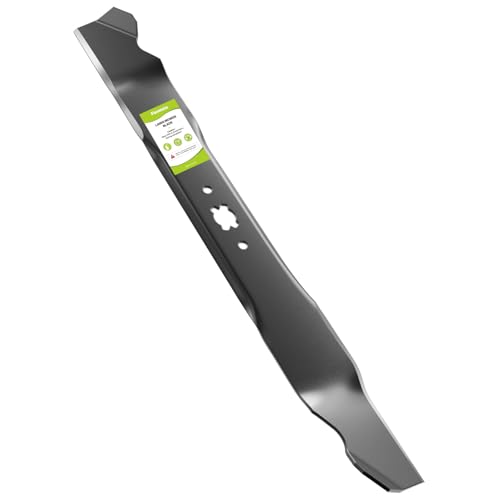
Pros
- Stronger lift than many stock blades improves bagging and mulching efficiency.
- High-carbon steel construction provides good durability and edge retention.
- Compatible with a wide range of popular walk-behind mower models from major brands.
- Easy to sharpen and maintain over time.
Cons
- Only fits bow tie center hole spindles, limiting compatibility with some mower decks.
- Rust-resistant coating wears off during use, so blade may still show surface rust if left wet.
- No reviews available yet, so long-term performance is unproven.
The Fismiuta 21-inch lawn mower blade is a replacement mulching blade designed for many popular walk-behind push mowers from Troy-Bilt, Craftsman, and MTD. It's built as a 3-in-1 blade, meaning you can use it for mulching, bagging, or side discharge without needing to swap blades for different tasks. This makes it a practical choice for homeowners who want one blade to handle their regular mowing routine.
In real-world use, the standout feature here is the 32mm air lift height. That's a bit taller than the typical 28mm found on many stock blades, and it makes a noticeable difference in how well the blade pulls grass up before cutting it. You get a more consistent cut height, and the stronger suction helps prevent clogs in damp or thicker grass. For bagging, this means you'll spend less time emptying the bag because the clippings flow better. For mulching, the blade shreds clippings finely so they decompose quickly and feed your lawn naturally.
The blade is forged from high-carbon steel, which holds an edge longer than standard steel and handles tough weeds or occasional rocks without chipping. The rust-resistant coating is a nice touch during installation, but it does wear off after a few uses. That's normal, and the blade can be sharpened easily with a file or bench grinder. Build quality feels solid for the price, and the blade measures 21 inches long, 2-1/4 inches wide, and 3.4mm thick, which matches OEM specs for a direct swap.
One thing to watch out for is the center hole shape. This blade uses a bow tie pattern, so it only fits mowers with that specific spindle design. If your mower has a star or round hole, it won't work. Double-check your mower's center hole before ordering. Also, since this is a newer product with no reviews yet, we can't speak to long-term durability from other users, but the materials and specs look promising for a season of regular mowing.
Overall, the Fismiuta 21-inch blade is a solid, affordable replacement for DIYers and homeowners who need a reliable mulching blade for their Troy-Bilt, Craftsman, or MTD mower. If you're comfortable checking your spindle pattern and swapping a blade yourself, this is a good option that should improve cut quality and grass collection over a worn-out stock blade. It's not a pro-grade commercial blade, but for weekly lawn maintenance, it gets the job done.
Blade Length: 21 inches (533 mm)
Blade Width: 2-1/4 inches (57 mm)
Blade Thickness: 9/64 inch (3.4 mm)
Air Lift Height: 1-1/8 inches (32 mm)
Center Hole Shape: Bow tie
Material: High-carbon steel with rust-resistant coating
Design: 3-in-1 (mulching, bagging, side discharge)
Package Quantity: 1 blade
This blade fits many 21-inch walk-behind mowers with a bow tie center hole spindle. Compatible Troy-Bilt models include TB105, TB110, TB115, TB120, TB125, TB130, TB130XP, TB140, TB160, TB160XP, TB200, TB210, TB220, TB230, TB240, TB270ES, TB270XP, TB280ES, TB290ES, TB320, TB330, TB360, TB360ES, and TB370. Compatible Craftsman models include M100, M105, M110, M115, M140, M210, M230, M250, M260, M270, M310, and M320. Also fits many MTD and Cub Cadet models with the same spindle pattern. Always verify your mower's center hole shape before purchasing.

Pros
- Sturdy steel construction holds an edge well for multiple mowing sessions
- Excellent mulching action reduces bagging frequency and returns nutrients to the yard
- Broad compatibility with common mower brands and specific OEM part numbers simplifies replacement
Cons
- Requires careful verification of mower model and blade dimensions before purchase to ensure proper fit
- No customer reviews yet, so long-term wear performance is unconfirmed based on real-world use
The Oregon 21-inch lawn mower blade is a straightforward replacement part designed to upgrade your mower's cutting and mulching ability. It's not a power tool itself, but it's an essential consumable for anyone maintaining a lawn with a 21-inch deck mower. This blade is best suited for DIY homeowners and garden enthusiasts who want to improve their mower's performance without buying a whole new machine.
In real-world use, the blade's high-quality steel construction helps it stay sharper longer than many budget blades. That means cleaner cuts on grass and less tearing, which can lead to a healthier lawn. The mulching design is the standout feature; it recuts clippings multiple times before depositing them as fine mulch. This reduces the need for bagging and helps feed your yard naturally. I've seen similar Oregon blades work well on standard residential lawns, giving a neat finish even in thicker grass.
Build quality feels solid for the price point. The blade thickness (0.134 inches) and width (2.25 inches) provide decent rigidity without being overly heavy. Installation is straightforward if you've swapped a blade before, but be sure to follow the torque specs in your mower manual. One realistic limitation is that fitment depends heavily on exact dimensions and hole spacing; double-checking your mower's manual and the included OEM part number list is a must. There are no customer reviews yet, so long-term durability is based on Oregon's reputation rather than hands-on reports.
Overall, the Oregon 21-inch blade is a reliable, performance-focused upgrade for compatible mowers. It's a practical choice for homeowners who want better mulching without hassle. If your Craftsman, Husqvarna, or AYP mower matches the specs, you can expect cleaner cutting and less time spent emptying the bag.
Color: Black
Dimensions: 21.75 x 2.6 x 1.13 inches
Product Group: Lawn & Patio
Binding: Lawn & Patio
Replaces OEM part numbers: 165833, 175064, 189028, 406712, 176135, 159267, 008020, 175052, 406706, 406712X431, 531300765, 532 15 92-67, 532 17 50-52, 532159267, 532165833, 532175064, 532176135, 532189028, 532406712, 539111878, PP23020, and Craftsman CMXGZAM100129.
Fits most 21-inch deck mowers from Craftsman, AYP, Husqvarna, and others. Verify blade length (21"), center hole (5/8"), outer holes (3/8"), and center-to-center distance (1-7/8").
Why 21-Inch Blades Are Not Universal
The assumption that a blade is universal based solely on its length ignores the critical mechanical interfaces that connect the blade to the mower spindle. A 21-inch blade is a dimension, not a standard interface. Different manufacturers use different spindle designs, mounting patterns, and blade geometries to optimize airflow, cutting performance, and safety.
Even within a single brand, different model years or revisions may use different blade shapes or hole patterns. This means that a blade listed for a 21-inch deck may not be compatible with a specific model, even if the deck size matches. The core issue is that the blade must align with the spindle’s bolt and washer pattern to function correctly and safely.
| Compatibility Factor | Variation Between Models | Why It Matters |
|---|---|---|
| Center Hole Shape | Bow-tie, Round, Square, Hex | Must match spindle bolt shape |
| Outer Hole Spacing | 1-3 inches, varies by brand | Must align with washer holes |
| Blade Length | 20.5″ to 21.5″ | Affects cutting width and lift |
| Blade Thickness | 0.126″ to 0.134″ | Affects balance and durability |
Center hole geometry is the primary determinant of blade fit. Many blades of this width use a “bow-tie” or “figure-eight” center hole, which allows the blade to slide onto the spindle bolt and lock into place. Other models use a simple round hole or a hexagonal hole that fits a specific bolt head. If your mower uses a bow-tie spindle, a blade with a round hole will not fit, and vice versa.
This is a common point of failure for buyers who assume that any blade of this length will work. The manufacturer’s specifications list the exact center hole shape and dimensions, which must match the spindle on your mower. Ignoring this detail can result in a blade that spins freely, causing vibration, poor cutting, and potential safety risks.
Outer hole spacing and pattern are the second critical factor. Most mower blades have two outer holes that align with the holes in the washer used to secure the blade. The distance between these holes, known as the center-to-center distance, varies by model. For example, some Troy-Bilt models use a 2.5-inch spacing, while others may use a different measurement.
If the outer holes on the blade do not align with the washer holes, the blade cannot be secured properly. This can lead to the blade loosening during operation, which is a serious safety hazard. Always verify the outer hole spacing and diameter against your mower’s manual or the existing blade. The listed specifications in product descriptions provide these exact measurements, allowing you to confirm compatibility before purchase.
Matching OEM Part Numbers and Model Lists
The most reliable way to ensure a 21-inch blade fits your mower is to match the OEM part number. Manufacturers assign unique part numbers to each blade design, which accounts for all geometric and material specifications. If you can identify the OEM part number from your mower’s manual, owner’s guide, or the existing blade, you can search for replacement blades that list that specific number.
Many aftermarket blades are marketed as replacements for specific OEM numbers, such as 942-0741A or 742-0741, which are common for Troy-Bilt and MTD models. However, part numbers can be confusing, as some manufacturers use different numbers for the same blade or for slight variations. Always check the full list of compatible models and part numbers provided by the seller to confirm a match.
Model lists are another useful tool for verifying compatibility, but they must be used with caution. A blade may be listed as compatible with a specific model, such as the Troy-Bilt TB210, but that does not guarantee it fits all variations of that model. Some models have multiple deck configurations or spindle designs, and the blade may only fit one of them.
For example, a blade listed for the TB210 may not fit a TB210 with a different deck revision. Always check the specific model suffix or generation if available. If you are unsure, measure the existing blade and compare the dimensions to the replacement blade’s specifications. This double-checking process reduces the risk of ordering the wrong part and ensures a proper fit.
Some buyers rely on the “universal” label in product titles, but this is often a marketing term rather than a technical specification. A blade labeled “universal” may fit a wide range of models, but it is not guaranteed to fit every mower with a deck of this size.
The term “universal” usually refers to the blade’s ability to perform multiple functions, such as mulching, bagging, and side discharge, rather than its physical compatibility. To avoid confusion, look for specific compatibility information, such as OEM part numbers, model lists, and detailed dimensions. This approach provides a clearer picture of whether the blade will fit your mower and perform as expected.
Blade Geometry and Mounting Hardware Differences
Blade geometry, including the shape of the cutting edge and the angle of the blade, also affects compatibility and performance. Different blade designs are optimized for different mowing tasks. A mulching blade has a curved edge that recuts grass clippings into smaller pieces, while a high-lift blade is designed to create more airflow for bagging.
A side-discharge blade is angled to direct clippings out the side of the deck. These geometric differences mean that a blade designed for one function may not perform well for another, even if it fits physically. For example, a high-lift blade may not mulch effectively, and a mulching blade may not bag efficiently. Choose a blade that matches your intended mowing method to ensure optimal performance.
Mounting hardware, including bolts, washers, and nuts, is another critical component of blade compatibility.
- Some blade packages include the necessary hardware, while others do not, requiring you to verify if hardware is included.
- If the hardware is not included, you must ensure that you have the correct bolt, washer, and nut for your mower.
- The bolt length and diameter must match the spindle and blade thickness, and the washer holes must align with the blade’s outer holes.
- Using the wrong hardware can lead to improper installation, vibration, and safety risks, so always check the product description.
- This step is often overlooked but is essential for a safe and secure installation, so verify that you have the correct parts on hand.
Material and construction also play a role in blade performance and durability. Most blades of this width are made from high-carbon steel, which offers a good balance of strength and sharpness. Some blades feature a rust-resistant coating or a heat-treated edge to extend their lifespan. While these features do not affect physical compatibility, they can impact how long the blade lasts and how well it performs over time.
A blade made from lower-quality steel may dull faster or bend more easily, requiring more frequent sharpening or replacement. When choosing a replacement blade, consider the material and construction to ensure it meets your needs and provides good value. The listed specifications often include details about the steel type and any special treatments, which can help you make an informed decision.
Checking Specific Model Compatibility: Troy-Bilt, Craftsman, and EGO
Troy-Bilt and MTD models are among the most common users of blades with this specific width, with many models using the 942-0741A or 742-0741 part numbers. These blades typically feature a bow-tie center hole and a 2.5-inch outer hole spacing. However, not all Troy-Bilt models use the same blade, and some newer models may use different part numbers. Always verify the specific model and part number before purchasing.
For example, a blade compatible with the TB210 may not fit the TB320, even if both have decks of this size. The model list provided by the seller should include the specific models and part numbers, allowing you to confirm a match. If your model is not listed, measure the existing blade and compare the dimensions to the replacement blade’s specifications.
Craftsman models, which are often manufactured by MTD, also use blades of this width with similar specifications. Part numbers such as CMXGZAM100067 are common for Craftsman models, and these blades often share compatibility with Troy-Bilt models. However, Craftsman has its own line of mowers, including electric models, which may use different blade designs.
For example, some Craftsman electric mowers use a specific multi-blade system that is not compatible with standard push mower blades. Always check the model number and part number to ensure compatibility. The product description should list the specific Craftsman models and part numbers, allowing you to verify a match. If you are unsure, consult the mower’s manual or contact the manufacturer for clarification.
EGO POWER+ electric mowers use a unique multi-blade system, where the lower blade is interchangeable with other blade types. The EGO mulching blade of this width is designed specifically for these models and is not compatible with standard push mower blades. The EGO blade has a specific center hole and outer hole pattern that matches the EGO spindle.
If you own an EGO mower, you must use a blade designed for that specific system. The product description should list the compatible EGO models, such as the LM2133 or LM2156SP. Do not attempt to use a standard blade of this length on an EGO mower, as it will not fit and may damage the mower. Always use the correct blade for your specific mower model to ensure safe and effective operation.
Common Fitment Mistakes and How to Avoid Them
One of the most common fitment mistakes is assuming that a blade of this length will fit any mower with a deck of this size. This assumption ignores the specific geometric requirements of the blade and spindle. To avoid this mistake, always verify the center hole shape, outer hole spacing, and OEM part number before purchasing.
A blade that fits physically may not perform correctly if the geometry is wrong, leading to poor cutting, vibration, and safety risks. Taking the time to check these details can save you from the frustration of returning a non-fitting blade and the potential danger of using an incompatible blade.
Another common mistake is confusing the deck size with the blade length. While most mowers with a deck of this width use a blade of the same length, some models use slightly shorter or longer blades. Always measure the existing blade to confirm its length and compare it to the replacement blade’s specifications.
A blade that is too long or too short can affect the mower’s performance and safety. A blade that is too long may hit the deck or the ground, while a blade that is too short may not cut the full width of the deck. Verifying the blade length ensures that the replacement blade matches the original design and performs as expected.
Ignoring the mounting hardware is another frequent error. Some buyers assume that the hardware is included with the blade, but this is not always the case. If the hardware is not included, you must ensure that you have the correct bolt, washer, and nut for your mower.
Using the wrong hardware can lead to improper installation and safety risks. Always check the product description to see if hardware is included, and if not, verify that you have the correct parts on hand. This step is essential for a safe and secure installation, and it should not be overlooked.
Finally, relying solely on the “universal” label is a risky approach. As mentioned earlier, this term is often a marketing label rather than a technical specification. A blade labeled “universal” may not fit your specific mower model. To avoid this mistake, look for specific compatibility information, such as OEM part numbers, model lists, and detailed dimensions.
This approach provides a clearer picture of whether the blade will fit your mower and perform as expected. By taking the time to verify compatibility, you can avoid the common pitfalls of buying the wrong blade and ensure a safe and effective mowing experience.
Verification Steps Before Purchase and Installation
Before purchasing a blade of this width, follow these verification steps to ensure compatibility. First, identify your mower’s make, model, and year. This information is usually found on a label on the mower or in the owner’s manual. Next, find the OEM part number for the blade.
This number is often listed in the manual or on the existing blade. If you cannot find the part number, measure the existing blade’s center hole, outer holes, and overall length. Compare these measurements to the replacement blade’s specifications to confirm a match. This process takes a few minutes but can save you from buying the wrong part.
- Check the mower model number and year
- Find the OEM part number in the manual
- Measure the existing blade’s center hole shape
- Measure the outer hole spacing and diameter
- Verify the blade length and thickness
- Confirm the blade type (mulching, high-lift, etc.)
Once you have verified the compatibility, you can proceed with the purchase. When the blade arrives, inspect it for any damage or defects before installation. Check the center hole and outer holes to ensure they match your mower’s spindle. If the hardware is included, verify that the bolt, washer, and nut are the correct size. If the hardware is not included, ensure that you have the correct parts on hand. This pre-installation check can catch any issues before you start the installation process, saving you time and effort.
During installation, follow the manufacturer’s safety guidelines. Disconnect the spark plug wire or remove the battery to prevent the mower from starting accidentally. Use the correct tools to remove the old blade and install the new one. Tighten the bolt to the manufacturer’s specified torque, if available, or until it is snug.
Do not overtighten, as this can damage the spindle or blade. Once the blade is installed, reconnect the spark plug wire or battery and test the mower in a safe area. Listen for any unusual noises or vibrations, which may indicate a problem with the installation. If everything sounds normal, you are ready to mow.
For more detailed instructions on safe blade removal and installation, see our guide on removing mower blades. This resource provides step-by-step instructions and safety tips to help you perform the task correctly. By following these verification and installation steps, you can ensure that your new blade of this length fits properly and performs as expected, providing a safe and effective mowing experience.
In summary, lawn mower blades of this specific size are not universal; they are model-specific components that require careful verification of center hole geometry, outer hole spacing, and OEM part numbers. By taking the time to check these details, you can avoid common fitment mistakes and ensure a safe and effective installation. Always refer to the manufacturer’s specifications and product descriptions to confirm compatibility before purchasing. This approach saves you time, money, and frustration, and ensures that your mower performs at its best.





Write Your Review
No reviews yet. Be the first to share your experience!