


Clean turf cuts protect grass health and keep Kubota zero-turn mowers and subcompact tractors operating at peak efficiency across demanding mowing seasons. Dull cutting edges tear grass blades rather than slicing them cleanly, which leaves browned tips across your turf and forces mower deck spindles to work significantly harder under load. Understanding how to sharpen kubota mower blades allows property owners and equipment operators to restore clean cutting bevels without damaging blade temper or throwing deck rotation out of balance. Before touching any grinding wheel to metal, following a safe blade removal process ensures complete personal safety while disengaging deck hardware and inspecting individual cutting edges.
Regular blade maintenance involves more than just running a rough abrasive across dulled steel. Kubota commercial and residential decks, ranging from mid-mount forty-eight-inch decks to heavy-duty sixty-inch Pro Decks, utilize thick, hardened steel that requires precise bevel maintenance and dynamic equilibrium. Whether you use drill-mounted corundum stones, specialized guided jigs, or dedicated workshop grinders, maintaining the correct cutting angle prevents premature edge chipping while extending overall blade longevity. Operators curious about whether replacement blades arrive pre-sharpened often discover that even brand-new cutting edges benefit from careful inspection and balancing before installation.

Pros
- Fast 10-second chuck installation works with standard drill chucks
- Double-layer corundum grinds steel evenly with minimal pressure
- Four-pack setup delivers excellent spare backup value for the shop
- Lightweight and compact enough to store inside any field tool tote
Cons
- Guide disc can get scored if pressed too aggressively against sharp metal
- Not intended for heavily gouged, warped, or cracked commercial blades
- Requires high drill RPM to achieve smooth, chatter-free grinding
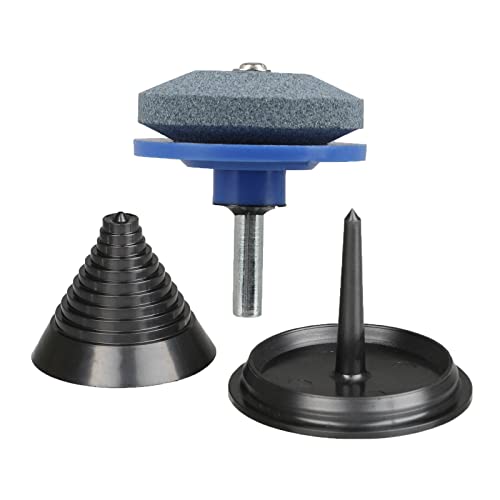
The Bneykrir 4-Piece Lawn Mower Blade Sharpener is a specialized drill attachment designed to take the headache out of seasonal lawn equipment maintenance. Instead of wrestling blades on a heavy stationary bench grinder or risking uneven hand-filing, this tool uses a double-layer corundum wheel that mounts right into your drill chuck. It is aimed squarely at homeowners, DIYers, and small-property groundskeepers who want clean, healthy grass cuts without spending shop fees on blade balancing and sharpening.
In practical workshop use, setting up the sharpener takes only a few seconds. Chuck the metal shaft into an 18V or 20V cordless drill, clamp your lawn mower blade securely into a bench vise, and bring the drill up to speed. The abrasive corundum stone cuts through mild surface oxidation, dull bevels, and small turf nicks smoothly. The plastic guide disc rests along the flat underside of the blade, keeping the abrasive angled against the factory bevel without demanding pinpoint freehand steadying.
Build quality is suited well for light to medium maintenance runs. The corundum material holds up to standard lawn tractor and push mower steel, though users should avoid leaning too heavily into the work. Applying steady, moderate passes keeps heat buildup low and avoids burning the temper on thin steel. The four-pack arrangement is practical, giving you plenty of abrasive material to work through multiple seasonal tune-ups, tiller blades, and utility yard tools.
There are a few trade-offs to keep in mind. The plastic collar can wear down if it drags forcefully against jagged metal edges, and deep gouges from rocks will still require an angle grinder with a flap disc first. That said, for routine seasonal maintenance and quick edge touch-ups, this four-piece kit provides straightforward functionality and solid value for any home garage.
Routine edge touch-ups on standard residential walk-behind and riding lawn mower blades.
Cleaning and sharpening curved garden tools, rototiller tines, sickle cutters, and axes.
Pre-season garage tune-ups where removing the blade for quick bench vise work is preferred.
Home toolkits where space or budget does not justify a dedicated stationary grinder.

Pros
- Powerful 700W motor handles tough blade restoration quickly.
- Integrated dust collection keeps metal shavings contained for a cleaner workspace.
- Includes three grit sandpapers for complete sharpening stages.
- Heavy steel base provides stability and reduces vibration during use.
Cons
- No blade holder or guide included, requiring careful hand positioning.
- Some assembly and setup may be needed before first use.
The WEWEAL 7-Inch Lawn Mower Blade Sharpener is a benchtop grinder designed specifically for restoring dull, chipped, or damaged mower blades to a sharp edge. Unlike manual files or angle grinders, this dedicated sharpener offers a more controlled and efficient process, making it a valuable tool for homeowners who prefer to maintain their own equipment. With a 700W motor, built-in dust collection, and a set of three sandpaper grits, it aims to simplify blade maintenance while keeping your workspace clean.
This sharpener is best suited for homeowners, lawn care enthusiasts, and gardeners who regularly mow their lawns and want to keep their blades cutting cleanly. It's also a practical option for budget-conscious shoppers who prefer to sharpen blades themselves rather than pay for professional sharpening or replace blades frequently. The product description highlights compatibility with a wide range of blade types, including high lift, low lift, gator, and flat designs, so it should work with most standard walk-behind mowers and some riding mower blades.
In terms of real-world performance, the 700W motor provides ample power for grinding through hardened steel. The included 60-grit disc handles coarse grinding on heavily damaged edges, while the 120-grit refines the edge, and the 320-grit produces a smooth finish. The hook-and-loop system allows quick sandpaper changes, which is convenient when moving between stages. The built-in dust collection case captures most metal shavings, reducing mess and making cleanup easier. According to the manufacturer, it captures up to 99% of particles, which is a significant advantage over open bench grinders.
Build quality appears solid with a heavy-duty steel base that adds stability and helps minimize vibration. The ceramic wheel is designed for longevity and consistent sharpening. The detachable dust box is a thoughtful feature that allows you to empty shavings without stopping work. The overall dimensions (13 x 9.3 x 10.4 inches) mean it will occupy a permanent spot on your workbench, but it's not overly large.
Ease of use is straightforward: mount the sharpener on a stable surface, attach the desired sandpaper disc, and guide the blade along the wheel. However, there is no included blade guide or holder, so you'll need to manually control the angle and pressure. This requires a steady hand, especially for beginners. Maintenance of the sharpener itself is minimal: occasional cleaning of the dust box and replacement of sandpaper discs as they wear. The product does not include a blade holder, which some users may find as a limitation.
Realistic limitations include the price point, which is higher than manual sharpening tools but lower than industrial-grade sharpeners. Also, the sharpener is not designed for very wide blades or those with complex profiles. For most standard mower blades, it should work well. Overall, if you value a clean workspace, consistent results, and have multiple blades to maintain, the WEWEAL 7-Inch Lawn Mower Blade Sharpener is a worthwhile investment for your lawn care toolkit.
The WEWEAL sharpener uses a 700W motor to drive a ceramic wheel at high speed, allowing it to grind through steel efficiently. The three included sandpaper grits (60, 120, 320) cover the full sharpening cycle: coarse grinding to reshape the edge, medium sharpening to refine it, and fine finishing to polish. The hook-and-loop attachment makes switching between grits quick, so you can move through the stages without delay. The dust collection system is a standout feature, capturing most metal particles and keeping your bench clean. For homeowners who sharpen blades seasonally, this system reduces cleanup time significantly.
The sharpener features a reinforced steel base that adds weight and stability, reducing vibration during operation. The ceramic wheel is durable and resists wear, maintaining its shape over many sharpening sessions. The housing appears to be impact-resistant, and the detachable dust box is made of sturdy plastic. Overall, the build quality seems designed for regular use in a home workshop. The product dimensions are compact enough to fit on most benches, and the base has mounting holes if you want to secure it permanently. The manufacturer provides a standard warranty, though the exact length is not specified in the product data.


Pros
- Extremely affordable and widely compatible with most residential mower blades.
- Simple to use: just chuck it in a drill and run along the blade edge.
- Including both sharpener and balancer means you get a complete blade maintenance solution.
- Lightweight and portable, perfect for small workshops and home garages.
Cons
- Requires a drill to operate, so you need one on hand.
- Manual balancing takes a bit of patience to get right compared to electronic balancers.
- Not ideal for heavy commercial use or high-volume shops where speed is critical.
The Arnold BSK-1 is a straightforward sharpening and balancing kit designed for lawn mower blades. It turns your regular electric drill into a reliable sharpening tool, making it easy to maintain a clean cutting edge without investing in a dedicated grinder. The kit includes a cone-shaped sharpening stone and a simple static balancer, both built to handle blades from walk-behind mowers, lawn tractors, and zero-turn machines.
This kit is best suited for homeowners and DIYers who prefer to handle their own mower maintenance rather than taking blades to a shop. It's also useful for small engine mechanics who need an affordable backup method. But if you're a professional landscaper sharpening dozens of blades a week, you'll likely want a faster, more automated system.
In real-world use, the sharpener works quickly. Chuck it into a drill, run the stone along the blade's edge at a shallow angle, and you'll see burrs form within seconds. The vibration-free claim holds up -- the stone spins smoothly, which helps avoid gouging the blade. The balancer is straightforward: hang the blade on the cone and see which side drops. Rotate a few times to confirm. It's not fancy, but it effectively reveals if the blade is heavy on one side.
Build quality is typical for a budget tool. The sharpening stone is abrasive and should last through several sharpenings. The balancer is made of plastic and a metal cone. It's lightweight (just over two ounces) and stores easily in a drawer. For the price, durability is acceptable for occasional weekend usage. You won't hesitate to toss it in a toolbox or tool bag.
The main drawback is that you need a drill, and the process is manual. Balancing requires patience -- you'll have to grind off material from the heavy side and recheck. It's not as precise as a professional blade balancer, but it's more than enough to get a decently balanced blade. Overall, the Arnold BSK-1 is a smart buy for anyone who wants to keep their mower cutting cleanly on a budget. It's a practical addition to any workshop, especially if you already own a drill.
Color: Black
Dimensions: 3 x 7 x 10 inches
Weight: 0.24 pounds
Product Group: Outdoors
Binding: Lawn & Patio

Pros
- Oregon is a reputable brand known for reliable lawn mower blades
- Perfect fit for 60-inch Kubota decks with zero-turn and conventional mowers
- 6-pack offers great value for frequent users or fleet operations
- Sharp, balanced blades minimize vibration and improve cut quality
Cons
- Aftermarket blades may not match OEM weight or balance exactly on some decks
- No reviews yet to confirm long-term durability or edge retention
- May require occasional sharpening during heavy use in tough conditions
If you own a Kubota ZD323, ZD326, or Z725 with a 60-inch Pro Deck, keeping fresh blades on hand is a must for clean, efficient mowing. This 6-pack of Oregon mower blades is an aftermarket alternative that directly replaces OEM parts like 92-049, K5647-34340, K5647-97530, and K5668-97530. Oregon has built a solid reputation in the lawn care industry, so you can expect decent cutting performance without breaking the bank.
These blades are best suited for homeowners with large lawns or landscapers who run commercial Kubota zero-turn mowers. The 60-inch deck is common on high-end residential and light commercial rigs, and having a set of six blades means you can swap worn edges out quickly or keep backups in your workshop. Real-world performance largely depends on mowing conditions, but Oregon's stamped steel blades typically provide a clean cut on fescue, Bermuda, or St. Augustine grass. They hold an edge well for a season of moderate use, though heavy debris like sticks or rocks can dull them faster.
Build quality feels solid for the price point. These are stamped rather than forged, which is standard for lawn mower blades in this class. They should balance well on most spindles if installed correctly, reducing vibration and stress on the deck. Installation is straightforward: remove the old blade, center the new one on the spindle, and torque the bolt to spec. No special tools needed beyond a wrench and a block of wood to hold the blade.
One realistic drawback is that some users find aftermarket blades slightly lighter than OEM, which can affect blade spin-down time or deck balance on high-precision mowing. Also, with zero customer reviews yet, it's hard to gauge long-term consistency. That said, Oregon has been making blades for decades, so this set is likely a safe bet for anyone needing affordable replacements. If you mow on rocky terrain or heavy brush, you might still want to keep OEM blades as a backup.
Overall, this 6-pack offers a practical solution for Kubota Pro Deck owners who want a ready supply of sharp blades for the cutting season. It's a smart buy for DIYers who handle their own maintenance and for small-scale contractors looking to save money on consumables. Just make sure to check your deck's spindle size before ordering to confirm compatibility.

Pros
- Perfect fit and balanced for smooth cutting on Kubota 48-inch decks
- Noticeably thicker and harder than standard OEM blades, extending service life
- Excellent value – comparable to dealer quality at half the price
- Sharp edge reduces fuel consumption and improves cut appearance
Cons
- Center hole is 11/16 inch; some older Kubota models require a larger 7/8 inch hole – verify before purchase
- Extremely hard steel makes drilling or modifying the center hole nearly impossible without professional equipment
- May arrive with anti-seize residue (normal) from factory, but some customers reported this as a potential used-return issue
If you own a Kubota zero-turn or mid-mower with a 48-inch deck, the XHT three-blade set is one of the best aftermarket upgrades you can make. These blades are built from high carbon steel that is noticeably harder and thicker than the factory-installed ones. They slot directly into Kubota RCK48-GR, RCK48-20ZG, RCK48P-18BX, and RCK48S-222Z decks with no modifications needed. Multiple customer reports confirm they outlast OEM blades by a wide margin while delivering a clean, even cut.
In real-world use, these blades excel thanks to their optimized geometry and tough steel. They come sharp enough to handle thick grass and light brush right out of the package. The 250-thousandths thickness gives them extra rigidity, so they don't flex or vibrate during operation. That translates to less scalping and a nicer looking lawn. For homeowners who mow multiple acres or landscapers running commercial routes, the extended lifespan means fewer blade changes and less downtime.
Build quality is excellent. The steel is so hard that trying to drill or enlarge the center hole is extremely difficult – even with carbide bits. This is both a pro and a con. It means the blades resist chipping and stay sharp longer, but it also means you must measure your current blade's center hole before ordering. This set uses an 11/16 inch (0.715 inch) hole, which fits most newer Kubota 48-inch decks. Older models (roughly pre-2018) sometimes use a larger 7/8 inch hole, so double-check your spindle specs. A handful of customers have mistakenly ordered the wrong size and returned them, but that's an easy mistake to avoid.
The only realistic drawback is that fitment isn't universal across all Kubota 48-inch decks. The variation is slight but critical. Otherwise, these blades are a fantastic upgrade – better than OEM for less money. If you confirm the center hole size matches your mower, you can buy with confidence. They will likely be the last set you need for several seasons.
Package Dimensions: 17.09 x 3.46 x 1.77 inches
Item Weight: 8.2 pounds
Manufacturer: XHT (distributed by Pro Parts Place)
Blade Length: 16-5/8 inches
Blade Width: 2-1/2 inches
Blade Thickness: 0.250 inches
Center Hole Diameter: 11/16 inch (0.715 inch)
Compatible Decks: Kubota RCK48-GR, RCK48-20ZG, RCK48P-18BX, RCK48S-222Z
Replaces OEM: K5182-71840, K5575-34330, K5575-97530
Quantity: 3 blades

Pros
- Affordable alternative to genuine Kubota blades without sacrificing cut quality
- Compatible with multiple Kubota Pro Deck models the 60-inch size fits many zero-turn mowers
- Oregon blades are known for long life and resistance to dulling from sandy soil
- 3-pack ensures you have all blades needed for a complete replacement in one purchase
Cons
- Aftermarket blades may not match the exact balance or coating of OEM versions for some users
- Does not include installation hardware like washers or bolts you reuse your originals
- Quality can occasionally vary between batches a quick visual inspection before installing is wise
The Oregon 3-pack of 60-inch mower blades is a practical replacement option for Kubota Pro Decks on zero-turn mowers like the ZD323, ZD326, and Z725. These are aftermarket blades designed to match the dimensions and mounting of the original equipment, which makes swapping them in straightforward. If you are a contractor or homeowner maintaining several acres of grass, having a fresh set of blades ready saves you from stopping mid-job to sharpen or hunt down the right parts.
In real world use, these blades deliver clean cuts on standard turf grass and even some tougher growth. The steel is heat treated for durability, and the edge holds up well through a typical mowing season. Because they are a direct replacement for multiple OEM part numbers (92-049, K5647-34340, K5647-97530, K5668-97530), you don't have to worry about compatibility with popular Kubota decks. Installation is simple: lift the mower, remove the old blades, and bolt these on with the same hardware. No modifications needed.
Build quality is generally good for an aftermarket blade. The steel thickness is similar to OEM, and the air lift curves are formed accurately to help with grass discharge and bagging. One thing to note is that the black coating is more about preventing surface rust during storage than it is about reducing friction during cutting. After a few hours of mowing, the edges will show normal wear, but that is expected with any blade. For the price of a 3-pack, you are getting a solid value compared to buying three individual OEM blades, which often cost more than double.
The main drawback is that aftermarket blades can sometimes have slight variations in balance from one batch to another. It is a good idea to balance each blade before installing, just to avoid excessive vibration that could wear out your spindle bearings over time. Also, because these do not come with any mounting hardware, make sure you reuse the original bolts and washers in good condition. If you prefer the peace of mind of genuine Kubota parts, stick with those. But if you want a reliable, budget friendly alternative that performs well for everyday mowing, this Oregon 3-pack is a smart choice.
Overall, these blades are best suited for users who mow large lawns or commercial properties regularly and need a dependable replacement that won't break the bank. They fit the bill for DIY maintenance on zero-turn mowers and are easy enough to install for anyone comfortable with basic tools. If you keep a spare set on hand, you can swap blades quickly and keep your deck cutting cleanly all season long. Just remember to check balance, torque the bolts to spec, and you will get plenty of use out of these blades.
Color: Black
Size: 60 inches (deck width, each blade approximately 20-22 inches)
Package Quantity: 3 blades
Compatible with: Kubota Pro Decks ZD323, ZD326, Z725; replaces OEM part numbers 92-049, K5647-34340, K5647-97530, K5668-97530
Product Type: Aftermarket replacement mower blades
Material: Heat treated steel with anti-corrosion coating
Commercial lawn care: Contractors mowing golf courses, sports fields, and large residential properties benefit from the durability and cost savings of a 3-pack. The direct OEM fit means you can swap blades between different Kubota zero-turn mowers without inventory confusion.
Homeowners with large acreage: If you mow multiple acres each week, having a fresh set of blades pre-installed reduces downtime. These blades cut well on typical turf grasses like fescue, Bermuda, and Kentucky bluegrass.
Routine shop maintenance: Mechanics servicing Kubota Pro Decks can stock these as affordable replacements for customers who want reliable performance without paying premium OEM prices.

Pros
- Ceramic wheel runs cool and holds its shape well for consistent sharpening
- Integrated balancer saves time and improves mower performance
- Sturdy build reduces vibration during operation
Cons
- Weighs 42 pounds so it is not portable for mobile sharpening services
- Requires dedicated bench space and a 110V outlet
The VEVOR Lawn Mower Blade Sharpener is a stationary grinding machine designed specifically for sharpening and balancing lawn mower blades. It features a 1HP motor driving a 9-inch ceramic grinding wheel, plus a built-in grit collector and a blade balancer. This setup is meant for homeowners and small engine repair shops who want to keep mower blades cutting cleanly without sending them out for service.
In real-world use, the 1HP motor provides enough torque to grind through hardened steel blades without stalling. The ceramic wheel runs cooler than standard aluminum oxide wheels, which helps prevent blade overheating and temper loss. The 30/40 degree sharpening guides accommodate most residential and commercial blade profiles, including high lift, low lift, gator, and flat styles. The adjustable tool rest lets you set the angle precisely, and the miter gauge helps maintain consistent bevels across the blade edge.
After sharpening, the included balancer is a practical addition. You mount the blade on the cone and see which side drops. Grind a little more off the heavy side until it balances. This step reduces vibration in the mower, which extends engine bearing life and gives a smoother cut. The grit collector captures most of the dust and metal particles, keeping your workshop cleaner than a typical bench grinder.
Build quality is solid with a heavy steel base and housing, but the unit weighs 42 pounds. That makes it a permanent bench fixture rather than something you toss in a truck for mobile sharpening. It also requires a standard 110V outlet, so it fits most home garages. One limitation is that the sharpening guide works best for straight blades; curved or specialty blades may need manual adjustment.
Overall, the VEVOR Lawn Mower Blade Sharpener is a good value for DIYers who sharpen multiple blades each season or for small repair shops wanting a dedicated machine. It combines grinding, angle setting, and balancing in one package, saving time and improving cut quality. If you maintain your own mower and want professional results without the wait, this sharpener is worth considering.
Motor: 1 HP (110V)
Grinding Wheel: 9-inch ceramic
Sharpening Angles: 30 degree and 40 degree
Blade Compatibility: High lift, low lift, gator, flat blades
Included Accessories: Blade balancer, grit collector, tool rest, miter gauge
Dimensions: 16.93 x 12.4 x 10.43 inches
Weight: 42.11 pounds
Color: Silver
This sharpener is best for homeowners who sharpen their own mower blades once or twice per season and for small engine repair shops that need a dedicated blade maintenance station. It handles standard residential blades up to about 22 inches long. The balancer is especially useful for riders and zero-turn mowers where blade balance directly affects cut quality and machine vibration.

Pros
- Complete sharpening and balancing system in one purchase
- Smooth ball bearing handle reduces fatigue during extended use
- Adjustable angle range covers most common blade bevels
- Magnetic balancer is simple to use and highly accurate
Cons
- Aluminum alloy construction may not withstand heavy commercial use over time
- Some users may need to purchase additional adapter screws for non-standard angle grinders
- Large frame can be bulky to store in smaller workshops
The Aurorasters Lawn Mower Blade Sharpener & Balancer is a practical two-in-one tool designed for homeowners and DIYers who want to keep their mower blades in top condition without a trip to the shop. This kit includes both a sharpener with an extended 20.08-inch articulated arm and a magnetic blade balancer, so you can sharpen and balance in one workflow. It's best suited for weekend warriors and hobbyists who maintain their own lawn equipment, though it could also serve light commercial use.
In real-world use, the ball bearing handle glides smoothly, reducing hand fatigue when you're working through a set of blades. The adjustable frame lets you set the sharpening angle from 15 to 45 degrees across 7 positions, which covers most standard mower blades. The magnetic balancer is straightforward: just set the blade on the magnetic post and see where it dips. That makes it easy to spot and correct imbalances that cause vibration and uneven cuts. The included adapter screws fit most angle grinders, so you don't need to buy extra hardware.
Build quality is decent for the price point. The aluminum alloy frame feels sturdy enough for regular home use, but it's not built to withstand the abuse of a professional landscaping crew working daily. The bushings fit snugly over the guide pins, which helps reduce wobble during sharpening and improves accuracy. At 5.81 pounds, the kit is portable but not ultralight. The large frame takes up some bench space, so you'll want a dedicated spot in your garage or workshop.
One realistic drawback is that the aluminum construction may show wear over time if you're sharpening heavily pitted or thick blades frequently. Also, while the sharpener works with most angle grinders, you might need to source additional adapter screws for some models. The balancer is magnetic but not overly strong, so larger commercial blades might not hold as securely. These are minor issues for the typical homeowner, but something to consider if you plan to use it every week.
Overall, the Aurorasters Lawn Mower Blade Sharpener & Balancer is a solid investment for anyone who wants to maintain their mower blades at home. It delivers good precision, reduces vibration, and extends blade life between sharpenings. If you're a DIYer or homeowner who values a clean cut and doesn't want to pay for professional sharpening, this kit offers excellent value. For heavy commercial use, you may want to look at a more rugged steel option, but for most people, this will get the job done well.
Color: Black Red
Dimensions: 20 x 10 x 20 inches
Weight: 5.81 Pounds
Product Group: Lawn & Patio
Binding: Unknown Binding
Ideal for homeowners and DIYers who sharpen their lawn mower blades 2-4 times per season. Works well for standard residential mowers, riding mowers, and zero-turn blades. Also suitable for small engine repair shops that need a reliable sharpening setup for walk-behind mowers. Not recommended for heavy daily commercial use where a steel frame would hold up better.
Complete Guide to Sharpening and Balancing Kubota Mower Blades
Sharpening Kubota mower blades requires maintaining the factory thirty-degree cutting angle, removing minimal steel to preserve balance, and verifying that individual blades remain straight and structurally sound. Operating with sharp blades ensures that turf foliage is cleanly severed rather than frayed, protecting commercial turf and residential acreage from pest vulnerability and heat stress. The sharpening process involves safe deck isolation, meticulous edge reshaping with appropriate workshop grinding tools, deburring, and precision balancing before reinstalling mounting hardware.
Safe Deck Disassembly and Blade Removal Protocols
Safety begins before reaching underneath the mower deck or loosening any mounting hardware. Disengage the power take-off lever, set the commercial parking brake, shut down the diesel or gasoline engine, and disconnect the spark plug lead or main battery terminal. Chocking the rear drive tires prevents unintended rolling while working around the mower deck frame. Lowering the deck to its lowest position or utilizing mid-mount drive-over ramps provides secure clearance for wrench access.
Securing the blade against rotational movement is essential when applying high torque to stubborn spindle bolts. Wedge a solid wooden block between the blade cutting wing and the interior steel baffle of the deck housing. Using an extended breaker bar paired with a correct six-point heavy-duty socket prevents rounding the factory bolt heads. Kubota mower decks generally utilize standard right-hand threads, meaning counterclockwise rotation loosens the hardware, though checking your specific deck manual remains wise.
Carefully lower the blade once the fastener breaks free, taking note of the mounting stack orientation. Keep the heavy dish washer, Belleville spring washer, and center bolt organized in the exact order they came off the spindle shaft. Inspect the splined or circular spindle hub for rounded corners, severe rust, or grass buildup that could impede flush seating. Wiping away accumulated grass mulch and dirt from the spindle face allows for a thorough inspection of the spindle bearing seal.
Evaluating Blade Wear: Sharpening Versus Replacement Thresholds
Visual inspection dictates whether a dull Kubota blade can be restored through grinding or must be retired immediately. Examine the leading cutting edge along its entire length for deep indentations, rock gouges, or severe rolling. Light nicks can easily be ground out during routine sharpening passes without compromising blade geometry. However, extensive gouges that penetrate deep into the blade body require excessive metal removal that will destroy the balance and structural integrity of the steel.
Checking the rear curved sail or lift wing is just as crucial as inspecting the cutting edge. High-velocity sand, abrasive dirt, and constant friction gradually erode the backside of the sail, thinning the metal until dangerous cracks develop. If the trailing sail edge becomes knife-blade thin or shows any hairline fractures near the bend, the blade risks shattering under high rotational speed. Blades with thinned lift wings must be discarded promptly to protect the operator, bystanders, and the mower deck itself.
Understanding mower blade steel composition helps operators appreciate how heat treatment and carbon content influence wear resistance. Heavy-duty aftermarket options such as XHT blades for Kubota forty-eight-inch decks use hardened steel alloys designed to withstand abrasive friction without premature deformation. Lay the blade on a completely flat steel table or workbench to check for bends along its longitudinal axis. Any blade with a twisted body, bent wing, or oblong mounting hole cannot be safely repaired and must be replaced.
Comparing the effort of grinding down severely degraded metal against replacement mower blade costs often reveals that fresh blades are the more practical investment. Sourcing heavy-duty three-blade sets for forty-eight-inch RCK48-GR decks or six-pack bundles for sixty-inch Kubota Pro Decks ensures that your cutting deck always maintains consistent factory airflow. New blades provide a factory-standard baseline for lift and mulching action across large acreage. Retiring excessively worn metal saves valuable shop time while maintaining predictable grass discharge.
Sharpening Tools and Equipment Comparison
Choosing the right sharpening tool depends on your workshop setup, available budget, and how many blades require regular maintenance. Drill-mounted rotary corundum sharpeners, such as kits from Bneykrir, Eoppen, Arnold, or jtfrkope, provide an accessible option for quick seasonal touch-ups. These rotary stones feature built-in plastic guide collars that slide directly along the blade edge while spinning in a standard corded or cordless hand drill. They work adequately for smoothing light dullness but struggle against deep rock nicks on hardened Kubota commercial steel.
Dedicated workshop grinders provide substantial power and speed for frequent sharpening tasks. Stationary bench sharpeners like the WEWEAL seven-inch unit utilize a robust 700W motor with multi-grit discs and integrated dust collection to restore blunted edges cleanly. Similarly, heavy-duty machines like the VEVOR one-horsepower sharpener use large nine-inch ceramic wheels with preset angle slots to handle high-lift, low-lift, and flat blades rapidly. These motorized systems remove steel swiftly while capturing metal filings, making them ideal for commercial operators maintaining multiple cutting decks.
Guided angle grinder jigs offer an excellent middle ground between freehand grinding and costly commercial machinery. The Aurorasters large-frame sharpener incorporates an articulated arm, ball-bearing guide pins, and adapter screws that clamp securely to standard handheld angle grinders. This setup allows operators to select precise bevel angles from fifteen to forty-five degrees while locking the blade firmly in place. By eliminating manual wobble, guided frames ensure consistent edge straightness across wide cutting bevels on heavy commercial steel.
Manual mill bastard files remain the most controlled and heat-free method for sharpening lawn mower blades. Clamping the blade into a heavy bench vise allows an operator to file smooth forward strokes along the factory bevel angle without risk of overheating the steel. While hand filing demands more physical effort and time, it removes metal selectively and preserves delicate cutting temper. A flat twelve-inch mill file is also indispensable for deburring the flat underside of the blade after using power grinding tools.
Establishing the Proper Bevel Angle and Grinding Technique
Matching the original factory bevel angle is essential for balancing cutting efficiency against long-term edge durability. Kubota factory blades and heavy replacement equivalents typically feature a thirty-degree cutting angle on the top face of the blade. Sharpening at a steeper angle creates an excessively blunt edge that mashes grass tips rather than slicing them cleanly. Conversely, sharpening at a narrower angle below twenty-five degrees produces a fragile edge that will quickly roll over or chip when striking common lawn debris.
Managing heat buildup during power grinding is critical to preserving the steel’s metallurgical properties. Applying heavy localized pressure with a grinding disc or abrasive wheel generates extreme heat that softens factory-tempered steel. If you notice the steel turning amber, purple, or deep blue, the temper has been compromised, leaving that section permanently soft and prone to rapid dulling. Make light, fluid passes across the entire cutting length, dipping the blade into cool water frequently to dissipate excess thermal energy.
Many lawn owners mistakenly assume that mower blades should be sharpened to a razor-sharp, surgical edge. A razor edge on a high-velocity mower blade dulls almost immediately upon contacting thick grass crowns, sandy turf, or small twigs. The optimal profile resembles a dull butter knife, maintaining a flat cutting edge approximately one-sixty-fourth of an inch thick. This slight flat edge provides outstanding slicing velocity while giving the steel sufficient mass to withstand abrasive impacts without micro-fracturing.
Completing the grinding process requires cleaning the flat underside of the cutting wing. Grinding the top bevel naturally rolls a thin wire burr of displaced metal over the bottom surface of the blade. Lay a flat mill file or fine whetstone completely flush against the flat bottom face and make several light strokes toward the edge. Never grind or bevel the underside of a standard Kubota mower blade, as this will disrupt airflow dynamics and degrade cutting performance.
Precision Balancing: Static Cones Versus Magnetic Balancers
Balancing is an indispensable step that must follow every sharpening session before reinstalling blades on your Kubota mower deck. An unbalanced mower blade spinning at several thousand revolutions per minute generates severe centrifugal vibrations that transfer directly into spindle assemblies. Over time, rotational imbalance destroys spindle bearings, loosens deck mounting brackets, and accelerates belt wear across the drive system. Verifying perfect weight distribution between both cutting ends guarantees smooth deck operation and prolongs equipment lifespan.
Static cone balancers, such as the step-style tools found in kits from Arnold and jtfrkope, offer a simple and affordable balancing solution. Place the cone on a perfectly level workbench surface and seat the blade’s center hole squarely over the tiered plastic or zinc rings. If the blade remains completely horizontal, the weight distribution between both wings is even and ready for service. When one side consistently dips toward the table, that heavy end carries excess metal that must be trimmed down.
High-precision magnetic balancers, such as the wall-mounted assemblies supplied with advanced Aurorasters or commercial sharpening stations, deliver superior sensitivity. These devices suspend the blade horizontally using strong permanent magnets on a frictionless bearing spindle. The magnetic field holds the steel securely by its center hole while permitting uninhibited rotational movement under the slightest weight discrepancy. Commercial operators and discerning tractor owners favor magnetic balancing because it immediately detects subtle weight variations that static cones might miss.
Correcting an unbalanced blade requires careful grinding from the appropriate section of the heavy wing. Never grind metal away from the newly sharpened cutting edge to correct an imbalance, as this alters cutting width and tracking alignment. Instead, grind small amounts of material from the rear lift sail or the non-cutting flat spine on the heavy side. Test the blade on the balancer frequently after every brief grinding pass until both ends rest in perfect horizontal equilibrium.
Reinstallation, Torque Specifications, and Deck Verification
Reinstalling sharpened blades requires strict attention to orientation and component positioning. The curved lift sails must always point upward toward the underside of the mower deck shell to generate proper aerodynamic suction. The sharpened cutting bevel must face the direction of spindle rotation as the deck engages. Position the blade squarely against the spindle hub shoulder so the center hole registers flush without pinching any debris or cocking sideways.
Inspect the mounting hardware and reinstall the dish or Belleville spring washer with its concave side facing the blade surface. Thread the center spindle bolt into the shaft by hand for several turns to confirm smooth engagement without cross-threading. Secure the blade firmly using your wooden block to block rotation, then apply a calibrated torque wrench to tighten the bolt. Consult your specific Kubota operator manual for the required foot-pound torque rating, ensuring the hardware stays secure without overstressing spindle threads.
Conducting a physical clearance check before lowering the mower deck completes the mechanical installation. Slowly rotate each blade by hand a full three hundred and sixty degrees while listening and watching for contact with internal deck baffles. On multi-blade decks, verify that adjacent blade tips maintain adequate clearance throughout their rotational arcs. Reconnect the spark plug wire or battery cable, clear the workspace of tools, and verify that all safety shields remain securely fastened.
Routine Maintenance Schedule and Edge Preservation Tips
Establishing a consistent sharpening schedule prevents severe edge deterioration and reduces overall maintenance downtime. As a practical benchmark, Kubota mower blades should be inspected and sharpened after every twenty-five to fifty hours of active mowing. Properties with sandy soils, hidden tree roots, or scattered gravel beds require more frequent inspections due to accelerated abrasive wear. Inspecting the tips of grass clippings after each mow provides immediate feedback on edge sharpness, as frayed white tips signal dull blades.
Maintaining a secondary matched set of blades in your workshop simplifies equipment management during busy summer growing seasons. When cutting edges become dull, simply swap in your balanced backup set and sharpen the removed blades at your leisure. Pre-sharpened replacements, whether Oregon commercial sets or heavy-duty aftermarket bundles, keep your zero-turn or tractor operational without unexpected yard maintenance delays. Storing sharpened spare sets in a dry location with a light coat of protective oil prevents surface rust between rotations.
Taking a systematic approach to blade care pays immediate dividends in turf health, fuel economy, and equipment longevity. Clean cuts allow grass blades to seal wounds quickly, resisting fungal diseases and conserving vital moisture during hot summer droughts. Spindles, deck belts, and hydrostatic drive systems experience substantially less strain when rotating sharp, perfectly balanced cutting assemblies. Regular inspection and careful sharpening ensure that your Kubota cutting deck continues to deliver professional manicured results year after year.


Write Your Review
No reviews yet. Be the first to share your experience!