


Dull cutting edges can quickly transform a routine weekend mow into an exercise in frustration. Instead of slicing cleanly through turfgrass, worn steel batters the foliage, leaving ragged brown tips across the lawn surface that invite moisture loss and disease. Knowing what angle are lawn mower blades sharpened helps restore crisp cutting action while preserving enough metal thickness to withstand soil abrasion, small pebbles, and hidden yard debris. Homeowners who maintain their equipment promptly notice cleaner grass discharge, reduced engine strain, and healthier turf recovery after every pass.
Before touching any grinding wheel or sharpening jig to a cutting edge, following proper safety steps such as disconnecting the spark plug and safely removing a lawn mower blade remains essential. Grinding steel without understanding the original factory bevel often leads to mismatched angles, premature edge dulling, or severe deck vibration. Modern maintenance accessories now provide guided angle brackets and balancing cones that make edge restoration predictable. Selecting the proper bevel profile ensures your mower blade stays durable throughout the entire growing season.

Pros
- Adjustable angle range works with various blade types for custom sharpening
- Solid build with minimal wobble when properly mounted on a workbench
- Quick setup saves time compared to handheld sharpening methods
Cons
- Requires an angle grinder and a stable workbench, which may not be suitable for everyone
- Sharpening results depend on user technique and grinder quality
Keeping your lawn mower blade sharp is one of the simplest ways to ensure a clean, healthy cut. Dull blades tear grass rather than slice it, leaving ragged edges that turn brown and invite disease. The SporGain Lawn Mower Blade Sharpener is designed to make resharpening blades at home straightforward, without needing a professional shop. This jig works with most angle grinders to guide the sharpening stone along your blade at a consistent angle, restoring a keen edge quickly.
This tool is ideal for homeowners who maintain their own mowers, whether you have a push mower, self-propelled model, or even a riding mower with removable blades. If you prefer to handle routine maintenance yourself rather than paying for sharpening service, this jig may be a good fit. Budget-conscious shoppers will also appreciate the long-term savings from sharpening blades multiple times instead of buying new ones. However, it does require a compatible angle grinder and a bench or table where you can clamp the jig down for stability. It is not a standalone sharpener; you need a grinder to use it.
The sharpening jig allows you to set the angle between 15 and 45 degrees, which covers most standard mower blades, including straight blades, mulching blades, and high-lift designs. According to the product info, the included guide pins fit most angle grinders and the bushings help reduce wobble for a more consistent cut. The blade holder accommodates blades from 1.65 to 3.60 inches wide, so it works with many popular residential mower blades.
Setup is fairly simple: you clamp the jig to your workbench, adjust the angle using the thumb screws, place your blade in the holder, and then run the grinder along the blade edge. The jig keeps the grinder at a fixed orientation, helping you maintain the proper angle across the entire blade. This can be easier and more consistent than freehand sharpening, especially for beginners. Once you finish, you can reinstall the sharpened blade on your mower and get back to cutting grass.
Some limitations to keep in mind: the jig needs to be mounted on a sturdy surface, so if you lack a workbench or vice, setup might be less convenient. Also, achieving the best edge is still somewhat dependent on your grinder quality and your experience. Users with no prior sharpening may need a few tries to get a perfect edge. Additionally, this tool only sharpens the cutting edge and does not balance the blade, so you will still want to balance the blade before reinstalling it on your mower to avoid vibration and uneven cutting.
Overall, if you already own an angle grinder and have a place to mount the jig, the SporGain sharpener offers an affordable, repeatable way to maintain your mower blades. It saves money compared to repeated professional sharpening and helps keep your lawn looking its best with clean cuts. For homeowners who like to do their own maintenance and want a simple sharpening guide, this is a practical addition to the garage or shed.

Pros
- Versatile enough for both large garden tools and fine household blades.
- Very easy to use with clear slot guides for angle and pressure.
- Sturdy construction with no moving parts that can fail or require maintenance.
Cons
- Some users find it doesn’t put a razor edge on very dull or thick blades; best for regular touch-ups.
- The carbide slot can remove metal quickly but may leave a slightly rough finish without the ceramic hone.
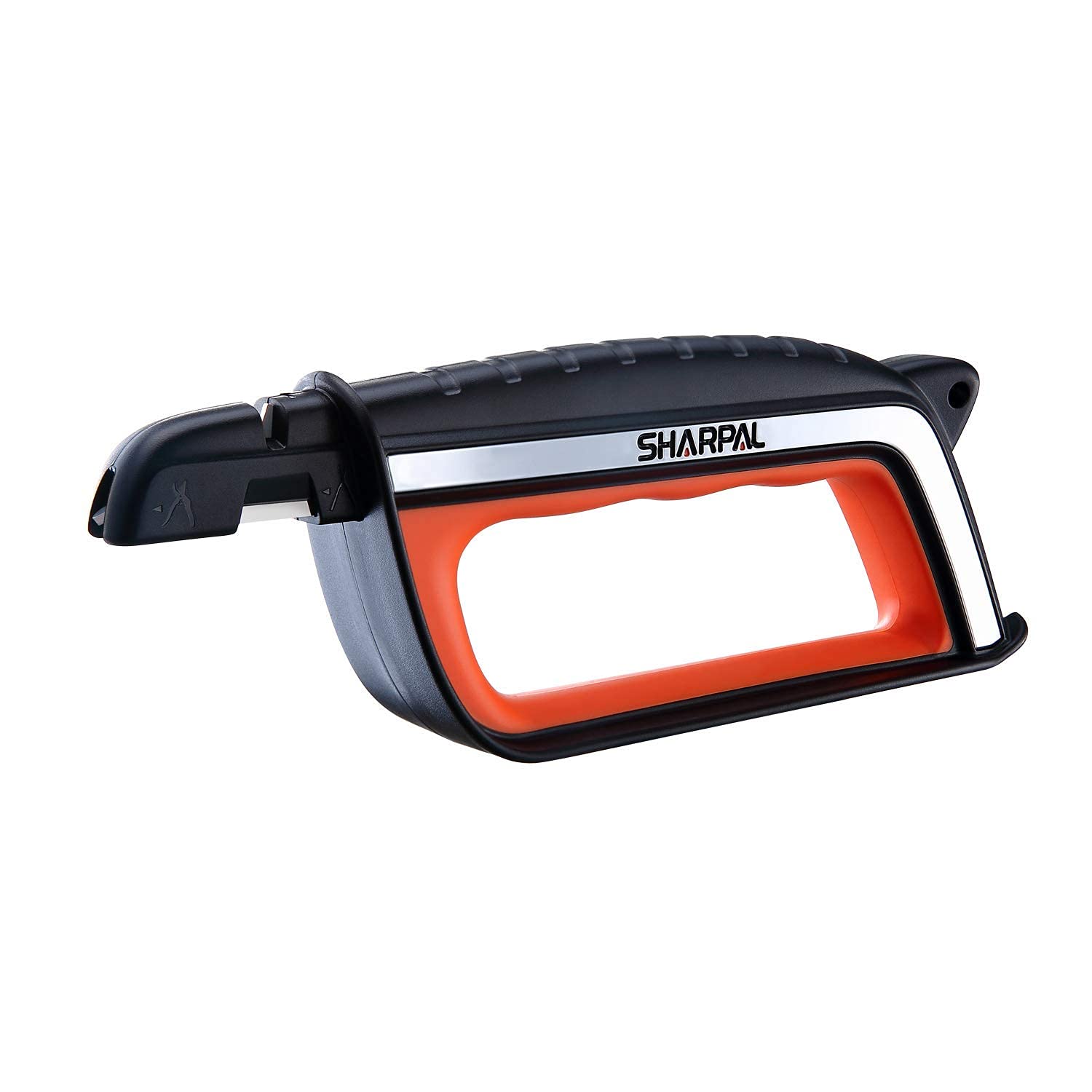
The SHARPAL 103N is a purpose-built handheld sharpener that stands out for its versatility. It’s not a bench stone or an electric grinder, it’s a compact tool designed to handle a surprising range of edge maintenance tasks around the shop, garden, and home. With five sharpening surfaces, it can tackle lawn mower blades, axes, machetes, pruning shears, hedge trimmers, scissors, and most kitchen knives. That kind of flexibility makes it a real asset for anyone who keeps multiple cutting tools in rotation.
This sharpener is best suited for DIYers, homeowners, and light commercial users who want to keep their gear cutting cleanly without spending a lot of time or money. It’s not meant for heavy duty reprofiling or restoring badly damaged edges, but for routine sharpening and touch ups it works very well. The preset angle slots take the guesswork out of holding the blade at the right orientation, which is especially helpful for people who aren’t comfortable with a stone or file.
In use, the 103N feels solid and secure. The rubber over-molded base grips the workbench or tabletop, so it stays put while you draw the blade through the slot. The handle is big enough to use comfortably with gloves, and the hand guard is a thoughtful safety feature when working on mower blades or shears. Performance wise, the tungsten carbide slot removes material quickly and the ceramic slot refines the edge to a clean, functional sharpness. Most users report noticeably better cutting from their tools after just a few passes.
Build quality is good for the price point. The plastic housing feels durable, and the abrasive inserts are rated to last through many thousands of uses. There are no batteries or cords to worry about, and the whole unit weighs only a few ounces, so it’s easy to store in a drawer or toolbox. Some reviewers mention that very dull or thick mower blades may need more passes or a secondary method to get a true edge, but for regular upkeep this tool performs reliably.
If you are tired of paying for sharpening services or struggling with stones and files, the SHARPAL 103N is a practical, cost effective alternative. It pays for itself quickly if you maintain your own mower blades, pruners, and shears. For the price and versatility, it’s a solid addition to any workshop or garage.
Brand: SHARPAL
Model: 103N
Dimensions: 8.46 x 2.95 x 1.34 inches
Weight: 6.2 ounces (176 grams)
Materials: Tungsten carbide and ceramic abrasives
Grit types: Coarse, medium, fine
Number of sharpening slots: 5 preset angle guides
Color: Orange and black
Warranty: 3 years
Lawn Mower Blade Touch Ups: Use the dedicated carbide slot to quickly restore a clean cutting edge without removing the blade from the mower (if accessible) or with the blade removed on a bench. Ideal for seasonal maintenance.
Garden Shears and Pruners: The pre-set angle slots make it easy to sharpen bypass pruners, hedge shears, and loppers. A few passes bring back factory sharpness.
Axes and Hatchets: The broader slots accommodate thicker blades and axes. Great for campsite or woodlot tool upkeep.
Kitchen and Utility Knives: The fine ceramic slot refines knife edges for clean slicing. Works well on most straight edge kitchen blades.

Pros
- Precise angle adjustment from 15 to 45 degrees covers most blade requirements.
- Durable metal build with ball bearings ensures long-lasting stability and accuracy.
- Integrated balancer promotes even blade weight distribution, reducing vibration and extending engine life.
- Easy to set up and use with most grinders, thanks to included guide pins.
Cons
- Requires a compatible angle grinder; not a standalone sharpener.
- Initial learning curve to dial in exact angle and balance for different blade types.
- Best suited for lawn mower blades only, not for other workshop tools.
The SporGain Lawn Mower Blade Sharpener and Balancer Kit is a practical workshop accessory for anyone who takes lawn care seriously. This two-in-one set includes a sharpening jig and a balancer tool, designed to keep your mower blades in top shape. It's best suited for DIY homeowners, lawn care enthusiasts, and small-scale contractors who maintain their own equipment and want a reliable, efficient way to sharpen and balance blades without frequent trips to a shop.
In real-world use, the sharpener's adjustable 15 to 45 degree angle lets you match the factory bevel on most blades, resulting in a clean, precise edge. The metal jig with ball bearings holds the blade securely while you run a grinder across it, and the enlarged handle gives you a firm grip. After sharpening, the zinc alloy balancer helps you check for even weight distribution, which cuts down on vibration and engine wear. This process is straightforward and makes a noticeable difference in how smoothly the mower runs.
Build quality is solid for the price. The frame is made from thick metal and high-density aluminum alloy, with bushings that keep wobble to a minimum. The included four guide pins fit most common angle grinders, so you can usually get started without hunting for adapters. The tool-free setup is a nice touch, letting you switch between sharpening and balancing quickly. However, keep in mind that this kit is specialized for lawn mower blades. If you sharpen other workshop tools, you'll need a different setup.
One realistic drawback is that the sharpener requires some practice to get the angle just right, especially if you're new to blade maintenance. Also, you need a grinder that's compatible with the guide pins, though most standard models work. The balancer is simple to use but relies on a level surface for accurate readings. These are minor issues for the value this kit provides.
Overall, the SporGain Lawn Mower Blade Sharpener and Balancer Kit is a smart buy for DIYers and homeowners who want to extend the life of their mower blades and improve cutting performance. It saves you money on professional sharpening and gives you the satisfaction of well-maintained equipment. If you maintain your own lawn gear and have an angle grinder, this kit is a worthwhile addition to your workshop.
Color: Dark
Dimensions: 13.5 x 9 x 3.4 inches
Product Group: Lawn & Patio
Material: High-density aluminum alloy sharpener, zinc alloy balancer, thick metal frame with ball bearings
Adjustment Range: 15-45 degrees
Included Guide Pins: 4 different sizes for compatibility with most angle grinders
Tool-Free Operation: Yes

Pros
- No need to remove the blade, which simplifies maintenance and reduces downtime
- Adjustable angle guide ensures a precise edge for professional-quality cuts
- Cordless operation with rechargeable battery offers freedom of movement around the yard
- Lightweight and compact design for easy storage and portability
Cons
- Not suitable for zero-turn or heavy-duty mower blades that require higher torque
- Battery life may be limited for multiple sharpening sessions on larger lawns
- Build quality may feel less rugged compared to professional-grade rotary tools
The Sharp Pebble Cordless Lawn Mower Blade Sharpener is a purpose-built rotary tool designed to make blade maintenance quick and hassle-free. Unlike traditional sharpening methods that require removing the blade, this tool lets you sharpen in place, saving you the time and frustration of disassembly. It's an ideal solution for DIY homeowners and weekend gardeners who want to keep their mower blades sharp without investing in expensive professional equipment.
Performance wise, the adjustable angle guide (20-40 degrees) is a standout feature. It allows you to set the exact angle for your blade type, ensuring a consistent edge that promotes cleaner cuts and healthier grass. The variable speed control (5,000-30,000 RPM) gives you the flexibility to handle different blade conditions, from light touch-ups to more aggressive sharpening. The included replaceable sharpening wheels are effective and easy to swap out when they wear down.
Build quality is decent for the price point. The tool feels lightweight and well-balanced, with an ergonomic grip that reduces fatigue during extended use. The cordless design with a rechargeable battery adds convenience, letting you move freely around the yard without being tethered to an outlet. However, the battery life is adequate for a few blades but may require a recharge for larger mowing setups. The tool is best suited for standard mower blades; it lacks the torque needed for zero-turn or heavy-duty commercial blades.
In terms of practicality, this sharpener is a time-saver. You can quickly touch up the blade between mows, ensuring optimal cutting performance without the downtime of removal and reinstallation. Safety features like the ergonomic grip and speed control help maintain control during operation. The compact size makes it easy to store in a toolbox or garage drawer.
One realistic drawback is that the tool may not satisfy users who need to sharpen multiple blades in one session, as the battery could run out. Additionally, the build quality, while adequate for occasional use, may not withstand heavy daily use by professionals. Overall, the Sharp Pebble Cordless Lawn Mower Blade Sharpener is a practical, affordable choice for DIYers and homeowners who value convenience and precision. If you're looking for a quick way to maintain your mower blade without the hassle of removal, this tool delivers solid performance for the price.
Product Dimensions: 8 x 2.8 x 1.2 inches
Item Weight: 1.37 pounds
Manufacturer: Mighty Dreams
Model Number: SPMower2024
Battery: 1 9V battery included
Best Sellers Rank: #56,427 in Patio, Lawn & Garden, #212 in Lawn Mower Accessories
This sharpener is best for standard residential lawn mower blades. It is ideal for DIY homeowners who mow their own lawns and want to keep blades sharp without removing them. Use it for quick touch-ups between mows or to restore a dull blade to a clean cutting edge. Not recommended for commercial zero-turn mowers or heavy-duty blades that require higher torque.

Pros
- Complete sharpening and balancing system in one purchase
- Smooth ball bearing handle reduces fatigue during extended use
- Adjustable angle range covers most common blade bevels
- Magnetic balancer is simple to use and highly accurate
Cons
- Aluminum alloy construction may not withstand heavy commercial use over time
- Some users may need to purchase additional adapter screws for non-standard angle grinders
- Large frame can be bulky to store in smaller workshops
The Aurorasters Lawn Mower Blade Sharpener & Balancer is a practical two-in-one tool designed for homeowners and DIYers who want to keep their mower blades in top condition without a trip to the shop. This kit includes both a sharpener with an extended 20.08-inch articulated arm and a magnetic blade balancer, so you can sharpen and balance in one workflow. It's best suited for weekend warriors and hobbyists who maintain their own lawn equipment, though it could also serve light commercial use.
In real-world use, the ball bearing handle glides smoothly, reducing hand fatigue when you're working through a set of blades. The adjustable frame lets you set the sharpening angle from 15 to 45 degrees across 7 positions, which covers most standard mower blades. The magnetic balancer is straightforward: just set the blade on the magnetic post and see where it dips. That makes it easy to spot and correct imbalances that cause vibration and uneven cuts. The included adapter screws fit most angle grinders, so you don't need to buy extra hardware.
Build quality is decent for the price point. The aluminum alloy frame feels sturdy enough for regular home use, but it's not built to withstand the abuse of a professional landscaping crew working daily. The bushings fit snugly over the guide pins, which helps reduce wobble during sharpening and improves accuracy. At 5.81 pounds, the kit is portable but not ultralight. The large frame takes up some bench space, so you'll want a dedicated spot in your garage or workshop.
One realistic drawback is that the aluminum construction may show wear over time if you're sharpening heavily pitted or thick blades frequently. Also, while the sharpener works with most angle grinders, you might need to source additional adapter screws for some models. The balancer is magnetic but not overly strong, so larger commercial blades might not hold as securely. These are minor issues for the typical homeowner, but something to consider if you plan to use it every week.
Overall, the Aurorasters Lawn Mower Blade Sharpener & Balancer is a solid investment for anyone who wants to maintain their mower blades at home. It delivers good precision, reduces vibration, and extends blade life between sharpenings. If you're a DIYer or homeowner who values a clean cut and doesn't want to pay for professional sharpening, this kit offers excellent value. For heavy commercial use, you may want to look at a more rugged steel option, but for most people, this will get the job done well.
Color: Black Red
Dimensions: 20 x 10 x 20 inches
Weight: 5.81 Pounds
Product Group: Lawn & Patio
Binding: Unknown Binding
Ideal for homeowners and DIYers who sharpen their lawn mower blades 2-4 times per season. Works well for standard residential mowers, riding mowers, and zero-turn blades. Also suitable for small engine repair shops that need a reliable sharpening setup for walk-behind mowers. Not recommended for heavy daily commercial use where a steel frame would hold up better.
Everything You Need to Know About Lawn Mower Blade Sharpening Angles
Determining the proper sharpening angle represents the single most important technical detail when restoring a dull rotary mower blade. Rotary mower blades are engineered with a specific single-sided bevel designed to shear grass cleanly at rotational speeds exceeding three thousand revolutions per minute. Applying the wrong bevel geometry can cause the cutting edge to chip upon impact or tear turf rather than slicing it cleanly. Understanding factory specifications, angle tolerances, and correct sharpening tools allows DIY equipment owners to achieve dependable cutting performance.
The Standard Factory Angle for Rotary Mower Blades
The overwhelming majority of rotary lawn mower manufacturers sharpen replacement blades to an angle of 30 degrees. This thirty-degree bevel applies across virtually all standard residential push mowers, lawn tractors, commercial walk-behind units, and zero-turn mowing decks. Manufacturers treat thirty degrees as the industry baseline because it represents the ideal engineering balance between sharpness and structural durability. A thirty-degree profile slices cleanly through grass stems while retaining adequate metal mass directly behind the cutting edge to resist deformation.
Acceptable manufacturer tolerances for standard rotary blades generally span between 30 degrees and 35 degrees. If a sharpening tool cuts slightly steeper toward thirty-two or thirty-five degrees, the blade will still deliver clean cuts without risking structural failure. The bevel angle is always measured from the flat bottom face of the blade upward along the angled top edge. The bottom face of a rotary mower blade must remain entirely flat to create smooth airflow and clean aerodynamic lift inside the mowing chamber.
Why the Correct Sharpening Angle Matters for Grass Health and Blade Life
Grass leaves consist of fibrous cellular walls that require a crisp shearing action to seal properly after cutting. When a blade bevel becomes rounded, blunted, or ground to an improper slope, the blade bashes through grass stalks rather than slicing them. Ragged grass tips turn white or brown within forty-eight hours, spoiling the uniform green appearance of the lawn. These frayed plant wounds also increase water evaporation from the soil and create entry points for fungal turf infections.
Beyond lawn appearance, the correct sharpening angle directly dictates how long the blade maintains its edge during routine mowing. An edge ground to thirty degrees retains enough steel support to resist premature flattening when colliding with dense thatch, sand particles, or fallen twigs. A blade with improper geometry dulls rapidly, forcing the engine or electric motor to work harder to maintain rotational momentum. Proper bevel maintenance therefore protects your mower deck components, saves fuel or battery runtime, and preserves turf health.
Comparing Shallow Angles and Steep Angles on Rotary Cutters
Homeowners sometimes mistakenly believe that grinding a mower blade like a kitchen knife at twenty or twenty-five degrees will produce superior mowing results. A shallow twenty-degree bevel feels exceptionally sharp to the touch, but it lacks the structural steel thickness necessary for outdoor cutting environments. At high blade tip speeds, a twenty-degree edge folds over, notches, or rolls immediately upon striking small pebbles, tough weeds, or pine cones. Shallow bevels dull so rapidly that the mower often begins tearing grass after only one or two mowing sessions.
Conversely, bevels ground steeper than thirty-five degrees toward forty or forty-five degrees provide immense structural toughness at the expense of cutting finesse. Steep angles behave more like an axe or brush-clearing wedge, resisting impact fractures in extremely rocky pastures or sandy topsoil. However, on fine residential turfgrass, a forty-degree edge lacks sufficient cutting sharpness and tends to push grass blades down rather than severing them cleanly. Mowing enthusiasts in sandy regions sometimes compromise at thirty-five degrees, but forty degrees remains reserved primarily for rough-cut brush cutters rather than finished lawns.
How Blade Types and Mowing Conditions Influence Angle Choice
Different blade profiles present distinct cutting requirements across rotary mower decks. Standard straight blades and high-lift bagging blades feature simple linear cutting edges that easily match standard thirty-degree grinder jigs. Mulching blades, on the other hand, incorporate curved profiles, raised center kickers, and extended serrated cutting surfaces designed to circulate clippings repeatedly. When sharpening mulching configurations, maintaining a uniform thirty-degree bevel along the entire contour is vital to preserve balanced airflow and cutting efficiency.
Many replacement blades arrive from the factory with a protective powder coating covering the cutting edge, which raises questions about whether factory-sharpened replacement blades require immediate regrinding. New blades typically arrive ground to thirty degrees beneath the paint layer, meaning they do not require sharpening before initial installation. When refreshing worn blades, versatile jig holders such as the SporGain Lawn Mower Blade Sharpener,15°-45°Adjust handle blade widths from 1.65 inches to 3.60 inches. These tools accommodate straight, high-lift, and mulching contours across varying deck configurations.
The Leading Edge Rule: Why Mower Blades Must Never Be Razor Sharp
One of the most widespread mistakes during DIY blade maintenance is honing the cutting edge to razor sharpness. Unlike kitchen cutlery, a lawn mower blade must never feature a paper-thin, razor-sharp wire edge. Spinning at three thousand revolutions per minute, blade tips travel at linear speeds between one hundred fifty and two hundred miles per hour. A razor edge exposed to those extreme centrifugal velocities and air pressures curls, chips, and loses its cutting ability almost instantly.
Experienced lawn care operators recommend leaving a blunt flat face along the leading edge measuring approximately one sixty-fourth to one thirty-second of an inch thick. This flat edge corresponds roughly to the thickness of a business card or a dull butter knife. Providing this minimal blunt landing gives the cutting apex enough structural support to withstand collisions with acorns, tree roots, and dirt mounds without chipping. The sheer kinetic energy of the rotating blade ensures crisp grass shearing even with this durable, slightly blunt profile.
Sharpening Tools and Maintaining Consistent Angle Geometry
Maintaining a uniform thirty-degree angle by freehand grinding requires steady motor control that many DIYers struggle to replicate consistently. Angle grinder jigs such as the SporGain Lawn Mower Blade Sharpener or the Aurorasters New Upgrade Large Size Lawn Mower Blade Sharpener mount to workbenches and hold the grinder at fixed settings. These jigs feature articulated guide pins and indexed frame positions that prevent angle wander during long grinding passes. Clamping the blade firmly inside the jig fixture ensures identical bevel angles across both cutting ends.
For lighter touch-ups without angle grinders, handheld multi-tools such as the SHARPAL 103N All-in-1 Knife Garden Tool feature preset tungsten carbide slots and ceramic bars designed to restore edged tools safely. While manual pull-through sharpeners remove less material than powered wheels, their preset slots prevent users from accidentally altering the original factory angle. Alternatively, compact rotary sharpeners like the Sharp Pebble Cordless Lawn Mower Blade Sharpener offer adjustable angle guides spanning twenty to forty degrees. This battery-powered option suits standard mower blades and allows rapid field adjustments without demanding heavy shop machinery.
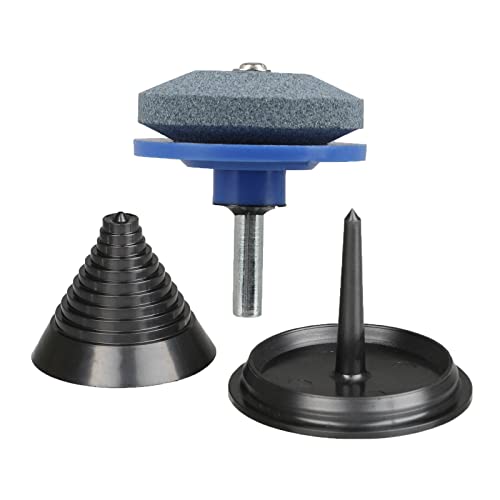
Budget-friendly drill attachments such as the Lawn Mower Blade Sharpener for Drill and Lawn utilize double-layer corundum stones shaped to ride directly along the blade bevel. When using drill attachments, operating at moderate drill speeds prevents stone bouncing and ensures even contact along the cutting flat. Operators must remember that drill stones feature fixed conical angles that may not match non-standard mower bevels. Regardless of tool choice, taking slow, deliberate passes along the factory edge yields much cleaner results than forcing rapid material removal.
Steel Metallurgy, Grinding Heat, and Temper Protection
Understanding the material composition of your blade is crucial because excessive grinding friction can permanently ruin tempered cutting edges. Exploring common lawn mower blade steel types shows that medium-carbon and high-carbon alloy steels undergo controlled heat treating to balance impact toughness with wear resistance. Applying excessive pressure with an angle grinder or bench wheel generates extreme thermal friction that draws the temper out of the steel. If the cutting edge turns blue, purple, or black during grinding, the localized steel has annealed and softened permanently.
Softened steel dulls within minutes of mowing and deforms upon touching the slightest lawn obstacle. To prevent heat buildup, maintain a light touch and keep the grinding wheel moving smoothly along the thirty-degree bevel without pausing in one spot. Keeping a bucket of clean water nearby allows you to quench the blade between light grinding passes to dissipate accumulated friction heat. Inspecting the metal frequently guarantees that the original factory hardness remains intact across the entire working length of the cutting edge.
Dynamic Balancing and Deck Spindle Protection After Sharpening
Restoring the correct thirty-degree angle is only half the maintenance process; balancing the sharpened blade is equally critical for machine longevity. Grinding away nicks and gouges naturally removes metal, which frequently causes one side of the blade to become lighter than the opposite side. An unbalanced blade spinning at full engine throttle creates intense rotational vibration that travels directly into the spindle assembly. Over time, dynamic imbalance causes premature spindle bearing wear, deck cracking, loose mounting hardware, and uneven cutting swaths across your turf.
Testing balance requires placing the blade on a tiered cone balancer or a high-precision magnetic balancer like those supplied with SporGain or Aurorasters kits. If one side dips downward, that heavy end contains excess metal mass that must be ground away before installation. Crucially, metal removal for balancing purposes should take place on the rear sail or unsharpened back wing of the blade rather than the sharpened cutting bevel. Grinding away metal from the cutting bevel destroys the carefully established thirty-degree geometry and shortens blade service life.
Practical Step-by-Step Guidance for Setting and Maintaining the Angle
Executing a successful sharpening procedure begins with cleaning all accumulated grass clippings, dried mud, and sap from the blade surface using a wire brush. Once the steel is clean, coating the existing top bevel with a black permanent marker provides an immediate visual guide for grinding accuracy. Clamping the blade securely into a bench vise or an adjustable sharpener jig prevents dangerous shifting during the process. Adjust the sharpening guide to thirty degrees and take a light preliminary pass across the marked surface to confirm the tool matches the factory slope.
If the grinder removes ink only from the top shoulder or bottom cutting tip, adjust the jig angle until the stone clears ink evenly across the entire bevel face. Move the grinding tool in continuous, uniform strokes from the inside shoulder out toward the blade tip using light, steady pressure. After establishing a clean, uniform thirty-degree bevel, inspect the bottom flat side of the blade for a thin metal burr. Lightly stroke a fine hand file or sharpening stone flat against the bottom surface to deburr the edge, taking care never to grind an angle into the flat underside.
Final Pre-Operation Inspection and Hardware Verification
Once both cutting edges exhibit matching thirty-degree bevels and the blade balances level on a balancer tool, inspect the mounting center hole and hardware. Examine the center star, circle, or specialized mounting geometry for signs of wallowing, stress cracks, or physical distortion. Clean the spindle mating face and inspect the blade bolt, washer, and bellville spring for thread wear or deformation before remounting. Always reinstall the blade with the angled wings pointing upward toward the underside of the mower deck and the flat surface facing the grass.
Tighten the mounting bolt securely using a calibrated torque wrench set to the manufacturer torque specifications detailed in your mower operator manual. Establishing a routine maintenance cadence of inspecting and sharpening your blades every twenty-five to fifty mowing hours keeps cutting performance optimal. Adhering to the thirty-degree factory standard preserves clean lawn cuts, protects your mower deck assemblies, and extends the operational life of your cutting hardware. Regular attention to proper blade geometry ensures your lawn equipment performs reliably throughout every mowing season.


Write Your Review
No reviews yet. Be the first to share your experience!