


Mowing a residential lawn involves spinning steel cutting edges at tremendous velocity right beneath your feet. Homeowners rarely think about the mounting hardware holding those cutting components until a sudden rattle, harsh vibration, or jarring impact occurs under the deck. Many property owners find themselves wondering whether can a lawn mower blade fly off when hardware loosens or unseen debris strikes the cutting chamber. While equipment manufacturers design decks to contain loose parts, mechanical neglect and incorrect fastener assembly can create dangerous operating hazards. Reviewing proper mower blade sizing and matching factory hardware specifications helps prevent catastrophic deck failures.
A detached blade poses severe risks to operators, nearby bystanders, and the internal structure of the lawn mower itself. Rotational energy at several thousand revolutions per minute can turn a loose fastener or fractured blade into a destructive projectile. Understanding what causes hardware to back out, how different center-hole geometries seat against the spindle, and how to spot subtle warning signs protects your yard and equipment. Whether you operate a walk-behind push mower or a high-torque zero-turn tractor, disciplined deck maintenance keeps cutting edges safely anchored throughout the season.

Pros
- Exceptional torque and blade speed rival gas mowers without the fumes or noise
- Self-propelled drive with intuitive hand control makes mowing effortless on hills and uneven terrain
- Peak Power technology allows dual battery use for extended runtime and extra power when needed
- LED headlights enable early morning or evening mowing with clear visibility
- Brushless motor is efficient, quiet, and built to last with minimal maintenance
Cons
- Tool-only package requires purchase of batteries and charger separately, increasing upfront cost
- Weighs 70.3 pounds, which is heavier than some cordless mowers, though the self-propelled drive helps
- Battery runtime may be insufficient for very large lawns without additional batteries or a second charge
The EGO Power+ LM2240SP is a cordless electric lawn mower that redefines what you can expect from battery-powered lawn care. With a 22-inch Super Composite deck and a brushless motor that cranks out up to 10.6 foot-pounds of torque and 3,200 RPM blade speeds, this mower is built for homeowners who want gas-level performance without the hassle of fuel, oil, or pull cords. It's a tool-only model, meaning you'll need to supply your own EGO 56V ARC Lithium batteries and charger, but for those already in the EGO ecosystem, it's a seamless upgrade.
This mower shines in real-world use. The torque is impressive, easily chewing through thick St. Augustine grass and overgrown fescue without bogging down. The Select Cut Multi-Blade system includes a high-performance blade for general mowing and a high-lift bagging blade for cleaner collection. You can also switch between ECO, Normal, and Turbo blade speeds via the LED control panel, giving you fine control over runtime and cutting aggression. The Precision Mulch Control lets you adjust the cut depth on the fly, which is handy for adapting to different grass conditions.
Build quality is solid. The Super Composite deck feels tough yet lightweight, and the 10-year warranty on it adds peace of mind. The Touch Drive self-propelled system is one of the best in the business, with a handgrip that lets you control speed intuitively. It's especially useful on slopes or when maneuvering around flower beds. The LED headlights are a nice touch for early morning or dusk mowing sessions. At 70.3 pounds, it's not the lightest mower, but the self-propelled drive makes it manageable for most users.
One realistic drawback is the weight, which can be noticeable when lifting the mower into a truck bed or over a curb. Also, since batteries and charger are not included, the initial investment can be steep if you're starting from scratch. Runtime is solid at up to 90 minutes with two 6.0Ah batteries, but if your lawn is over half an acre, you might need a second set or a quick charge break. The mower is also relatively quiet compared to gas, so your neighbors will appreciate it.
Overall, the EGO Power+ LM2240SP is a top-tier choice for homeowners who already own EGO batteries or are willing to invest in the platform. It delivers genuine gas-like power, excellent cutting quality, and smart features like variable blade speed and self-propulsion. If you have a medium to large lawn and want a reliable, low-maintenance electric mower, this is one of the best options on the market.
Color: Black
Dimensions: 63 x 23.5 x 45 inches
Weight: 70.3 pounds
Product Group: Lawn and Patio
Binding: Lawn and Patio

Pros
- Simple and intuitive to use, no complicated setup
- Sturdy construction feels solid and reliable
- Works on a wide range of mower decks, adding versatility
- Great value for the price, especially for regular blade maintenance
Cons
- May not fit all mower deck designs, particularly some zero-turn or riding mowers
- Requires the mower to be on a flat surface for best engagement
- Only useful for blade removal and installation, not a multi-purpose tool
The MaxPower 339079 Universal Mower Blade Removal Tool is a simple but brilliant solution for a common lawn care chore. Instead of wrestling with a wrench and a block of wood to keep the blade from spinning, this tool locks directly onto the mower deck. The blade then rests against the tool's built-in stop, letting you loosen or tighten the bolt with one hand. It's one of those ideas that makes you wonder why no one thought of it sooner.
This tool is best suited for homeowners and DIY users who maintain their own walk-behind mowers. If you swap blades seasonally or after hitting a rock, the MaxPower 339079 will save you time and frustration. Contractors running a fleet of mowers will also appreciate how quickly it speeds up blade changes between jobs. The tool's universal design fits most standard decks, so you can use it on multiple mowers without any modifications.
In real-world use, the tool feels solid and well-built. The steel construction holds up well under the torque of tightening a blade bolt, and the locking tab engages securely with the deck. It doesn't slip or flex during use. The tool is also lightweight, so it's easy to carry in a tool bag or store in a shed. There's no learning curve, you simply slide it into place and get to work.
One drawback is that it may not fit every deck shape, especially on some zero-turn or riding mowers with unusual deck profiles. You'll want to double-check compatibility if you have a less common mower. Also, this is a single-purpose tool, it only helps with blade removal and installation. But for that one task, it does the job perfectly.
Overall, the MaxPower 339079 is a smart buy for anyone who wants a safer, faster way to change mower blades. It's not flashy, but it works exactly as advertised. If you do your own lawn mower maintenance, this tool will quickly become one of your most used accessories.
Product Dimensions: 8 x 4.75 x 2 inches
Item Weight: 1.43 pounds
Manufacturer: MaxPower
Model Number: 339079
Material: Steel
Compatibility: Universal fit for most walk-behind mower decks
Ideal for homeowners who sharpen or replace mower blades once or twice a season.
Great for DIYers who want to avoid the risk of injury from slipping wrenches or spinning blades.
Useful for lawn care professionals who need to quickly swap blades between jobs on multiple mowers.
Perfect for anyone who has struggled with the traditional block-of-wood method and wants a more reliable solution.

Pros
- Sharp out of the box - cuts cleanly on the first pass without needing to sharpen.
- Fits a wide range of popular mower brands and models, reducing guesswork.
- Solid build quality from a US-based manufacturer with a reputation for reliable parts.
- Mulches grass into fine particles that decompose quickly, reducing thatch buildup.
- Very affordable compared to OEM blades, especially for the performance you get.
Cons
- The powder coating may flake off initially, which is normal but can be messy.
- Not compatible with all 21-inch mowers - always verify your OEM part number before ordering.
- Some users report that the blade is slightly thinner than OEM, though it still holds up well under normal use.
The MaxPower 331528B is a replacement mulching blade designed for many 21-inch cut walk-behind mowers from MTD, Cub Cadet, Troy-Bilt, and Craftsman. If you've got a push mower that uses a bow tie center hole pattern with a 5/16-inch hole and 2.5-inch spacing, this blade is likely a direct drop-in. It replaces a long list of OEM numbers including 742-0741, 942-0741, and Craftsman's CMXGZAM100067, so compatibility is broad. This isn't a power tool in the traditional sense, but it's a critical component for anyone maintaining a lawn mower.
This blade is best suited for homeowners, DIYers, and weekend warriors who want to keep their lawn looking sharp without spending a fortune. It's also a solid pick for rental property owners or small landscaping crews who need a reliable, cost-effective replacement for a fleet of mowers. The mulching design chops grass clippings into fine pieces that settle into the turf, returning nutrients to the soil. That means less bagging and a healthier lawn overall.
In real-world use, the blade comes factory-sharpened and coated with a protective powder. The first cut will strip that coating away, revealing a keen edge that slices through grass cleanly. Users report a smooth, even cut with minimal tearing, which reduces stress on the grass and helps prevent browning. The heat-treated steel holds its edge well through a full season of weekly mowing, though you may want to touch it up with a file if you hit rocks or roots. Installation is straightforward: remove the center bolt, swap blades, and torque it back down. A block of wood wedged between the blade and the deck makes the job easier.
Build quality is solid for an aftermarket blade. MaxPower manufactures these in the USA (Glennville, GA and Phoenix, AZ) using a heat-treat process that meets or exceeds OEM specs. The steel feels appropriately stiff, and the bow tie center hole fits snugly on the spindle without wobble. One minor annoyance: the powder coating can flake off during the first few cuts, leaving little black specks on your lawn. That's cosmetic and harmless, but worth noting. Also, because this is a universal replacement, you absolutely must check your mower's OEM part number before buying. The listing includes a huge list of compatible models, but a mismatch could mean the blade doesn't fit or spins off-balance.
Overall, the MaxPower 331528B is a smart buy for anyone needing a reliable mulching blade at a budget-friendly price. It cuts well, fits a wide range of mowers, and is built to last. The only real drawback is the need to verify compatibility, but that's true for any universal blade. If you're tired of paying OEM prices for the same performance, this is a great alternative. Just double-check your part number, and you'll be back to mowing in no time.
Blade Length: 21 inches
Blade Width: 2.25 inches
Center Hole: Bow tie pattern, 5/16-inch diameter outer holes, 2.5-inch center-to-center spacing
Weight: 1.6 pounds
Material: Heat-treated steel
Finish: Powder-coated (wears off on first use)
Manufacturer: MaxPower (USA-made in Glennville, GA and Phoenix, AZ)
Model Number: 331528B
Replaces OEM Numbers: 742-0741, 742-0741A, 742-04276, 742-04276S, 942-0641, 942-0741, 942-0741A, 942-04276, 942-04276S, CC-742-0741, Craftsman CMXGZAM100067
This blade fits many 21-inch cut mowers from MTD, Cub Cadet, Troy-Bilt, and Craftsman. Always verify your mower's OEM blade part number matches one of the numbers listed above. Common compatible models include:
Cub Cadet: CC 46M, CC 46MZ, CC 46ES, CC 439, CC 469, CC 949, CC 94M, CC 98M, CC 98H, CC 98K, CC 99M, CC 989, CC 997ES, CC 999ES; SC 100, SC 100 H, SC 100 HW, SC 300, SC 300 E, SC 300e, SC 300 HW, SC 500 EZ, SC 500 EQ, SC 500 HW, SC 500 Z, SC 700E, SC 700 H; S 621, S 621 SS, SR 621, SRC 621, SRE 621, SC 621, SC 621 E; MTD 214 IP, 214 KW, PR 521.
Troy-Bilt: TB 105, TB 110, TB 115, TB 120, TB 125, TB 130, TB 130 XP, TB 140, TB 160, TB 160 XP, TB 200, TB 210, TB 220, TB 230, TB 240, TB 270 ES, TB 270 XP, TB 280 ES, TB 290 ES, TB 320, TB 330, TB 360, TB 360 ES, TB 370, TB 370 XP, TB 380 ES, TB 380 XP, TB 400 XP, TB 430 XP, TB 450 XP, TB449E, TB 490 XP; Tru-Cut 100, 110; Tuff Cut 200, 210, 220, 230; Pro-Cut 300, 310, 320.
Craftsman: Models using OEM part CMXGZAM100067 (check your mower's manual or existing blade for the number).

Pros
- Affordable replacement blade that works on many 21 inch deck models.
- Durable alloy steel stands up to regular use and resists corrosion.
- Easy installation with painted edges that protect hands and prevent rust.
- Effective mulching performance that helps maintain a healthy lawn.
Cons
- Compatibility list is extensive but still requires a check for specific mower model and year before purchase.
- Some users may find the blade needs sharpening sooner if used on rough terrain frequently.
- No included hardware like washers or bolts for installation.
The Hipa 942-0741A is a replacement mulching blade designed for 21 inch cutting decks on walk-behind mowers, self-propelled mowers, and even some riding lawn tractors. It's a straightforward accessory that targets the heart of lawn care: cutting and managing grass clippings. If you own a compatible Troy Bilt, Craftsman, MTD, or similar model from the mid-1990s onward, this blade could be a smart, budget-friendly swap.
This blade excels for the typical homeowner who mows weekly and wants a cleaner yard without constant bag emptying. The 3-in-1 design means you can switch between mulching, bagging, and side discharge just by changing the mower's plug or discharge chute (depending on your mower's setup). The high-lift wing helps throw clippings into the bag more efficiently, which really cuts down on extra passes. In real-world use, the alloy steel holds up well against rocks and sticks, though any blade will dull eventually with heavy use.
Build quality is solid for the price point. The blade is made from alloy structural steel with added chromium and molybdenum, which improves hardness and corrosion resistance. The paint coating on the edges is a nice touch to reduce rust during storage and to keep your fingers safe while handling the blade. Just keep in mind that the paint will wear off quickly as you mow. At 21 inches long and 1.74 pounds, it's lightweight enough to swap without much effort, but you'll still want to use thick gloves and check for cracks before each use.
One realistic limitation is the compatibility: while the list of supported models is huge, you still need to confirm your specific mower's deck size and blade mount pattern (bow tie center hole). Not every 21 inch deck uses the same blade profile, so double check your old blade's shape and dimensions. Also, the blade does not come with mounting hardware, so reuse your existing bolts and washers or buy new ones separately.
Overall, the Hipa 942-0741A is a reliable, affordable choice for maintaining a healthy lawn without emptying the budget. It's best suited for DIY homeowners who want a straightforward replacement that works across multiple mower brands. For the price, it delivers good durability and effective mulching performance that keeps your grass looking neat and your lawn fed naturally.
Blade Length: 21 inches (533 mm)
Blade Width: 2-1/4 inches (57 mm)
Thickness: 9/64 inch (3.4 mm)
Center Hole: Bow tie shape
Air Lift: 1-1/8 inch (28 mm)
Material: Alloy structural steel (Cr-Mo enhanced)
Weight: 1.74 pounds
Deck Size Compatibility: 21 inch cut
Brand Compatibility: Troy Bilt, Craftsman, MTD, Yard Machines, Murray, Cub Cadet, Snapper, and more (1995+ models)

Pros
- Arrives sharp and well-balanced for most users, reducing vibration and ensuring clean cuts.
- Easy to install with a standard 5/8-inch socket and a block of wood to hold the blade.
- Compatible with a wide range of mower brands, including older models from Briggs & Stratton and Craftsman.
- Solid build quality from a trusted OEM supplier, priced lower than many big-box store alternatives.
Cons
- A small number of users have reported blades arriving with a heavy coating of paint over the edge, requiring a brief break-in period.
- Not compatible with mowers that use a different spindle design or blade mounting system (e.g., some newer 22-inch or battery-powered mowers).
- Limited to 21-inch deck sizes, so owners of smaller or larger mowers will need a different blade.
If you are maintaining a standard 21-inch push mower, you already know the importance of a sharp, well-fitted blade. The MTD Genuine Parts 490-100-M067 mulching blades deliver exactly what the OEM intended, offering a direct replacement for models from Troy-Bilt, MTD, Yard Machines, Huskee, Bolens, and more. These blades are built to handle the typical homeowner mowing a quarter-acre lot or a medium-sized lawn, and they do so with consistent cutting performance.
These are genuine OEM parts, not cheap aftermarket knockoffs. The steel feels substantial, and the star-shaped center hole locks onto the shaft without wobble. On my Troy-Bilt TB100, installation took about 10 minutes, and after a quick static balance check, the blade ran smooth with no unusual vibration. The mulching action chops clippings into fine flakes that settle into the turf rather than clumping on top, which means less raking and more natural fertilizer for your lawn.
That said, a few customers have reported receiving blades with a heavy paint layer on the cutting edge. In my experience, that paint wears away after the first mowing, and the underlying edge is sharp enough for typical grass. If you want to be extra cautious, a quick pass with a whetstone will take it to razor sharpness. The blade also works well for bagging and side discharge, but its real strength is mulching, where it leaves a clean finish without scalping uneven ground.
Build quality is solid, with a thick metal body that should last several seasons if you keep it sharpened and avoid rocks. The price is very competitive compared to what you would pay at Home Depot or Lowe's, especially given that you can order two or three blades for the price of one from those stores. Just remember to use a breaker bar for stubborn bolts and always disconnect the spark plug before servicing your mower.
Overall, these mulching blades are a reliable, cost-effective choice for any homeowner with a compatible 21-inch mower. They do exactly what they are supposed to do, and they do it without drama. If you need a replacement blade that fits perfectly, cuts cleanly, and mulches efficiently, this MTD Genuine Parts set is the right call.
Dimensions: 21 inches long x 2.25 inches wide x 1 inch thick
Weight: 1.6 pounds
Center hole type: Star-shaped for secure fit
Compatible with: Troy-Bilt, MTD, Yard Machines, Huskee, Bolens, and other 21-inch mowers (1995 and after)
Replaces OEM part numbers: 942-0741, 942-0741A, 742-0741, 742-0741A
Ideal for homeowners who mow regularly and prefer mulching over bagging to return nutrients to the lawn. Also great for those with older MTD or Troy-Bilt mowers who need a direct OEM replacement without paying dealership prices. Not recommended for commercial landscapers who mow multiple acres daily, as they will likely need a more heavy-duty blade with faster wear resistance.
Pros
- Works well for light dethatching and leaf pickup
- Simple to install with no special tools
- Compatible with a wide range of popular mower brands
Cons
- Nylon tines wear down quickly on heavy thatch or rough terrain
- Not recommended for battery powered mowers due to extra load
- Some users report tines can fly off during first use
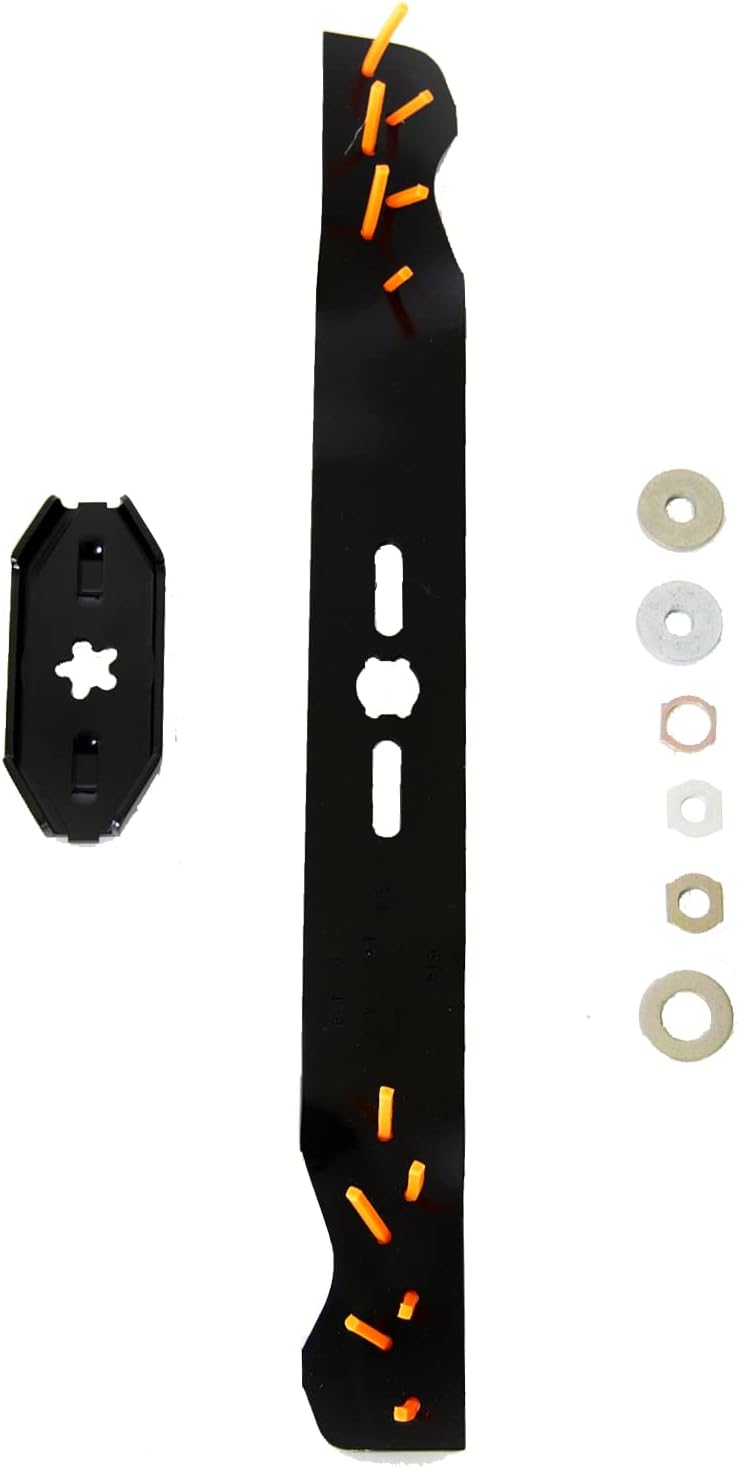
The Arnold 490-100-0083 is a universal replacement blade designed for 21, 22, and 23 inch walk-behind lawn mowers. It combines a standard cutting blade with nylon dethatching lines, letting you mow and clean up your lawn at the same time. This is a smart upgrade for homeowners who want to reduce manual raking and dethatching without investing in a separate machine.
This blade is best suited for DIY homeowners with medium sized lawns. It fits most popular mower brands including Troy-Bilt, Craftsman, Honda, Husqvarna, Toro, Snapper, and Yard Machines. The included adapters make it easy to install on different center hole sizes. Just note that it's not designed for battery powered mowers, as the extra load can drain batteries quickly or strain the motor.
In real world use, the blade cuts grass cleanly while the nylon lines help lift and break up leaves and light thatch. Many users report it saves hours of raking each season. The dethatching effect is mild, so it works best for light to moderate thatch buildup. For heavy thatch, the nylon lines can wear down fast, and some users have reported tines breaking off on the first pass. Replacing the lines with thicker trimmer string can improve durability.
Build quality is solid for the price. The steel blade is sturdy, and the nylon lines are easy to replace. Installation is straightforward, though you should always refer to your mower's manual for torque specs and safety. The blade is lightweight and stores easily. One drawback is that the tines are not aggressive enough for serious dethatching, so if your lawn has thick thatch, you might need a dedicated dethatcher or a metal tine blade.
Overall, the Arnold 490-100-0083 is a practical, budget friendly way to add dethatching and leaf cleanup to your mowing routine. It's not a heavy duty solution, but for routine yard maintenance, it gets the job done. If you have a gas powered mower and want to save time on fall cleanup, this blade is a solid choice.
Understanding Mower Blade Detachment: Causes, Mechanics, and Prevention
A lawn mower blade can indeed fly off if mounting hardware loosens, spindle threads strip, or a severe impact fractures the steel. Mower decks are engineered with heavy skirts to contain flying debris, but a detached blade spinning at over three thousand revolutions per minute remains extraordinarily dangerous. The violent release of kinetic energy can deform the mower deck, damage the drive shaft, or project metal shards into the yard. Understanding the specific mechanical relationships that keep cutting blades anchored is essential for safe outdoor property maintenance.
The Mechanics of Retaining Hardware and Torque Loss
Retaining bolts secure the cutting blade directly to the engine crankshaft or spindle assembly under considerable rotational stress. Most walk-behind mowers rely on a single central bolt paired with a specialized concave or Belleville washer. If this bolt is undertorqued during routine maintenance, cyclic engine vibrations can gradually back the fastener out of its threads. Once clamping force drops below the necessary threshold, the blade begins slipping against the spindle adapter. This friction accelerates hardware wear until the bolt loses all thread engagement.
Overtightening mounting hardware introduces an equally severe risk of mechanical separation under the deck. Applying excessive leverage stretches the bolt shank beyond its elastic limit, creating microscopic fissures along the steel threads. Over time, recurring cutting resistance and sudden engine stops can snap the fatigued fastener clean off the spindle shaft. Homeowners should always check manufacturer specifications for recommended torque settings rather than guessing with standard hand wrenches. Replacing stretched fasteners during regular blade swaps prevents dangerous thread failures beneath the deck.
Center Hole Geometry and Spindle Adapter Alignment
Center hole compatibility dictates how securely a cutting blade locks onto the drive mechanism. Equipment manufacturers utilize distinct geometric patterns, including bow tie cutouts, six-point star patterns, and standardized round center holes. Replacement parts such as the Maxpower 331528B Mulching Blade for some 21 Inch mowers feature specific bow tie center holes designed to engage matching shaft splines. Forcing an incompatible center hole pattern onto an improper shaft eliminates the positive mechanical interlock. Without this physical engagement, the retaining bolt bears the entire rotational cutting load alone.
Mismatched components quickly erode the drive lugs on the spindle adapter during regular operation. When a blade shifts off-center by even a fraction of an inch, centrifugal forces create violent rotational imbalances that loosen hardware. Universal replacement blades, such as the Arnold 490-100-0083 21-Inch/ 22-Inch Walk-Behind model, often provide adapter sizers to accommodate multiple shaft diameters. Installing these reduction washers incorrectly or skipping them altogether allows the blade to wobble vigorously. That wobbling motion can shear mounting hardware and send the steel cutting bar loose under the deck.
Sudden Impact Hazards and Hidden Yard Obstacles
Striking immovable objects represents one of the most common catalysts for catastrophic blade detachment. Lawnmower blades rotating at full operational speed experience instantaneous deceleration when contacting exposed tree roots, steel survey stakes, or buried rocks. This sudden stop transfers immense shock loads through the cutting edge, blade body, and spindle housing. While quality replacement blades tolerate substantial flex, hard impacts can induce internal micro-cracks in the steel. When mowing on uneven ground, unseen obstacles hide easily beneath dense turf, multiplying collision risks.
Repeated strikes against smaller yard debris also contribute to metal fatigue over multiple mowing seasons. A hairline fracture that starts near the center mounting hole or lift sail can propagate across the blade width unnoticed. During subsequent high-speed operation, normal aerodynamic drag and grass resistance can cause the weakened metal to shear completely in half. The broken section then separates with tremendous velocity, relying entirely on the deck skirt to prevent external ejection. Routine visual inspections after every significant yard strike remain essential for detecting early structural deformation.
Spindle Assembly Failures and Bearing Seizure
Spindle assemblies house the precision bearings that allow the cutting shaft to rotate smoothly inside the mower deck. When moisture, grass buildup, or old age compromises the internal bearing seals, friction increases dramatically within the housing. A bearing that runs dry will eventually overheat and seize during heavy cutting conditions. When a spindle shaft locks instantaneously while the engine or drive belt is still transferring power, the rotational inertia has to dissipate somewhere. This violent mechanical stop can snap the spindle housing mounting bolts or break the shaft itself.
Riding mowers and lawn tractors with multi-blade decks experience heightened spindle stress because multiple assemblies operate simultaneously. Cracked aluminum spindle housings allow the entire spindle shaft and attached blade to wobble out of alignment. If the housing breaks free from the stamped steel deck, the spinning blade assembly will churn violently against the deck walls. Regular grease maintenance on commercial-style spindles and prompt replacement of grinding bearings prevent these catastrophic housing fractures. Listening for high-pitched squealing or grinding noises under the deck offers early notice of bearing distress.
Recognizing Critical Warning Signs Before Separation Occurs
A loose or damaged mower blade rarely detaches without providing unmistakable physical warnings to the operator. The most immediate symptom of a compromised cutting assembly is intense, sudden deck vibration felt through the handlebars or footrests. While minor vibration is normal on gas-powered equipment, an unbalanced or slipping blade produces a distinct harmonic shudder that rattles the entire frame. Ignoring this vibration allows loose retaining hardware to back out further with each revolution of the motor. Shutting down the machine immediately when unusual shaking starts is the safest initial response.
Visual cutting irregularities also signal that mounting hardware or blade geometry has suffered severe degradation. A blade that has loosened on its spindle will tilt slightly, resulting in ragged, uneven streaks across previously manicured grass. Operators may also hear an intermittent metallic clinking or rattling beneath the deck as the loose metal contacts the spindle adapter irregularly. Another telling sign is engine bogging during light cutting passes, caused by the blade shifting and wedging against the inner deck baffle. Inspecting the underside of the deck at the first sign of poor cut quality prevents compounding mechanical damage.
Electric Versus Gas Deck Mechanics and Kinetic Realities
Modern electric mowers introduce unique operational characteristics compared to traditional combustion-powered equipment. Advanced battery machines, such as the EGO Power+ Electric Lawn Mower with its 22-inch composite deck, generate up to 10.6 foot-pounds of cutting torque and blade speeds up to 3,200 RPM. Electric motors deliver near-instantaneous torque upon startup, placing distinctive rotational loads on the blade interface. Exploring how specialized brushless electric mower blades manage airflow and cutting resistance highlights the importance of matching hardware to specific drive systems.
Electric decks frequently employ stacked dual-blade systems to maximize mulching performance and bagging efficiency. Stacking an upper mulching blade over a lower standard cutting blade doubles the reliance on correct spacer alignment and flange seating. If an operator mounts the blades out of rotational phase or omits the key washer, the stacked assembly can slip under load. While composite deck materials offer substantial impact dampening, maintaining correct fastener tightness remains just as critical on electric mowers as on heavy steel gas tractors. Both platforms demand strict adherence to manufacturer assembly diagrams.
Best Practices for Safe Blade Removal and Installation
Servicing cutting blades requires deliberate safety precautions before touching any hardware beneath the mower deck. Operators must always disconnect the spark plug boot on gas mowers or remove the safety key and battery pack on cordless models. Wedging a scrap piece of lumber against the deck wall is a common DIY method to immobilize the blade, but wood can slip under high torque. Utilizing a specialized locking clamp, such as the MaxPower 339079 Universal Mower Blade Removal Tool, securely anchors the blade edge against the deck flange. This rigid mechanical restraint prevents accidental rotation while breaking stubborn bolts loose.
Installing replacement blades like the Hipa 942-0741A Mulching Blade for Troy Bilt 21 inch models requires careful attention to blade orientation. The curved lift wings or mulching ridges must point upward toward the mower deck, never down toward the soil. Installing a cutting blade upside down degrades cutting performance and exposes the retaining bolt to direct friction against grass and ground debris. Applying a small drop of clean machine oil or thread locker only when explicitly recommended by the manufacturer ensures stable thread engagement. Finally, tightening the center bolt with a calibrated torque wrench guarantees adequate clamping without stretching fastener threads.
Washer Orientation, Thread Wear, and Fastener Replacement Protocols
The retaining washer placed under the blade bolt plays an indispensable role in maintaining constant clamping tension. Many mower manufacturers specify Belleville spring washers, which feature a slight conical crown designed to exert spring pressure against the blade face. If a homeowner installs this curved washer backward with the crown facing away from the bolt head, the washer loses its spring resistance completely. Under normal mowing vibrations, a flat or inverted washer permits rapid bolt loosening. Inspecting the washer for cracks, flattened crowns, or rust pitting should accompany every blade swap.
Reusing old, rounded, or corroded hardware across multiple blade changes creates unnecessary risk for equipment owners. Factory bolt threads stretch microscopically each time they are torqued down, reducing their ultimate holding capability over years of service. If a bolt shows thread galling, rounded hex corners, or corrosion along the shank, replacing it with factory-spec hardware is essential. Sourcing direct replacements from reputable manufacturers like MTD Genuine Parts ensures thread pitch, grade rating, and shank dimensions match factory requirements. Never substitute standard utility hardware from a local hardware store for hardened outdoor power equipment fasteners.
Deck Baffles, Safety Skirts, and Containment Dynamics
Even in the rare event that a blade bolt shears or a cutting edge fractures, mower decks are specifically engineered to contain high-speed debris. Steel and engineered composite decks incorporate rolled skirts and deep side baffles designed to absorb violent internal deflections. When a detached blade strikes the interior deck wall, the impact redirects kinetic energy downward into the soil rather than outward toward the operator. Discharge chutes and heavy rubber safety flaps serve as secondary barriers to arrest loose fragments traveling through the exit tunnel.
Maintaining the structural integrity of these protective deck barriers is just as vital as securing the blade hardware itself. Mower decks that suffer from severe rust perforation, cracked weld seams, or missing discharge chutes lose their defensive containment capabilities. If an internal component detaches inside a rusted deck, high-velocity fragments can breach the thin metal shell and escape into the surrounding yard. Keeping the underside of the deck clean of caked grass prevents moisture buildup that accelerates deck rot. Replacing damaged safety flaps and patching corroded deck housings ensures the containment envelope remains fully functional.
Ongoing Maintenance Discipline and Final Verification
Establishing a routine inspection schedule prevents minor hardware loosening from developing into dangerous deck failures. Before each mowing session, taking a moment to rock the blade gently by hand with the engine disabled reveals any looseness in the spindle or bolt. If the blade exhibits any vertical play or rocks independently of the spindle shaft, do not start the engine until the hardware is inspected. Checking blade balance after sharpening is equally critical, as an uneven blade edge generates destructive harmonics that shake fasteners loose over time.
Operating outdoor power equipment demands respect for the powerful rotational forces working silently beneath the cutting deck. While a mower blade can detach under conditions of extreme neglect, improper hardware installation, or catastrophic impact, such events are entirely preventable with disciplined maintenance. Matching exact center-hole patterns, utilizing proper blade removal tools, and torquing retaining bolts to factory specifications keeps cutting equipment operating safely. Diligent care protects both the mechanical longevity of your mower and the safety of everyone in your yard.



Write Your Review
No reviews yet. Be the first to share your experience!