


Maintaining a healthy lawn requires sharp, durable cutting edges that can withstand spinning against thick turf, dense weed patches, and accidental contact with hidden yard debris. When a blade strikes a firm object, the metallurgical composition determines whether it bends safely, maintains its sharpened bevel, or fractures catastrophically beneath the cutting deck. Homeowners and maintenance professionals often wonder what steel are lawn mower blades made from when shopping for replacements or sharpening their existing equipment. Selecting the correct replacement involves examining not just outer dimensions, but also the structural grade of steel and its corresponding heat treatment. Matching your mower with an appropriate design, like consulting a reliable Craftsman lawn mower blade sizing guide, prevents premature dulling and unnecessary strain on the mower spindle.
Standard rotary lawn mowers generally rely on tough carbon steel formulations rather than brittle high-hardness alloys, ensuring that rotating parts absorb impacts without shattering. From heavy-duty mulching designs to lightweight walk-behind replacements, manufacturers engineer specific steel chemistries and tempering processes to balance edge retention against impact toughness. Newer designs also incorporate protective powder coatings or specialized forged single-piece geometry to combat grass moisture and mechanical fatigue. Understanding the relationship between steel alloy selection, blade thickness, and operational durability helps you make informed decisions when upgrading or replacing cutting hardware. By looking closely at how steel grades perform under heavy cutting loads, you can keep your machine running smoothly across every mowing session.

Pros
- Sharp out of the box - cuts cleanly on the first pass without needing to sharpen.
- Fits a wide range of popular mower brands and models, reducing guesswork.
- Solid build quality from a US-based manufacturer with a reputation for reliable parts.
- Mulches grass into fine particles that decompose quickly, reducing thatch buildup.
- Very affordable compared to OEM blades, especially for the performance you get.
Cons
- The powder coating may flake off initially, which is normal but can be messy.
- Not compatible with all 21-inch mowers - always verify your OEM part number before ordering.
- Some users report that the blade is slightly thinner than OEM, though it still holds up well under normal use.
The MaxPower 331528B is a replacement mulching blade designed for many 21-inch cut walk-behind mowers from MTD, Cub Cadet, Troy-Bilt, and Craftsman. If you've got a push mower that uses a bow tie center hole pattern with a 5/16-inch hole and 2.5-inch spacing, this blade is likely a direct drop-in. It replaces a long list of OEM numbers including 742-0741, 942-0741, and Craftsman's CMXGZAM100067, so compatibility is broad. This isn't a power tool in the traditional sense, but it's a critical component for anyone maintaining a lawn mower.
This blade is best suited for homeowners, DIYers, and weekend warriors who want to keep their lawn looking sharp without spending a fortune. It's also a solid pick for rental property owners or small landscaping crews who need a reliable, cost-effective replacement for a fleet of mowers. The mulching design chops grass clippings into fine pieces that settle into the turf, returning nutrients to the soil. That means less bagging and a healthier lawn overall.
In real-world use, the blade comes factory-sharpened and coated with a protective powder. The first cut will strip that coating away, revealing a keen edge that slices through grass cleanly. Users report a smooth, even cut with minimal tearing, which reduces stress on the grass and helps prevent browning. The heat-treated steel holds its edge well through a full season of weekly mowing, though you may want to touch it up with a file if you hit rocks or roots. Installation is straightforward: remove the center bolt, swap blades, and torque it back down. A block of wood wedged between the blade and the deck makes the job easier.
Build quality is solid for an aftermarket blade. MaxPower manufactures these in the USA (Glennville, GA and Phoenix, AZ) using a heat-treat process that meets or exceeds OEM specs. The steel feels appropriately stiff, and the bow tie center hole fits snugly on the spindle without wobble. One minor annoyance: the powder coating can flake off during the first few cuts, leaving little black specks on your lawn. That's cosmetic and harmless, but worth noting. Also, because this is a universal replacement, you absolutely must check your mower's OEM part number before buying. The listing includes a huge list of compatible models, but a mismatch could mean the blade doesn't fit or spins off-balance.
Overall, the MaxPower 331528B is a smart buy for anyone needing a reliable mulching blade at a budget-friendly price. It cuts well, fits a wide range of mowers, and is built to last. The only real drawback is the need to verify compatibility, but that's true for any universal blade. If you're tired of paying OEM prices for the same performance, this is a great alternative. Just double-check your part number, and you'll be back to mowing in no time.
Blade Length: 21 inches
Blade Width: 2.25 inches
Center Hole: Bow tie pattern, 5/16-inch diameter outer holes, 2.5-inch center-to-center spacing
Weight: 1.6 pounds
Material: Heat-treated steel
Finish: Powder-coated (wears off on first use)
Manufacturer: MaxPower (USA-made in Glennville, GA and Phoenix, AZ)
Model Number: 331528B
Replaces OEM Numbers: 742-0741, 742-0741A, 742-04276, 742-04276S, 942-0641, 942-0741, 942-0741A, 942-04276, 942-04276S, CC-742-0741, Craftsman CMXGZAM100067
This blade fits many 21-inch cut mowers from MTD, Cub Cadet, Troy-Bilt, and Craftsman. Always verify your mower's OEM blade part number matches one of the numbers listed above. Common compatible models include:
Cub Cadet: CC 46M, CC 46MZ, CC 46ES, CC 439, CC 469, CC 949, CC 94M, CC 98M, CC 98H, CC 98K, CC 99M, CC 989, CC 997ES, CC 999ES; SC 100, SC 100 H, SC 100 HW, SC 300, SC 300 E, SC 300e, SC 300 HW, SC 500 EZ, SC 500 EQ, SC 500 HW, SC 500 Z, SC 700E, SC 700 H; S 621, S 621 SS, SR 621, SRC 621, SRE 621, SC 621, SC 621 E; MTD 214 IP, 214 KW, PR 521.
Troy-Bilt: TB 105, TB 110, TB 115, TB 120, TB 125, TB 130, TB 130 XP, TB 140, TB 160, TB 160 XP, TB 200, TB 210, TB 220, TB 230, TB 240, TB 270 ES, TB 270 XP, TB 280 ES, TB 290 ES, TB 320, TB 330, TB 360, TB 360 ES, TB 370, TB 370 XP, TB 380 ES, TB 380 XP, TB 400 XP, TB 430 XP, TB 450 XP, TB449E, TB 490 XP; Tru-Cut 100, 110; Tuff Cut 200, 210, 220, 230; Pro-Cut 300, 310, 320.
Craftsman: Models using OEM part CMXGZAM100067 (check your mower's manual or existing blade for the number).

Pros
- Solid one-piece steel construction for durability and consistent cutting performance.
- Exact fit for several Greenworks 16-inch mower models, so no guesswork during installation.
- Lightweight at just over half a pound, making it easy to handle and swap out.
- Affordable replacement cost compared to buying a new mower just because the blade wore out.
Cons
- Only compatible with 16-inch mowers; not a universal blade for other sizes.
- Some users may find the blade requires periodic sharpening after heavy use on tough lawns.
- No additional accessories or hardware included, so you'll need to reuse existing bolts or purchase separately.
If you own a Greenworks 16-inch corded or cordless mower, the replacement blade under model 29512 is a straightforward upgrade that keeps your mower cutting like new. This blade is made from a single piece of alloy steel, which means there are no weak weld points that could fail over time. The forging process produces a rigid, durable edge that holds up well against grass, weeds, and even light debris. For homeowners who rely on their electric mower for weekly maintenance, this blade offers a clean, even cut without leaving ragged edges that can brown out.
The installation process is simple. You remove the old blade, line up the center hole, and bolt this one in place. The 15.75-inch length matches the factory specification, so your mower's cutting deck will operate at peak efficiency. Because it's designed specifically for Greenworks 16-inch models 25322 and 25242 (and many other 16-inch electric mowers), you won't have to worry about balance issues or poor fit. Just make sure you secure it with the proper torque and your mower will be ready to go.
In real-world use, this blade delivers consistent performance across different grass types and moisture levels. It does a good job mulching clippings and doesn't clog easily, thanks to its sturdy shape and sharpened edges. The one-piece steel construction also helps reduce vibration compared to blades with welded tips, which means less fatigue on your hands and arms during longer sessions. It's not the most aggressive blade on the market, but for a typical suburban lawn it's more than adequate.
Build quality is solid. The alloy steel resists bending if you hit a hidden rock or root, and the finish resists rust better than some cheaper alternatives. That said, like any mower blade, it will eventually need sharpening. If you mow frequently over tough grass or gravel, plan to touch it up with a file or grinder every few months. The lightweight design (just under 0.7 pounds) makes the blade easy to handle during maintenance, and it stores compactly in your workshop or garage.
One limitation is that it's not a universal blade. It only fits 16-inch mowers with the specific center hole pattern. Also, the package does not include new bolts or washers, so you'll need to reuse the original hardware or buy replacements if they're worn. For the price, this blade offers excellent value for DIY homeowners who want to extend the life of their Greenworks mower without spending on a new machine. It's a practical, reliable choice that gets the job done neatly.
Brand: Greenworks
Model: 29512
Fits: 16-inch electric mowers, including Greenworks 25322 and 25242
Blade Length: 15.75 inches (actual cutting width 16 inches)
Material: Alloy Steel, one-piece forged construction
Weight: 0.69 pounds
Dimensions: 15.75 x 1.97 x 0.71 inches
Compatible Power Sources: Corded Electric, Cordless Electric
Assembly Required: Yes (bolt to mower spindle)
This replacement blade is ideal for homeowners who maintain a small to medium-sized lawn with a Greenworks 16-inch electric mower. It's perfect for routine weekly mowing of Bermuda, fescue, or rye grass. Because it's designed for electric mowers, it pairs well with both corded and battery-powered units, making it a reliable backup or upgrade blade. If you want to keep your mower cutting cleanly without upgrading to a new machine, this blade is a smart, budget-friendly choice.

Pros
- Exceptional mulching performance reduces yard waste and cleanup time.
- Significantly quieter operation compared to standard blades based on user feedback.
- Solid build quality with thicker steel than many OEM replacements.
Cons
- High lift design can suck up sand or small debris, so avoid bare spots or loose dirt.
- Not compatible with S-shape center hole decks; requires 6-point star fitment.
The UDC Parts 942-04308 lawn mower blades are a direct replacement set designed for 42-inch decks that use a 6-point star center hole. Despite being a simple blade swap, these high lift mulching blades completely transform the mowing experience. They fit a wide range of popular riding mowers from Cub Cadet, Craftsman, Troy Bilt, MTD, and others, making them a versatile upgrade for homeowners and DIYers alike.
In real-world use, the standout feature is the mulching capability. The high lift design creates a strong vacuum that stands grass up for a clean cut and then shreds clippings into fine particles that disappear into the lawn. Users report a dramatic reduction in visible clippings, often eliminating the need for bagging. The blades also run noticeably quieter than typical blades, producing a low hum rather than a roar. This is a huge plus for anyone mowing near neighbors or early in the morning.
Build quality is impressive for the price. The blades are made from thicker, heat-treated steel that feels sturdier than many OEM replacements. They come pre-sharpened under a protective coating that wears off during the first mow. After that, you can resharpen them several times to extend their life. Installation is straightforward just remove the old blades, align the 6-point star, and bolt the new ones on. No adapters or modifications needed.
One realistic drawback is the high lift design itself. Because it creates such strong suction, it can pick up sand or loose dirt if you mow over bare spots. This can dull the blades faster and may kick up debris. Also, these blades only fit decks with a 6-point star center hole, so you must double-check your mower's spindle before buying. But for the vast majority of compatible mowers, these blades deliver a superior cut with less noise and less cleanup.
Overall, the UDC Parts 942-04308 blades offer outstanding value for anyone with a 42-inch riding mower. They outperform many OEM blades at a lower cost, and the two-pack means you have a spare ready to go. Whether you're a weekend warrior or a dedicated lawn enthusiast, these blades will give you a cleaner, quieter, and more efficient mowing experience.
Length: 21-1/4 inches (measured diagonally)
Width: 2-1/2 inches
Thickness: 0.157 inches
Center Hole: 6-point star
Side Hole: 3/8 inch
Center to Center Outside Hole: 3 inches
Air Lift: 1-7/64 inches
Cutting Edge Length: 6-57/64 inches
Compatible Deck Size: 42 inches
Package Includes: 2 blades
Replaces OEM part numbers: 942-04308, 942-04308A, 942-04312, 942-04308-X, 942-04312A, 742-04308, 742-04308A, 742-04312, 742-04312A, 942-0656, 742-0656, 490-110-C108, 490-110-C109, 490-110-M108, CMXGZAM110108, OCC-742-04312, OEM-742-04308.
Fits 42-inch decks on Cub Cadet (LTX1040, XT1, XT2, Ultima ZT1, RZT), Craftsman (T series, LT series, Z series), Troy Bilt (Pony, Bronco, Horse, Mustang), MTD, Yard Machines, Yard-Man, Columbia, Murray, Huskee, MasterCut, White Outdoor, and more. Always verify your mower model number and deck type before ordering.
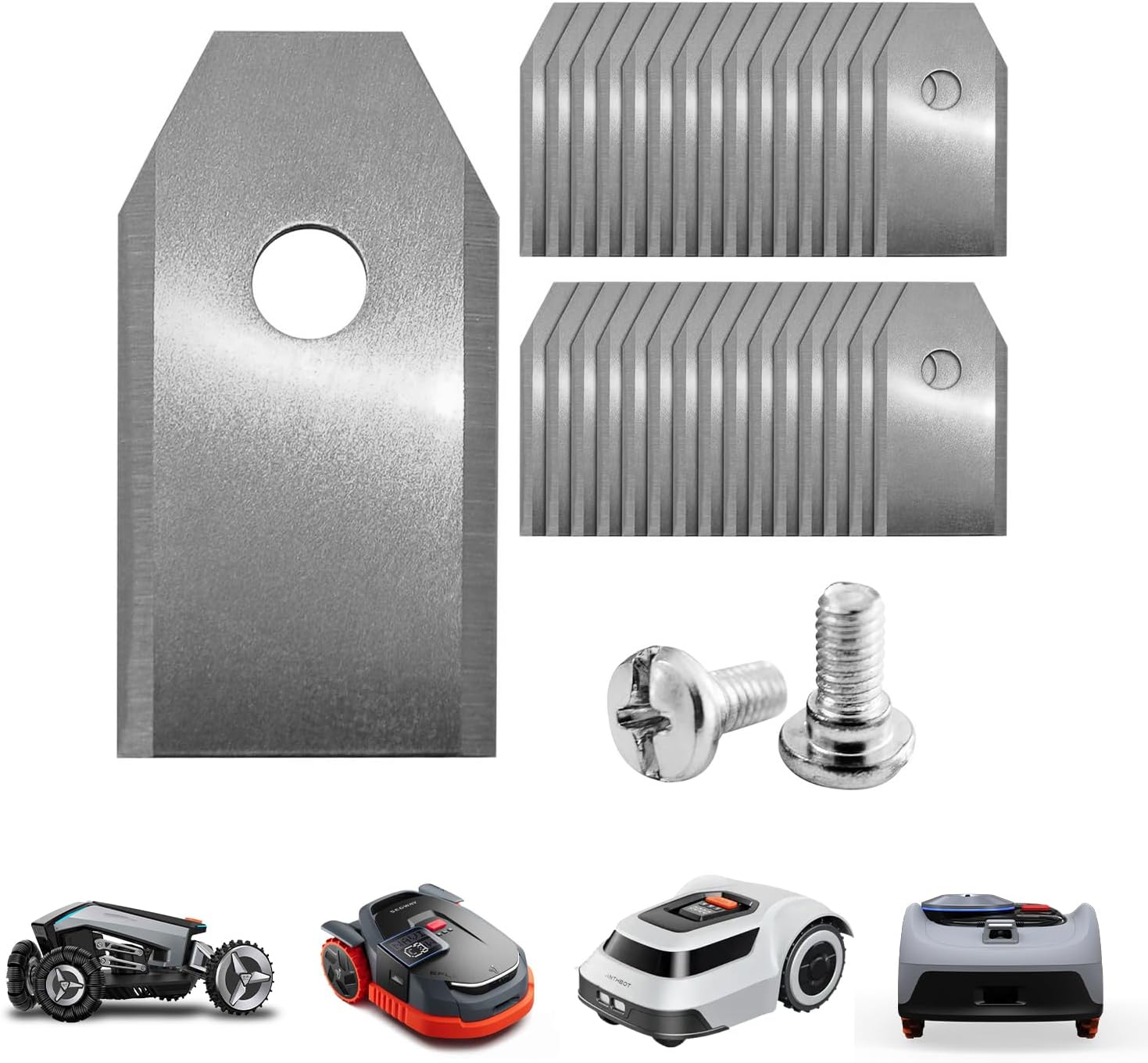
Pros
- High-quality stainless steel resists rust and stays sharp longer than standard blades.
- Extra length improves cutting efficiency and gives a cleaner lawn finish.
- Includes perfectly matched screws for a secure, vibration-free fit.
Cons
- Compatibility limited to single-disc mowers - will not fit models like Ecovacs Goat A3000 with dual discs.
- Some users may prefer a thicker blade for very tough or overgrown grass conditions.
- As a new product with no reviews yet, long-term durability is unproven in the field.
If you own a robotic mower from Husqvarna, Gardena, Segway Navimow, or a handful of other single-disc models, the Green Piece 30-pack replacement blades are worth a close look. These aren't your average generic blades - they're 43mm extra-long stainless steel pieces designed to cover more ground per rotation. For homeowners or DIYers who want a clean, well-maintained lawn without constant blade changes, this set offers a practical and affordable solution.
Out of the box, the blades feel premium. The stainless steel is 0.75mm thick - enough to stay rigid during cutting but thin enough to slice through grass cleanly. The double-sided edge is a smart touch: when one side dulls, just flip the blade and keep going. That effectively doubles the lifespan of each blade, which is a real plus for anyone mowing a larger yard. The included screws are also stainless, so you won't deal with rust seizing up the threads halfway through the season.
Installation is as easy as it gets. No special tools are needed - just a standard screwdriver to swap out old blades. The precision-drilled bore hole lines up perfectly with the mowing disc, so you get a vibration-free fit. In real-world use, these blades produce a crisp, even cut that reduces tearing on grass blades. Healthier grass means a greener lawn with fewer bare spots, which is exactly what you want from a robotic mower.
That said, there are a couple of things to keep in mind. First, these blades are designed exclusively for mowers with a single mowing disc. If you have an Ecovacs Goat A3000 or any dual-disc model, they won't work. Second, the 0.75mm thickness is great for normal grass but might struggle with very thick, wet, or overgrown lawns where a heavier-duty blade would be better. Also, since this is a brand-new product with zero customer reviews yet, you're relying on the manufacturer's specs alone for now.
Overall, the Green Piece 30-pack is a smart buy for anyone with a compatible robotic mower who wants reliable, long-lasting blades without spending a fortune. The extra length and stainless steel construction deliver noticeable cutting improvements, and the included screws make maintenance a breeze. For the DIYer or homeowner who values a sharp lawn and hassle-free upkeep, this pack is a solid choice.

Pros
- Solid hardened steel build with good rigidity for consistent cutting on large decks
- Balanced design keeps vibration low, reducing strain on the mower spindle and operator
- Corrosion-resistant coating helps the blades last longer in humid storage or frequent wet mowing
- Affordable three-pack price point makes full deck replacement economical
Cons
- Limited review data available, so long-term durability compared to OEM blades is not yet proven
- Coating may wear off over time if used heavily on abrasive or sandy soil
- Only fits specific 52-inch deck models, so careful deck measurement is required before purchase
The Yolvvetrx 04771200 lawn mower blades are a replacement set designed specifically for Ariens IKON X, IKON XL, Edge and Gravely ZT X, ZT XL zero-turn mowers with 52-inch decks. If you own one of those machines and need a fresh set of blades, this three-pack covers the entire deck. These blades measure 18 inches in length, 2-1/4 inches in width, and 0.158 inches in thickness, with a 5/8-inch center hole. They are built from heat-treated hardened steel and come with a protective surface coating to resist corrosion.
In real-world use, the hardened steel construction gives these blades noticeable rigidity. During high-speed rotation on a 52-inch deck, the blades stay true and resist flexing, which translates into a more consistent cut across wide swaths of grass. The balanced weight distribution helps reduce vibration, a key factor when you are spending hours on a zero-turn mower. Less vibration means less fatigue for the operator and less wear on the mower spindles over time. The 0.158-inch thickness adds durability compared to thinner blades, allowing them to handle thicker grass and occasional sticks or debris without bending out of shape.
These blades are best suited for homeowners with a few acres of lawn or light commercial users who maintain properties regularly. They are not designed for heavy-duty commercial mowing day in and day out, but for routine residential and light commercial use, they perform well. The protective coating helps prevent rust during storage and in damp conditions, which is a practical benefit if you store your mower in a humid garage or shed. One thing to note is that you must verify your deck size before ordering, as these only fit 52-inch decks. Double-check your mower model compatibility from the list provided.
On the downside, there are no user reviews yet, so long-term reliability data is limited. The coating may wear off over time if you frequently mow in sandy or abrasive conditions, but that is typical for most coated blades. Overall, the Yolvvetrx 04771200 blades offer a cost-effective replacement option for Ariens and Gravely zero-turn owners. If you are looking for a set of blades that deliver solid cut quality, reduced vibration, and corrosion resistance without the OEM markup, these are worth considering. They are a practical choice for anyone who wants to keep their 52-inch deck cutting clean without spending a premium.
Length: 18 inches
Width: 2-1/4 inches
Thickness: 0.158 inches
Center Hole Diameter: 5/8 inches
Quantity: 3 blades per pack
Material: Heat-treated hardened steel
Coating: Protective corrosion-resistant finish
Color: Black
Compatible Decks: 52-inch decks on select Ariens and Gravely zero-turn mowers
Ariens IKON X: 915177, 915225, 915222, 915223, 915332, 915205, 915330
Ariens IKON XD: 915266, 915267, 915335, 915341, 915343
Ariens IKON XL: 915227, 915239, 915201
Ariens Edge: 915254, 915285
Gravely ZT X and ZT XL models with 52-inch decks
Always verify your deck size and model number before purchasing.
Lawn Mower Blade Metallurgy: Steel Types, Heat Treatment, and Longevity
Rotary lawn mower blades are predominantly manufactured from medium-carbon steel, heat-treated high-carbon alloys, or specialized spring steels rather than ultra-hard tool steels or common mild steel. This specific metallurgical balance provides enough ductility to bend slightly under extreme shock loads while maintaining sufficient hardness along the cutting edge to resist rapid dulling. Because a lawn mower blade spins at tip speeds exceeding one hundred and fifty miles per hour, mechanical failure through brittle cracking presents severe safety hazards. Understanding how manufacturers select steel alloys, apply heat treatment, and finish cutting edges helps buyers evaluate aftermarket replacements and maintain their cutting hardware safely throughout the mowing season.
Medium-Carbon and High-Carbon Steel in Rotary Blades
Most standard walk-behind and riding mower blades use medium-carbon steels such as AISI 1045, 1050, or 1060 grades, along with modified alloys like 5160 spring steel. Carbon content in these alloys typically ranges between zero point four percent and zero point six percent by weight, which establishes an ideal middle ground for outdoor power equipment. If a manufacturer uses low-carbon mild steel, the blade will bend too easily against dense thatch and lose its sharp cutting edge after only a few mowing sessions. Conversely, using an ultra-high-carbon tool steel would make the rotating component excessively brittle, creating dangerous projectile risks if the blade strikes an exposed tree root or rock.
Alloy additions like manganese and chromium are frequently introduced during steel production to increase hardenability, tensile strength, and impact resistance. Manganese helps deoxidize the molten steel and enhances depth hardening during quenching, while chromium supports basic wear resistance and grain structure stability. In heavy commercial decks and high-stress residential tractors, spring steel formulations like 5160 provide exceptional elasticity that allows the blade body to flex momentarily when encountering obstacles and return to its true alignment. When reviewing durable mower blade feedback, buyers consistently note that blades made from properly specified carbon steel alloys resist permanent deformation far better than budget alternatives stamped from unrefined sheet scrap.
The Critical Role of Heat Treatment and Rockwell Hardness
The raw steel composition is only half of the metallurgical equation, as controlled heat treatment fundamentally dictates how the blade behaves during operation. After steel blanks are stamped or forged to shape, manufacturers heat the material to an austenitizing temperature before rapidly cooling it through oil or water quenching. This rapid cooling transforms the crystal structure into hard martensite, which is subsequently reheated during a controlled tempering cycle to relieve internal stresses. Without precision tempering, quenched carbon steel remains too glass-like to survive standard rotational vibrations, making thermal regulation essential during manufacturing.
The target hardness for most rotary mower blades falls between 40 and 50 on the Rockwell C scale (HRC), with many quality blades calibrated around 42 to 46 HRC. In comparison, high-end kitchen knives frequently reach 58 to 62 HRC, which produces an extraordinarily keen edge that would chip or shatter instantly under lawn mowing conditions. Products like the Yolvvetrx 04771200 commercial replacement blades explicitly highlight heat-treated, hardened steel construction designed to maintain structural rigidity and resist blade flex at high operating speeds. Maintaining a moderate Rockwell rating ensures the cutting bevel can be touched up repeatedly with a standard mill bastard file without requiring specialized diamond grinding wheels.
One-Piece Forging Versus Stamped Steel Manufacturing
Lawn mower blades are primarily formed through two distinct manufacturing methods: precision sheet stamping or hot drop forging. Stamping involves feeding rolled steel sheets through high-tonnage punch presses that cut the blade outline and punch the center mounting hole in rapid production cycles. While modern stamping with high-grade carbon steel yields dependable blades, the directional grain structure of cold-rolled sheet metal can leave localized stress points near complex contours. Stamped blades require careful deburring and post-stamping thermal processing to ensure uniform mechanical characteristics from hub to tip.
Forged construction, utilized in components such as the Greenworks 16-inch replacement blade, shapes heated steel billets under mechanical compressive force to align the metallic grain structure along the entire length of the component. The manufacturer notes that forging from a single piece of steel provides enhanced durability, helping the structure withstand extensive rotational strain during dense cutting tasks. This aligned grain flow increases fatigue resistance, making forged blades particularly capable of absorbing continuous harmonic vibration without developing hairline cracks near the spindle adapter. While forged blades often entail tighter manufacturing tolerances, both forged and properly stamped high-grade steel blades deliver reliable cutting performance when matched to appropriate deck requirements.
Stainless Steel Construction in Robotic Mower Blades
While traditional rotary lawn mowers strictly avoid stainless steel due to cost and impact toughness limitations, robotic mowers represent a notable metallurgical exception. Products such as the Green Piece robotic mower blades utilize razor-thin stainless steel measuring roughly 0.75 millimeters in thickness rather than heavy carbon steel bars. Robotic mowers operate on completely different cutting mechanics, using free-swinging miniature razor blades mounted on a spinning disc that clip grass tips daily rather than chopping tall overgrown stalks in weekly intervals. Because these small blades do not experience massive kinetic impact loads, manufacturers prioritize corrosion resistance over gross structural bulk.
Stainless steel grades utilized in robotic cutting discs contain elevated chromium levels that resist aggressive organic acids, grass sap, and constant moisture found in damp turf. In high-humidity environments or rainy mowing conditions, carbon steel razor blades would corrode rapidly, degrading cutting sharpness within days. The double-sided stainless steel design allows operators to flip the blades to utilize fresh cutting edges while enjoying natural rust immunity. However, this stainless formulation remains restricted to lightweight automated cutting discs, as installing a thin or brittle stainless alloy on a high-displacement gas mower deck would quickly result in catastrophic structural failure.
Steel Thickness, Rotational Inertia, and Deck Rigidity
A blade’s structural performance depends heavily on material thickness, which directly influences rotational inertia, aerodynamic lift, and deflection resistance under load. Standard residential walk-behind push mowers typically feature steel thicknesses between 0.120 and 0.135 inches, which keeps rotating mass low for smaller engines while preserving basic durability. In contrast, heavy-duty lawn tractors and commercial zero-turn decks require substantially thicker steel stock to maintain stability across wider cutting paths. Products such as the UDC Parts 942-04308 blades specify a thickness of 0.157 inches, while the Yolvvetrx commercial 18-inch blades measure 0.158 inches, reflecting commercial-grade material volume.
Increased steel thickness prevents the cutting tips from fluttering or bowing downward when high-lift sails generate powerful vacuum currents inside the deck baffle. When a thin blade deflects under heavy grass volume, the cutting height fluctuates, producing an uneven or streaked lawn finish. Thicker steel also provides more sacrificial material along the cutting bevel, allowing owners to sharpen the blade multiple times over multiple seasons before the profile becomes dangerously narrow. However, thicker blades increase overall weight, requiring adequate engine displacement and sturdy spindle assemblies to accelerate and brake the spinning mass safely.
Protective Surface Coatings and Powder Coating Technology
Because carbon steel oxidizes quickly when exposed to moisture and acidic lawn clippings, manufacturers apply protective surface treatments prior to packaging and distribution. Powder coating is the prevailing industrial standard, electrostatically applying dry polymer particles before curing the blade inside a high-temperature baking oven. As seen with Maxpower 331528B mulching blades, the entire surface is precision sharpened during production and then powder coated for user protection and warehouse corrosion resistance. The manufacturer notes that this protective coating naturally wears away from the cutting bevel during initial mowing to expose the clean, factory-sharpened steel edge beneath.
Some premium commercial blades feature advanced e-coating or proprietary black enamel finishes designed to resist abrasive wear from sandy soils and organic mulch debris. Exploring specialized black mower blade configurations illustrates how protective coatings prevent pitting along the blade body, extending service life between seasonal maintenance intervals. While paint and powder coatings effectively preserve steel during shipping and winter storage, they do not replace routine deck cleaning. Wet grass clippings trapped against the steel body will eventually break down surface coatings through continuous chemical degradation, underscoring the importance of post-mow deck scraping and dry storage.
Sharpening Practices and Preserving Steel Temper
Maintaining a factory-sharp cutting bevel requires careful technique to prevent overheating and altering the heat-treated metallurgical structure of the blade. When homeowners use aggressive bench grinders or high-speed angle grinders without adequate cooling, localized temperatures along the cutting edge can rapidly exceed the original tempering threshold. If the steel changes color to a deep blue or straw brown during grinding, it indicates that the metal has annealed and lost its heat-treated hardness. An edge that has lost its temper becomes soft, causing the blade to dull almost immediately after striking ordinary grass blades.
To preserve original steel hardness, maintenance experts recommend using light passes with a fine-grit flap disc, a dedicated blade sharpener, or a traditional hand file. Dipping the blade periodically into cold water during mechanical grinding helps dissipate thermal buildup before it compromises the underlying crystal lattice. Furthermore, operators must maintain the factory bevel angle, which typically measures between 30 and 35 degrees on rotary cutting hardware. Creating a razor-thin angle like a surgical scalpel weakens the edge geometry, causing the steel to roll over or chip when meeting coarse turf, twigs, or small landscape stones.
Verifying Steel Integrity, Balance, and Safe Operating Boundaries
Routine inspection of the steel substrate is a vital safety procedure that prevents catastrophic mechanical failures beneath the mower deck. Over extended mowing seasons, continuous friction from abrasive soil particles scours away metal from the high-lift sail and the trailing edge of the blade body. If the steel near the lift wings wears excessively thin or develops visible stress cracks extending outward from the center mounting hole, the component must be replaced immediately. Operating a cracked or severely fatigued carbon steel blade can cause large metal fragments to break free at high velocity, potentially penetrating deck baffles and causing catastrophic injury.
Dynamic balancing is equally essential following any blade sharpening or steel repair to ensure smooth rotational harmony across the spindle bearings. An uneven blade removes metal disproportionately from one wing, generating severe centrifugal vibrations that loosen mounting bolts and accelerate wear across engine crankshafts or hydrostatic transmissions. Utilizing a mechanical cone balancer or precision wall-mounted balancing tool verifies that both cutting wings carry identical weight before reinstallation. Before installing any replacement, always confirm that the center-hole geometry, such as the 6-point star found on UDC Parts or the bow-tie shape on Maxpower models, matches your mower spindle precisely to avoid mounting play and dangerous vibration.
Selecting the right lawn mower blade comes down to understanding how medium-carbon and heat-treated alloy steels balance cutting hardness against essential impact toughness. Whether you manage a residential lawn with a single-piece forged blade, run a commercial zero-turn with heavy-gauge hardened steel, or rely on stainless steel discs for robotic trimming, matching the metallurgy and physical specifications to your equipment ensures safe, efficient operation. Prioritizing verified OEM fitment, preserving steel temper during maintenance, and replacing worn blades before metal fatigue sets in will keep your cutting deck operating at peak reliability season after season.




Write Your Review
No reviews yet. Be the first to share your experience!