


Thick carpet-like grass varieties require specific cutting dynamics to stay healthy throughout the warm growing season. When stolons spread across the soil, ordinary yard tools can bog down or chew unevenly across the lawn surface. Many property owners ask what is best lawn mower for st augustine grass after noticing torn blade tips or yellowing turf patches. Choosing the right cutting platform ensures your grass maintains strong root systems and resists summer heat stress without suffering from scalping damage.
St. Augustine turf forms dense mats of above-ground runners that demand adequate deck clearance and reliable cutting power. If you are managing larger turf areas, reviewing mowers suited for half-acre lawns provides helpful perspective on propulsion, cut quality, and deck width. Proper mower selection helps maintain the ideal canopy height without scalping irregular terrain or overloading the motor. Balancing wheel maneuverability, durable construction, and clean cut quality gives your yard an attractive, uniform appearance every week.

Pros
- Easy to apply with standard hose-end sprayer or watering can.
- Gentle formula doesn't burn grass even with regular use.
- Noticeable improvement in grass color and thickness within weeks.
- Clear instructions on label for proper dilution and application.
Cons
- 8 oz bottle may only cover small lawns; larger yards may need multiple bottles.
- Liquid concentrate requires mixing and careful measurement for best results.
- Not effective during winter dormancy; best used in growing season.
This liquid fertilizer from TPS Nutrients is purpose-built for St. Augustine grass, a warm-season turf that needs careful feeding to stay lush without getting burned. Unlike granular fertilizers that can be messy and uneven, this concentrate mixes cleanly with water and applies through a hose-end sprayer for uniform coverage. Homeowners who've struggled with patchy lawns or slow spring green-up will find this product a straightforward solution.
Best suited for DIY lawn enthusiasts and homeowners, this fertilizer delivers balanced nutrition that supports thicker grass blades and deeper root systems. Users in warmer climates like Florida report that it helps fill in thin areas and boosts color noticeably within a few weeks. The NPK ratio is moderate, so you don't have to worry about shocking the grass even if you apply on a regular schedule.
Application is simple: mix the concentrate with water per the label instructions and spray over the lawn. The liquid soaks in quickly without leaving residue or requiring watering in. Build quality is solid - the bottle is well-sealed and the concentrate stays stable if stored properly. One 8 oz bottle covers a modest area, so larger lawns might need to buy multiple bottles or a larger size.
A realistic drawback is the small volume. While it's perfect for a trial or for small yards, homeowners with half-acre lots will need to stock up. Also, it's not a weed killer or a complete soil amendment - it's just a fertilizer. So if your lawn has other issues like compacted soil or pests, you'll need additional treatments.
Overall, this is a reliable liquid fertilizer for St. Augustine grass that delivers on its promises. It's easy to use, safe for regular applications, and helps achieve that deep green, dense lawn most homeowners want. If you're looking for a gentle, effective boost for your warm-season turf, this is worth trying.

Pros
- Designed exclusively for St. Augustine grass so you get targeted nutrition
- Liquid form is easy to apply evenly and absorbs quickly into the soil
- Gentle formula avoids burning or yellowing, even during active growing periods
Cons
- Requires a hose-end sprayer or pump sprayer for application, not a ready-to-use bottle
- One gallon may need multiple applications for larger lawns, so factor in recurring cost
The TPS Plant Foods St. Augustine Grass Fertilizer is a liquid concentrate that delivers a well-balanced nutrient blend specifically for warm-season turf. It's not a one-size-fits-all product; this formula is tailored to St. Augustine's unique needs, helping it stay thick, green, and healthy through the growing season. If you've struggled with granular fertilizers that either burn or don't reach the roots, this liquid alternative offers more control and even coverage.
Most homeowners will find this fertilizer works best as part of a regular lawn care program. It's easy to apply with a standard hose-end sprayer, which means you can cover a large area without heavy bags or spreaders. The nutrition is gentle enough for frequent use, and reviewers consistently mention the deep green color and thicker growth they see after just a couple of treatments. The 1-gallon container is enough for several applications, depending on your lawn size.
One thing to keep in mind is that this isn't a granular slow-release product. You'll need to apply it more often, typically every 4 to 6 weeks during the active growing season. That said, the payoff is a lawn that handles foot traffic and heat better, with fewer bare spots. For DIYers and homeowners who want a vibrant St. Augustine lawn without the guesswork, this liquid fertilizer is a reliable choice.

Pros
- Integrated hose-end sprayer makes application fast and hassle-free without extra measuring equipment
- Seaweed and fish additives enrich soil composition alongside primary NPK nutrients
- Noticeable greening visible within days on actively growing grass
- Covers a wide range of grass varieties across both northern and southern lawns
Cons
- Hose-end bottle pressure can fluctuate if home water pressure is inconsistent
- 32-ounce bottle treats a limited square footage, making it less economical for multi-acre properties
- Liquid formulas require more frequent maintenance applications than coated slow-release granules
Simple Lawn Solutions 16-4-8 Balanced NPK is a ready-to-use concentrated liquid fertilizer designed for routine lawn maintenance and rapid nutrient delivery. Built for homeowners, hobbyist groundskeepers, and DIY property care enthusiasts, this product bypasses the hassle of calibration gauges, broadcast spreaders, and heavy dry fertilizer bags. The integrated hose-end spray head pulls the concentrate right into your garden hose stream, ensuring an even distribution across your turf with minimal setup time.
Under the cap, the 16% nitrogen drives bold green growth, while 4% phosphorus and 8% potassium reinforce root strength and heat tolerance. What sets this blend apart from standard chemical feeds is the inclusion of fish emulsion and seaweed extract. These organic additives nourish soil microbes, allowing grass blades to absorb nutrients more effectively. On actively growing cool-season or warm-season turf, you will typically observe deeper color and renewed vigor within just a few days of application.
In practical use around the workshop yard or home landscape, handling is straightforward. The two-pound bottle hooks directly to standard brass or plastic garden hose fittings without leaking, offering solid balance while walking the yard. However, consistent water pressure is key to getting the correct suction ratio from the siphon nozzle. For larger properties over several thousand square feet, burning through multiple 32-ounce bottles can add up quickly compared to commercial bulk concentrates or professional pull-behind spreaders.
If you want an efficient, mess-free solution to green up residential grass between major workshop projects, Simple Lawn Solutions 16-4-8 delivers solid performance. It offers a quick, dependable boost that keeps turf looking sharp without turning lawn care into an all-day chore.
Spring and early summer feeding when grass exits dormancy and demands quick nitrogen uptake.
Spot-treating faded patches, high-traffic pathways, or heat-stressed sections of your lawn.
Maintaining small to medium residential yards where storing a dedicated broadcast spreader is impractical.
Formula: 16-4-8 Balanced NPK (16% Nitrogen, 4% Phosphorus, 8% Potassium)
Added Ingredients: Seaweed and Fish Emulsion
Volume: 32 Fluid Ounces (approx. 2 lbs)
Application Method: Ready-to-Spray Hose-End Attachment
Origin: Manufactured in the USA

Pros
- Simple to mix and apply with standard lawn sprayers saves time compared to granular fertilizers
- Promotes quick greening and thicker turf without excessive growth or thatch buildup
- Balanced formulation reduces risk of nutrient burn even on sensitive St. Augustine varieties
Cons
- Only effective for warm-season grasses like St. Augustine not suitable for cool-season lawns
- Liquid format requires more frequent applications compared to slow-release granular options
- Bottle size may be small for larger lawns multiple quarts needed for significant coverage
TPS Plant Foods St. Augustine Grass Fertilizer is a liquid plant food designed specifically for warm-season lawns, particularly St. Augustine grass. Unlike all-purpose fertilizers that can throw off the delicate balance this turf type needs, this formula delivers targeted nutrition for denser growth and richer green color without sending the grass into overdrive. If you're a homeowner or DIY landscaper looking to bring a patchy St. Augustine lawn back to life, this is a solid choice.
Applying the fertilizer is straightforward. The liquid concentrate mixes with water and works great with a standard hose-end sprayer. That means you can cover a decent area without hauling a spreader around. According to early user feedback, the grass responds quickly, filling in thin spots and deepening to a healthy emerald shade. The NPK ratio is moderate enough to avoid burning, even during the hot summer months when St. Augustine is most active. It also supports root development, which helps the lawn resist heat stress and foot traffic over time.
Build quality here is less about the tool itself and more about the formulation. The liquid is free of heavy ammonia salts and uses a balanced nutrient profile that won't leave chemical residues. Being made in the USA adds confidence in manufacturing standards. The 32-ounce bottle is compact and easy to store on a garage shelf next to other lawn care products. For most standard residential lots (say up to 5,000 square feet), one bottle may cover two to three applications depending on your sprayer settings.
One limitation is that this fertilizer is strictly for warm-season grasses. If you have fescue or Kentucky bluegrass, look elsewhere. Also, because it's liquid, you do need to apply it more frequently than a slow-release granular product. Plan for every two to four weeks during the active growing season. The bottle size is on the smaller side for larger properties, so budget for multiple units or consider the larger gallon option if available.
Overall, this is a reliable, easy-to-use fertilizer for anyone committed to maintaining a lush St. Augustine lawn. It pairs well with a DIY lawn care routine and delivers visible results without the guesswork. If you already have a sprayer and want a targeted liquid feed for warm-season turf, this product is worth adding to your toolbox.

Pros
- Absorbent mulch expands and holds six times its weight in moisture, cutting down on excessive watering cycles.
- Controlled-release fertilizer actively encourages nearby St. Augustine stolons to spread over thin spots.
- Simple three-step application requires no specialized spreaders, heavy machinery, or complicated tools.
- Two-container bundle provides ample coverage for multiple pet spots, walkway edges, or drought-damaged areas.
Cons
- Does not include grass seed because St. Augustine turf spreads vegetatively via stolons and runners.
- Targeted spot-repair volume is not intended for renovating large, fully cleared acreage.
- Requires consistent initial watering to keep the mulch layer expanded and active in hot weather.
Scotts EZ Patch Lawn Repair Mulch and Fertilizer for St. Augustine Grass is a specialized lawn treatment designed to restore thin, bare, or damaged sections in warm-season southern turf. Suburban homeowners, southern lawn care enthusiasts, and property managers dealing with St. Augustine yards often encounter stubborn bare patches caused by summer heat, pet traffic, or routine mowing stress. This dual-container bundle provides targeted support to help surrounding turf spread across open soil, creating a uniform, lush appearance without requiring full lawn renovation equipment.
In typical yard maintenance routines, mowing over bare, sunken dirt can cause scalping and blade dulling. This repair mix addresses the problem by combining highly absorbent mulch with controlled-release lawn fertilizer. The mulch expands to hold up to six times its weight in water, forming a protective moisture blanket over bare dirt. Because St. Augustine grass expands via creeping stolons and runners rather than traditional turf seed, this nutrient-dense mulch matrix creates the ideal humid microclimate for neighboring runners to root down and fill in thin spots quickly before regular Saturday morning mowing routines.
The two-pack bundle delivers a total coverage area of up to 170 square feet, making it well suited for spot treatments along sidewalks, fence lines, and outdoor entertaining areas before a backyard barbecue. Each 3.75 lb container is lightweight and easy to carry across the yard, eliminating the strain of lugging 50-pound soil bags. Storing the remaining product is equally convenient, as the rigid plastic containers resist moisture and stack neatly on garage or garden shed shelving between routine lawn care chores.
Applying the mix is straightforward and requires no complex outdoor power tools or mechanical spreaders. Homeowners simply loosen the top layer of hard-packed dirt with a standard hand rake to clear away dead thatch, shake an even layer of EZ Patch across the target area, and soak it thoroughly with a garden hose nozzle. The visible expansion of the mulch provides a clear visual cue that moisture levels are sufficient, simplifying the watering routine for busy suburban residents and first-time yard owners alike.
While this repair formula excels at encouraging stolon growth and moisture retention, users should recognize its specific design. The blend does not contain grass seed, reflecting the biological nature of St. Augustine grass, so homeowners must rely on existing surrounding runners or paired turf plugs to complete the repair. For warm-climate homeowners and suburban lawn enthusiasts looking to eliminate unsightly bare patches, level out turf before seasonal mowing, and maintain vibrant curb appeal, this Scotts EZ Patch bundle offers a practical, low-effort yard maintenance solution.
Integrating spot repair into a regular warm-season mowing schedule requires proper timing and care. Before applying the patch mix, mowing the surrounding St. Augustine turf at a slightly higher deck setting helps reduce plant stress and encourages lateral runner expansion. Keeping mower blades sharp is equally important, as clean cuts prevent turf browning while adjacent runners work their way across the newly treated mulch bed.
During the initial establishment weeks, adjusting your weekly mowing pattern around the patched sections helps protect tender new root growth. Raising the mower cutting height when passing near the repair perimeter prevents accidental scalping, allowing the controlled-release fertilizer to steadily deliver nutrients until the repaired area blends seamlessly with the rest of your lush green lawn.
Pros
- Quiet and emission-free, great for early morning or late evening mowing without disturbing neighbors
- Very easy to assemble and requires almost no ongoing maintenance
- Cuts grass cleanly without shredding, leading to a healthier lawn appearance
- Lightweight and easy to store, takes up minimal garage or shed space
Cons
- Not suitable for tall or wet grass; requires frequent mowing when grass is dry and under 4 inches
- Limited cutting width of 14 inches means more passes on larger lawns, best for small to medium yards
- No power assist, so uneven or hilly terrain can make pushing more difficult
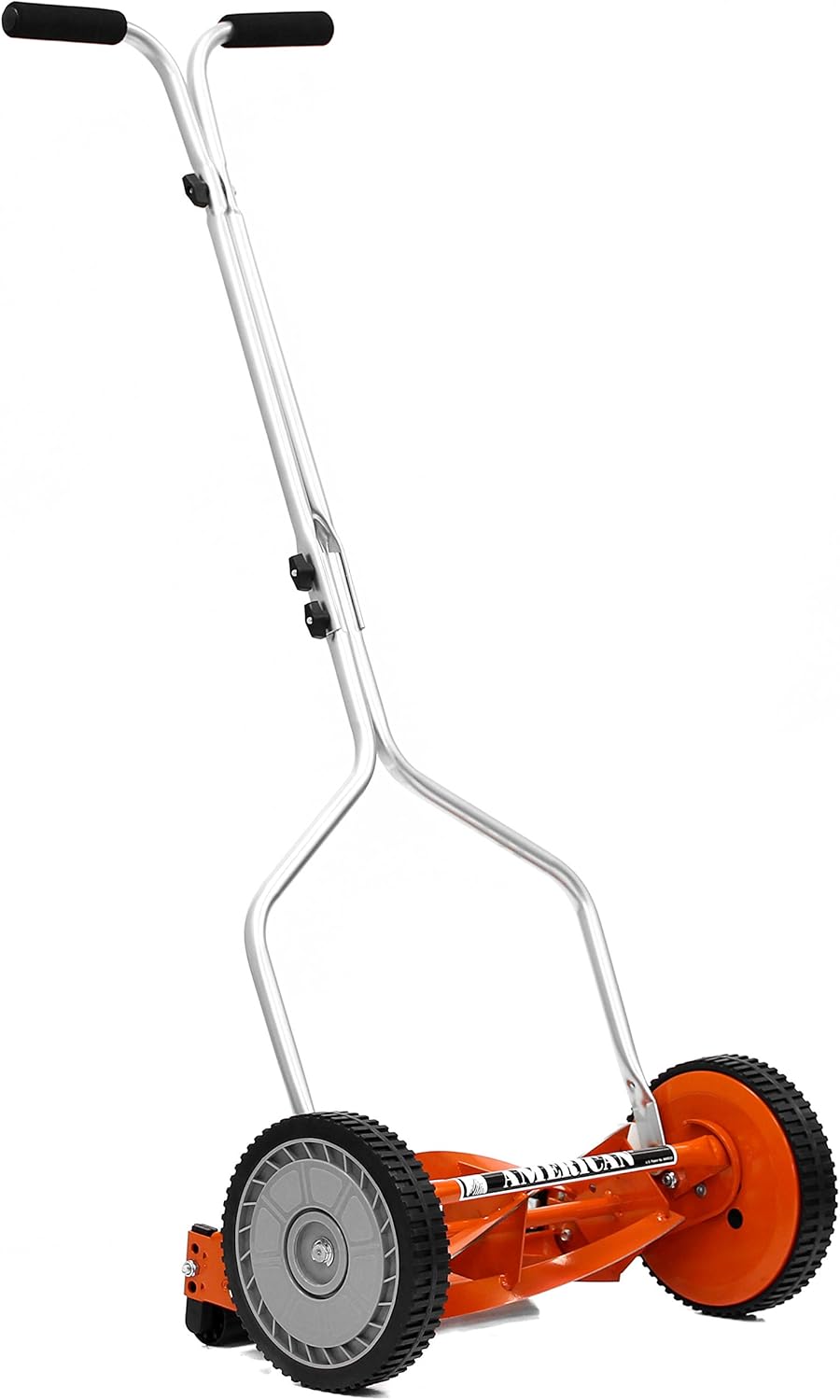
The American Lawn Mower Company 1204-14 is a classic push reel mower that brings back the simplicity of manual lawn care. Unlike gas or electric mowers, this tool relies entirely on your own muscle power to spin the reel and cut grass. It's a straightforward, no-nonsense machine designed for homeowners who prioritize quiet operation, zero emissions, and low maintenance over speed and brute force.
This mower is best suited for small, flat lawns with cool-season grasses like bluegrass, fescue, and rye. It's ideal for DIY homeowners who enjoy a bit of exercise while taking care of their yard. If you have a quarter acre or less and don't mind mowing more frequently during the growing season, this reel mower can deliver a clean, precise cut that actually promotes a healthier lawn by slicing rather than shredding the grass blades.
In real-world use, the 1204-14 performs best when you stay on top of your mowing schedule. It handles grass up to 4 inches tall, but for the best results, you should mow when the grass is dry and no more than about 3 inches high. The adjustable cutting height ranges from 0.5 to 1.75 inches, giving you good control over lawn appearance. The 8.5-inch polymer wheels roll smoothly on flat ground, but the mower can struggle on uneven or bumpy terrain. You'll need to make multiple passes if the grass is on the taller side, and wet grass will clog the reel and leave an uneven cut.
Build quality is decent for the price point. The frame is made of steel, and the reel blades are heat-treated alloy steel that stay sharp for years with minimal care. Assembly is straightforward and can be done in about 15 minutes with basic tools. The cushioned T-handle is comfortable for most users, though taller individuals might find it a bit low. At just 19 pounds, the mower is easy to lift and store, and it takes up very little space in a garage or shed.
One realistic drawback is that this mower won't replace a gas or electric model for larger or more demanding lawns. If you have a half-acre or more, or if your yard has hills, you'll likely find the manual effort tiring and time-consuming. Also, the 14-inch cutting width means more passes compared to a 21-inch power mower. But for its intended use - small, flat lawns - the American Lawn Mower 1204-14 is a reliable, eco-friendly, and cost-effective choice that gets the job done without noise, fumes, or ongoing fuel costs.
Evaluating Mower Requirements and Cutting Habits for St. Augustine Turf
The primary rule for cutting St. Augustine grass is selecting a mower that accommodates high cutting heights with sharp, clean-slicing blades. Standard St. Augustine varieties like Floratam or Palmetto perform best when maintained between 3 and 4 inches tall. Cutting this turf too short starves root systems, exposes soil to weeds, and encourages fungal development. A suitable mower must offer easy deck adjustments, sturdy wheels that do not sink into spongy turf, and ample power to handle thick runners.
Coarse warm-season grasses create more mechanical resistance than fine cool-season turf. When a mower blade impacts thick leaf tissue, dull cutting edges tear rather than slice, turning the lawn tips pale brown within hours. Scalping uneven spots also damages growing nodes that are elevated above the soil surface. Selecting an appropriate mower requires evaluating cutting height adjustability, propulsion type, blade design, and clipping management.
St. Augustine Grass Characteristics and Required Cutting Heights
St. Augustine grass grows by sending out thick, fleshy stolons that crawl horizontally along the ground. Broad leaf blades emerge vertically from nodes along these runners, forming a dense and spongy surface canopy. Because the runners sit above the soil line rather than deep below ground, aggressive low cutting can sever the main vegetative framework of the lawn. Maintaining proper blade height protects these runners from direct sunlight and mower blade impact.
Most residential St. Augustine cultivars require a mower deck that comfortably reaches 3.5 to 4 inches. Standard cultivars such as Floratam, Raleigh, and Charleston develop deeper root systems when kept at the upper end of their recommended height range. Dwarf cultivars like Seville, Delmar, or Captiva can be maintained slightly lower, typically between 2 and 2.5 inches. You should verify your mower has adjustment settings that match your specific grass cultivar before running it across the yard.
Scalping occurs when a mower deck dips into a low spot or when the wheels sink into thick thatch layers. When the mower cuts below the green leaf blades into the woody stolons, recovery can take several weeks of active growth. Uneven yards amplify this issue if the mower deck is narrow or lacks anti-scalp deck wheels. Setting your mower to cut high acts as a protective buffer against unexpected elevation changes in your yard.
Rotary Mowers Versus Reel Mowers on Coarse Turf
Rotary mowers are the most common choice for residential St. Augustine lawns due to their high deck clearance and airflow design. The high-speed spinning blade creates an upward draft that lifts heavy grass blades upright before cutting them off. This airflow helps eject or circulate clippings inside the deck chamber, preventing clumping over dense runners. Most rotary mowers also provide top cutting positions that exceed 3.5 inches, matching standard St. Augustine requirements.
Manual push reel mowers offer an alternative cutting action based on a rotating cylinder of curved blades against a stationary bedknife. The American Lawn Mower Company 1204-14 14-inch push reel mower features a 4-blade reel, lightweight 19-pound construction, and 8.5-inch polymer wheels. The manufacturer specifications indicate an adjustable cutting height range of 0.5 to 1.75 inches for this manual model. While reel mowers deliver a precise scissor cut, this height range is significantly lower than what standard St. Augustine varieties demand.
Using a reel mower like the American Lawn Mower Company 1204-14 requires strict adherence to mowing frequency and grass height limits. The manufacturer notes this mower can cut grass up to 4 inches tall but operates less effectively on overgrown growth. Because its maximum cut height is 1.75 inches, it is best reserved for specialized dwarf cultivars or tightly managed landscape borders. Attempting to push a low-clearance reel mower through tall, dense Floratam runners often results in wedged blades and severe scalping.
The scissor-like cutting action of a reel cylinder produces minimal cellular bruising compared to the high-impact chop of a rotary blade. Cleanly severed grass tips lose less moisture and heal rapidly, reducing the entry points for turf pathogens. Rotary blades can match this cut quality only if they are kept sharp and free of nicks. Understanding the mechanical differences between reel and rotary units helps you pick the right tool for your specific cultivar.
Engine Power, Battery Platforms, and Drive Systems
Moving a lawn mower across spongy, thick St. Augustine turf creates substantial rolling friction. Push mowers require steady physical effort because the wheels can sink slightly into the soft thatch layer. Self-propelled drive systems assist significantly by maintaining forward momentum without relying entirely on operator push force. Variable speed controls allow you to slow down in dense patches where the cutting blade needs extra time to process heavy growth.
Gas engines supply consistent torque output, but modern cordless platforms provide a quieter, low-maintenance alternative. Evaluating modern battery-powered push mowers highlights how cordless motors manage residential yards without exhaust fumes or spark plug changes. Brushless electric motors can automatically increase torque when sensors detect heavy blade resistance in thick grass. Ensuring your mower has adequate power prevents engine bogging and uneven cutting across the lawn.
Battery runtime can drop noticeably when cutting thick, fast-growing warm-season grass compared to lighter turf varieties. The continuous electrical draw from slicing dense stolons causes batteries to deplete faster during peak summer months. If you choose a cordless electric mower, having a secondary battery on hand ensures you can complete the entire property without waiting for a recharge cycle. Matching motor performance to your yard size prevents frustrating work stoppages.
Rear-wheel drive configurations generally provide superior traction on St. Augustine turf compared to front-wheel drive options. Because the rear of the mower carries the weight of the motor and optional grass catcher, rear drive wheels maintain better grip on spongy surfaces. Front-wheel drive mowers can slip or spin if the front end lifts slightly over thick runners. Large rear wheels also help smooth out bumps and rolling resistance on uneven residential terrain.
Blade Sharpness and Preventing Turf Tip Shredding
Wide St. Augustine grass blades reveal dull mower edges immediately through split, frayed leaf margins. Instead of a clean horizontal line, damaged tips turn stringy and bleached white within hours after mowing. These frayed fibers dry out quickly, giving the entire lawn an unsightly brown haze despite regular watering. Keeping mower blades razor-sharp preserves clean cuts and maintains the rich emerald color homeowners expect.
Regular blade inspection and balancing should be part of routine maintenance every four to six weeks during active growing months. Following a safe lawn mower blade removal guide allows you to sharpen or swap blades without damaging deck spindles or compromising operator safety. Always disconnect spark plug leads or remove battery packs before inspecting or handling sharp cutting edges. Proper balance also reduces spindle bearing wear and unwanted deck vibration.
High-lift blades provide stronger suction inside rotary decks, which helps pull recumbent St. Augustine leaves into the cutting plane. Standard low-lift or worn blades may simply ride over leaning stems without severing them, leaving unsightly stragglers behind. Mulching blades with curved cutting teeth help chop coarse clippings into smaller fragments that settle harmlessly between runners. Choosing a blade profile designed for warm-season lawns improves overall cut uniformity.
Clipping Management and Thatch Control
St. Augustine produces large, fibrous clippings that take longer to decompose than fine fescue or bluegrass clippings. Mulching works effectively only when the lawn is mowed frequently and no more than one-third of the blade height is removed. If the lawn becomes overgrown, returning heavy clippings to the turf can smother underlying runners and block sunlight. In those situations, bagging clippings or making multiple passes at graduated heights helps protect the lawn.
Bagging clippings is particularly advantageous when dealing with weed seeds or active fungal issues like large patch disease. Collecting the leaf material removes potential spore reservoirs from the turf surface rather than redistributing them across the yard. However, bagging requires frequent emptying because wet St. Augustine clippings fill collection bags rapidly. Ensuring your mower deck has easy transitions between bagging, mulching, and side discharge adds practical versatility.
Thatch buildup occurs when dead stolons and root material accumulate faster than soil microorganisms can break them down. Heavy layers of unmulched clippings can accelerate this buildup, creating a spongy barrier that repels water and fertilizers. Keeping your mower blades sharp ensures mulched material is cut finely enough to fall directly to the soil surface. Proper clipping management preserves healthy microbial activity without creating thick, impenetrable thatch layers.
How Soil Nutrition and Lawn Density Affect Mowing Frequency
A healthy St. Augustine lawn requires balanced nutrition to maintain thick turf canopy and strong root systems. Formulations such as TPSNutrients St Augustine Grass Fertilizer provide targeted plant food that supports root vigor without causing nutrient burn. Similarly, Simple Lawn Solutions Advanced 16-4-8 Balanced NPK lawn food combines key macronutrients with seaweed and fish extracts to promote steady summer growth. Supplying balanced nitrogen, phosphorus, and potassium creates dense, uniform turf that withstands regular mechanical mowing.
Rapid turf growth following regular fertilization means mowing schedules must be adjusted to avoid breaking the one-third cutting rule. When grass shoots surge during peak summer rains, delaying mowing by even a few days can force you into scalping territory. Increasing mowing frequency to every five or six days prevents overloading your mower engine and keeps clipping volume manageable. Consistent trimming encourages horizontal branching and fills in thin spots naturally.
Bare or thin spots in St. Augustine lawns can be addressed with targeted repair mixes like Scotts EZ Patch lawn repair mulch and fertilizer. This repair product uses absorbent mulch technology and controlled-release nutrients to establish new growth in damaged turf areas. When mowing around newly patched areas or newly laid sod, raise the mower deck to its highest setting. Protecting young stolons from low blades allows the new runners to anchor firmly into the soil bed.
Practical Takeaways for Selecting the Right Machine
Determining the right mower for St. Augustine grass comes down to matching your turf cultivar with adequate deck height range. Standard cultivars require rotary mowers that reliably reach 3.5 to 4 inches, while specialized dwarf cultivars can accommodate low-profile manual reel mowers like the 14-inch American Lawn Mower Company model. Look for sturdy wheel assemblies that glide over spongy runners without sinking, and select a drive system that matches your yard slope and physical preferences.
Sharp blades, appropriate engine torque, and dependable height adjustments form the cornerstone of successful warm-season lawn care. Maintaining proper cutting height protects your lawn from weeds, heat stress, and fungal outbreaks while preserving vigorous root development. Regular equipment cleaning and periodic blade sharpening ensure your mower delivers clean, crisp cuts throughout the entire growing season. Matching your mower to the specific growth habits of St. Augustine grass ensures a resilient, lush lawn year after year.




Write Your Review
No reviews yet. Be the first to share your experience!