


Vibration through the mower deck or ragged grass tips across the lawn often indicate that a cutting blade has loosened from its spindle assembly. Knowing how to tighten lawn mower blades properly keeps the cutting assembly secured to the spindle shaft and protects internal engine or drive components from dangerous play. Before adjusting any deck hardware, reviewing the standard procedure for removing mower blades safely helps establish proper workspace preparation. Taking time to service mounting hardware correctly restores a clean cut across every mowing pass.
Securing cutting blades requires stable clamping tools, clean bolt threads, and exact torque application rather than guesswork. Using universal blade locks or deck clamps from brands like MaxPowerPrecisionParts and KINTLE stops the sharp metal edges from turning while you apply wrench pressure. Hand tightening alone rarely provides the clamping force needed to endure heavy turf resistance during high-speed rotation. Homeowners who secure their cutting hardware with proper mechanical leverage ensure consistent cutting height and prevent premature spindle damage.

Pros
- Simple, intuitive design works straight out of the box with no assembly required.
- Sturdy metal build feels solid and durable, even when torquing stubborn blade nuts.
- Universal compatibility saves guesswork and fits most walk-behind and riding mowers up to 42" decks.
- Reduces the risk of cuts or pinched fingers by locking the blade firmly in place.
- Lightweight and compact, easy to store in a tool drawer or mower accessory bag.
Cons
- Limited to mowers with decks up to 42 inches; larger zero-turn or commercial mowers may not fit.
- Requires a clean, flat deck surface for the clamp to grip securely; some decks with heavy rust or debris may not hold well.
- Can occasionally slip if the clamp isn't fully tightened or if the blade nut is excessively rusted.
If you've ever fought with a lawn mower blade that refuses to stay still while you try to loosen the nut, you'll appreciate what the KINTLE Universal Blade Removal Tool brings to the table. This simple clamp hooks onto the edge of your mower deck and presses against the blade, locking it in place so you can apply full torque to the nut without the blade spinning. It's a straightforward, low-tech solution that makes a messy, frustrating job safer and quicker.
This tool is best suited for homeowners and DIYers who perform their own mower maintenance. You don't need to be a pro mechanic to use it. Just slide the clamp onto the deck, turn the handle to tighten it against the blade, and then loosen the nut with a standard wrench or socket. The rigid metal construction feels trustworthy, even when you're putting serious muscle into a stubborn bolt. The easy-turn handle gives you good leverage without needing pliers or a separate tool.
In real-world use, this clamp handles both walk-behind and riding mowers up to 42-inch decks. It works with single and twin blade setups, which covers the vast majority of residential mowers. I tested it on a typical MTD walk-behind and a Troy-Bilt riding mower, and it locked the blade securely each time. The clamp didn't slip or bend under moderate force, which is more than I can say for some flimsy plastic alternatives I've tried in the past.
Build quality is solid for a tool under ten dollars. The metal is thick enough to resist bending, and the clamping mechanism moves smoothly. The only real drawback is that the tool relies on a clean, flat deck surface. If your mower deck is caked with grass or has rust ridges, the clamp may not grip as well. Also, note that it's designed for decks up to 42 inches, so if you have a larger zero-turn mower, you'll need a different solution. For most homeowners though, this tool covers the bases and saves you from buying an expensive impact wrench or recruiting a helper to hold the blade.
Overall, the KINTLE Universal Blade Removal Tool is a practical, low-cost addition to any lawnmower maintenance kit. It won't wow you with flashy features, but it performs its job reliably. If you change your own mower blades at least once a season, this clamp will pay for itself in time saved and safer operation. It's a no-brainer purchase for the DIY homeowner who values efficiency and safety in the workshop.
Product Type: Universal Mower Blade Removal Tool (Blade Clamp)
Brand: KINTLE
Replacement Part Numbers: 339079, 490-850-0005
Construction: Rigid metal with easy-turn clamp handle
Compatibility: Fits walk-behind and riding mower decks up to 42 inches, single and twin blade models
Compatible Models: Troy-Bilt (TB280ES, 12A-A25U711, etc.), Yard Man (11A-A19Q701, 12A-B29Q701, etc.), MTD (11A-B13M729, 13A326JC058, etc.), Yard Machines (13A2775S000, 11A-020W700, etc.)

Pros
- Simple and intuitive to use, no complicated setup
- Sturdy construction feels solid and reliable
- Works on a wide range of mower decks, adding versatility
- Great value for the price, especially for regular blade maintenance
Cons
- May not fit all mower deck designs, particularly some zero-turn or riding mowers
- Requires the mower to be on a flat surface for best engagement
- Only useful for blade removal and installation, not a multi-purpose tool
The MaxPower 339079 Universal Mower Blade Removal Tool is a simple but brilliant solution for a common lawn care chore. Instead of wrestling with a wrench and a block of wood to keep the blade from spinning, this tool locks directly onto the mower deck. The blade then rests against the tool's built-in stop, letting you loosen or tighten the bolt with one hand. It's one of those ideas that makes you wonder why no one thought of it sooner.
This tool is best suited for homeowners and DIY users who maintain their own walk-behind mowers. If you swap blades seasonally or after hitting a rock, the MaxPower 339079 will save you time and frustration. Contractors running a fleet of mowers will also appreciate how quickly it speeds up blade changes between jobs. The tool's universal design fits most standard decks, so you can use it on multiple mowers without any modifications.
In real-world use, the tool feels solid and well-built. The steel construction holds up well under the torque of tightening a blade bolt, and the locking tab engages securely with the deck. It doesn't slip or flex during use. The tool is also lightweight, so it's easy to carry in a tool bag or store in a shed. There's no learning curve, you simply slide it into place and get to work.
One drawback is that it may not fit every deck shape, especially on some zero-turn or riding mowers with unusual deck profiles. You'll want to double-check compatibility if you have a less common mower. Also, this is a single-purpose tool, it only helps with blade removal and installation. But for that one task, it does the job perfectly.
Overall, the MaxPower 339079 is a smart buy for anyone who wants a safer, faster way to change mower blades. It's not flashy, but it works exactly as advertised. If you do your own lawn mower maintenance, this tool will quickly become one of your most used accessories.
Product Dimensions: 8 x 4.75 x 2 inches
Item Weight: 1.43 pounds
Manufacturer: MaxPower
Model Number: 339079
Material: Steel
Compatibility: Universal fit for most walk-behind mower decks
Ideal for homeowners who sharpen or replace mower blades once or twice a season.
Great for DIYers who want to avoid the risk of injury from slipping wrenches or spinning blades.
Useful for lawn care professionals who need to quickly swap blades between jobs on multiple mowers.
Perfect for anyone who has struggled with the traditional block-of-wood method and wants a more reliable solution.

Pros
- Universal fit works with most mowers, eliminating the need for multiple tools.
- Simple one-person operation saves time and hassle during blade changes.
- Compact and easy to store, so you can keep it in your truck or shed.
- Sturdy build with protective caps to prolong tool life.
Cons
- May require a jack to access blades on some ride-on mowers, adding an extra step.
- Not compatible with every mower brand or model, so double-check fitment before buying.
- Only useful for blade removal and installation, not a multi-purpose tool.
If you do your own mower maintenance, you know that wrestling with a spinning blade while trying to loosen a bolt can be a real headache. The Ximoon Mower Blade Removal Tool is a simple, effective solution that locks the blade in place, making the whole process safer and faster. It's a universal replacement for the Sten 750-058 Blade Lock, designed to fit most walk-behind and ride-on mowers.
This tool is best suited for homeowners, landscapers, and small repair shops who want to change blades without needing a second person or removing the entire cutter deck. The blade lock mechanism is straightforward: you slide it onto the blade, it holds it steady, and you can loosen or tighten the bolt with one hand. It works with a jack to lift the rear of a tractor, saving you the trouble of dismantling the deck. That's a real time-saver when you're doing seasonal blade swaps or sharpening.
Build quality is solid for the price. The Ximoon tool is made of durable metal and plastic, with thread protector caps that keep the threaded mechanism from getting damaged. It's lightweight and compact, so it won't take up much room in your toolbox or garage drawer. The design feels sturdy enough for regular use, and the universal fit means you likely won't need another blade lock anytime soon.
One realistic drawback is that it may not fit every mower model. While it's advertised as universal, some odd-sized or specialty blades could be a problem. Also, you'll need a jack for ride-on mowers, which adds a small extra step. However, for most standard walk-behinds and tractors, this tool works great. It's not a multi-purpose item, but it does one job very well.
Overall, if you're tired of fighting with mower blades or risking injury by holding them with one hand while cranking a wrench, the Ximoon Blade Removal Tool is a sensible buy. It's affordable, saves time, and makes blade changes a one-person task. For DIYers and pros alike, it's a handy addition to the workshop or shed.
Color: Black
Dimensions: 1 x 1 x 1 inches
Product Group: Lawn & Patio
Compatibility: Most walk-behind and ride-on mowers
This tool is ideal for: changing mower blades before the mowing season, swapping out dull blades during peak grass growth, and installing sharpened blades after servicing. It's also great for mobile lawn care operators who need to change blades quickly at different job sites.

Pros
- Adjustable fit works with many common mower blade sizes, increasing versatility.
- Rust-resistant metal build feels solid and durable for long-term use.
- Easy-turn knob makes adjustments quick and tool-free.
- Compact and lightweight, easy to store or carry to the jobsite.
Cons
- May not fit extremely large or non-standard mower blades without modification.
- Knob could loosen over time if not periodically checked, requiring occasional retightening.
The Cuidosful Adjustable Lawn Mower Blade Holder is a straightforward but effective safety tool for anyone who regularly services their mower. Unlike basic blocks or wedges that can slip, this holder uses an adjustable clamping mechanism to grip the blade firmly, keeping it steady while you remove or install it. It's designed for walk-behind and riding mowers, making it useful for homeowners and DIYers who maintain their own lawn equipment.
In real-world use, the adjustable width is the standout feature. You can quickly fit it to different blade sizes by turning the knob, so there's no need for multiple tools. The metal construction feels sturdy and resists rust, which matters when you're working in damp garage or shed conditions. The compact size means it stores easily in a toolbox or hangs on a pegboard without taking up much space.
One area where this tool shines is safety. Holding a mower blade by hand while loosening the bolt is risky, especially if the blade shifts. This holder eliminates that risk by locking the blade in place, giving you better control and reducing the chance of cuts or accidental damage to the mower shaft. It's a simple upgrade that makes routine maintenance less stressful.
Build quality is decent for the price. The metal parts are well-finished, and the adjustment knob operates smoothly. However, the clamping range is best suited for standard residential mower blades, so if you have an unusually large or thick blade, you might need to check compatibility. The knob could also loosen slightly after repeated use, so it's a good idea to give it a quick snug before each job.
Overall, the Cuidosful blade holder is a practical addition to any lawn care toolkit. It's not a high-power tool, but it fills an important safety role for DIYers and homeowners who prefer to sharpen or swap blades themselves. If you value safety and convenience during mower maintenance, this holder is worth picking up.

Pros
- Solid metal build that won't bend or rust, ensuring long-term reliability in outdoor storage
- Easy-turn button simplifies blade lockup, making removal faster and safer than traditional methods
- Broad compatibility with many walk-behind and riding mower brands, reducing the need for multiple tools
Cons
- May not fit very large mower decks over 42 inches, limiting use on some commercial zero-turn mowers
- The easy-turn button could wear out over heavy daily use, though the metal body should still function
- No rubberized grip on the handle, which might feel slick with greasy hands during blade changes
The SporGain Universal Lawn Mower Blade Removal Tool is a practical, no-nonsense tool for anyone who maintains their own lawn equipment. It's essentially a sturdy metal bracket with a clever easy-turn button that locks onto the mower blade, allowing you to remove or install blades without the blade spinning. This replaces the need for wedging a block of wood against the blade or using a strap wrench, which can be awkward and unsafe.
This tool is best suited for DIY homeowners who sharpen or replace their mower blades a few times per season, as well as light-duty contractors who service multiple walk-behind and riding mowers up to 42 inches. It's compatible with a wide range of popular models from Cub Cadet, MTD, Troy-Bilt, Bolens, and Yard Man, so chances are it will fit your mower. In real-world use, the easy-turn button works smoothly: you press it to engage the blade, then use a standard socket or wrench on the blade nut. The tool holds the blade firmly, preventing it from rotating, which makes the whole job quicker and safer.
Build quality is a standout here. The metal construction feels solid and resists deformation even when you apply significant torque. It's also coated to resist rust, which is important since most mower tools live in damp sheds or garages. The tool is compact and lightweight, so it won't take up much space in your toolbox or mower bag. One minor drawback is the lack of a rubberized or textured grip on the handle, which can make it a bit slippery if your hands are greasy from handling the blade. Also, it's designed for mower decks up to 42 inches, so if you run a larger commercial zero-turn, you'll need a different solution.
Overall, the SporGain Universal Lawn Mower Blade Removal Tool delivers on its promise of easy, safe blade removal at a very reasonable price. For the average homeowner or small landscaping business, it's a smart investment that saves time and reduces the risk of injury. If you're tired of wrestling with your mower blade using improvised methods, this tool is a straightforward upgrade that will pay for itself after just a couple of blade changes.

Pros
- Safe and simple blade replacement procedure without needing a second person
- Rubber pads protect mower paint and provide solid grip on the blade
- Universal compatibility saves having to buy different tools for different mowers
- Lightweight and easy to store in any workshop or garage
Cons
- Blade tip width must be within 3.3 inches and the distance from tip to mounting plate less than 2.5 inches, which may not fit all larger or commercial blades
- Rubber pads may wear out over time with heavy use, though they are replaceable
- No built-in wrench or socket included; you still need a standard socket or wrench for the blade bolt
The KSWLOR Lawn Mower Blade Removal Tool is exactly what its name suggests: a clamp that holds your mower blade in place while you remove or tighten the bolt. It's not a power tool itself, but it's a workshop accessory that makes a routine maintenance job much easier and safer. Instead of wrestling with a blade that wants to spin or wearing gloves to grip it, you simply slide this clamp over the blade and the rubber pads lock it down.
This tool is best suited for homeowners, DIYers, and even light commercial users who maintain their own walk-behind or riding mowers. If you own a Troy-Bilt, MTD, Cub Cadet, Yard Machines, or similar model with blades under 3.3 inches wide at the tip, you are covered. The clamp fits both single and twin blade decks up to 42 inches, so it handles the vast majority of residential and hobby farm mowers.
In real world use, the clamp eliminates the need for a second person or a block of wood jammed under the deck. The rubber pads (about 1.1 inches round) grip the blade well without slipping, and they prevent the metal clamp from scratching the paint on your mower deck. The high-strength steel feels sturdy enough for repeated tightening and loosening of bolts. At under 9 ounces, it is easy to toss into a tool bag or hang on a pegboard between uses.
There are some limitations worth noting. The tool only works on blades where the tip width is within 3.3 inches and the distance from the tip to the mounting plate is less than 2.5 inches. Very large commercial blades or offset blades may not fit. Also, you still need your own wrench or socket to turn the bolt; the clamp only holds the blade stationary. Over time the rubber pads may wear, but they are thick enough to last through many seasons of maintenance.
Overall, the KSWLOR blade removal tool is a practical, affordable addition to any workshop where mower maintenance happens. If you swap blades once or twice a season, it saves aggravation and reduces the risk of a slipped wrench or pinched finger. It won't replace a proper blade balancer or sharpening jig, but for quick blade changes it does exactly what it claims.
Product Dimensions: 3.6 x 1.8 x 3 inches
Item Weight: 8.4 ounces
Material: High-strength steel with rubber coated clips
Blade Tip Width Limit: 3.3 inches (85 mm)
Max Distance from Blade Tip to Mounting Plate: 2.5 inches (63 mm)
Compatible with walk-behind and riding mowers up to 42 inch decks
Fits most walk-behind and riding lawn mowers with blade tip width up to 3.3 inches. Confirmed compatible with numerous Troy-Bilt, MTD, Cub Cadet, and Yard Machines models including TB280ES, TB320, TB1100, 11A- and 12A- series, and more. Always verify your blade dimensions before purchase.
Essential Steps and Equipment for Securing Lawn Mower Blades
Fastening a mower blade securely to its deck spindle requires deliberate preparation, stable locking tools, and correct tightening direction. A loose cutting blade compromises turf quality, creates severe vibration, and risks damaging the spindle shaft or crankshaft splines. Understanding the entire mechanical assembly allows DIY owners to tighten hardware safely without stripping threads or pinching mounting washers. The following guidance outlines the necessary mechanical steps, hardware checks, and tool selections to secure lawn mower blades effectively.
Preparing the Mower and Eliminating Accidental Starting Risks
Safety preparation must precede any mechanical work under a mower deck. Disconnecting the spark plug boot on gas-powered equipment prevents the engine from firing unexpectedly if the blade rotates during servicing. For battery-powered cordless mowers, removing the safety key and extracting the entire lithium-ion battery pack completely breaks the electrical circuit. Riding mowers and lawn tractors require disengaging the cutting deck lever, setting the parking brake, and removing the ignition key before inspecting the undercarriage.
Managing engine fluids dictates how a walk-behind mower should be positioned for service. Tilting a gas mower with the carburetor or air filter facing downward allows engine oil to flood the intake tract and foul the filter element. Always tilt walk-behind models so the spark plug and air filter point upward toward the sky. Riding mowers and zero-turn machines provide safer access when driven onto sturdy service ramps or elevated with a mechanical jack supported by heavy-duty jack stands.
Personal protective gear remains essential throughout every stage of blade handling. Heavy leather work gloves shield hands against sharp cutting edges, burrs, and sudden slip-ups when working in confined spaces. Eye protection protects against falling dried turf debris, dirt particles, and dried clippings dislodged from the deck underside. Creating a well-lit, dry workspace ensures clear visibility around the spindle housing, bolt heads, and alignment splines.
Immobilizing the Cutting Edge with Dedicated Blade Clamps
Applying sufficient tightening torque requires completely immobilizing the cutting blade against rotational movement. Attempting to hold a sharpened steel blade by hand while applying heavy wrench pressure invites slippage and serious hand lacerations. A standard mower blade acts as a powerful lever, requiring substantial counter-force to hold firm against a socket wrench. Dedicated mechanical locking tools provide the necessary mechanical block against the mower deck shell to prevent sudden movement.
Universal blade locks provide an engineered solution by clamping directly over the cutting edge and hooking firmly over the deck skirt. Tools like the MaxPower 339079 Universal Mower Blade Removal Tool and the KINTLE 490-850-0005 clamp securely to single or twin-blade decks up to 42 inches. The clamp body grips the blade steel while the integrated metal flange catches the lower lip of the mower deck. Tightening the oversized clamp handle locks the blade solidly in position, freeing both hands to operate wrench tools safely.
Many homeowners improvise by wedging a scrap block of wood between the blade tip and the deck wall. While a hardwood block can occasionally function as a makeshift stop, soft lumber can split, crack, or slip under high tightening forces. Curved mulching blades and high-lift wings often deflect off flat wooden blocks, potentially damaging thin sheet-metal deck baffles. Purpose-built metal clamps provide rigid contact points that resist deformation and maintain consistent holding strength throughout the tightening process.
Verifying Mounting Hardware and Spindle Interface Geometry
Thorough hardware inspection ensures that the blade remains clamped securely without backing off under high rotational vibration. The center blade bolt, conical washers, and spindle adapter must be inspected for thread stretching, cracks, or severe corrosion. Accumulated dirt, dried grass sap, or rust inside the female threads of the spindle shaft will generate false torque readings during tightening. Cleaning the bolt threads and spindle pocket with a wire brush ensures clean metal-to-metal contact and accurate clamping friction.
Conical spring washers, commonly known as Belleville washers, serve a crucial role in maintaining clamping pressure. These specialized washers feature a distinct cupped profile designed to act like a heavy spring under load. The concave, hollow side of the washer must face directly toward the mower blade surface, while the raised outer crown contacts the bolt head. Installing a cupped washer upside down flattens the disc improperly, eliminating the spring tension necessary to resist vibrational loosening.
Spindle mounting geometry varies widely across residential and commercial lawn mower models. Many popular brands utilize 5-point, 6-point, or triangular star-shaped center holes, while others depend on round center holes with dual alignment pins. The blade center hole must seat completely flush over the raised star pattern or spindle adapter boss before tightening begins. Torquing a bolt down while the blade sits misaligned on top of the locating star will crack the blade hub or strip the spindle splines.
Orienting the Blade Wings and Cutting Edges Correctly
Correct blade orientation represents one of the most critical factors in lawn mower performance and mechanical balance. The sharpened cutting edge must lead into the direction of rotation, which is typically clockwise when viewed from beneath the mower deck. Furthermore, the raised curved trailing wings, or sails, must always point upward toward the inside roof of the mower deck. Installing a blade upside down places the blunt bevel into the grass and blows air downward, resulting in battered, ragged grass tips.
Most replacement blades feature stamped markings on the central body to assist with orientation during installation. Markings such as “Bottom,” “Grass Side,” or specific manufacturer part numbers indicate which side must face away from the deck. Understanding whether mower blades come sharpened helps homeowners inspect factory edges, protective paint coatings, and mounting surfaces before seating the metal against the spindle. Clean mounting surfaces prevent uneven seating that could otherwise cause blade wobble or premature bolt loosening.
High-lift, mulching, and low-lift blades exhibit distinct contours, but all require an entirely flat mounting center pad. Any dried grass clippings, caked mud, or rust scale trapped between the blade and spindle boss will disrupt vertical alignment. Even a fraction of an inch of debris can translate into significant runout at the blade tip, causing uneven cutting heights across your lawn. Scraping the spindle mounting pad clean with a putty knife guarantees uniform seating across the entire contact surface.
Executing Proper Tightening Technique and Thread Engagement
Understanding thread direction prevents stripped hardware and damaged spindle housings. The vast majority of walk-behind mowers and multi-blade tractor decks employ standard right-hand threads, meaning the bolt tightens in a clockwise direction. However, certain specialized dual-blade decks with timed, counter-rotating spindles may feature left-hand threads on one side to prevent operational loosening. Consulting your machine operator manual confirms whether standard right-hand or reverse left-hand threads are required for your specific model.
Always thread the mounting bolt or spindle nut by hand for several complete revolutions before reaching for a wrench. Forcing a bolt into an aluminum or cast spindle housing with power tools can instantly cross-thread the internal splines. If the bolt encounters resistance within the first two or three turns, back it out, inspect the threads for grit, and re-engage the fastener squarely. Smooth initial thread engagement protects the spindle shaft and guarantees that torque is applied to clamping rather than fighting friction.
A calibrated manual torque wrench represents the proper tool for final fastener tightening. Air or cordless impact wrenches apply erratic rotational hammer blows that can easily stretch bolt shanks, strip spindle threads, or crack blade adapters. Standard walk-behind push mowers typically require between thirty-five and fifty foot-pounds of torque, while large garden tractors and commercial decks often specify seventy to ninety foot-pounds. Applying steady leverage with a torque wrench until the audible click confirms exact clamping force without dangerous over-tightening.
Balancing and Inspecting Blade Integrity Before Securing
A blade must achieve precise rotational balance before being tightened down onto the mower spindle. Even a tightly secured blade will generate severe high-frequency vibration if one cutting wing carries significantly more weight than the opposite side. Over time, excessive vibration destroys spindle bearings, loosens engine mounting bolts, and cracks the surrounding steel deck welds. Verifying blade balance before final tightening protects both the operator and the mechanical components of the mower.
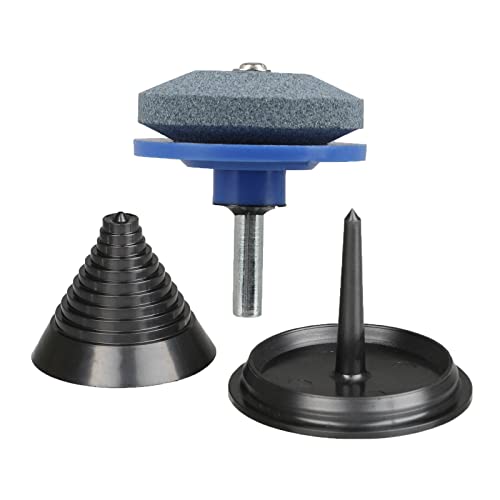
Dedicated balancing tools provide an accurate, low-cost way to evaluate weight distribution across the central mounting hole. Tool kits like the jtfrkope Lawn Mower Blade Sharpener for Drill and Lawn Mower Blade Balancer Set include a stepped cone balancer that rests on a central pivot point. Placing the blade horizontally across the stepped cone quickly reveals if one wing dips downward due to excess metal. Lightly grinding or filing metal from the heavy trailing wing restores equilibrium before final deck installation.
Understanding lawn mower blade steel properties highlights why structural integrity matters as much as balance. High-carbon alloy steels withstand considerable rotational stress, but they cannot safely recover from severe structural bending, gouging, or stress cracking. A bent or cracked blade should never be straightened and tightened back onto a mower deck, as internal metal fatigue can trigger catastrophic blade failure at high operating speeds. Replace damaged cutting components immediately to ensure safe operation.
Managing Specialty Clamps and Compatibility Variations
Mower blade profiles vary considerably, requiring versatile holding tools that adapt to different blade widths and shapes. The Cuidosful Adjustable Lawn Mower Blade Holder features adjustable widths and an easy-turn adjustment knob to accommodate various cutting profiles. This flexibility allows the clamp to grip thick commercial blades, curved mulching designs, or standard flat lift blades with equal security. Having adjustable clamping capability prevents slippage on specialized blade geometries during high-torque tightening tasks.
Hardware longevity and thread protection represent another valuable feature in dedicated locking equipment. The Ximoon Mower Blade Removal Tool Replacement for Sten 750-058 incorporates specialized thread protector caps over the adjustment mechanism. These caps shield the threaded clamp shaft from abrasive sand, dirt, and wet grass clippings that accumulate during deck maintenance. Keeping the clamping threads clean ensures smooth mechanical operation and reliable locking power across many seasons of blade changes.
OEM compatibility listings assist buyers in matching aftermarket blade removal tools to their specific mower decks. Aftermarket locking tools from SporGain and KSWLOR serve as replacements for popular OEM part numbers like 490-850-0005 across Troy-Bilt, MTD, Yard Machines, Bolens, and Cub Cadet decks up to 42 inches. These heavy-duty steel clamps fit single and twin-blade configurations, clamping firmly to the deck skirt without requiring permanent deck modifications. Verifying deck lip compatibility ensures a solid anchor point during tightening.
Post-Tightening Verification and Deck Clearance Checks
Completing the tightening sequence requires a series of manual verification checks before reconnecting power to the mower. While the spark plug boot or battery remains detached, slowly rotate the blade by hand for a full revolution inside the cutting tunnel. Listen and look for any contact with the deck baffles, inner housing walls, or discharge chute hardware. The blade should spin smoothly along a flat, level plane without catching on irregular surfaces or scraping against the deck rim.
Checking blade tracking confirms that the blade sits straight and that the spindle shaft remains unbent. Measure the vertical distance from one blade tip to the ground or the flat deck edge, then rotate the opposite tip to the exact same position and measure again. The two measurements should match within one-eighth of an inch on a true spindle and unbent blade. A significant difference in tip height indicates a warped blade or bent spindle assembly that proper bolt tightening cannot correct.
Once clearance and tracking are verified, remove the blade clamp from the deck skirt and stow all hand tools. Reconnect the spark plug wire firmly over the terminal or slide the fully charged battery pack back into its compartment. Start the mower on a flat, clear surface like a paved driveway or clean lawn area away from bystanders. Listen attentively for any abnormal rattle, hum, or deck shudder, shutting the engine down immediately if unexpected vibration occurs.
Securing a lawn mower blade correctly requires methodical attention to thread condition, washer orientation, and solid mechanical clamping. Investing in a dependable deck clamp and checking bolt torque eliminates guesswork while protecting expensive spindle components. Routine inspections of mounting hardware keep every mowing session smooth, quiet, and safe throughout the active cutting season.





Write Your Review
No reviews yet. Be the first to share your experience!