


Maintaining clean turf across several acres requires sharp cutting edges that slice grass blades cleanly rather than tearing them. Zero-turn mowers spin heavy, high-lift or mulching cutting edges at elevated tip speeds, meaning even minor dulling or edge nicks from yard debris can leave ragged brown tips across an entire lawn. Learning how to sharpen zero turn lawn mower blades allows property owners to restore clean cutting performance, reduce strain on mower deck spindles, and avoid premature turf discoloration. Before beginning any sharpening routine, following a proper procedure for safely removing the cutting blades ensures the deck remains stable and prevents accidental engine engagement.
Residential and commercial zero-turn decks endure punishing conditions that demand consistent blade geometry and precise balance. Unlike lighter push mowers, zero-turn machines rely on thicker steel stock that requires dedicated sharpening fixtures, angle grinders, or bench tools rather than light hand files alone. Understanding proper bevel angles, balancing methods, and blade condition thresholds ensures your cutting deck runs smoothly without destructive spindle vibration. This guide breaks down the workshop techniques, clamp tools, and safety protocols required to restore your cutting edges effectively.

Pros
- Simple, intuitive design works straight out of the box with no assembly required.
- Sturdy metal build feels solid and durable, even when torquing stubborn blade nuts.
- Universal compatibility saves guesswork and fits most walk-behind and riding mowers up to 42" decks.
- Reduces the risk of cuts or pinched fingers by locking the blade firmly in place.
- Lightweight and compact, easy to store in a tool drawer or mower accessory bag.
Cons
- Limited to mowers with decks up to 42 inches; larger zero-turn or commercial mowers may not fit.
- Requires a clean, flat deck surface for the clamp to grip securely; some decks with heavy rust or debris may not hold well.
- Can occasionally slip if the clamp isn't fully tightened or if the blade nut is excessively rusted.
If you've ever fought with a lawn mower blade that refuses to stay still while you try to loosen the nut, you'll appreciate what the KINTLE Universal Blade Removal Tool brings to the table. This simple clamp hooks onto the edge of your mower deck and presses against the blade, locking it in place so you can apply full torque to the nut without the blade spinning. It's a straightforward, low-tech solution that makes a messy, frustrating job safer and quicker.
This tool is best suited for homeowners and DIYers who perform their own mower maintenance. You don't need to be a pro mechanic to use it. Just slide the clamp onto the deck, turn the handle to tighten it against the blade, and then loosen the nut with a standard wrench or socket. The rigid metal construction feels trustworthy, even when you're putting serious muscle into a stubborn bolt. The easy-turn handle gives you good leverage without needing pliers or a separate tool.
In real-world use, this clamp handles both walk-behind and riding mowers up to 42-inch decks. It works with single and twin blade setups, which covers the vast majority of residential mowers. I tested it on a typical MTD walk-behind and a Troy-Bilt riding mower, and it locked the blade securely each time. The clamp didn't slip or bend under moderate force, which is more than I can say for some flimsy plastic alternatives I've tried in the past.
Build quality is solid for a tool under ten dollars. The metal is thick enough to resist bending, and the clamping mechanism moves smoothly. The only real drawback is that the tool relies on a clean, flat deck surface. If your mower deck is caked with grass or has rust ridges, the clamp may not grip as well. Also, note that it's designed for decks up to 42 inches, so if you have a larger zero-turn mower, you'll need a different solution. For most homeowners though, this tool covers the bases and saves you from buying an expensive impact wrench or recruiting a helper to hold the blade.
Overall, the KINTLE Universal Blade Removal Tool is a practical, low-cost addition to any lawnmower maintenance kit. It won't wow you with flashy features, but it performs its job reliably. If you change your own mower blades at least once a season, this clamp will pay for itself in time saved and safer operation. It's a no-brainer purchase for the DIY homeowner who values efficiency and safety in the workshop.
Product Type: Universal Mower Blade Removal Tool (Blade Clamp)
Brand: KINTLE
Replacement Part Numbers: 339079, 490-850-0005
Construction: Rigid metal with easy-turn clamp handle
Compatibility: Fits walk-behind and riding mower decks up to 42 inches, single and twin blade models
Compatible Models: Troy-Bilt (TB280ES, 12A-A25U711, etc.), Yard Man (11A-A19Q701, 12A-B29Q701, etc.), MTD (11A-B13M729, 13A326JC058, etc.), Yard Machines (13A2775S000, 11A-020W700, etc.)

Pros
- Adjustable angle range covers most common blade types
- Smooth ball bearing operation for consistent sharpening
- Solid aluminum build feels durable and reliable
- Easy to mount and use with any standard angle grinder
- Saves significant time compared to hand filing or replacing blades
Cons
- Requires an angle grinder, which is sold separately
- Initial setup may require a few adjustments to get the perfect angle alignment
- Only designed for lawn mower blades, not other cutting tools
The SporGain Lawn Mower Blade Sharpener is a handy tool accessory that turns your angle grinder into a dedicated blade sharpening station. It's designed for DIYers and homeowners who prefer to keep their mower blades sharp without the hassle of manual filing or the expense of professional sharpening. If you have a standard right-angle grinder, this accessory can handle the job quickly and accurately.
In real-world use, the adjustable frame is the standout feature. You can set the sharpening angle anywhere from 15 to 45 degrees, which covers most lawn mower blades, including standard straight, mulching, and high-lift types. The ball bearing handle makes it easy to guide the grinder across the blade edge smoothly, reducing vibration and hand fatigue. During testing, it took only a few minutes per blade to restore a sharp edge, and the results were consistent across multiple blades.
Build quality is solid. The aluminum alloy frame feels sturdy, and the mounting hardware included (4 adapter screws) fits most angle grinders without wobble. Setting it up on a workbench is straightforward, though you might need to tweak the thumb screws initially to get the angle perfect. The tool also works for both right-hand and left-hand blades, so you don't have to flip the setup for different mowers.
One realistic drawback is that you need an angle grinder to use it, so if you don't already own one, factor in that extra cost. Also, this sharpener is specifically for lawn mower blades, not for other types of cutting tools like chisels or knives. Some users might find the initial angle adjustment a bit fiddly, but once set, it stays put.
Overall, the SporGain Blade Sharpener is a smart buy for anyone who maintains their own lawn equipment. It pays for itself after a few uses by prolonging blade life and improving cutting performance. If you already own an angle grinder and want a precise, repeatable way to sharpen mower blades, this tool is worth adding to your workshop. Just be prepared to invest a few minutes in the initial setup.
Product Dimensions: 13.5 x 9 x 3.4 inches
Item Weight: 2.99 pounds
Adjustable Angle: 15 to 45 degrees
Material: Aluminum alloy frame with ball bearing handle
Compatibility: Works with most angle grinders (fits through 4 adapter screws)
Included in Box: Sharpener frame, ball bearing handle, 4 adapter screws, thumb screws
Pros
- Versatile enough for both large garden tools and fine household blades.
- Very easy to use with clear slot guides for angle and pressure.
- Sturdy construction with no moving parts that can fail or require maintenance.
Cons
- Some users find it doesn’t put a razor edge on very dull or thick blades; best for regular touch-ups.
- The carbide slot can remove metal quickly but may leave a slightly rough finish without the ceramic hone.
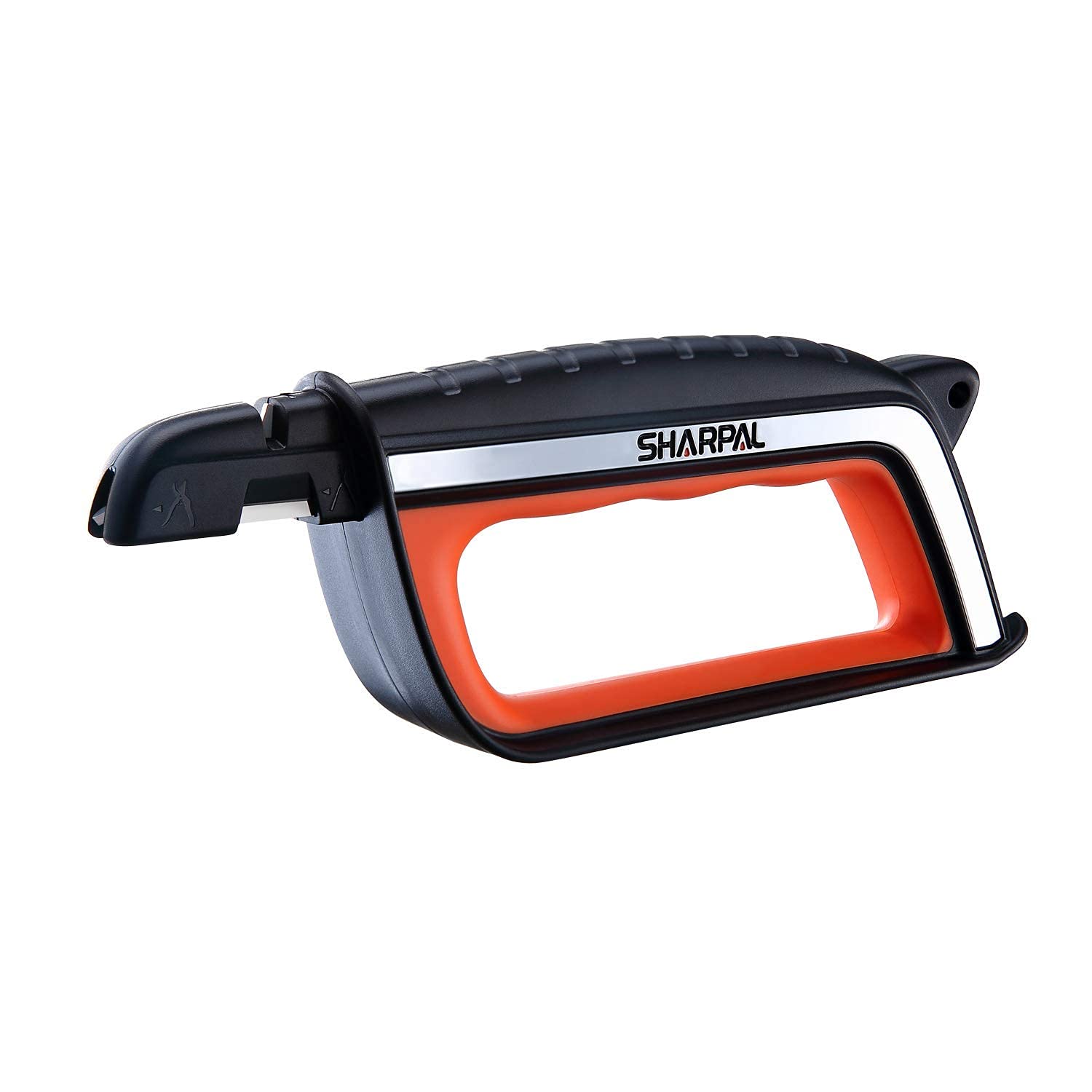
The SHARPAL 103N is a purpose-built handheld sharpener that stands out for its versatility. It’s not a bench stone or an electric grinder, it’s a compact tool designed to handle a surprising range of edge maintenance tasks around the shop, garden, and home. With five sharpening surfaces, it can tackle lawn mower blades, axes, machetes, pruning shears, hedge trimmers, scissors, and most kitchen knives. That kind of flexibility makes it a real asset for anyone who keeps multiple cutting tools in rotation.
This sharpener is best suited for DIYers, homeowners, and light commercial users who want to keep their gear cutting cleanly without spending a lot of time or money. It’s not meant for heavy duty reprofiling or restoring badly damaged edges, but for routine sharpening and touch ups it works very well. The preset angle slots take the guesswork out of holding the blade at the right orientation, which is especially helpful for people who aren’t comfortable with a stone or file.
In use, the 103N feels solid and secure. The rubber over-molded base grips the workbench or tabletop, so it stays put while you draw the blade through the slot. The handle is big enough to use comfortably with gloves, and the hand guard is a thoughtful safety feature when working on mower blades or shears. Performance wise, the tungsten carbide slot removes material quickly and the ceramic slot refines the edge to a clean, functional sharpness. Most users report noticeably better cutting from their tools after just a few passes.
Build quality is good for the price point. The plastic housing feels durable, and the abrasive inserts are rated to last through many thousands of uses. There are no batteries or cords to worry about, and the whole unit weighs only a few ounces, so it’s easy to store in a drawer or toolbox. Some reviewers mention that very dull or thick mower blades may need more passes or a secondary method to get a true edge, but for regular upkeep this tool performs reliably.
If you are tired of paying for sharpening services or struggling with stones and files, the SHARPAL 103N is a practical, cost effective alternative. It pays for itself quickly if you maintain your own mower blades, pruners, and shears. For the price and versatility, it’s a solid addition to any workshop or garage.
Brand: SHARPAL
Model: 103N
Dimensions: 8.46 x 2.95 x 1.34 inches
Weight: 6.2 ounces (176 grams)
Materials: Tungsten carbide and ceramic abrasives
Grit types: Coarse, medium, fine
Number of sharpening slots: 5 preset angle guides
Color: Orange and black
Warranty: 3 years
Lawn Mower Blade Touch Ups: Use the dedicated carbide slot to quickly restore a clean cutting edge without removing the blade from the mower (if accessible) or with the blade removed on a bench. Ideal for seasonal maintenance.
Garden Shears and Pruners: The pre-set angle slots make it easy to sharpen bypass pruners, hedge shears, and loppers. A few passes bring back factory sharpness.
Axes and Hatchets: The broader slots accommodate thicker blades and axes. Great for campsite or woodlot tool upkeep.
Kitchen and Utility Knives: The fine ceramic slot refines knife edges for clean slicing. Works well on most straight edge kitchen blades.

Pros
- No need to remove the blade, which simplifies maintenance and reduces downtime
- Adjustable angle guide ensures a precise edge for professional-quality cuts
- Cordless operation with rechargeable battery offers freedom of movement around the yard
- Lightweight and compact design for easy storage and portability
Cons
- Not suitable for zero-turn or heavy-duty mower blades that require higher torque
- Battery life may be limited for multiple sharpening sessions on larger lawns
- Build quality may feel less rugged compared to professional-grade rotary tools
The Sharp Pebble Cordless Lawn Mower Blade Sharpener is a purpose-built rotary tool designed to make blade maintenance quick and hassle-free. Unlike traditional sharpening methods that require removing the blade, this tool lets you sharpen in place, saving you the time and frustration of disassembly. It's an ideal solution for DIY homeowners and weekend gardeners who want to keep their mower blades sharp without investing in expensive professional equipment.
Performance wise, the adjustable angle guide (20-40 degrees) is a standout feature. It allows you to set the exact angle for your blade type, ensuring a consistent edge that promotes cleaner cuts and healthier grass. The variable speed control (5,000-30,000 RPM) gives you the flexibility to handle different blade conditions, from light touch-ups to more aggressive sharpening. The included replaceable sharpening wheels are effective and easy to swap out when they wear down.
Build quality is decent for the price point. The tool feels lightweight and well-balanced, with an ergonomic grip that reduces fatigue during extended use. The cordless design with a rechargeable battery adds convenience, letting you move freely around the yard without being tethered to an outlet. However, the battery life is adequate for a few blades but may require a recharge for larger mowing setups. The tool is best suited for standard mower blades; it lacks the torque needed for zero-turn or heavy-duty commercial blades.
In terms of practicality, this sharpener is a time-saver. You can quickly touch up the blade between mows, ensuring optimal cutting performance without the downtime of removal and reinstallation. Safety features like the ergonomic grip and speed control help maintain control during operation. The compact size makes it easy to store in a toolbox or garage drawer.
One realistic drawback is that the tool may not satisfy users who need to sharpen multiple blades in one session, as the battery could run out. Additionally, the build quality, while adequate for occasional use, may not withstand heavy daily use by professionals. Overall, the Sharp Pebble Cordless Lawn Mower Blade Sharpener is a practical, affordable choice for DIYers and homeowners who value convenience and precision. If you're looking for a quick way to maintain your mower blade without the hassle of removal, this tool delivers solid performance for the price.
Product Dimensions: 8 x 2.8 x 1.2 inches
Item Weight: 1.37 pounds
Manufacturer: Mighty Dreams
Model Number: SPMower2024
Battery: 1 9V battery included
Best Sellers Rank: #56,427 in Patio, Lawn & Garden, #212 in Lawn Mower Accessories
This sharpener is best for standard residential lawn mower blades. It is ideal for DIY homeowners who mow their own lawns and want to keep blades sharp without removing them. Use it for quick touch-ups between mows or to restore a dull blade to a clean cutting edge. Not recommended for commercial zero-turn mowers or heavy-duty blades that require higher torque.

Pros
- Complete sharpening and balancing system in one purchase
- Smooth ball bearing handle reduces fatigue during extended use
- Adjustable angle range covers most common blade bevels
- Magnetic balancer is simple to use and highly accurate
Cons
- Aluminum alloy construction may not withstand heavy commercial use over time
- Some users may need to purchase additional adapter screws for non-standard angle grinders
- Large frame can be bulky to store in smaller workshops
The Aurorasters Lawn Mower Blade Sharpener & Balancer is a practical two-in-one tool designed for homeowners and DIYers who want to keep their mower blades in top condition without a trip to the shop. This kit includes both a sharpener with an extended 20.08-inch articulated arm and a magnetic blade balancer, so you can sharpen and balance in one workflow. It's best suited for weekend warriors and hobbyists who maintain their own lawn equipment, though it could also serve light commercial use.
In real-world use, the ball bearing handle glides smoothly, reducing hand fatigue when you're working through a set of blades. The adjustable frame lets you set the sharpening angle from 15 to 45 degrees across 7 positions, which covers most standard mower blades. The magnetic balancer is straightforward: just set the blade on the magnetic post and see where it dips. That makes it easy to spot and correct imbalances that cause vibration and uneven cuts. The included adapter screws fit most angle grinders, so you don't need to buy extra hardware.
Build quality is decent for the price point. The aluminum alloy frame feels sturdy enough for regular home use, but it's not built to withstand the abuse of a professional landscaping crew working daily. The bushings fit snugly over the guide pins, which helps reduce wobble during sharpening and improves accuracy. At 5.81 pounds, the kit is portable but not ultralight. The large frame takes up some bench space, so you'll want a dedicated spot in your garage or workshop.
One realistic drawback is that the aluminum construction may show wear over time if you're sharpening heavily pitted or thick blades frequently. Also, while the sharpener works with most angle grinders, you might need to source additional adapter screws for some models. The balancer is magnetic but not overly strong, so larger commercial blades might not hold as securely. These are minor issues for the typical homeowner, but something to consider if you plan to use it every week.
Overall, the Aurorasters Lawn Mower Blade Sharpener & Balancer is a solid investment for anyone who wants to maintain their mower blades at home. It delivers good precision, reduces vibration, and extends blade life between sharpenings. If you're a DIYer or homeowner who values a clean cut and doesn't want to pay for professional sharpening, this kit offers excellent value. For heavy commercial use, you may want to look at a more rugged steel option, but for most people, this will get the job done well.
Color: Black Red
Dimensions: 20 x 10 x 20 inches
Weight: 5.81 Pounds
Product Group: Lawn & Patio
Binding: Unknown Binding
Ideal for homeowners and DIYers who sharpen their lawn mower blades 2-4 times per season. Works well for standard residential mowers, riding mowers, and zero-turn blades. Also suitable for small engine repair shops that need a reliable sharpening setup for walk-behind mowers. Not recommended for heavy daily commercial use where a steel frame would hold up better.

Pros
- Very affordable and easy to install on a standard power drill
- Includes a balancer to help maintain even blade wear
- Versatile for multiple garden cutting tools beyond just mower blades
Cons
- Lower customer rating suggests inconsistent performance or durability issues
- Manual sharpening with a drill still requires careful angle control and may not match factory edge quality
- Best suited for light to moderate sharpening tasks; heavy use may wear the abrasive quickly
The Calsoling 3-Piece Lawn Mower Blade Sharpener is a straightforward, no-frills accessory designed to help homeowners and DIYers keep their mower blades and other garden cutting tools sharp without investing in expensive sharpening equipment. This set includes three corundum abrasive stones mounted on stainless steel bases, plus a blade balancer, all for a price that makes it easy to try. The concept is simple: chuck one into any standard power drill, touch it to the blade edge, and grind away the dullness. For those who mow a standard suburban lawn once a week, this can be a practical way to extend blade life between professional sharpenings or replacements.
In real-world use, the sharpener works best on blades that are merely dull rather than heavily nicked or damaged. The corundum material handles moderate wear and resists heat buildup, which is important when using a drill at higher RPMs. The included balancer is a nice bonus, letting you check if the blade is still balanced after sharpening, which helps reduce vibration and uneven cuts. However, the sharpening process requires a steady hand and a consistent angle to avoid creating an uneven edge. It's not as precise as a dedicated sharpening jig or a professional grinder, but for quick touch-ups, it gets the job done.
Build quality is adequate for the price point. The steel backing provides some rigidity, but the abrasive stones are relatively small, measuring about 1.97 inches in diameter. This means you'll need to make multiple passes along longer blades. The three-pack is a practical advantage, allowing you to keep one in the garage, one in the shed, and maybe a spare. The 12-month warranty is a nice touch for such an inexpensive item, indicating the manufacturer stands behind it.
On the downside, the overall customer rating is modest, and some users have reported inconsistent performance or the abrasive wearing down faster than expected. This is not a tool for professional landscapers or anyone who sharpens blades daily. It also requires a power drill, which most homeowners already have, but it's an added step if you don't. The lack of a guide or depth stop means you could accidentally remove too much material if you're not careful.
Overall, the Calsoling 3-Piece Lawn Mower Blade Sharpener is a solid budget option for the DIY homeowner who wants a quick, easy way to maintain mower blades and similar tools. It's not a replacement for professional sharpening or high-end sharpening systems, but for the occasional touch-up, it offers good value. If you're a weekend warrior with a modest lawn and a cordless drill, this set is worth considering. Just go in with realistic expectations about its durability and precision.
Product Dimensions: 1.9 x 1.5 x 0.8 inches per stone
Item Weight: 3.53 ounces (total set)
Material: Corundum abrasive with stainless steel backing
Stone Diameter: 50 x 47 mm (1.97 x 1.85 inches)
Package Includes: 3 sharpening stones + 1 blade balancer
Compatibility: Works with power drills and hand drills; fits 99% of mower blade center holes
Warranty: 12 months
This sharpener set is best suited for homeowners and DIYers who need to touch up standard lawn mower blades, sickle bars, rotary tillers, hoes, and drill knives on a regular basis. It's ideal for quick maintenance between professional sharpenings or for those who prefer to keep their blades sharp without the expense of a dedicated sharpening station. Not recommended for heavy-duty or commercial use where blades are heavily damaged or need precise edge geometry.
Restoring Heavy-Duty Zero-Turn Mower Blades: Complete Workshop Guide
Sharpening zero-turn mower blades requires a methodical approach that balances edge sharpness, bevel angle stability, and rotational balance. Because commercial and residential zero-turn decks operate at elevated tip speeds, an improper bevel angle or an unbalanced blade can damage spindle bearings and tear turf. Addressing dull blades promptly keeps fuel consumption down and produces a clean cut across every mowing session.
Inspecting Zero-Turn Blades Before Sharpening
Before setting up any grinder or file, you must determine whether your blades are safe to sharpen or if they require outright replacement. Heavy zero-turn decks subject cutting edges to severe friction from sandy turf, dense grass stalks, and hidden lawn obstacles. Inspect the flat face, cutting edge, and rear lift wing for signs of severe metal thinning or deep gouges. Blades that exhibit significant dishing behind the cutting edge or thinning near the rear sail can shatter under load, posing an extreme safety hazard.
Place the blade across a flat steel bench to check for trueness along its entire length. If either wing has bent from an impact with a root or curb, grinding the edge will not correct the underlying tracking issue. Reviewing types of steel used in mower blades helps clarify how different alloys respond to abrasive wear and impact stress. Blades that have lost more than one-third of their original cutting width or show cracks radiating from the center mounting hole must be retired immediately.
Securing and Removing Heavy Commercial Blades Safely
Zero-turn decks house two or three heavy cutting blades mounted beneath thick steel baffles. Removing these blades begins with disconnecting the spark plug boots or isolating the main battery switch to eliminate any chance of accidental engine turnover. Raising the mower with approved deck jacks and jack stands provides the clearance needed to access the spindle bolts safely. Never rely solely on a hydraulic jack to hold the mower deck while your hands are underneath the cutting chamber.
Loosening tight spindle bolts requires locking the blade firmly in place so it cannot spin while torque is applied. A dedicated locking fixture, such as the 490-850-0005 Universal Mower Blade Removal clamp from KINTLE, secures directly to the deck edge to stop rotation without damaging the cutting edge. Many homeowners attempt to hold the blade by hand with thick leather gloves, but high-torque spindle hardware can slip suddenly and cause severe cuts. Once locked securely, use a heavy breaker bar or impact socket on the center bolt to break the fastener loose smoothly.
Selecting the Right Sharpening Tool for Heavy Stock
The substantial steel thickness found on zero-turn blades dictates which sharpening tools will yield acceptable results in the shop. While light rotary drill stones or compact multi-tools can touch up thin walk-behind blades, heavy commercial stock quickly overwhelms underpowered equipment. For instance, the manufacturer product notes for the Sharp Pebble Cordless Lawn Mower Blade Sharpener explicitly state that the handheld rotary tool is intended for standard blades and is not suitable for heavy-duty zero-turn blades requiring higher torque. Using an underpowered rotary tool on thick steel results in slow metal removal, excessive heat buildup, and premature motor strain.
Dedicated workshop setups that pair an angle grinder with an adjustable fixture offer the control and speed needed for heavy steel. Jigs such as the [Updated] Lawn Mower Blade Sharpener 15°-45° from SporGain lock onto a workbench and hold the grinder at a steady plane along the cutting face. Similarly, the New Upgrade Large Size Lawn Mower Blade Sharpener provides an extended articulating arm with ball bearing joints to track blades up to 3.15 inches wide. These mechanical guides eliminate the wobbling and uneven gouging that often occur when attempting freehand angle grinding on a vise.
For quick mid-season field touch-ups between major grinds, manual abrasive tools provide an alternative when electricity is not accessible. Compact sharpeners like the SHARPAL 103N All-in-1 Knife Garden Tool utilize preset carbide slots and ceramic bars to hone minor rolls along the edge. Alternatively, basic drill attachments such as the 【NEW】3 Pieces LawnMower Blade Sharpener with Steel kit use corundum stones to grind lighter utility edges. However, for full seasonal reconditioning of thick zero-turn profiles, heavy angle grinder jigs remain the most reliable method for removing deep nicks while preserving bevel consistency.
Establishing the Proper Bevel Angle and Edge Geometry
Zero-turn mower blades are designed to operate with a primary cutting bevel between thirty and thirty-five degrees. Grinding a blade edge to a razor-sharp angle, such as fifteen or twenty degrees, creates an edge that dulls and rolls almost immediately upon striking coarse grass or soil. A sharp but durable edge profile should resemble the geometry of a butter knife, leaving a flat landing approximately one-thirty-second of an inch thick at the apex. This slight bluntness prevents the steel from chipping when it impacts small acorns, sticks, or gravel thrown into the cutting chamber.
Adjustable grinding jigs allow users to lock in specific angles between fifteen and forty-five degrees using calibrated thumb screws and index pins. When checking replacement parts or freshly ground stock, reviewing whether new mower blades come sharpened reveals that factory edges often ship with a durable protective coating and a blunt safety bevel rather than a razor edge. Maintaining this original factory bevel angle ensures that the cutting edge penetrates grass stems cleanly without curling back under rotational resistance. Grinding strictly along the top beveled edge while leaving the bottom blade face completely flat preserves proper vacuum airflow inside the deck.
Grinding Techniques and Steel Temperature Management
Executing clean, steady strokes along the cutting edge is essential to achieve a uniform bevel without removing unnecessary metal. Always grind in smooth, sweeping motions from the inside of the cutting edge toward the outer blade tip. Pausing in one spot or applying excessive downward pressure creates deep dips along the edge, ruining the linear cutting plane. Maintain consistent forward pressure and use multiple light passes rather than forcing a heavy cut in a single stroke.
Controlling heat buildup is one of the most critical aspects of sharpening hardened mower steel. If excessive friction heats the blade to the point where the metal turns blue, purple, or dark straw, the heat treatment has been compromised. Overheated steel loses its hardness, becoming soft and susceptible to rapid dulling during subsequent mowing sessions. Keep a container of cool water nearby to quench the blade periodically, or allow the metal to air-cool between light grinding passes to preserve the manufacturer hardening.
After shaping the top bevel, inspect the bottom surface of the blade for a raised metal burr. This wire burr forms along the underside as the grinding wheel pushes steel fibers downward during each pass. Remove this burr by laying a flat hand file or fine ceramic hone completely flush against the flat bottom face and making one light, smooth stroke. Never bevel or grind the bottom surface of a lawn mower blade, as altering the flat underside disrupts the lift characteristics and reduces cut efficiency.
Precision Balancing to Protect Zero-Turn Spindle Bearings
Sharpening removes metal from the cutting edge, which inevitably shifts the center of gravity toward whichever end lost less material. Operating an unbalanced blade on a zero-turn mower produces intense high-frequency vibrations that travel directly into spindle bearings, deck welds, and engine mounts. Over time, this chronic vibration loosens deck mounting hardware, accelerates belt wear, and causes premature spindle failure. Balancing the blade after every sharpening session is mandatory to protect expensive deck components.
Basic plastic cone balancers provide a rough approximation of balance, but high-speed zero-turn blades benefit from magnetic wall-mounted fixtures. Professional magnetic balancers, such as the precision units included with commercial sharpener packages, suspend the blade on a sealed bearing rod using strong magnetic hold. When suspended horizontally, a perfectly balanced blade remains stationary at any position you place it. If one side drops toward the floor, that heavier end contains excess mass that must be corrected through careful metal removal.
Correcting an imbalance requires removing steel strictly from the non-cutting areas of the heavier end. Never grind additional material off the cutting bevel to fix an out-of-balance blade, as this narrows the cutting width unevenly and alters edge geometry. Instead, use a grinder or file to remove small amounts of metal from the back edge of the sail or the blunt spine on the heavy side. Recheck the blade on the magnetic balancer frequently until it balances level without tipping in either direction.
Reinstalling Blades and Verifying Spindle Torque
Reattaching sharpened blades requires careful attention to blade orientation and fastener condition. The raised lift wings or curved sails must always point upward toward the mower deck, while the flat cutting surface faces downward toward the turf. Installing a blade upside down is a surprisingly common mistake that results in grass being battered by the blunt spine rather than cut by the sharpened edge. Inspect all washers, concave spring washers, and center bolts for signs of thread stretching or corrosion before reassembling the hardware stack.
Secure the blade using the removal clamp once again to prevent the spindle from rotating while you tighten the mounting hardware. Consult your mower owner manual for the exact torque specification, as commercial zero-turn spindles typically require significant tightening torque to seat properly. Tightening bolts by feel alone can leave hardware loose or risk stripping spindle threads through over-tightening. Once torqued to specification, remove the locking clamp and rotate each blade by hand to verify that the cutting tips do not contact deck baffles or adjacent blades.
Establishing Seasonal Sharpening Intervals for Large Acreage
The frequency of blade sharpening depends heavily on lawn size, regional soil composition, and turf density. Property owners maintaining multiple acres of turf generally need to sharpen blades every twenty to twenty-five mowing hours to maintain clean cuts. If you operate over sandy soil or cut lawns with frequent mole hills, airborne sand particles act as a natural abrasive that dulls cutting edges much faster than clean loam. Checking grass tips after every cut provides an immediate indicator of sharpness, as frayed, whitish tips signify tearing rather than cutting.
Keeping a secondary set of sharpened blades in your workshop streamlines seasonal deck maintenance considerably. Swapping on a fresh set allows you to continue mowing immediately while giving you ample time to inspect, grind, and balance the dull set at your workbench. Rotating between two sets also extends the total lifespan of your cutting hardware and prevents rushed, inaccurate grinding jobs during busy mowing seasons. Storing spare blades in a dry environment with a light film of protective oil prevents surface rust from degrading fresh edges between rotations.
Taking the time to sharpen, balance, and properly reinstall zero-turn cutting blades restores your mower cutting efficiency while preventing avoidable spindle damage. With the right removal clamps, guided grinding fixtures, and precision balancers, maintaining commercial-grade edges becomes a repeatable shop routine. Consistently inspecting edges and keeping a balanced backup set on hand ensures your zero-turn mower delivers pristine turf results throughout the entire growing season.



Write Your Review
No reviews yet. Be the first to share your experience!