


Ragged grass tips, brown turf fringes, and sluggish engine performance often point directly to dull or uneven cutting edges under the mowing deck. When cutting edges dull from sand, hidden sticks, or dense turf, understanding how to sharpen lawnmower blades with a bench grinder can restore clean cutting performance without requiring immediate replacement. Spinning at high speeds, an improperly serviced edge tears grass blades instead of shearing them crisply, exposing your lawn to disease and moisture stress. For homeowners running tough equipment like electric lawn mowers for thick grass, maintaining a crisp bevel angle ensures the deck glides smoothly without bogging down.
Dedicated grinding setups and bench-mounted sharpening machines provide the rigidity, speed, and angle control necessary to remove nicks while preserving proper factory geometry. While some severely bent or cracked cutting tools require authentic replacement mower blades, most seasonal wear responds well to disciplined bench grinding. Taking the time to secure your workstation, measure the bevel angle accurately, and inspect blade balance prevents excessive spindle strain and prolongs mower deck life. With the right grinding technique and safety habits, you can restore clean slicing performance and keep your cutting deck operating smoothly all season.
Top Products

Pros
- Powerful 700W motor handles tough blade restoration quickly.
- Integrated dust collection keeps metal shavings contained for a cleaner workspace.
- Includes three grit sandpapers for complete sharpening stages.
- Heavy steel base provides stability and reduces vibration during use.
Cons
- No blade holder or guide included, requiring careful hand positioning.
- Some assembly and setup may be needed before first use.
The WEWEAL 7-Inch Lawn Mower Blade Sharpener is a benchtop grinder designed specifically for restoring dull, chipped, or damaged mower blades to a sharp edge. Unlike manual files or angle grinders, this dedicated sharpener offers a more controlled and efficient process, making it a valuable tool for homeowners who prefer to maintain their own equipment. With a 700W motor, built-in dust collection, and a set of three sandpaper grits, it aims to simplify blade maintenance while keeping your workspace clean.
This sharpener is best suited for homeowners, lawn care enthusiasts, and gardeners who regularly mow their lawns and want to keep their blades cutting cleanly. It's also a practical option for budget-conscious shoppers who prefer to sharpen blades themselves rather than pay for professional sharpening or replace blades frequently. The product description highlights compatibility with a wide range of blade types, including high lift, low lift, gator, and flat designs, so it should work with most standard walk-behind mowers and some riding mower blades.
In terms of real-world performance, the 700W motor provides ample power for grinding through hardened steel. The included 60-grit disc handles coarse grinding on heavily damaged edges, while the 120-grit refines the edge, and the 320-grit produces a smooth finish. The hook-and-loop system allows quick sandpaper changes, which is convenient when moving between stages. The built-in dust collection case captures most metal shavings, reducing mess and making cleanup easier. According to the manufacturer, it captures up to 99% of particles, which is a significant advantage over open bench grinders.
Build quality appears solid with a heavy-duty steel base that adds stability and helps minimize vibration. The ceramic wheel is designed for longevity and consistent sharpening. The detachable dust box is a thoughtful feature that allows you to empty shavings without stopping work. The overall dimensions (13 x 9.3 x 10.4 inches) mean it will occupy a permanent spot on your workbench, but it's not overly large.
Ease of use is straightforward: mount the sharpener on a stable surface, attach the desired sandpaper disc, and guide the blade along the wheel. However, there is no included blade guide or holder, so you'll need to manually control the angle and pressure. This requires a steady hand, especially for beginners. Maintenance of the sharpener itself is minimal: occasional cleaning of the dust box and replacement of sandpaper discs as they wear. The product does not include a blade holder, which some users may find as a limitation.
Realistic limitations include the price point, which is higher than manual sharpening tools but lower than industrial-grade sharpeners. Also, the sharpener is not designed for very wide blades or those with complex profiles. For most standard mower blades, it should work well. Overall, if you value a clean workspace, consistent results, and have multiple blades to maintain, the WEWEAL 7-Inch Lawn Mower Blade Sharpener is a worthwhile investment for your lawn care toolkit.
The WEWEAL sharpener uses a 700W motor to drive a ceramic wheel at high speed, allowing it to grind through steel efficiently. The three included sandpaper grits (60, 120, 320) cover the full sharpening cycle: coarse grinding to reshape the edge, medium sharpening to refine it, and fine finishing to polish. The hook-and-loop attachment makes switching between grits quick, so you can move through the stages without delay. The dust collection system is a standout feature, capturing most metal particles and keeping your bench clean. For homeowners who sharpen blades seasonally, this system reduces cleanup time significantly.
The sharpener features a reinforced steel base that adds weight and stability, reducing vibration during operation. The ceramic wheel is durable and resists wear, maintaining its shape over many sharpening sessions. The housing appears to be impact-resistant, and the detachable dust box is made of sturdy plastic. Overall, the build quality seems designed for regular use in a home workshop. The product dimensions are compact enough to fit on most benches, and the base has mounting holes if you want to secure it permanently. The manufacturer provides a standard warranty, though the exact length is not specified in the product data.


Pros
- Dedicated blade sharpener with preset angle guides speeds up the process for common mower blades.
- Ceramic grinding wheel stays cool and resists loading, making it suitable for frequent use.
- Included balancer is a practical addition that helps prevent vibration related engine damage.
- Solid build with a low vibration footprint once mounted to a bench.
- Simple to operate with minimal learning curve for DIYers.
Cons
- Limited to lawn mower blades only, not versatile for other shop grinding tasks.
- At 26.7 pounds, it's not portable for mobile sharpening services without a dedicated cart.
- The 1/3 HP motor is adequate for residential blades but may struggle with very thick or hardened commercial blades in continuous use.
The VEVOR Lawn Mower Blade Sharpener is a purpose-built tool that fills a specific gap in many home workshops and small engine repair shops. Instead of wrestling with a general purpose bench grinder and trying to hold a mower blade at the correct angle, this unit gives you a dedicated rest and preset angle stops for 30 and 40 degrees. That alone saves time and produces more consistent edges across multiple blades.
For the DIY homeowner who sharpens blades once or twice a season, this might feel like a specialized luxury. But for anyone maintaining several mowers or offering blade sharpening as a side gig, the VEVOR makes sense. The 7-inch ceramic grinding wheel is a nice upgrade over standard wheels. It runs cooler and resists glazing, which means you can sharpen several blades in a row without worrying about overheating the edge and ruining the heat treat. The 1/3 HP motor is quiet and has enough torque for typical residential and light commercial blades, though it will slow down if you push too hard on thick, hardened steel.
Build quality is solid for the price point. The base is heavy enough to stay planted on a workbench, and the included balancer is a practical addition that many general grinders lack. After sharpening, you pop the blade on the cone balancer and see if it tips. This step is often overlooked but it's critical for reducing mower vibration and preventing premature spindle bearing wear. The tool rest is adjustable and the miter gauge helps you repeat the same angle blade after blade. Setup is straightforward, and the manual covers the basics clearly.
On the downside, this is a single-purpose machine. You won't be using it for drill bits, chisels, or any other shop tools. And at nearly 27 pounds, it's not something you'll toss in a truck bed for mobile sharpening without a dedicated cart or mount. The motor, while adequate, isn't built for continuous commercial duty cycles. If you're sharpening dozens of blades daily for a landscaping business, you might want a heavier duty model. But for the serious DIYer, small engine mechanic, or part-time sharpener, this VEVOR unit delivers consistent results without the hassle of angle guesswork.
Overall, the VEVOR Lawn Mower Blade Sharpener is a practical investment for anyone who values a sharp, balanced blade and wants to avoid the cost and turnaround time of sending blades out. It's straightforward, well featured for the price, and the ceramic wheel is a genuine plus. If you maintain multiple mowers or just want your own blades done right every time, this sharpener earns a spot on the bench.
Motor: 1/3 HP, 110V AC
Grinding Wheel: 7 inch diameter, ceramic abrasive
Sharpening Angles: 30 degrees and 40 degrees preset
Blade Types: High lift, low lift, gator, and flat blades
Dimensions: 13.39 x 12.4 x 9.65 inches
Weight: 26.72 pounds
Color: Gray
Includes: Blade balancer, tool rest, miter gauge, grinding wheel
Homeowners with multiple mowers or a riding mower who want to sharpen blades themselves and ensure proper balance.
Small engine repair shops that sharpen customer blades as a service.
Landscapers who maintain a fleet of push mowers and want a dedicated sharpening station in their shop.
DIYers who prefer doing their own maintenance and want consistent edge geometry without guesswork.
The VEVOR Lawn Mower Blade Sharpener comes with a 7-inch ceramic grinding wheel pre-installed, a blade balancer for checking balance after sharpening, an adjustable tool rest, and a miter gauge for setting sharpening angles. The unit is ready to use out of the box after mounting to a stable work surface.
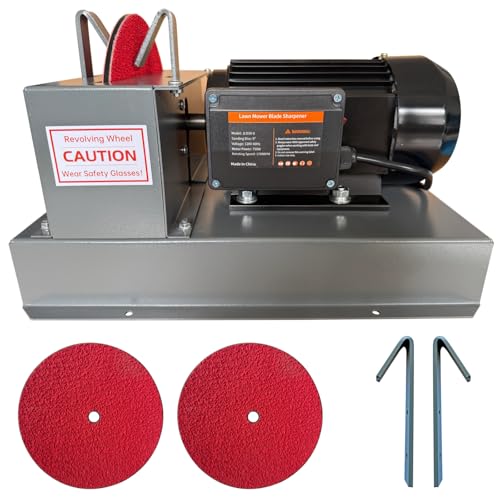
Pros
- Powerful 750W motor handles tough, dull blades quickly without bogging down
- 9-inch ceramic grinding wheel stays sharp longer and produces a smooth edge
- Sturdy steel base and brackets keep the grinder stable during operation
- Easy to set up and use; clear instructions and included accessories simplify the process
Cons
- May require a dedicated workspace or bench mounting for optimal stability
- Ceramic wheel may need occasional dressing to maintain flatness over heavy use
- Price point is higher than manual sharpening tools, but offers professional-grade results
The Goldsand Lawn Mower Blade Sharpener is a dedicated bench grinder designed specifically for restoring the cutting edges on mower blades. Unlike general-purpose grinders, this unit focuses on the unique geometry and hardness of lawn mower blades, making it a practical addition for any homeowner or landscaping professional who prefers to maintain their equipment rather than replace it.
This sharpener is best suited for suburban homeowners with medium to large lawns, rural property owners who maintain multiple mowers, and lawn care enthusiasts who value a crisp, clean cut. It also appeals to budget-conscious shoppers who want to extend blade life and avoid frequent replacements. For apartment dwellers with small yards, the grinder may be overkill unless they service shared equipment or are serious about DIY maintenance.
In real-world use, the 1HP motor and 9-inch red ceramic grinding wheel deliver noticeable sharpening efficiency. Dull blades that previously tore grass or left ragged edges can be restored to a sharp, even edge in minutes. The adjustable blade guide allows you to match the original bevel angle, which helps maintain cutting performance across high-lift, low-lift, gator, and flat blades. Many users report that after sharpening, their mowers cut cleaner and require less effort, especially in thick or damp grass.
Build quality is a strong point. The integrated steel base and blade fixing brackets provide a solid platform that resists vibration during operation. This stability is crucial for achieving consistent results and reducing the risk of overheating the blade. The grinder includes mounting hardware for permanent installation on a workbench, and the included replacement grinding discs add long-term value.
Setup is straightforward: attach the base, mount the motor, and install the grinding wheel. The instructions are clear, and most users can complete assembly in under 30 minutes. Maintenance is minimal, though the ceramic wheel may occasionally need dressing to keep it flat. The sharpener's compact footprint (16.9 x 12.6 x 9.6 inches) fits well on most workbenches, and its gray and red finish is practical for a shop environment.
One realistic limitation is that this tool is designed for blade sharpening only; it does not balance blades or remove deep nicks. For severely damaged blades, you may still need to replace them. Additionally, the price point is higher than manual files or inexpensive grinders, but the power and precision justify the investment for those who sharpen multiple blades per season. Overall, the Goldsand blade sharpener is a smart purchase for anyone serious about lawn care maintenance, offering professional-grade results that help keep your mower performing at its best.

Pros
- Robust 500W (2/3 HP) motor with an aluminum housing and sturdy steel base
- Comes with dedicated 30-degree and 40-degree brackets for consistent bevel angles
- Complete maintenance package includes a blade balancer, six center-hole adapters, and extra abrasives
- Accommodates flat, high-lift, low-lift, and gator mower blade designs
Cons
- Substantial 35-pound listed weight requires dedicated bench space and limits casual portability
- Fixed angle bracket choices are limited to 30 degrees and 40 degrees without micro-angle adjustments
- Sharpening heavily curved or complex commercial blade profiles may require extra operator technique
The Holdwell S Lawn Mower Blade Sharpener is a dedicated 2/3 HP (500W) bench-style grinding machine engineered specifically for maintaining lawn mower cutting edges. Featuring a black finish, an integrated aluminum motor housing, and a solid steel base, this unit is tailored to handle routine lawn tractor, zero-turn, and walk-behind mower blade upkeep. It is best suited for DIY homeowners, groundskeepers, and lawn-care maintenance buyers who want to eliminate manual hand-filing while maintaining repeatable edge angles.
Driven by a 500W electric motor, the grinder utilizes a 7-inch 60-grit ceramic grinding wheel designed for quick and controlled steel removal. A key practical feature is the inclusion of dedicated angle brackets, featuring a pre-installed 30-degree bracket and an interchangeable 40-degree bracket. These fixed guides assist operators in maintaining the appropriate bevel angle across standard flat blades, high-lift bagging blades, low-lift discharge blades, and toothed gator mulching blades without freehand guesswork.
Beyond the grinder itself, the kit addresses complete blade servicing by providing six center-hole adapters to support different blade mount configurations. This helps lock various center-hole dimensions firmly into place to reduce slip during sharpening passes. The package also includes extra replacement sandpapers, a screwdriver for the straightforward three-step assembly, and an essential static blade balancer, which allows users to verify balanced blade weight before reattaching blades to mower spindles.
In terms of workshop footprint, the machine measures 15.7 by 12.4 by 9.4 inches and carries a listed weight of 35 pounds. That heavy steel base helps isolate vibration during grinding, but it also means the unit is best assigned to a permanent workbench rather than transported frequently. While the dual 30-degree and 40-degree guides cover the most common manufacturer bevel specifications, buyers with atypical edge angles or extreme contour curves should note that the bracket architecture does not feature continuous micro-adjustability.
For residential and commercial property maintenance owners seeking an all-in-one sharpening station, the Holdwell S grinder delivers substantial value through its motor power and complete accessory bundle. Verifying blade balance with the included balancer and checking center-hole adapter fit prior to operation ensures safe, effective maintenance. As with any workshop power tool, operators should disconnect power before changing brackets or wheels and adhere to manufacturer guidance for safe grinding and blade inspection.
The Holdwell S blade grinder package is notably complete right out of the box. It includes the core 500W motorized sharpener unit fitted with a 7-inch 60-grit ceramic wheel, as well as a pre-installed 30-degree bracket and an interchangeable 40-degree bracket for setting edge bevels.
To support proper blade mounting during grinding, the package supplies six different blade hole adapters designed to accommodate a range of center-hole sizes. Maintenance and setup hardware include extra replacement sandpapers, an assembly screwdriver, a user manual, and a dedicated blade balancer to check balance after grinding.
The sharpener is designed to service a wide array of rotary mower blades used on residential lawn tractors, commercial zero-turn mowers, and walk-behind units. The grinding geometry supports standard flat blades, low-lift side-discharge blades, high-lift bagging blades, and stepped or toothed gator-style mulching blades.
Operators should select the bracket angle that matches their blade manufacturer recommendation, using the 30-degree bracket for typical factory cuts or the 40-degree bracket for steeper bevel requirements. The included adapters help steady blades with various center-hole diameters against the guide during sharpening.

Pros
- Substantial 44.6-pound frame keeps the machine vibration-resistant and firmly planted on the workbench.
- Dual 30-degree and 40-degree guide brackets take the mystery out of consistent bevel angles.
- Includes a full starter package with four ceramic discs, spark guard, and a blade balancer.
- Fast disc replacement system does not require tedious mechanical teardowns.
- 750W motor provides reliable torque without bogging down on nicked or chipped blades.
Cons
- At nearly 45 pounds, it requires a dedicated workbench space and is not convenient for frequent mobile transport.
- Slower 1700 RPM rotation prioritizes metal temperature control and precision over ultra-fast bulk material removal.
- Requires basic mechanical comfort with blade removal and safety precautions before operation.
The Goldsand 1HP Lawn Mower Blade Sharpener is a dedicated benchtop grinding machine engineered to keep outdoor power equipment cutting at peak performance. For suburban homeowners with expansive turf, rural acreage owners maintaining multiple riding mowers, and DIY lawn care enthusiasts, dull mower blades are an unavoidable reality of the mowing season. This dedicated sharpener bridges the gap between imprecise hand filing and expensive dealer service trips, giving property owners an efficient way to dress their cutting edges right in their garage or workshop.
A razor-sharp edge directly influences turf health, whether you are mulching fallen autumn leaves or completing routine weekly cuts ahead of a weekend gathering. Dull blades rip and fray grass blades, leaving yellowed tips that invite lawn diseases, whereas clean cuts allow grass to heal quickly and stay vibrant green. Based on the product specifications, this sharpener accommodates flat blades, high-lift bagging blades, low-lift blades, and serrated gator blades. The included 30-degree and 40-degree fixed guide brackets eliminate common freehand grinding mistakes, helping you lock in the correct bevel angle every single time without uneven gouging.
At the center of the unit sits an upgraded 750W motor that delivers approximately 1 horsepower, driving a large 9-inch ceramic grinding disc at 1700 RPM. This controlled rotational speed provides ample torque to grind out nicks and rock damage while minimizing the risk of excessive heat buildup, which can ruin the heat treatment of mower steel. The 36-grit ceramic sandpaper disc offers substantial abrasion resistance across repeated uses, while the zero-disassembly disc replacement design lets you install fresh sandpaper discs quickly without taking apart the entire machine frame.
Build quality is substantial, evidenced by a hefty 44.6-pound overall weight that keeps the unit firmly planted on your workbench to dampen vibrations during operation. Safety and precision are well addressed with the included spark guard assembly and grit collector, which help contain metal debris and abrasive dust. The package also provides a dedicated blade balancer and five hole adapters, allowing you to test static balance before reinstalling the blade back onto your mower deck, preventing premature spindle bearing wear and excessive deck vibration.
While the unit is remarkably capable, prospective buyers should recognize that its weight and footprint require dedicated workbench space, making it less practical for apartment dwellers or those with very limited shed storage. However, for any homeowner or lawn care hobbyist who frequently mows challenging terrain, hits hidden stones, or wants clean lawn striping results, this sharpener offers dependable convenience, consistent edge geometry, and long-term cost savings on replacement blades.
Constructed with a rugged steel chassis, this blade grinder weighs in at over 44 pounds to provide unmatched stability on standard garage workbenches. The robust framework prevents unwanted walking or shifting while pressing hardened blade steel against the disc.
The 750W electric motor is built to handle sustained workshop duty, while the oversized 9-inch ceramic abrasive disc provides generous contact surface area for fast, even material removal. With its durable gray finish, the machine stands up well to ambient garage humidity and seasonal workshop storage.
Achieving a balanced blade is just as critical as getting a sharp cutting edge. Operating an unbalanced blade can cause intense vibration that damages mower engine crankshafts, deck spindles, and blade adapters over time.
The included cone-style blade balancer lets you verify weight distribution between passes on the grinder. By alternating between the fixed 30-degree bracket for standard blades and the 40-degree bracket for mulching blades, you can easily restore crisp factory geometry while preserving the structural integrity of your mower blades.

Pros
- Powerful motor handles multiple blades in one session without bogging down.
- Simple setup and operation with no complex adjustments needed.
- Sturdy construction feels solid and stable during use.
- Versatile compatibility with all major blade brands and sizes.
Cons
- Single-direction rotation limits sharpening to one side of the blade per pass.
- At 41 pounds, it's not truly portable for mobile contractors without a dedicated cart.
- Adjustable light is sold separately, which adds cost for users who need better visibility.
The Oregon Economy Lawn Mower Blade Sharpener (model 88-025) is a dedicated blade grinding station designed for homeowners, DIYers, and small repair shops. Unlike universal bench grinders, this unit is purpose-built for sharpening lawn mower blades, which means it gets the job done faster and more accurately. The 1/3 HP motor spins at 1750 RPM, providing enough torque to grind through nicked or worn blades without stalling.
In real-world use, this sharpener shines when you have a stack of blades to refresh. The easy height adjustment lets you set the grinding depth quickly, and the included 8-inch stone removes material evenly. The compact footprint 21 inches long by 14.8 inches wide fits on a workbench without hogging space. The built-in safety kill switch is a nice touch for peace of mind, especially if you're working alone.
Build quality is solid for the price point. The metal housing and sturdy base keep vibration minimal during operation. However, the single-direction rotation means you have to flip the blade to sharpen both sides, which adds a bit of time. The 41-pound weight is manageable for a stationary setup but not ideal for frequent hauling between sites. Also, the adjustable light is sold separately, so you'll want to add a work light if your shop lighting is dim.
Overall, the Oregon Economy Blade Sharpener is a practical investment for anyone who maintains multiple mowers or wants to extend blade life. It's especially useful for small engine repair shops, landscaping crews with a home base, or DIYers who sharpen blades seasonally. The 1-year warranty adds confidence, and the ability to sharpen blades from any manufacturer makes it versatile. If you're tired of replacing blades every season, this grinder pays for itself quickly.
Motor: 1/3 HP, 1750 RPM
Grinding Stone: 8-inch included (Oregon 88-047 or 88-048 compatible)
Blade Capacity: Up to 9 inches of sharpened edge
Dimensions: 21 x 14.8 x 18.8 inches
Weight: 41 pounds
Power Source: 120V AC, manual operation
Safety: Built-in kill switch
Warranty: 1 year on defects and workmanship
This package includes the blade grinder unit and one 8-inch grinding stone (Oregon 88-047 or 88-048 type). No additional accessories are included. The adjustable light is sold separately, and replacement stones are available from Oregon.

Pros
- Sharpens a wide variety of single-edge garden tools quickly
- Reversible blades extend product life
- Safe ergonomic design reduces hand fatigue
- Dishwasher safe for convenient cleaning
- Compact and portable for easy storage
Cons
- Only suitable for single-edge tools, not serrated blades or knives
- Coarse grit may not produce a polished edge for fine cutting tools
- Handle may feel small for users with very large hands
The AccuSharp Garden Tool Sharpener is a straightforward manual sharpener designed to handle the dullest garden tools. It is not a power tool, but an essential workshop accessory for anyone who works with lawn mowers, pruners, shears, hoes, or shovels. Whether you are a homeowner maintaining your own yard or a professional landscaper, this tool saves you time and money by quickly restoring sharp edges without any electricity or complex setup.
Best suited for DIY homeowners, gardeners, and even contractors who need a reliable way to keep their tools in peak condition. The diamond-honed tungsten carbide blade is exceptionally hard, allowing you to sharpen very dull or damaged blades with just a few strokes. The reversible blade feature doubles its useful life, making it a long-term investment for your workshop. Users report getting 5 to 10 years of regular use before needing to replace the blade.
Build quality is solid, with a comfortable ergonomic handle that fits either hand and includes a guard to protect your fingers. The compact size (5 inches) and lightweight design (1.4 ounces) make it easy to store in a drawer or take along on jobs. It is dishwasher safe, so cleaning off residue from sharpening is hassle-free. However, keep in mind that this sharpener works only on single-edge tools; serrated blades or fine knives require a different tool. Also, the coarse grit is great for fast material removal but won't produce a polished, mirror-like finish.
Overall, the AccuSharp Garden Tool Sharpener is a practical, durable addition to any workshop or tool shed. Its ease of use, safety features, and long-lasting performance make it a smart buy for anyone who wants to keep their garden tools working like new without spending much time or money.

Pros
- Powerful 500W motor handles even heavily worn blades without bogging down.
- Stable, heavy steel base reduces vibration for more accurate sharpening.
- Easy to assemble and use, even for beginners.
- Ceramic grinding wheel provides a clean, sharp edge on various blade types.
- Includes extra sandpapers for maintenance convenience.
Cons
- At 33 pounds, it's fairly heavy and not easily portable for mobile jobs.
- No built-in angle guide, so you'll need to manually set the bevel angle for each blade.
- The included sandpapers may wear out quickly with frequent heavy use.
The VEVOR Lawn Mower Blade Sharpener is a dedicated bench grinder that's built to handle one of the most tedious tasks in lawn care: keeping mower blades sharp. This is a 500W (2/3 HP) machine with a 7-inch 60-grit ceramic grinding wheel, designed specifically for restoring edges on dull, damaged, or worn-out lawn mower blades. It's a stationary tool meant to sit on a workbench or sturdy table in your garage, shed, or workshop.
Who is this sharpener best for? It's a great fit for DIY homeowners who maintain their own mowers and want a faster, more consistent result than using a hand file or angle grinder. It also works well for small landscaping crews or farm operations that sharpen several blades a week and need a reliable, no-fuss setup. If you're a professional sharpening service, you might want a larger commercial unit, but for personal or light commercial use, this VEVOR hits a sweet spot.
In real-world use, the 500W motor delivers solid power. It doesn't bog down on thick, high-lift blades or blades with deep nicks. The ceramic wheel cuts smoothly and leaves a clean edge without excessive heat buildup, which is important for blade longevity. The steel base and integrated frame keep vibration to a minimum, so you can focus on holding the blade at the right angle without fighting the machine. Assembly is straightforward, taking about 10-15 minutes out of the box. The extra sandpapers are a nice touch for refreshing the wheel surface without needing a full replacement.
Build quality is decent for the price point. The steel components feel sturdy, and the overall construction inspires confidence for regular use. However, at 33 pounds, it's not something you'll want to move around often. It's a set-it-and-forget-it tool. One realistic drawback is the lack of an adjustable angle guide. You'll need to manually set the bevel angle by eye or use a separate guide, which can take some practice to get consistent results. Also, the included sandpapers are basic and may wear out faster than premium alternatives.
Overall, the VEVOR Lawn Mower Blade Sharpener is a practical, affordable solution for anyone who wants to keep their mower blades sharp without spending a lot of money or time. It's easy to set up, powerful enough for typical residential blades, and built to last through seasons of use. If you're tired of wrestling with dull blades or paying someone else to sharpen them, this bench grinder is a solid investment for your workshop.
Motor Power: 500W (2/3 HP)
Grinding Wheel: 7-inch diameter, 60-grit ceramic
Color: Black and gray
Dimensions: 16.93 x 12.60 x 9.45 inches
Weight: 33.31 pounds
Product Group: Tools & Home Improvement
Binding: Tools & Home Improvement
This sharpener is ideal for home garage workshops, small landscaping businesses, and farm shops where maintaining lawn mower blades is a regular task. It works well for sharpening high-lift, low-lift, gator, and flat blades. It can also be used to sharpen other metal tools like axes, hoes, and shears, making it a versatile addition to any DIY or professional tool collection.
A Complete Guide to Sharpening Mower Blades on a Bench Grinder
Sharpening a lawnmower blade with a bench grinder requires a steady hand, consistent travel speed, and strict adherence to the original edge angle. Running a dull blade forces mower engines to work harder while shredding the tips of grass blades, which often leaves a ragged, brown appearance across the lawn. Restoring the cutting edge on a bench-mounted wheel removes dull metal and small nicks efficiently, returning the tool to functional working order in just a few minutes. Following a methodical, safety-focused grinding workflow ensures you remove just enough metal to establish a clean edge without overheating the steel or compromising rotational balance.
Essential Safety Equipment and Workspace Setup
Operating a bench grinder generates rapid streams of hot metal sparks, friction heat, and abrasive dust that demand thorough physical protection. Heavy leather work gloves shield hands from sharp blade edges and heat buildup, while impact-resistant safety glasses paired with a full-face shield guard against stray grit. Long-sleeved cotton shirts and sturdy footwear prevent spark contact, whereas synthetic clothing should be avoided because it can melt easily under hot grinding debris. A dedicated dust mask or respirator also helps protect your lungs from inhaling microscopic ceramic wheel particles and fine steel filings.
Your workspace must provide a stable, vibration-free platform to keep each grinding stroke controlled and uniform across the blade surface. Bolting the grinder securely to a sturdy workbench prevents unwanted chatter that could gouge the cutting edge or cause the tool to slip. Clear all flammable liquids, dry clippings, and loose debris away from the tool stand before applying power to the grinding wheel. Proper lighting directly over the wheel assembly allows you to monitor the contact patch clearly, helping you observe how metal is being removed during each pass.
Inspecting Blade Condition Before Grinding
Before mounting a blade against any abrasive wheel, thorough inspection is necessary to verify whether the steel remains structurally sound for service. Blades that show deep cracks along the center hole, heavy gouges along the body, or severe thinning on the upward-curved sail must be retired immediately. Grinding cannot repair metal fatigue or restore structural integrity to a blade that has thinned from repeated seasons in abrasive, sandy soil. Attempting to sharpen a compromised blade risks catastrophic failure under the mower deck, which presents severe hazards to equipment and operators alike.
Minor surface rust, light pitting, and shallow nicks from gravel can usually be ground away without compromising blade safety. Laying the blade flat against a known straight edge helps identify any bending along the length or twisting near the mounting plate. If a blade shows noticeable vertical or horizontal deflection from hitting a stump or metal pipe, grinding will not correct the bent profile. In those situations, replacing the damaged part ensures the mower deck maintains proper clearance, safe airflow, and vibration-free rotation.
Selecting Grinding Wheels and Motor Speeds
Standard shop bench grinders typically run at approximately 3450 RPM, which cuts quickly but generates substantial friction heat in a short amount of time. Dedicated lawn mower blade sharpeners, such as the Oregon Economy model or units with 1750 RPM motors, run at lower rotational speeds that significantly reduce the risk of burning the cutting edge. Slower motor speeds provide greater control during passes, allowing the operator to maintain a consistent bevel without accidentally grinding deep hollows into the blade. Lower-speed machines often incorporate 1/3 HP to 1 HP motors that deliver plenty of torque while maintaining manageable surface contact temperatures.
Abrasive wheel composition also plays an important role in how cleanly metal is removed from dull cutting surfaces. Ceramic grinding wheels, frequently available in 7-inch or 9-inch diameters, cut cooler and shed dull abrasive grains more evenly than standard aluminum oxide stones. Coarser grits, such as 36-grit or 60-grit ceramic discs, excel at removing heavy nicks quickly without requiring heavy downward pressure against the wheel. Choosing the right wheel type helps maintain consistent cutting action, prevents premature wheel loading, and keeps metal temperatures within acceptable limits throughout the sharpening session.
Preserving Correct Factory Bevel Angles
Mower blades are engineered with a specific factory bevel angle, typically ranging between 30 degrees and 40 degrees, depending on the manufacturer and blade configuration. Standard flat blades and high-lift bagging blades often feature a 30-degree bevel, whereas heavy-duty mulching blades or commercial cutters may utilize a steeper 40-degree edge. Grinder models equipped with fixed angle brackets, including systems from brands like Holdwell S, VEVOR, and Goldsand, simplify holding these specific angles consistently across the full cutting length. Preserving the original factory bevel ensures the edge slices cleanly through turf while retaining adequate metal thickness behind the cutting surface.
Homeowners sometimes make the critical mistake of grinding a lawnmower blade until it feels as sharp as a kitchen razor. A razor-thin cutting edge lacks sufficient structural mass to withstand impacts with twigs, dense thatch, and small stones, causing it to fold or chip almost immediately. The ideal mower blade edge should resemble the thickness of a butter knife, measuring roughly 1/32 of an inch along the flat leading edge. This slightly blunted edge maintains excellent cutting efficiency on turfgrass while resisting rapid dulling, rolling, and fracturing during normal mowing sessions.
Step-by-Step Grinding Technique and Pass Control
Begin the grinding process by establishing a comfortable, balanced stance that allows you to guide the blade in a smooth, continuous horizontal motion. Hold the blade firmly with both hands, positioning the existing factory bevel flat against the rotating grinding wheel face or bracket guide. Move the blade across the abrasive surface from the inside shoulder out toward the tip in one continuous, fluid pass. Never pause or hold the blade stationary against the wheel, as lingering in one spot will quickly carve a deep depression and ruin the edge profile.
Apply light, uniform pressure against the wheel during each stroke, letting the abrasive media do the work rather than forcing the steel into the stone. Several light passes produce a much smoother, flatter bevel than a single heavy pass, reducing heat buildup and minimizing the amount of wasted metal. Maintain the exact same contact angle from the beginning of the stroke all the way to the outer tip. Counting your passes on the first side provides a helpful baseline for removing an equal amount of material from the opposite cutting edge later.
Monitoring the color of the steel during grinding is vital to protecting the heat treatment and hardness of the blade. If the metal turns dark straw, purple, or blue, friction has generated excessive heat that destroys the temper of the steel, leaving that section permanently softened. Softened metal dulls very quickly in normal turf and may bend or chip when striking common lawn debris. To prevent heat buildup, keep a shallow container of clean water nearby and quench the blade frequently between passes whenever the steel becomes warm to the touch.
Sharpening High-Lift, Mulching, and Specialty Blade Designs
Different mower blade designs feature unique geometries that require tailored handling during the grinding process. Standard straight blades present a simple flat cutting edge that follows a predictable horizontal plane across the grinding wheel. High-lift blades feature pronounced curved sails at the rear to generate updraft, but their leading cutting edges are usually ground just like standard straight models. Operating equipment on challenging terrain, such as running mowers for uneven terrain, often demands high-lift blades to keep clippings moving smoothly through the discharge chute without clumping under the deck.
Mulching blades and toothed designs, such as gator-style blades, incorporate distinct curves or serrated teeth along the back edge of the wing. When sharpening these specialized profiles, you must only grind the continuous cutting bevel along the front edge of the blade. Never grind or reshape the raised serrations on the rear wing, as those teeth are designed purely to shatter airborne clippings rather than shear standing grass. Dedicated sharpeners with adjustable blade guides accommodate these contoured shapes, enabling you to follow gentle curves without grinding into the functional air-deflecting surfaces.
Static Balancing and Center Hole Geometry
Once both cutting edges have been sharpened to an even bevel, testing the rotational balance of the blade is an indispensable maintenance step. An unbalanced blade spins with unequal centrifugal force, sending severe vibrations through the spindle bearings, deck housing, and mower engine. Inexpensive cone-style balancers or precision magnetic wall-mounted balancers allow you to check whether one side remains heavier than the other. If one end dips noticeably toward the workbench, you must remove additional metal from the heavy side to restore equilibrium before reinstalling the part.
When balancing a blade, always grind metal away from the back edge or the flat face of the sail on the heavier side rather than shortening the cutting edge. Removing metal from the cutting bevel changes the edge angle and shortens the cutting radius unevenly, which degrades mowing consistency. Center-hole geometry also requires careful attention, as modern blades utilize round holes, 5-point stars, 6-point stars, or proprietary shapes to lock onto the spindle. Equipment kits from brands like Goldsand and Holdwell S supply dedicated hole adapters to ensure the blade sits perfectly centered during balance checks.
Deburring, Inspection, and Proper Reinstallation
Grinding steel against an abrasive wheel naturally leaves a raised burr or wire edge along the flat underside of the blade. This thin metal lip can be removed easily by running a fine hand file, a 5-inch wire wheel brush, or a deburring pad lightly across the flat back. Keep the file completely flat against the underside surface, taking care not to create a secondary bevel on the flat bottom of the blade. Removing the burr leaves a clean, crisp cutting boundary that cleanly shears grass stalks rather than bruising the plant tissue.
Before reinstalling the blade under the deck, check all mounting hardware, including blade bolts, Belleville washers, and spindle adapters, for thread wear or distortion. Installing premium grade replacement mower blades or freshly sharpened originals requires orienting the blade correctly, with the raised sails pointing up toward the mower deck underside. Torque the center mounting bolt to the manufacturer’s specified rating using a calibrated torque wrench rather than guessing with an impact gun. Proper bolt tension prevents the blade from slipping on the spindle adapter while eliminating the risk of stripped threads or fractured mounting hardware.
Grinder Features, Brackets, and Workshop Selection
Selecting the right grinding equipment depends heavily on how many blades you maintain each season and the workspace available in your shop. Dedicated sharpening machines often feature motors ranging from 500W up to 800W, offering robust power that resists bogging down under prolonged contact. Models like the WEWEAL sharpener include integrated dust collection systems designed to capture loose metal shavings and wheel debris, keeping the shop floor clean. Systems equipped with emergency stop switches and heavy steel bases provide added stability, reducing machine vibration so each grinding stroke remains controlled and predictable.
Multi-angle guide brackets, commonly offering preset stops at 20, 30, 35, and 40 degrees, remove guesswork for operators seeking repeatable bevel angles across multiple blade brands. While manual sharpeners like tungsten carbide hand tools provide quick touch-ups in the field, bench grinders deliver the raw cutting capacity needed to reshape badly damaged edges. Pairing an adequately powered bench grinder with quality ceramic wheels and a reliable blade balancer gives you the capability to maintain professional-grade cutting edges season after season. Investing in proper bench equipment reduces downtime, extends blade life, and ensures your mower deck consistently produces a healthy, manicured lawn.
Mastering the use of a bench grinder for lawnmower blade maintenance comes down to patience, steady travel speed, and regular balance checks. By respecting factory bevel angles, preventing heat buildup, and keeping leading edges slightly blunt rather than razor-sharp, you protect both the cutting steel and the mower spindle. Routine inspection before and after grinding ensures that damaged blades are retired safely while serviceable blades continue to deliver clean, crisp cutting performance. Taking these careful steps in your workshop preserves turf health, minimizes deck vibration, and keeps your outdoor power equipment operating at peak efficiency throughout the growing season.





Write Your Review
No reviews yet. Be the first to share your experience!