


Uneven lawn patches and ragged grass tips often signal that an old cutting edge needs replacement, but finding the correct replacement requires knowing exact physical dimensions rather than guessing. Homeowners frequently run into confusion when attempting to match an old part against deck labels, making it critical to master how to measure lawn mower blade size before placing an order. A blade that is even slightly too long can strike the deck housing, while an undersized blade leaves uncut grass strips across the yard. Understanding how to pull measurements from tip to tip prevents costly return cycles and keeps your machine cutting smoothly. If you work with specific brands, consulting our sizing guide for Craftsman blades can help clarify brand-specific deck dimensions alongside these core measuring fundamentals.
Measuring involves more than running a tape measure down the center face of the steel, as diagonal length, center-hole geometry, blade width, and metal thickness all dictate whether a blade mounts securely. Using proper safety tools such as a blade clamp prevents accidental rotation while removing hardware, allowing you to lay the cutting component flat for exact evaluation. Many deck setups also require balancing checks and deck leveling gauges once a replacement installs to ensure the cutting plane stays perfectly aligned across both sides of the lawn tractor or walk-behind unit. Taking accurate measurements upfront ensures that replacement blades match the original spindle specifications, protect the engine drive components, and deliver clean lawn grooming throughout the cutting season.

Pros
- Simple to use, no complex setup or training required.
- Scale markings are clear and easy to read on the job.
- Lightweight and portable, easy to carry between mowers or job sites.
- Affordable price point for a dedicated leveling tool.
Cons
- Plastic construction may not be as durable as metal alternatives over many years of heavy use.
- Scale range limited to 1 1/2 to 5 inches, which may not suit every mower deck or aftermarket blade setup.
- Manual measurement still relies on your eye for true level; best used as a quick reference, not a precision instrument.
The Xhziy Mower Deck Leveling Gauge is a straightforward measuring tool designed to help you set blade height accurately on lawn mowers. It's a pocket-sized plastic gauge that reads from 1 1/2 to 5 inches, giving you a quick visual reference for leveling your deck. No batteries, no electronics, just a simple mechanical tool that gets the job done.
This gauge is best suited for DIY homeowners and lawn maintenance techs who want a faster way to check blade height without dragging out a tape measure or level. If you zero-turn mows every week or you're a contractor who maintains a fleet of mowers, this tool saves time and reduces guesswork. The ergonomic handle makes it easy to use even with greasy fingers or work gloves.
In real-world use, the gauge works as advertised. Place it on the mower deck, line up the scale with the blade tip, and read the height. The markings are clear and easy to interpret. It's robust enough for occasional drops on the lawn or shop floor, though the plastic body won't survive a direct hit from a truck or heavy equipment.
Build quality is decent for the price. The plastic feels solid, and the blue color helps prevent losing it in the grass. At just 2.24 ounces and measuring 12x5x2 inches, it's truly portable. You can stash it in a tool pouch or leave it in the mower's storage compartment. The main drawback is the limited range and the fact it requires manual reading, so you still need some basic understanding of deck leveling. Also, if you have non-standard blades or a deck with unusual geometry, the gauge might not fit perfectly.
Overall, for under ten bucks, the Xhziy Mower Deck Leveling Gauge is a handy addition to any lawn care setup. It won't replace a professional dial indicator or laser level, but for everyday tuning and quick checks, it's a practical, no-fuss tool. I'd recommend it to any homeowner who wants a level cut without the hassle, or to lawn service crews who need a quick reference gauge for multiple mowers.

Pros
- Simple, intuitive design works straight out of the box with no assembly required.
- Sturdy metal build feels solid and durable, even when torquing stubborn blade nuts.
- Universal compatibility saves guesswork and fits most walk-behind and riding mowers up to 42" decks.
- Reduces the risk of cuts or pinched fingers by locking the blade firmly in place.
- Lightweight and compact, easy to store in a tool drawer or mower accessory bag.
Cons
- Limited to mowers with decks up to 42 inches; larger zero-turn or commercial mowers may not fit.
- Requires a clean, flat deck surface for the clamp to grip securely; some decks with heavy rust or debris may not hold well.
- Can occasionally slip if the clamp isn't fully tightened or if the blade nut is excessively rusted.
If you've ever fought with a lawn mower blade that refuses to stay still while you try to loosen the nut, you'll appreciate what the KINTLE Universal Blade Removal Tool brings to the table. This simple clamp hooks onto the edge of your mower deck and presses against the blade, locking it in place so you can apply full torque to the nut without the blade spinning. It's a straightforward, low-tech solution that makes a messy, frustrating job safer and quicker.
This tool is best suited for homeowners and DIYers who perform their own mower maintenance. You don't need to be a pro mechanic to use it. Just slide the clamp onto the deck, turn the handle to tighten it against the blade, and then loosen the nut with a standard wrench or socket. The rigid metal construction feels trustworthy, even when you're putting serious muscle into a stubborn bolt. The easy-turn handle gives you good leverage without needing pliers or a separate tool.
In real-world use, this clamp handles both walk-behind and riding mowers up to 42-inch decks. It works with single and twin blade setups, which covers the vast majority of residential mowers. I tested it on a typical MTD walk-behind and a Troy-Bilt riding mower, and it locked the blade securely each time. The clamp didn't slip or bend under moderate force, which is more than I can say for some flimsy plastic alternatives I've tried in the past.
Build quality is solid for a tool under ten dollars. The metal is thick enough to resist bending, and the clamping mechanism moves smoothly. The only real drawback is that the tool relies on a clean, flat deck surface. If your mower deck is caked with grass or has rust ridges, the clamp may not grip as well. Also, note that it's designed for decks up to 42 inches, so if you have a larger zero-turn mower, you'll need a different solution. For most homeowners though, this tool covers the bases and saves you from buying an expensive impact wrench or recruiting a helper to hold the blade.
Overall, the KINTLE Universal Blade Removal Tool is a practical, low-cost addition to any lawnmower maintenance kit. It won't wow you with flashy features, but it performs its job reliably. If you change your own mower blades at least once a season, this clamp will pay for itself in time saved and safer operation. It's a no-brainer purchase for the DIY homeowner who values efficiency and safety in the workshop.
Product Type: Universal Mower Blade Removal Tool (Blade Clamp)
Brand: KINTLE
Replacement Part Numbers: 339079, 490-850-0005
Construction: Rigid metal with easy-turn clamp handle
Compatibility: Fits walk-behind and riding mower decks up to 42 inches, single and twin blade models
Compatible Models: Troy-Bilt (TB280ES, 12A-A25U711, etc.), Yard Man (11A-A19Q701, 12A-B29Q701, etc.), MTD (11A-B13M729, 13A326JC058, etc.), Yard Machines (13A2775S000, 11A-020W700, etc.)

Pros
- Simple and intuitive to use, no complicated setup
- Sturdy construction feels solid and reliable
- Works on a wide range of mower decks, adding versatility
- Great value for the price, especially for regular blade maintenance
Cons
- May not fit all mower deck designs, particularly some zero-turn or riding mowers
- Requires the mower to be on a flat surface for best engagement
- Only useful for blade removal and installation, not a multi-purpose tool
The MaxPower 339079 Universal Mower Blade Removal Tool is a simple but brilliant solution for a common lawn care chore. Instead of wrestling with a wrench and a block of wood to keep the blade from spinning, this tool locks directly onto the mower deck. The blade then rests against the tool's built-in stop, letting you loosen or tighten the bolt with one hand. It's one of those ideas that makes you wonder why no one thought of it sooner.
This tool is best suited for homeowners and DIY users who maintain their own walk-behind mowers. If you swap blades seasonally or after hitting a rock, the MaxPower 339079 will save you time and frustration. Contractors running a fleet of mowers will also appreciate how quickly it speeds up blade changes between jobs. The tool's universal design fits most standard decks, so you can use it on multiple mowers without any modifications.
In real-world use, the tool feels solid and well-built. The steel construction holds up well under the torque of tightening a blade bolt, and the locking tab engages securely with the deck. It doesn't slip or flex during use. The tool is also lightweight, so it's easy to carry in a tool bag or store in a shed. There's no learning curve, you simply slide it into place and get to work.
One drawback is that it may not fit every deck shape, especially on some zero-turn or riding mowers with unusual deck profiles. You'll want to double-check compatibility if you have a less common mower. Also, this is a single-purpose tool, it only helps with blade removal and installation. But for that one task, it does the job perfectly.
Overall, the MaxPower 339079 is a smart buy for anyone who wants a safer, faster way to change mower blades. It's not flashy, but it works exactly as advertised. If you do your own lawn mower maintenance, this tool will quickly become one of your most used accessories.
Product Dimensions: 8 x 4.75 x 2 inches
Item Weight: 1.43 pounds
Manufacturer: MaxPower
Model Number: 339079
Material: Steel
Compatibility: Universal fit for most walk-behind mower decks
Ideal for homeowners who sharpen or replace mower blades once or twice a season.
Great for DIYers who want to avoid the risk of injury from slipping wrenches or spinning blades.
Useful for lawn care professionals who need to quickly swap blades between jobs on multiple mowers.
Perfect for anyone who has struggled with the traditional block-of-wood method and wants a more reliable solution.
Pros
- Eight internal N52 magnets provide strong magnetic retention for steel mower blades
- Infinitely adjustable interface fits a wide variety of blade center holes without extra tools
- Hidden magnet design prevents debris collection on the magnetic surface
- Compact 6.5 x 4.25 x 5.31-inch frame fits conveniently on any level work surface
- Manufacturer offers customer service support with replies within 24 hours
Cons
- Requires a flat, level bench or mounting platform to ensure accurate static balancing
- Specific minimum and maximum center-hole diameter limits are not documented in the listing
- Balancing tool only; does not include blade-removal or blade-sharpening equipment
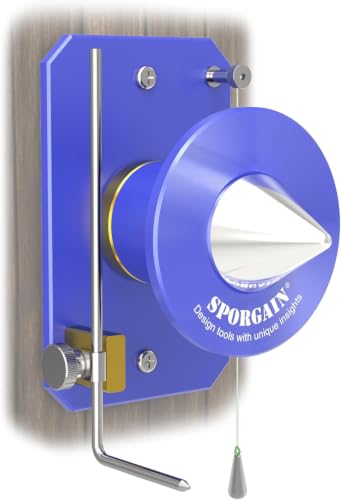
The SporGain Lawn Mower Blade Balancer is a dedicated benchtop blade-care tool designed to verify static balance across a wide range of rotary mower blades. Measuring 6.5 by 4.25 by 5.31 inches and finished in Denim Blue, the unit relies on an internal magnetic alignment system to suspend and check blades after grinding or regular seasonal maintenance. By incorporating eight powerful N52 magnets into an enclosed housing, this tool helps DIYers and equipment owners confirm that their replacement, mulching, or high-lift blades are evenly weighted prior to reinstallation.
This balancer is primarily suited for homeowners, property managers, and DIY small-engine maintenance enthusiasts who service their own push mowers, lawn tractors, or zero-turn mowers. Imbalanced blades frequently create severe deck vibration, which can lead to premature wear on spindle bearings, deck welds, and engine components. For buyers who sharpen their blades at home, an accessible magnetic balancer provides a critical quality-check step before mounting hardware is torqued back into place.
A notable design feature is the tool's hidden magnetic structure, which nests eight N52 magnets securely inside the alignment hub. Rather than exposing bare magnetic surfaces to metal shavings, filings, and abrasive grit from sharpening, the enclosed configuration protects the magnets while maintaining sufficient magnetic pull to support the blade. Paired with this is an infinitely adjustable centering mechanism, which the manufacturer states fits blades of most center-hole dimensions without needing distinct stepped adapters or loose plastic rings.
Practical ownership of the SporGain balancer requires minimal preparation, but buyers should ensure the device sits on a completely level, vibration-free surface during inspection. In standard operation, a clean, deburred blade is positioned onto the adjustable hub where the magnets engage the steel core. If one side dips, material must be incrementally removed from the heavy side until horizontal equilibrium is achieved. Blades should always be inspected when disengaged and disconnected from the mower, adhering strictly to machine safety guidelines.
While the infinitely adjustable hub provides broad versatility, the product documentation does not specify the precise minimum or maximum inner-diameter tolerances for uncommon or proprietary center holes. Prospective buyers with oversized commercial hubs or unusual star patterns should double-check physical compatibility before purchasing. Overall, for operators seeking an accessible, magnet-assisted balance tool for standard residential and light-duty commercial blades, the SporGain balancer offers practical workshop utility at a modest profile.
The SporGain balancer relies on an internal array of eight N52 neodymium magnets to hold mower blades securely on the alignment axis. Neodymium magnets of the N52 grade provide a dense magnetic field, ensuring that standard carbon steel and hardened mower blades remain firmly seated while pivoting freely for static balance checks.
By enclosing the magnets within a hidden design, the tool minimizes direct exposure to abrasive grinding dust, metal filings, and ambient moisture. This design choice helps protect the magnets from physical chipping and ensures smooth rotation when assessing horizontal level across the blade wings.
Unlike static cone balancers that require specific stepped increments, the SporGain tool features an infinitely adjustable alignment mechanism. This setup is designed to accommodate various center-hole configurations found across walk-behind, lawn tractor, and zero-turn mower decks without relying on interchangeable adapter bushings.
While the mechanism is engineered to seat most common round and shaped center holes, buyers should note that exact diameter boundaries are not listed by the manufacturer. Ensuring that the blade is cleaned of caked grass, dirt, and loose paint before mounting is essential for obtaining smooth, repeatable balance readings on the adjustable spindle.
Using a blade balancer is a vital safety and maintenance procedure that prevents rotational imbalance from damaging spindle assemblies, mower decks, and engine crankshafts. Blades should only be balanced after the lawn mower has been completely shut down, the spark plug boot disconnected, and the blade safely removed following manufacturer torque and safety procedures.
Care for the SporGain balancer itself involves keeping the unit clean and storing it in a dry workshop environment. Wiping away fine steel filings with a non-magnetic cloth after each sharpening session prevents buildup around the hub, preserving the smooth movement of the balancing mechanism over time.

Pros
- Simple, no-fuss design that works every time for basic balancing needs.
- Metal build feels solid and should hold up to years of garage use.
- Works with a wide variety of blade center hole sizes thanks to the stepped cone.
- Costs less than a coffee and delivers real performance improvement.
Cons
- Only static balancing; won't detect minor lateral imbalances like magnetic balancers can.
- May not fit blades with non-circular or odd-shaped center holes (e.g., some mulching or gator blades).
- Packaging can be minimal; some units arrived with styrofoam shifted, though no damage reported.
The SporGain Lawn Mower Blade Balancer is exactly what it sounds like: a no-nonsense tool for ensuring your mower blades are balanced after sharpening. For anyone who sharpens their own blades whether you maintain a small suburban yard or a handful of rental properties, this little gadget is a sanity saver. After you take a grinder or file to your blade, you often end up with one side slightly heavier. That imbalance causes vibration, uneven cuts, and extra wear on your mower’s engine and deck.
This balancer solves that problem simply. You set the blade on the tapered metal cone, and the heavy side drops down. Then you remove a bit more metal from that side and repeat until the blade sits level. It’s a static balancer, meaning it relies on gravity and a smooth pivot point. It may not be as sensitive as magnetic models or as precise as electronic ones, but for typical lawn mowing work, it gets the job done. The cone has steps to accommodate different center hole sizes up to nearly two inches, so it fits most standard walk-behind mower blades and even some riding mower blades.
Build quality is impressive for the price. The base and cone are made of metal, not plastic, so they won’t crack or warp. It’s small enough to toss in a tool bag or leave in a drawer. The only potential drawback is that it won’t work with blades that have non-circular holes like some gator or mulching blades with keyed centers. Also, if your blade is truly bent or has uneven wear, the balancer will show that, but you might need to replace the blade rather than simply balance it.
In real-world use, this balancer makes a noticeable difference. Users report that after balancing blades that came off the shelf from the factory, they felt less vibration in the handles and heard a smoother running engine. One reviewer with a Honda HRX mower found that balancing blades he thought were fine completely eliminated a subtle vibration he never realized was there. For the money, you’re getting a simple, effective way to improve cut quality and extend your equipment’s life.
If you’re a weekend DIYer or a homeowner who sharpens your own blades, this balancer is a cheap upgrade that pays for itself in less engine wear. Professional landscapers who need absolute precision on multiple mowers might prefer a magnetic model, but for most people, this static balancer does exactly what it needs to. A solid buy.
Product Dimensions: 2.4 x 2.4 x 2.1 inches
Item Weight: 3.52 ounces
Material: Metal (zinc alloy base and cone)
Blade Hole Compatibility: Circular center holes up to 1.97 inches (largest step)
Base Diameter: 2.36 inches
Color: Silver
Includes: One blade balancer only


Pros
- Adjustable sharpening angle (15°-45°) covers most common mower blades.
- Magnetic balancer is quick to use and provides accurate results.
- Solid build quality with metal components and ball bearings for durability.
- Easy to set up and use, even for beginners with no prior sharpening experience.
Cons
- May not accommodate very large or unusually shaped mower blades due to fixed mounting design.
- Magnetic balancer works best on flat, clean blades; debris or heavy rust can affect accuracy.
- Price is higher than simple sharpening guides, but the combo adds balancing capability.
The SporGain Lawn Mower Blade Sharpener & Balancer Combo Kit is a dual-purpose tool set designed for homeowners and DIYers who want to keep their mower blades in top shape without relying on a shop. This kit includes an adjustable blade sharpener and a high-precision magnetic balancer, both made with solid materials that feel substantial in hand.
For real-world performance, the sharpener’s 15° to 45° adjustment range lets you match the factory bevel on most push mower and riding mower blades. The ball-bearing mechanism allows smooth, controlled strokes, and the enlarged handle gives good leverage. After sharpening, the magnetic balancer quickly shows if the blade is off-center, which helps prevent vibration and uneven cutting. Users typically see a cleaner lawn and less strain on the mower engine after using this combo.
Build quality is a highlight here. The sharpener is made from thick aluminum alloy with sealed ball bearings, and the balancer uses strong N52 magnets to hold the blade securely. Both tools feel rugged enough for regular use in a garage or shed. The magnetic balancer has a hidden magnet design that avoids interference, and the sharpener’s clamping mechanism holds blades firmly without slipping.
One realistic drawback is that the sharpener’s clamping range may not accommodate very wide or oddly shaped aftermarket blades. Also, the magnetic balancer requires a clean, flat blade surface for accurate results; heavy rust or debris should be cleaned off first. These are minor trade-offs for a tool set that otherwise performs very well for its intended audience.
Overall, the SporGain Lawn Mower Blade Sharpener & Balancer Combo Kit is a smart buy for anyone who mows regularly and wants to extend blade life while improving cut quality. It’s especially useful for homeowners with a few acres, or DIYers who maintain multiple mowers. The combination of adjustable sharpening and magnetic balancing saves time and delivers professional-level results without a steep learning curve.

Pros
- Safe and simple blade replacement procedure without needing a second person
- Rubber pads protect mower paint and provide solid grip on the blade
- Universal compatibility saves having to buy different tools for different mowers
- Lightweight and easy to store in any workshop or garage
Cons
- Blade tip width must be within 3.3 inches and the distance from tip to mounting plate less than 2.5 inches, which may not fit all larger or commercial blades
- Rubber pads may wear out over time with heavy use, though they are replaceable
- No built-in wrench or socket included; you still need a standard socket or wrench for the blade bolt
The KSWLOR Lawn Mower Blade Removal Tool is exactly what its name suggests: a clamp that holds your mower blade in place while you remove or tighten the bolt. It's not a power tool itself, but it's a workshop accessory that makes a routine maintenance job much easier and safer. Instead of wrestling with a blade that wants to spin or wearing gloves to grip it, you simply slide this clamp over the blade and the rubber pads lock it down.
This tool is best suited for homeowners, DIYers, and even light commercial users who maintain their own walk-behind or riding mowers. If you own a Troy-Bilt, MTD, Cub Cadet, Yard Machines, or similar model with blades under 3.3 inches wide at the tip, you are covered. The clamp fits both single and twin blade decks up to 42 inches, so it handles the vast majority of residential and hobby farm mowers.
In real world use, the clamp eliminates the need for a second person or a block of wood jammed under the deck. The rubber pads (about 1.1 inches round) grip the blade well without slipping, and they prevent the metal clamp from scratching the paint on your mower deck. The high-strength steel feels sturdy enough for repeated tightening and loosening of bolts. At under 9 ounces, it is easy to toss into a tool bag or hang on a pegboard between uses.
There are some limitations worth noting. The tool only works on blades where the tip width is within 3.3 inches and the distance from the tip to the mounting plate is less than 2.5 inches. Very large commercial blades or offset blades may not fit. Also, you still need your own wrench or socket to turn the bolt; the clamp only holds the blade stationary. Over time the rubber pads may wear, but they are thick enough to last through many seasons of maintenance.
Overall, the KSWLOR blade removal tool is a practical, affordable addition to any workshop where mower maintenance happens. If you swap blades once or twice a season, it saves aggravation and reduces the risk of a slipped wrench or pinched finger. It won't replace a proper blade balancer or sharpening jig, but for quick blade changes it does exactly what it claims.
Product Dimensions: 3.6 x 1.8 x 3 inches
Item Weight: 8.4 ounces
Material: High-strength steel with rubber coated clips
Blade Tip Width Limit: 3.3 inches (85 mm)
Max Distance from Blade Tip to Mounting Plate: 2.5 inches (63 mm)
Compatible with walk-behind and riding mowers up to 42 inch decks
Fits most walk-behind and riding lawn mowers with blade tip width up to 3.3 inches. Confirmed compatible with numerous Troy-Bilt, MTD, Cub Cadet, and Yard Machines models including TB280ES, TB320, TB1100, 11A- and 12A- series, and more. Always verify your blade dimensions before purchase.
The Complete Guide to Measuring Lawn Mower Blade Size and Fitment
Accurately determining mower blade dimensions requires taking direct measurements from the steel rather than relying on deck size labels. Many property owners assume that a mower deck measurement translates directly to blade length, which frequently leads to purchasing incompatible parts that fail to clear the deck baffle or spindle housing. Learning how to measure lawn mower blade size involves four distinct measurements: diagonal tip-to-tip cutting length, blade width, steel thickness, and center-hole diameter or pattern. Taking time to measure each specification ensures that replacement blades match the original equipment tolerances without risking mechanical interference or excessive vibration.
When you know exact dimensional values, matching replacement options across brands becomes straightforward, regardless of whether you need standard high-lift, bagging, or mulching designs. Original equipment manufacturers often update part numbers or use distinct spindle configurations across different deck revisions of the same mower model. Pulling accurate measurements directly from your existing blade confirms physical compatibility before you finalize any replacement purchase.
Why Mower Blade Measurement Matters for Cutting Performance and Safety
Lawn mower blades operate at extreme rotational speeds, creating significant centrifugal force and lift within the mower deck. Installing an incorrect blade size poses serious mechanical and safety risks, ranging from deck collisions to severe engine crankshaft damage. If a blade is even a fraction of an inch too long, the tips can strike the inner deck baffle, damaging the spindle assemblies or chipping the cutting edges. Such impacts can also warp the mower deck shell or cause catastrophic structural failure to the spindle bearings.
Installing a blade that is noticeably shorter than manufacturer specifications diminishes total cutting swath and compromises airflow. Undersized blades create gaps between multiple rotating blades on multi-spindle decks, leaving uncut strips of grass down the center of your mowing path. Proper sizing also protects the spindle bearings, ensuring that rotational mass aligns with the engineered design of your specific walk-behind or riding mower deck. Consistent dimensions preserve optimal cutting suction, which keeps clippings moving efficiently toward your discharge chute or bagger.
Safety Preparations and Blade Removal Essentials
Before attempting to take any measurements, the cutting blade must be safely detached from the mower deck. Always disconnect the spark plug boot on gas mowers or remove the safety key and battery pack on electric machines to prevent accidental engine startup. Tilting a walk-behind mower requires placing the carburetor and air filter upward so engine oil does not flood the intake system or foul the spark plug. Heavy leather work gloves are also essential during this step to protect your hands against sharp metal edges and burrs.
Loosening the blade retaining bolt requires stabilizing the cutting edge so it does not spin freely during torque application. A dedicated blade clamp, such as the MaxPower 339079 Universal Mower Blade Removal Tool or KINTLE 490-850-0005 clamp, locks directly against the deck lip to immobilize the blade securely. Using a mechanical locking clamp prevents dangerous slip accidents and eliminates the need to hold the sharp cutting edge with your hands. This secure hold allows you to apply firm, steady wrench pressure without rounding off the blade bolt head.
Once the retaining bolt, washer, and any protective spindle cups are removed, lower the blade carefully onto a clean, flat working surface. Avoid attempting to measure the blade while it remains mounted beneath the dark underside of the mower deck. Laying the component flat on a workbench under adequate lighting ensures clear visibility of worn cutting edges and mounting holes. Cleaning off built-up grass clippings and dried mud with a wire brush will also reveal the true steel surface before you apply a tape measure.
How to Measure Blade Length: The Diagonal Tip-to-Tip Method
The most critical measurement for any mower blade is overall length, but many owners mistakenly measure straight across the flat center edge. Mower blades are manufactured with angled cutting edges and upward-turned sail wings, which means measuring straight across will yield an artificially short number. Standard outdoor power equipment industry practice dictates measuring diagonally from tip to opposite tip. This diagonal line accounts for the true cutting radius created when the blade spins on its central spindle axis.
To execute this measurement accurately, place the blade flat on your workbench with the cutting edges facing upward. Position your tape measure at the farthest outer corner of one sharpened cutting edge, then stretch the tape diagonally across the center mounting hole to the opposite cutting tip. This diagonal line represents the true sweep diameter of the blade as it rotates beneath the mower deck. Keep the tape measure pulled straight and tight rather than letting it drape loosely over the raised center hole or lift wings.
If the cutting tips are heavily worn, rounded, or broken from rock impacts, your measured length may appear slightly shorter than standard manufacturing sizes. In such situations, round up to the nearest standard fraction, which is typically sixteenths, eighths, or quarters of an inch. Commercial and residential blades usually fall into standardized lengths such as 21 inches, 21-3/16 inches, or 21-1/2 inches. Comparing your rounded measurement against the original mower deck manual confirms whether you have identified the correct standard blade length.
Measuring Blade Width and Steel Thickness Correctly
Blade width directly impacts the airflow volume, structural rigidity, and lift generated beneath the cutting deck. To measure width, position your tape measure or ruler perpendicular to the blade body across the widest flat section. Avoid measuring across the curved lift sail or near the tapered cutting edges, as these areas do not represent the main structural beam of the blade. Recording the width across the center flat section provides the standard dimension cataloged by parts manufacturers.
Standard residential walk-behind blades generally feature widths between 2.0 inches and 2.5 inches, while commercial and heavy-duty riding mowers often use blades measuring 2.75 inches to 3.0 inches wide. Installing a blade with inadequate width can reduce lift, leading to poor bagging performance and clumping during discharge. Conversely, an excessively wide blade may add unnecessary weight and strain lighter electric or walk-behind drive motors. Sticking to the factory-specified width ensures that your deck maintains intended airflow characteristics without overloading the drive mechanism.
Steel thickness determines the durability and impact resistance of the blade when encountering debris. You should measure thickness near the center mounting hole using a precision dial caliper or digital micrometer rather than a flexible tape measure. Common mower blade thicknesses include 0.120 inches, 0.134 inches, 0.150 inches, and heavy-duty 0.204 inches or 0.250 inches. Matching original thickness ensures that the factory blade bolt and cupped washer achieve correct clamping pressure against the spindle.
Identifying Center Hole Shapes and Measuring Mounting Dimensions
Center-hole geometry is one of the most common stumbling blocks when selecting replacement mower blades. Even if the length and width match your original blade perfectly, an incompatible center hole cannot mount onto the spindle shaft. Manufacturers employ a wide range of center hole configurations, including round holes, 5-point stars, 6-point stars, bowtie shapes, and rectangular slots. Selecting the exact geometry is mandatory because the spindle star or hub must engage the blade without any slippage.
For circular center holes, measure the internal diameter from inside edge to inside edge using calipers or a precise ruler. Common round center hole diameters include 3/8 inch, 7/16 inch, 1/2 inch, 5/8 inch, 11/16 inch, and 13/16 inch. For star-shaped mounting patterns, such as the 5-point star or 6-point star found on many MTD and Husqvarna machines, the blade must match the star point count precisely. Do not attempt to force a 6-point star blade onto a 5-point star spindle shaft, as doing so will strip the spindle splines.
Bowtie and proprietary shapes require matching the exact manufacturer pattern rather than simple circular dimensions. If you are servicing battery-powered machines, check our Ryobi mower blade replacement setup to review how specialized electric mounting hubs interface with modern deck hardware. Never drill, file, or modify a center hole to force a fit, as altering the steel weakens the structural core and creates severe vibration hazards. Maintaining factory mounting geometry protects the spindle threads and prevents blades from coming loose under heavy operating loads.
Checking Outer Holes, Pin Patterns, and Center-to-Center Spacing
Certain mower brands utilize alignment pins or multi-hole mounting hubs to prevent blade slippage during sudden impacts. These designs feature one central bolt hole accompanied by two smaller outer positioning holes on either side. When measuring a multi-hole blade, you must record both the diameter of the outer holes and the center-to-center distance between them. Overlooking outer hole spacing can result in purchasing a blade that cannot seat over the spindle pins.
To measure center-to-center hole spacing, measure from the center of the left outer hole to the center of the right outer hole. Alternatively, you can measure from the inside edge of one hole to the outside edge of the matching hole, which provides the identical center-to-center spacing value. Verifying outer hole diameter is equally critical, as alignment pins must slide smoothly through the steel without excessive play. Snug alignment prevents the blade from shifting slightly off-axis during acceleration or sudden stops.
If replacement blades lack the correct outer hole pattern, the blade will not seat flush against the spindle adapter. A blade that rests unevenly on top of alignment pins will wobble during operation, loosening the blade retaining bolt and causing extreme vibration. Always verify that all holes in the replacement part correspond with the alignment posts on your specific mower spindle. Confirming this alignment before tightening the hardware protects the spindle plate from bending under bolt tension.
Understanding the Difference Between Deck Width and Blade Length
A frequent point of confusion among homeowners is the difference between overall deck cutting width and individual blade length. A mower advertised with a 42-inch cutting deck does not use a single 42-inch blade. Instead, multi-blade riding mowers and lawn tractors combine two or three staggered blades to achieve their total cutting swath. Confusing deck size with blade length is one of the quickest ways to order an unworkable replacement part.
For example, a typical 42-inch deck utilizes two 21-inch blades, while a 46-inch deck often pairs two 23-inch blades. A 48-inch or 54-inch commercial zero-turn mower generally uses three separate blades measuring approximately 16.5 inches to 18.5 inches each. The combined sweep of multiple overlapping blades creates the advertised cutting path while preventing the blades from colliding inside the deck baffle. Spindle offset within the deck ensures that blade tips pass close to each other without touching during continuous operation.
Single-blade walk-behind mowers, such as standard 21-inch or 22-inch push mowers, use a blade that closely matches the deck size, typically measuring 20-3/4 inches to 21-13/16 inches to allow adequate clearance along the inner deck walls. If you are exploring modern battery-powered walk-behind equipment, reviewing brushless electric mower blades highlights how deck airflow profiles influence single-blade length requirements. Always divide multi-blade deck widths by the number of spindles to establish a baseline before confirming with physical blade measurements. This mental check prevents ordering blades that are physically impossible to mount within your mower deck perimeter.
Verifying Blade Balance and Deck Leveling After Sizing Replacement Parts
Once you have measured and procured the correct replacement blade, verifying balance and deck alignment ensures optimal cutting quality. Even brand-new blades or freshly sharpened edges can have minor weight discrepancies between the two wings. Using a cone balancer or a magnetic balancer, such as the SporGain Lawn Mower Blade Balancer Precision tool, confirms that both sides distribute weight evenly around the center axis. A balanced blade spins smoothly without transferring unwanted shaking into the mower deck or operator handle.
An unbalanced blade causes high-frequency vibrations that stress the mower engine, crack deck welds, and prematurely wear out spindle bearings. If one side dips on the balancer, carefully remove small amounts of metal from the heavy wing lift sail until the blade rests horizontally. Proper balancing ensures smooth motor operation and extends the lifespan of both walk-behind and riding equipment. Performing this check every time you measure or service blades maintains consistent, vibration-free mowing performance.
In addition to balancing, checking the deck pitch and level guarantees that your properly sized blades cut grass evenly across the lawn. Measuring tools like the HD Switch Deck Leveler Gage or Xhziy Deck Leveling Gauge allow you to measure the distance from the blade cutting edge to the ground on both sides of the deck. Leveling your deck prevents stair-stepped turf patterns and ensures clean clipping discharge into collection bags or across the turf. Ensuring that the front of the deck sits slightly lower than the rear prevents double-cutting clippings and saves engine power.
Common Mower Blade Measuring Mistakes and Pre-Purchase Verification
One of the most widespread errors is measuring a severely worn blade without accounting for missing metal. When cutting tips strike sand, gravel, or rocks over multiple seasons, the outer corners erode into rounded edges, reducing measured length by up to a half-inch. If your old blade appears significantly shorter than common replacement sizes, inspect the tip curvature and compare your measurement against the mower model number parts diagram. Accounting for missing metal ensures that you order a full-length replacement rather than a duplicate of a worn-down edge.
Another common pitfall is measuring the curve of the lift wing rather than keeping the tape measure flat across the diagonal line. Mower blades with high-lift sails feature pronounced curves that exaggerate tape measure readings if the tape follows the contour of the metal. Always maintain a taut, straight line between the cutting tips to obtain the true rotational sweep diameter. Keeping the measuring tape completely straight prevents overestimating blade length and ordering parts that hit the deck baffle.
Never rely strictly on online product listings that claim universal compatibility without cross-referencing your physical measurements. Double-check your recorded diagonal length, blade width, thickness, and center-hole specifications against the replacement part documentation. Taking these extra verification steps prevents frustrating returns, protects your mower engine, and ensures clean, crisp mowing results on every pass. Matching every single dimension guarantees that your mower returns to factory cutting efficiency without mechanical surprises.
Mastering the physical measurements of your lawn mower blade removes the guesswork from routine lawn equipment maintenance. By methodically recording diagonal length, width, thickness, and mounting hole geometry, you can select compatible blades that protect your spindle components and maintain peak cutting efficiency. Keeping these measurements documented alongside your mower model number ensures quick, reliable blade replacements whenever your cutting edges wear down. Precise measurements ultimately save time, prevent deck damage, and keep your lawn looking clean and healthy all season long.








Write Your Review
No reviews yet. Be the first to share your experience!