


Engine displacement, measured in cubic centimeters (cc), indicates the total volume of air and fuel an engine can process in one cycle. This figure, often referred to as cc in lawn mower engines, serves as a primary indicator of potential power output rather than a direct measure of cutting speed or efficiency. For a homeowner standing in the middle of a suburban lawn, this number helps predict whether the machine has enough torque to handle thick grass or steep slopes without stalling.
A higher cc rating generally correlates with a larger engine block and more robust internal components. This matters because a small engine may struggle under load, leading to increased wear or the need for frequent maintenance. Understanding this metric allows you to match the machine’s capability to your specific yard conditions, ensuring you do not buy a unit that is either underpowered or unnecessarily heavy. The following section outlines the available options and their specific engine configurations.


Pros
- Powerful 201cc engine provides reliable performance for large lawns without needing to recharge
- Wide 22-inch deck cuts mowing time by covering more grass per pass
- Self-propelled drive reduces pushing effort, especially on slopes and uneven ground
- Versatile 3-in-1 functionality allows bagging, mulching, or side discharge to suit yard conditions
- Easy single-lever height adjustment with 6 positions from 1.25 to 4 inches
Cons
- Gas mower requires regular maintenance like oil changes and air filter cleaning, unlike cordless electric models
- Self-propelled drive is single-speed, so users cannot adjust pace to match walking speed
- Heavier than many electric mowers, which may be less ideal for small or very hilly lawns
The SENIX 201cc 22-inch self-propelled gas lawn mower is a solid choice for homeowners and suburban property owners with medium to large lawns. This walk-behind mower packs a 201cc OHV 4-stroke engine that delivers reliable, long-lasting power for tackling thick grass and uneven terrain. The 22-inch steel cutting deck is wider than many standard 20-inch models, which means you can cover more ground per pass and finish mowing your front yard or backyard faster.
For lawn care enthusiasts or first-time buyers looking for a gas mower that won't break the bank, the SENIX offers great value. The self-propelled drive takes most of the pushing effort out of mowing, especially on gentle slopes or bumpy ground. The 11-inch rear wheels and 8-inch front wheels provide solid traction and help the mower glide smoothly over uneven spots. You can easily navigate around flower beds, garden hoses, and trees without wrestling the machine.
One of the standout features is the 3-in-1 function. You can quickly switch between bagging, mulching, or side discharge depending on your lawn's needs. Mulching clippings returns nutrients to the soil, which is great for lawn health during peak growing season. Bagging leaves a clean finish for a tidy look before a backyard barbecue, and side discharge handles thick grass without clogging. The single-lever height adjustment offers six positions from 1.25 to 4 inches, letting you dial in the perfect cut for different grass types and seasons.
Build quality is practical for everyday use. The steel deck feels sturdy and should hold up well against rocks and roots. The handle is comfortable and the self-propelled engagement is straightforward. Assembly is manageable with clear instructions, and most tools are included. Maintenance is typical for a gas mower: you'll need to check the oil, clean or replace the air filter, and sharpen the blade periodically. The engine has accessible components for oil changes and air filter servicing.
Storage is straightforward thanks to the foldable handle, which reduces the mower's footprint in a garage or shed. The grass bag has decent capacity for a 22-inch mower, though you may need to empty it more often if bagging very thick or wet grass. Some users might find the single-speed self-propelled drive limiting if they prefer to walk at a different pace, but for most homeowners it works well.
Overall, the SENIX 201cc self-propelled gas mower is a practical, budget-friendly option for suburban and rural property owners who need reliable cutting performance without the complexity of electric batteries. It's well-suited for medium to large lawns where gas power and wide deck coverage make a real difference in mowing time. If you're looking for a dependable gas mower that offers good versatility and easy maneuverability, this model is worth considering.

Pros
- Powerful gas engine handles thick, wet, and tall grass without bogging down.
- Self-propelled drive reduces effort on slopes and long stretches, great for larger lawns.
- 22-inch cutting width strikes a good balance between speed and maneuverability.
- Versatile 3-in-1 system covers mulching, bagging, and side discharge for year-round lawn care.
- Single-lever height adjustment is quick and tool-free, convenient for adjusting on the fly.
Cons
- Weighs 79 pounds, which may be heavy for some users to push manually if the self-propelled system fails or on flat ground.
- Gas engine requires regular maintenance like oil changes and fuel stabilization, less convenient than cordless electric models.
- Grass bag capacity not specified; may need frequent emptying on large lawns with heavy growth.
The SENIX 201cc 22-inch self-propelled gas lawn mower is designed for homeowners who need reliable cutting power for medium to large lawns. Powered by a 201cc 4-cycle OHV engine, this mower delivers consistent performance to tackle thick grass, uneven terrain, and seasonal overgrowth. Its 22-inch steel cutting deck is wider than many entry-level mowers, helping you cover more ground in fewer passes and finish mowing faster.
This mower is best suited for suburban and rural property owners with sloped or uneven lawns. The rear-wheel-drive self-propelled system, paired with large 11-inch rear wheels, provides excellent traction on hills and helps you maintain control on bumpy ground. The variable speed control lets you match your walking pace, which is especially helpful for elderly users or those with larger yards. First-time mower buyers will appreciate the straightforward single-lever height adjustment, offering six positions from 1.25 to 4 inches for precise cutting across different grass types and seasons.
In terms of lawn care performance, the 3-in-1 cutting system gives you flexibility: bag clippings for a clean finish during peak growth, mulch to nourish the lawn, or side discharge for tall grass after a vacation. The sharp steel blade and powerful engine handle mulching well, returning fine clippings that break down quickly. Bagging efficiency is solid for a gas mower, though the bag capacity may require frequent emptying on large lawns. The side discharge chute works effectively for thick, wet grass without clogging.
Build quality is practical for the price point. The steel deck feels durable and resistant to impacts from rocks and roots, though it may rust over time if not cleaned and stored properly. The large rear wheels roll smoothly over uneven ground, and the handle is comfortable with a rubberized grip. Assembly is straightforward with clear instructions and included tools, typically taking 30-45 minutes. Storage is easy thanks to a foldable handle that reduces the mower's footprint in a garage or shed.
Maintenance is manageable: you'll need to check and change oil, replace the air filter periodically, and sharpen or replace the blade. The gas engine requires fuel stabilization if storing over winter, which is a minor hassle compared to cordless electric models. However, for users who prefer the range and power of gas, this mower offers good value. The 79-pound weight is noticeable but manageable with the self-propelled drive engaged.
Overall, the SENIX 201cc self-propelled mower is a solid choice for budget-conscious homeowners who need reliable performance on medium to large lawns with slopes. It may not be the lightest or most feature-rich option, but its powerful engine, versatile cutting modes, and user-friendly adjustments make it a practical workhorse for routine weekly mowing and seasonal yard cleanup.

Pros
- Easy starting with B&S engine no battery to charge or cord to pull repeatedly
- Lightweight and easy to push even for smaller yards or less experienced users
- Simple height adjustment with front and rear levers for quick changes
- Compact fold for vertical storage in tight spaces
Cons
- Plastic wheels may not hold up as well on rough or uneven terrain over time
- Side discharge chute can clog in thick, damp grass requires occasional clearing
- Manual push only no self-propelled option for hills or larger lawns
The PowerSmart 21-inch push lawn mower is a straightforward gas-powered walk-behind mower designed for homeowners with small to medium yards up to about a quarter acre. It pairs a reliable Briggs & Stratton 125cc engine with a lightweight 62-pound frame, making it a practical choice for anyone who wants dependable cutting power without the complexity of a self-propelled model or the need to manage batteries.
In real-world use, the B&S E300 engine starts easily thanks to the Prime 'N Pull system. A few primes and a single pull get it running even after sitting for a few weeks. The 21-inch steel deck handles regular grass cutting with no trouble, and the 6-position height adjustment lets you quickly switch between a close 1.5-inch trim and a taller 3.9-inch cut for different seasons or grass types. The 2-in-1 mulching and side discharge options give you flexibility: mulch for nutrient recycling or side discharge to handle thicker growth without leaving clumps.
Build quality is decent for the price point. The all-steel deck feels sturdy enough for typical suburban lawns, though the plastic wheels are a compromise you will want to avoid rough, rocky ground if possible. The mower folds up compactly for storage, and since it comes fully assembled in the box, you just unfold the handle and start mowing. That is a big plus for users who want to get to work without fiddling with bolts and instructions.
On the downside, this is a manual push mower. If your yard has significant slopes or you have a larger lawn, you will likely find yourself working harder than with a self-propelled model. The side discharge can also clog in wet, tall grass, so you may need to stop and clear it occasionally. But for flat, small to medium lots, the PowerSmart delivers a clean cut with minimal effort.
Overall, this mower is a solid value for budget-conscious homeowners who want a simple, reliable gas mower that starts easily and stores away neatly. It is not built for heavy commercial use or steep hills, but for weekly maintenance on a quarter-acre or less, it gets the job done without breaking the bank.
Engine: Briggs & Stratton 125cc (E300 series) 4-stroke OHV single-cylinder
Power Type: Gas (pull start)
Deck Material: All-steel
Cutting Width: 21 inches
Cutting Height: 6 positions, 1.5 to 3.9 inches
Cutting Options: Mulch, side discharge
Wheel Size: 7-inch front, 8-inch rear
Weight: 61.9 pounds
Fuel Capacity: 0.21 gallons
Recommended Oil: SAE 10W-30 (included)
Assembly: Fully assembled in box; unfold handle
Folded Dimensions: 33 x 22 x 17 inches
This mower is best suited for homeowners with flat, small to medium lawns up to about a quarter acre. It is ideal for weekly mowing on established grass, especially when you want the simplicity of a gas engine without the hassle of batteries or cords. The lightweight design makes it a good choice for anyone who needs to maneuver around flower beds, trees, or tight garden paths. It also works well for those who prefer mulching to bagging, as the mulching capability returns nutrients to the soil.

Pros
- Easy to start on the first or second pull according to multiple customer reviews
- Self-propelled system moves smoothly up inclines, good for sloped lots up to half an acre
- Fully assembled out of the box except for unfolding the handle; no complicated setup
- Price point is competitive for a 21-inch self-propelled gas mower with 3-in-1 capability
Cons
- Some users report loose or failing parts on first use; quality control may vary
- 66-pound weight can feel heavy when maneuvering in tight flower beds or manually pushing
- Fuel tank is only 0.21 gallons, requiring refills for larger yards over half an acre
The AMERISUN AV8621S1 is a 21-inch, self-propelled gas lawn mower aimed at homeowners who want reliable cutting performance without spending a fortune. It packs a 170cc 4-cycle OHV engine and rear-wheel drive into a compact package that handles moderate slopes and thick grass with ease. While it's not a commercial-grade machine, it offers solid value for yards up to about half an acre.
This mower is best suited for DIY homeowners and weekend warriors who need a dependable tool for weekly mowing, leaf mulching, and occasional bagging. The auto choke and recoil starter make it far less frustrating than older gas mowers. Multiple reviews confirm it fires up on the first or second pull after filling with oil and gas. The 170cc engine provides enough torque to push through tall or damp grass without stalling, and the rear-wheel drive gives good traction on gentle hills.
Build quality is decent for the price. The 15-gauge steel deck feels sturdy enough for residential use, and the six-position lever height adjustment is quick to use. The folding handle is a genuine space-saver, letting you store the mower upright in a 33-inch tall space. However, a few early reviews mention parts rattling loose or falling off on the first run. That's a concern and suggests you should tighten all bolts before the first cut. The plastic bagger is a bit small at 1.4 bushels, so expect to empty it frequently if you bag heavy clippings.
Ergonomics are okay but not exceptional. The handle is fixed height and doesn't tilt for different operator heights. At 66 pounds, it's not light, but the self-propelled drive takes most of the effort out of mowing on flat or gently sloping ground. On steep banks you'll still need to muscle it a bit. The side-discharge works well for fast mowing on large open areas, and the mulching capability returns fine clippings to the lawn.
In summary, the AMERISUN AV8621S1 is a capable entry-level self-propelled mower that delivers on its core promise: easy starting, good power, and a clean cut. If you're a homeowner with a modest lot and you want to avoid the hassle of corded electric or battery swapping, this is a solid buy. Just check all hardware before first use and be prepared for a few plastic trim pieces that may need tightening over time. It's a fair trade for the price.
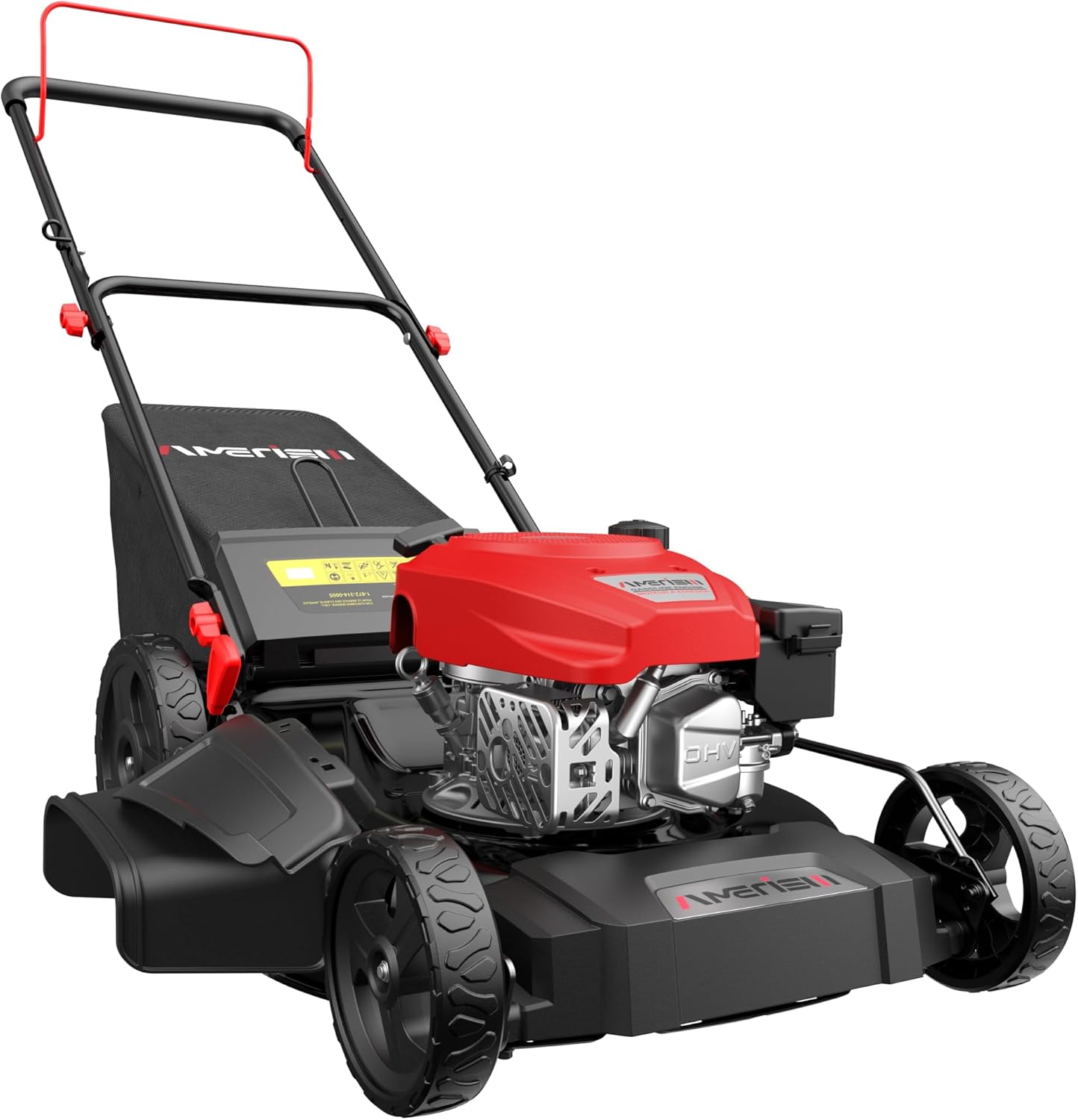
Pros
- Reliable 144cc engine with auto choke for easy starting.
- Versatile 3-in-1 cutting options (bag, mulch, side discharge).
- Large 1.4-bushel grass catcher reduces emptying trips.
- Sturdy 21-inch steel deck for efficient mowing.
- Smooth rolling on large wheels with good traction.
Cons
- Push mower requires more physical effort on slopes or thick grass compared to self-propelled models.
- Assembly is required out of the box, which may take some time for first-time users.
- No electric start option; relies on pull-start mechanism.
The AMERISUN 21-inch gas push mower is a straightforward, capable machine built for homeowners who need to tackle medium to large lawns without the complexity of a self-propelled or battery-powered model. Powered by a 144cc 4-stroke OHV engine with an auto choke system, it starts reliably and runs smoothly across a variety of grass conditions. The forced air cooling system helps maintain consistent performance during extended mowing sessions, so you won't have to worry about the engine overheating on a hot summer day.
This mower shines in its versatility. The 3-in-1 cutting system lets you switch between rear bagging, mulching, or side discharge with minimal effort. The included 1.4-bushel grass catcher holds a decent amount of clippings, so you can mow a good portion of the yard before needing to empty it. If you prefer a clean, manicured look, the bagging option works well. For those who want to recycle nutrients back into the soil, the mulching function chops clippings finely and distributes them evenly. And when the grass is thick and tall, the side discharge keeps the mower moving without clogging.
The 21-inch steel deck is a solid performer. It's wide enough to cover ground efficiently, reducing the number of passes needed on larger lawns. The single-lever height adjustment offers six positions from 1.5 to 3.9 inches, so you can easily change the cut for different seasons or grass types. The deck itself feels durable and should hold up well to regular use on typical suburban terrain. The large wheels (7-inch front, 10-inch rear) with wide treads and double ball bearings provide good stability and maneuverability, even when pushing over bumps or slightly uneven ground.
Build quality is decent for this price point. The steel deck is robust, and the engine feels well-made. Assembly is required but is straightforward with clear instructions. One thing to note: this is a push mower, not self-propelled. On flat or gently sloping lawns, it's easy to maneuver. But if you have steep hills or very thick grass, you might find yourself working harder. The pull-start mechanism is reliable, but there's no electric start option, which some users might miss.
Overall, the AMERISUN 21-inch gas push mower is a solid choice for the DIY homeowner who wants a reliable, versatile mower without breaking the bank. It's best suited for lawns up to about half an acre where you don't mind a bit of manual effort. If you have a larger property or prefer a self-propelled model, you might want to look at the self-propelled version of this mower. But for straightforward, dependable mowing with multiple clipping options, this mower delivers good value.
Brand: AMERISUN
Power Source: Gas Powered
Engine: 144cc 4-Stroke OHV
Cutting Width: 21 Inches
Cutting Height Range: 1.5 to 3.9 Inches (6 positions)
Deck Material: Alloy Steel
Grass Catcher Capacity: 1.4 Bushel
Wheel Size: 7-inch front, 10-inch rear
Product Dimensions: 32.9D x 16.5W x 22.6H inches
Item Weight: 68.3 pounds
Assembly Required: Yes
Color: Black + Red
Item Model Number: AV8621P1
This mower is ideal for homeowners with flat to gently sloping medium to large lawns up to about half an acre. It handles regular weekly mowing well and is especially useful for those who want the flexibility to bag, mulch, or side discharge clippings without needing multiple tools. The 21-inch deck is a good fit for open yards with minimal obstacles. If you have a lot of trees, flower beds, or tight corners, the push design requires a bit more effort but is still manageable. Not recommended for steep hills or very thick, overgrown grass where a self-propelled or higher-horsepower mower would be more suitable.
The mower comes with a 1.4-bushel grass catcher bag, a mulching plug, and a side discharge chute. You also get the necessary hardware and tools for assembly. The owner's manual includes maintenance and safety instructions. No additional accessories are included beyond these core items.

Pros
- Reliable Briggs & Stratton engine starts easily even after sitting for weeks
- Lightweight construction makes it easy to push and lift over obstacles
- Easy tool-free assembly and height adjustment; includes oil for first start
- Quiet operation for a gas mower, acceptable for residential neighborhoods
Cons
- Wheels may feel less durable than more expensive models, with some reports of adjustment pins popping out
- Side discharge only no mulching or bagging capability without separate accessories
- Not self-propelled, so larger lawns or hilly terrain may require more effort
The SENIX 20-inch gas push mower (model LSPG-L3) is a straightforward, no-frills walk-behind mower designed for homeowners with small to medium lawns. It pairs a 125cc Briggs and Stratton Prime n Pull engine with a stamped steel deck, offering a solid blend of power and durability at a price that won't break the bank. This isn't a commercial-grade machine, but for the average DIYer or contractor looking for a lightweight backup mower to handle tight spots around the jobsite, it gets the job done without fuss.
Real-world performance is where this mower shines for its class. The engine fires up on the first or second pull, even after sitting for a few weeks, as verified by multiple reviewers. It chews through tall grass and light weeds with ease, though it may stall in extremely dense patches. The 20-inch cutting width is practical for most suburban lots, and the 5-position height adjustment (1.25 to 3.75 inches) gives you solid control over cut quality. The side discharge chute with vortex tunnel design spreads clippings evenly, though you'll need to plan your mowing direction in tight quarters to avoid leaving piles.
Build quality is decent for the price point. The steel deck feels sturdy enough for years of use, and the fold-down handle is a nice touch for compact storage. Assembly is truly tool-free you can snap the handle in place and tighten a few wing nuts in minutes. However, some users have noted the wheels can feel a bit cheap, with occasional reports of the height adjustment lever popping out during use. Pushing effort is light thanks to the 49-pound weight and 7-inch wheels, making it easy to maneuver around landscaping and tight corners.
Ergonomics are generally good, with a comfortable plastic handlebar. The Prime n Pull startup reduces strain, though the pull cord recoil can produce a loud twang if the handle flexes too far. One notable drawback is the lack of mulching or bagging options out of the box it only side discharges. If you need a 3-in-1 mower, you'll need to look at the 21-inch or 22-inch SENIX models or buy an aftermarket bagger. Also, it's not self-propelled, so on larger lawns or gentle slopes you'll be doing the pushing yourself.
Overall, the SENIX 20-inch gas mower is a smart buy for homeowners who want reliable cutting performance without paying for features they don't need. It's especially suited for those with small yards, or as a light duty trim mower for contractors who already have a rider. If you catch it on sale near $200, it's an exceptional value. Just be aware of its limitations around wheel durability and lack of mulching, and it will serve you well for many seasons.

Pros
- Engine starts reliably and runs smooth even after sitting through winter.
- Steel deck feels solid and should hold up to years of regular use.
- Easy height adjustments with front and rear levers let you change cut on the fly.
- Compact fold makes storage a breeze in small tool sheds or under workbenches.
Cons
- Manual push only not self-propelled so it can be tiring on larger or sloped yards.
- Small 7-inch front wheels may struggle with uneven or bumpy ground.
- No bagging option included only mulching and side discharge require buying a separate bag if needed.
The PowerSmart 21-inch gas lawn mower is a straightforward push mower built for homeowners who want reliable mowing without overcomplicating things. At its heart is a 125cc Briggs & Stratton E300 engine made right here in the USA, and it's paired with a Prime 'N Pull system that makes cold starts genuinely easy. No priming? No problem. One or two pulls and you're off.
This machine is best suited for folks with small, relatively flat yards around 1/4 acre or less. If your ground has serious bumps or slopes, the manual push design and small 7-inch front wheels might wear you out. But for level lawns, it scoots along fine and the 21-inch cutting width covers decent ground per pass. The all-steel 15-gauge stamped deck is a highlight it feels robust and should handle abrasion and impacts better than budget plastic decks.
Cutting height adjustments are a breeze with dual levers at the front and rear. You get six positions ranging from 1.5 to 3.9 inches, so you can keep your grass healthy through the growing season. The 2-in-1 system lets you choose between nutrient-rich mulching or side discharge to keep clippings manageable. Just be aware there's no bagging setup out of the box you'll need to buy a separate bagger if that's your thing.
Assembly? There's none. This mower comes fully assembled in the box. You simply unfold the handle, add oil and gas, and start mowing. The foldable handle is also handy for storage, dropping the footprint by about 70% so it easily tucks into a garage corner or under a workbench. Weight is around 56 pounds, which is manageable for most users to push and maneuver.
Realistically, the main drawback is that it's not self-propelled. On sloped yards or if you have a larger than 1/4 acre lot, you'll feel that push. And the small wheels means it's not ideal for rough terrain. But for the price and the Briggs & Stratton engine reliability, this is a solid entry-level mower for homeowners who want simple, durable equipment without the premium self-propelled cost. If you've got a flat, compact lawn and want a mower that starts easy and stores small, this PowerSmart is a smart buy.
Engine Type: 125cc Briggs & Stratton E300 OHV (made in USA)
Start Type: Pull cord with Prime 'N Pull
Cutting Width: 21 inches
Deck Material: 15-gauge stamped steel
Cutting Height: 6 positions, 1.5 to 3.9 inches
Cutting Options: Mulch or side-discharge
Wheel Size: 7-inch front, 8-inch rear
Fuel Tank Capacity: 0.21 gallons
Weight: 56.4 pounds
Folded Dimensions: 33 x 22 x 17 inches (H x W x D)
Recommended Terrain: Flat, up to 1/4 acre
This mower shines on small, flat suburban lawns and weekend home properties. It's perfect for homeowners who want a gas mower without the hassle of complex assembly or the expense of self-propulsion. Use it for regular weekly cuts where you can adjust height easily. Not recommended for large acreage, steep slopes, or rough overgrown ground where a self-propelled mower or a tractor would be more efficient.

Pros
- Self-propelled rear-wheel drive handles inclines and uneven lawns better than front-wheel drive models
- Auto choke eliminates the frustration of flooding the engine during cold starts
- Steel deck construction is tough enough for years of residential use
- 6 height positions allow fine-tuning for seasonal grass growth
Cons
- 2-in-1 system lacks a side discharge option, which some users prefer for tall or wet grass
- Single speed self-propelled drive (3.6 km/h) may feel slow for larger or flat lawns
- Small 0.21-gallon fuel tank requires refilling more often on bigger yards
- Limited brand track record compared to established names like Honda or Toro
The PowerSmart 22-inch self-propelled gas lawn mower is a solid mid-range choice for homeowners who deal with sloped or uneven terrain. It combines a 170cc OHV engine with rear-wheel drive to give you the traction you need on hills without wearing you out. This is not a commercial-grade mower, but for a typical quarter to half-acre yard, it offers dependable cutting performance at a reasonable price.
Best suited for DIY-oriented homeowners, this mower shines on lawns with gentle to moderate slopes. The rear-wheel drive system digs in better than front-wheel drive alternatives, and the high 10-inch rear wheels help it roll over ruts and roots. The auto choke is a genuine time saver no more fiddling with a manual choke to get the engine started. Once running, the 170cc engine has enough torque to power through thicker grass without bogging down, though you will need to slow down in heavy patches.
Build quality is decent for the price point. The 16-gauge steel deck feels solid and should resist dents under normal residential use. The 22-inch cutting width is a sweet spot for maneuverability around flower beds and fences while still covering ground efficiently. Height adjustment via a six-position lever is straightforward, ranging from 1.5 to 3.9 inches. The 1.4-bushel rear bag collects clippings adequately, but you will need to empty it more often on lush lawns. The mower is relatively light at 60 pounds, making it easy to lift into a shed or truck bed.
On the downside, this model is a 2-in-1 only bagging and mulching which means no side discharge for those times when you want to blow clippings into a pile. The self-propelled drive is single speed, so you can not adjust your pace to match conditions. Some users may find 3.6 km/h a bit too fast or too slow depending on the terrain. The fuel tank is small (0.21 gallons), so expect to refill mid-job on larger lawns. And with only 11 reviews on Amazon, the long-term reliability data is still emerging, though initial feedback is positive overall.
All things considered, the PowerSmart 22-inch self-propelled mower is a practical option for homeowners who want self-propelled convenience on hilly lots without stepping into premium price territory. It is not the most feature-rich mower available, but it gets the job done reliably. If you value traction and easy starting over extra cutting modes or variable speed control, this is a machine worth considering for your next season of yard work.
Engine: 170cc OHV, gas powered with recoil start and auto choke
Cutting Width: 22 inches
Deck Material: 16-gauge steel
Cutting Height: 6 positions, 1.5 to 3.9 inches
Cutting Options: 2-in-1 (bagging, mulching)
Drive Type: Self-propelled, rear-wheel drive, single speed 3.6 km/h
Wheel Size: Front 7 inches, Rear 10 inches
Bag Capacity: 1.4 bushels
Fuel Tank: 0.21 gallons
Weight: 60 pounds
Dimensions (folded): 33 H x 24 W x 17 D inches
Terrain Recommended: Flat, slanted, uneven up to 1/2 acre
This mower is ideal for residential lawns with mild to moderate slopes up to about half an acre. Homeowners who have uneven ground, bumpy patches, or a few hills will appreciate the rear-wheel drive and high rear wheels. It is also a good fit for DIYers who want a simple, no-fuss mower that starts easily with auto choke. Not recommended for flat, large lawns where a wider deck or variable speed would be more efficient, nor for commercial landscaping due to the single speed and smaller fuel tank.
The term “cc” stands for cubic centimeters, a unit of volume used to measure the total displacement of an engine’s cylinders. In the context of lawn mower engines, this measurement represents the combined volume swept by all pistons as they move from the top to the bottom of their respective cylinders. It is a fundamental specification that helps buyers estimate the engine’s capacity to generate power. While it does not account for air filtration, fuel injection efficiency, or engine tuning, it provides a standardized baseline for comparing different models.
| Engine Displacement | Typical Yard Size | Common Application |
|---|---|---|
| 120cc – 140cc | Small to Medium | Flat terrain, light grass |
| 150cc – 170cc | Medium to Large | Uneven terrain, thick grass |
| 180cc – 200cc+ | Large Properties | Steep slopes, dense vegetation |
Most gas-powered walk-behind mowers fall into three distinct displacement categories. The lower end, typically between 120 and 140 cc, is designed for residential lawns with moderate grass density and flat surfaces. These engines prioritize fuel efficiency and lighter weight, making them easier to push for extended periods.
The mid-range category, spanning 150 to 170 cc, offers a balance between power and maneuverability. This range is often preferred for properties that include some uneven terrain or where the grass grows taller than average. The upper range, starting at 180 cc and extending beyond 200 cc, is built for larger properties or challenging conditions.
When selecting a mower, the cc rating should align with the physical demands of your yard. A buyer may prefer a smaller engine if the lawn is primarily flat and the grass is kept short, as this reduces overall weight and fuel consumption.
Conversely, a larger displacement engine provides the torque necessary to maintain blade speed when cutting through wet or overgrown grass. It is essential to consider that a higher cc number does not automatically mean better performance for every user; it simply indicates a greater potential for power output.
- Check the manufacturer’s recommended yard size for each displacement class.
- Consider the terrain; slopes require more torque than flat ground.
- Evaluate grass type; thick or coarse grass demands higher power.
- Review the engine type; OHV engines often deliver more power per cc.
- Assess your physical comfort with heavier, higher-displacement machines.
How Displacement Affects Power and Torque
Engine displacement directly influences the amount of air-fuel mixture an engine can burn in a single cycle. More volume means more potential energy release, which translates to higher torque at the crankshaft. This torque is what drives the blade and, in self-propelled models, the wheels. For a push mower, sufficient torque ensures the blade maintains its speed even when the grass is dense. If the engine lacks displacement, the blade may slow down, resulting in a ragged cut and increased strain on the operator.
Torque is particularly critical on slopes. When mowing uphill, gravity works against the machine, requiring extra force to keep the wheels turning. A 125cc engine might handle a gentle incline adequately, but a 170cc or 201cc engine provides a larger margin of safety and performance consistency. The listed specifications for various models indicate that higher displacement units are often paired with larger wheels and self-propelled drive systems to manage this increased load effectively. This combination helps maintain a consistent cutting speed without the operator having to push excessively.
It is important to distinguish between peak power and sustained torque. While a small engine may reach a high RPM, it may not sustain that power under heavy load. Larger engines, particularly those with Overhead Valve (OHV) designs, are engineered to deliver consistent torque across a wider range of operating conditions. This consistency is what prevents the engine from bogging down when the mower encounters a patch of thick weeds or wet grass. The difference in feel is noticeable; a higher-displacement engine feels more stable and controlled under load.
Engine Types and Their Efficiency
Not all engines with the same cc rating perform identically. The internal design of the engine plays a significant role in how efficiently that displacement is converted into usable power. Two-stroke engines were historically common but are now less prevalent due to higher emissions and the need for premixed fuel. Four-stroke engines, which make up the majority of modern lawn mowers, burn fuel and air separately, offering better fuel efficiency and cleaner combustion. Within four-stroke designs, the placement of the valves matters.
Overhead Valve (OHV) engines feature valves located at the top of the cylinder, allowing for better airflow and combustion efficiency. This design typically yields more power and torque from the same displacement compared to side-valve (SV) engines. For example, a 163cc OHV engine may outperform a 170cc SV engine in real-world cutting tasks.
When comparing mowers, look at the engine type in addition to the cc number. Manufacturer information lists specific engine models, such as Briggs & Stratton or B&S, which often provide details on their valve configuration and performance characteristics.
Efficiency also relates to fuel consumption. Larger engines consume more fuel per hour, but if they complete the mowing task faster due to higher power, the total fuel used for a full yard pass might be comparable to a smaller, slower engine. A buyer may prefer a slightly larger engine if it reduces the time spent mowing, potentially saving money on fuel and labor. However, for very small yards, a high-displacement engine may be overkill, leading to unnecessary fuel usage and a heavier machine to store and move.
Matching Engine Size to Yard Conditions
Selecting the right cc rating requires an honest assessment of your property’s specific challenges. Start by evaluating the total square footage and the shape of the lawn. Irregular shapes with many obstacles may require a more maneuverable mower, which often comes with a slightly smaller engine to keep the weight down.
Flat, open lawns can be mowed efficiently with a mid-range engine that offers a good balance of power and weight. If your lawn includes significant slopes, a higher displacement engine is advisable to ensure the mower can climb without stalling or requiring excessive pushing force.
Grass type and condition are equally important. Tall fescue or Bermuda grass requires more power to cut cleanly than fine fescue. If you tend to let the grass grow longer between mowings, a 170cc or 201cc engine will handle the thicker material more effectively.
Wet grass also increases the load on the engine, as it is heavier and harder to cut. In such conditions, a higher cc rating provides the reserve power needed to maintain a clean cut without clogging the deck or straining the engine. Consider your typical mowing schedule and the weather patterns in your region when making this decision.
Self-propelled mowers add another layer of complexity. The drive system draws power from the engine, so the cc rating must be sufficient to power both the blade and the wheels. A 125cc engine on a self-propelled mower may feel sluggish on slopes compared to a 170cc engine on the same model.
The listed specifications for self-propelled units often highlight the engine size as a key feature for handling uneven terrain. If you plan to use a self-propelled mower on a hilly property, prioritize models with higher displacement engines to ensure smooth operation and reduced physical effort.
- Measure your yard’s slope; steeper inclines need higher torque.
- Identify the dominant grass type and its typical height.
- Consider how often you mow and the condition of the grass.
- Check if the mower is self-propelled or push-only.
- Review the engine type (OHV vs SV) for efficiency.
- Assess your physical ability to handle heavier machines.
Common Misconceptions About Cc Ratings
A frequent misconception is that a higher cc number always means a better mower. While more displacement generally means more power, it also means more weight, higher fuel consumption, and potentially higher maintenance costs.
For a small, flat yard, a 200cc engine is overkill and may make the mower difficult to maneuver around tight spaces or store in a small garage. The goal is to find the minimum displacement that can handle your specific yard conditions comfortably. Overpowering the engine does not improve cutting quality; it only adds unnecessary bulk and expense.
Another common error is comparing cc ratings across different engine technologies without context. A 163cc OHV engine is not directly comparable to a 163cc SV engine in terms of performance. The internal design differences mean that the OHV engine will likely produce more power.
Similarly, comparing a 125cc engine on a push mower to a 125cc engine on a self-propelled mower is misleading. The self-propelled version must power the drive system in addition to the blade, so it operates under a heavier load. Always consider the total system requirements, not just the engine displacement number.
Some buyers assume that a higher cc rating will automatically make mowing easier. In reality, ease of mowing depends on a combination of factors, including mower weight, wheel size, cutting deck design, and operator technique. A well-designed 125cc mower with large wheels and a lightweight frame may be easier to use than a poorly balanced 201cc model. Focus on the overall design and how it matches your physical capabilities and yard layout. The cc rating is one piece of the puzzle, not the whole picture.
Maintenance Implications of Engine Size
Larger engines often require more frequent or more intensive maintenance. A 201cc engine, for example, may have a larger oil capacity and require more fuel to run, which can increase the cost of ownership over time. Oil changes, air filter cleaning, and spark plug replacement are standard maintenance tasks, but the frequency and complexity can vary by engine size.
Higher-displacement engines may also have more complex cooling systems, which need to be kept clean to prevent overheating. Regular maintenance is crucial to ensure the engine operates efficiently and lasts for many seasons.
Smaller engines, such as 125cc models, are often simpler in design and may be easier for a DIY owner to maintain. The components are typically smaller and lighter, making them easier to handle during servicing. However, this simplicity does not mean they are less durable.
With proper care, a small engine can last just as long as a larger one, provided it is not pushed beyond its intended capacity. It is essential to follow the manufacturer’s maintenance schedule, regardless of the engine size. Ignoring maintenance recommendations can lead to premature wear and costly repairs.
Fuel storage is another consideration. Larger engines consume more fuel, which means you may need to refill the tank more frequently during a full yard pass. This is a minor inconvenience for most users, but it is worth noting if you have limited access to fuel or if you prefer to minimize refueling stops.
Using fresh fuel is critical for all engines, as old fuel can gum up the carburetor and cause starting problems. Always drain the fuel tank or use a fuel stabilizer if storing the mower for an extended period.
When choosing a mower, consider your willingness and ability to perform regular maintenance. If you prefer a low-maintenance option, a smaller, simpler engine might be more suitable. If you are comfortable with regular servicing and want maximum power, a larger engine may be the better choice. The key is to align your maintenance expectations with the engine’s requirements.
A well-maintained engine of any size will perform reliably and efficiently, providing years of service. If you are unsure about maintenance procedures, our guide to safe blade removal offers practical steps for basic upkeep.
Future Considerations and Trends
The lawn mower industry is evolving, with a growing shift toward electric and battery-powered options. While this article focuses on gas engines and cc ratings, it is worth noting that electric mowers are increasingly popular for their lower maintenance and zero emissions.
However, for large or challenging lawns, gas engines with high displacement still offer advantages in terms of power and runtime. Battery technology is advancing, but it may not yet match the sustained power output of a 200cc gas engine on steep slopes. For now, understanding cc ratings remains essential for buyers in the gas segment.
As technology improves, we may see more hybrid designs or more efficient gas engines that deliver higher power from smaller displacements. Innovations in fuel injection, variable valve timing, and lightweight materials could change the landscape of lawn mower engines.
For now, the cc rating remains a reliable and straightforward metric for comparing gas-powered mowers. Keep an eye on new models and their specifications, as manufacturers continue to refine their designs to meet the needs of modern homeowners. The goal is always to find the right balance between power, efficiency, and usability for your specific situation.
Ultimately, the cc rating is a tool to help you make an informed decision. By understanding what it means and how it affects performance, you can choose a mower that fits your yard and your lifestyle. Take the time to evaluate your property’s conditions, your physical capabilities, and your maintenance preferences.
With the right engine size, you can enjoy a cleaner, healthier lawn with less effort and frustration. For more information on maintaining your equipment, check out our practical guide to blade replacement to ensure your mower stays in top condition.


Write Your Review
No reviews yet. Be the first to share your experience!