


Ragged grass tips and uneven turf lines often signal that cutting edges have lost their sharpness during heavy mowing seasons. When cutting surfaces become dull, grass blades tear rather than slice cleanly, leaving lawns vulnerable to browning, disease, and moisture loss. Learning how to sharpen cub cadet mower blades restores clean cutting performance while taking unnecessary mechanical stress off your tractor engine and mower deck spindles.
Before performing any maintenance under the mower deck, safety precautions and proper preparation are essential. Disconnecting the spark plug prevents accidental engine turnover, and removing the mower blade safely ensures you can work on the cutting bevel with steady control on a secure workbench. Taking time to inspect, grind, and balance the cutting edges will keep your Cub Cadet riding mower or lawn tractor operating smoothly throughout the cutting season.

Pros
- Fast 10-second chuck installation works with standard drill chucks
- Double-layer corundum grinds steel evenly with minimal pressure
- Four-pack setup delivers excellent spare backup value for the shop
- Lightweight and compact enough to store inside any field tool tote
Cons
- Guide disc can get scored if pressed too aggressively against sharp metal
- Not intended for heavily gouged, warped, or cracked commercial blades
- Requires high drill RPM to achieve smooth, chatter-free grinding
The Bneykrir 4-Piece Lawn Mower Blade Sharpener is a specialized drill attachment designed to take the headache out of seasonal lawn equipment maintenance. Instead of wrestling blades on a heavy stationary bench grinder or risking uneven hand-filing, this tool uses a double-layer corundum wheel that mounts right into your drill chuck. It is aimed squarely at homeowners, DIYers, and small-property groundskeepers who want clean, healthy grass cuts without spending shop fees on blade balancing and sharpening.
In practical workshop use, setting up the sharpener takes only a few seconds. Chuck the metal shaft into an 18V or 20V cordless drill, clamp your lawn mower blade securely into a bench vise, and bring the drill up to speed. The abrasive corundum stone cuts through mild surface oxidation, dull bevels, and small turf nicks smoothly. The plastic guide disc rests along the flat underside of the blade, keeping the abrasive angled against the factory bevel without demanding pinpoint freehand steadying.
Build quality is suited well for light to medium maintenance runs. The corundum material holds up to standard lawn tractor and push mower steel, though users should avoid leaning too heavily into the work. Applying steady, moderate passes keeps heat buildup low and avoids burning the temper on thin steel. The four-pack arrangement is practical, giving you plenty of abrasive material to work through multiple seasonal tune-ups, tiller blades, and utility yard tools.
There are a few trade-offs to keep in mind. The plastic collar can wear down if it drags forcefully against jagged metal edges, and deep gouges from rocks will still require an angle grinder with a flap disc first. That said, for routine seasonal maintenance and quick edge touch-ups, this four-piece kit provides straightforward functionality and solid value for any home garage.
Routine edge touch-ups on standard residential walk-behind and riding lawn mower blades.
Cleaning and sharpening curved garden tools, rototiller tines, sickle cutters, and axes.
Pre-season garage tune-ups where removing the blade for quick bench vise work is preferred.
Home toolkits where space or budget does not justify a dedicated stationary grinder.

Pros
- Sharp right out of the box – delivers clean cuts on the first pass
- Fits securely on compatible decks without modification or wobble
- Balanced construction minimizes vibration during operation
- Good value for a three-pack versus buying singles
Cons
- Only compatible with select MTD, Cub Cadet, Troy Bilt models – double-check your deck and blade size
- May not perform as well on very tall or wet grass compared to high-lift alternatives
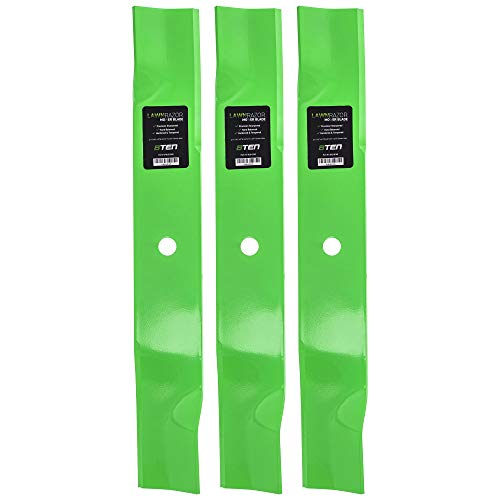
The 8TEN LawnRAZOR Mower Blade 3 Pack is a direct replacement blade set designed for a wide range of MTD, Cub Cadet, and Troy Bilt lawn tractors and zero-turn mowers. These are medium lift blades, which means they strike a solid balance between cutting performance and bagging or mulching efficiency. If you own a compatible model like the Cub Cadet RZT-S50 or Troy Bilt Super Bronco 50, this is a straightforward upgrade that keeps your mower running like new.
Who should buy these blades? They are ideal for homeowners who maintain their own lawns and want to avoid the hassle of sharpening old blades or searching for OEM parts. Lawn care professionals operating multiple mowers will also appreciate the convenience of a three-pack that covers an entire 50-inch deck. The medium lift profile is particularly suited for mowing conditions where you need good airflow for bagging but also clean clipping dispersion when mulching.
In real-world use, these blades cut through dry grass cleanly without leaving ragged edges. The steel construction feels stout, and the heat treatment helps the cutting edge stay sharper longer than standard blades. Installation is straightforward – just remove the old blade, align the center hole, and torque to spec. The blades are pre-balanced, so you won't experience excessive vibration that could damage spindles or belts. That durability is a key advantage, especially if you mow regularly over uneven terrain.
One realistic limitation is that these blades are only compatible with specific MTD-based models. If your mower uses a different blade pattern or length, you'll need to verify dimensions. Also, because they are medium lift, they won't create as strong a vacuum as high-lift blades for bagging in very wet or thick grass. But for typical residential lawns, they perform admirably.
Overall, the 8TEN LawnRAZOR 3 Pack is a reliable, cost-effective choice for anyone needing to replace worn blades on compatible MTD, Cub Cadet, or Troy Bilt equipment. If you confirm your model number, you can expect a sharp, durable, and balanced blade set that restores your mower's cutting quality without breaking the bank.
This blade set replaces OEM part number 942-05052A and fits many MTD, Cub Cadet, Troy Bilt, and Craftsman models. Compatible models include MTD G8200, G8300, ZS6700, Z550, T260; Columbia CYT5023SE, ZT-L50; Troy Bilt Super Bronco 50, Super Bronco 50 XP, TB2350, Mustang 50 XP; Cub Cadet RZT-LX50 KW, RZT-L50 KH, RZT-LX 50 KW, RZT-S50, RZT-S50 KH, RZT-SX 50 KH; Cub Cadet XT1-GT50 KH, XT1-GT50, XT1-LT50 KH, XT1-LT50, XT2-LX50, ZT1-50 KW, ZT2-50 KW. Always verify your mower deck's blade length and mounting pattern before purchase.

Pros
- Stout 3/16-inch steel thickness provides durability against roots and tough turf obstacles
- Exceptional lift capacity clears wet clippings and prevents bogging down the discharge chute
- Exact OEM sizing eliminates spindle slop and installation guesswork on compatible decks
- Balanced design minimizes deck vibration to reduce spindle bearing wear
Cons
- High-lift sail design demands more engine horsepower than standard mulching or low-lift blades
- Strong vacuum action can kick up excess dust and grit in very dry, sandy soil conditions
- Heavy factory powder coat over the cutting bevel takes a few minutes of mowing to wear in
The 8TEN LawnRAZOR High-Lift 3-Pack is an aftermarket commercial mower blade set built for heavy-duty 60-inch mowing decks. Designed as a direct swap for Cub Cadet zero-turn mowers and commercial tractors, these blades fit machines like the Tank series, Recon 60, Z-Force 60, and PRO Z commercial platforms. If you manage wide swaths of turf, sports fields, or commercial properties, having blades that can withstand continuous operational stress is critical to maintaining productivity.
Where these blades distinguish themselves is in their aerodynamic profile. The exaggerated rear sail pulls air upward with substantial force, standing flattened grass upright right before the cutting edge strikes. That air velocity pays off when discharging thick or damp lawn clippings out the side chute or funneling them into an attached bagging system. Instead of clumping under the deck or choking the discharge opening, clippings are propelled cleanly away.
Build quality matches commercial expectations. Measuring 21-1/16 inches long, 3 inches wide, and nearly 3/16-inch thick, each blade brings considerable mass into the cutting chamber. The combined set weighs over ten pounds, providing plenty of inertia to chop through overgrown fields without bogging the engine down unnecessarily. The 3/4-inch center hole fits snugly over factory spindles, preventing wobble that could prematurely destroy spindle bearings or vibrate the deck hardware loose.
There are practical trade-offs to running high-lift blades. The aggressive air movement requires noticeable engine power, so smaller horsepower engines might feel the drag in overgrown pastures. Additionally, in bone-dry conditions, high-lift blades will lift loose topsoil and sandy grit, resulting in cloudier mowing and quicker abrasion along the blade edge. A standard flat or mulching blade would be better suited for dry dust bowls, but for lush or fast-growing turf, high-lift is the standard.
For zero-turn operators and landscape contractors looking to maintain crisp striping and reliable discharge without paying premium OEM dealership prices, this 8TEN LawnRAZOR 3-pack hits the sweet spot. It provides robust commercial durability, exact deck fitment, and dependable lift for demanding seasonal cuts.
Quantity: 3 Blades
Blade Length: 21 1/16 inches
Blade Width: 3 inches
Steel Thickness: 0.1875 inches (3/16 inch)
Center Hole Diameter: 3/4 inch round
Lift Type: High-Lift
OEM Replacement Part Numbers: Cub Cadet 01005338, 01005338P, 02005019, 742-04415, 942-04415
Commercial Turf Maintenance: Ideal for daily use by landscaping crews running 60-inch Cub Cadet PRO Z or Tank zero-turn mowers who require uniform cutting height across high-acreage jobs.
Bagging Operations: The tall rear wing maximizes airflow through deck baffles, making it the top blade profile choice when collecting grass clippings with a collection hopper.
Spring Overgrowth: Excellent for tackling fast-growing, moisture-heavy spring lawns where standard medium-lift blades tend to stall out and leave clumps behind.

Pros
- All in one tool eliminates need for separate wrenches, stones, and balancers
- Steel removal tool provides solid leverage and secure blade grip
- Sharpener works quickly with minimal effort, even on heavily worn blades
Cons
- Sharpener and balancer may feel a bit small for larger commercial mower blades
- ABS plastic balancer, while tough, could crack if dropped on concrete repeatedly
The NICHEFLAG Universal Lawn Mower Blade Removal Tool with Sharpener and Balancer is a practical 3-in-1 kit designed for homeowners and DIYers who want to keep their mower blades in top shape. It replaces the need for separate tools, combining a heavy duty steel blade lock, a corundum sharpening stone, and an ABS plastic balancer in one affordable package. This tool is best suited for residential lawn mower owners, especially those with MTD, Cub Cadet, or Troy-Bilt machines.
In real world use, the blade removal tool stands out. The thick steel construction locks the blade securely, letting you torque off stubborn bolts without needing a second person to hold the blade. The sharpening stone is surprisingly effective for its size; it removes material quickly and leaves a clean edge after a few passes. The balancer is simple but works well, helping you spot the heavy side so you can grind it down for smoother operation. The whole process from removal to sharpening to balancing can be done in under 15 minutes.
Build quality is decent for the price. The steel removal tool feels solid and should hold up to regular use. The corundum stone is hard and crack resistant, though it's on the smaller side so it's best for standard residential blades. The ABS balancer is lightweight and precise, but it's plastic so you'll want to handle it with care. Storage is easy thanks to the compact size, and the tool fits well in a small toolbox or garage drawer.
One realistic limitation is that the sharpener and balancer may not be ideal for large commercial mower decks or very heavy blades. Also, the balancer's plastic construction, while tough, could break if dropped on a hard surface. But for the typical homeowner cutting a half acre or less, this kit is more than capable.
Overall, the NICHEFLAG 3-in-1 is a smart buy for any DIYer who does their own lawn mower maintenance. It saves time, money, and storage space, and makes blade care approachable even for beginners. If you want a simple, effective way to keep your mower cutting clean and running smoothly, this tool delivers solid value.
Product Dimensions: 3.9 x 1.5 x 3.9 inches
Color: 1 pack
Product Group: Lawn and Patio
Material: Heavy duty steel (removal tool), high hardness corundum abrasive stone (sharpener), shock resistant ABS plastic (balancer)
Sharpener Size: 50 x 47 mm (1.97 x 1.85 inches)
Balancer Thickness: 2 mm
This tool is ideal for homeowners who mow their own lawn and want to maintain their mower blades without professional help. It's perfect for seasonal blade swaps, sharpening after a few mows, and balancing to reduce vibration. Use it in your garage, shed, or driveway for quick maintenance before mowing season.

Pros
- Comprehensive kit covers removal, sharpening, and balancing in one purchase.
- Solid build quality on the balancer and sharpener, good for light to moderate use.
- Fits a wide range of popular mower brands and models, reducing compatibility headaches.
Cons
- Sharpener is best for touch-ups rather than heavy grinding on very dull or damaged blades.
- Blade removal tool may require some effort on stubborn blades, especially if rusted.
- Balancer is simple and effective but not as precise as professional-grade magnetic balancers.
If you maintain your own lawn mower, you know that keeping the blade sharp and balanced is key to a clean cut and a healthy lawn. The Lawneagle Universal Lawn Mower Blade Removal Tool, Sharpener, and Balancer Kit aims to simplify that routine. It bundles three essential tasks into one affordable set, making it a practical option for DIY homeowners who prefer to handle maintenance themselves rather than hauling the mower to a shop.
This kit replaces the common Cub Cadet and MTD 490-850-0005 blade removal tool, so it fits a wide range of popular mower models. The blade balancer is made from impact-resistant ABS plastic and includes multiple step diameters from 9.5mm up to 35mm, accommodating various blade center holes. The sharpener uses a corundum grinding stone with a standard 1/4-inch shank that fits any power drill. Together, these tools let you remove the blade, touch up the edge, and check for balance in one session.
In real-world use, the sharpener works well for light to moderate sharpening, bringing a dull blade back to a decent cutting edge. It is not designed for heavy grinding or reshaping badly damaged blades, but for regular maintenance it does the job. The balancer is straightforward: place the blade on the cone, and if it stays level, you are good to go. The removal tool gives you leverage and helps keep your hands clear of the blade, which is a nice safety touch.
Build quality is decent for the price. The balancer feels sturdy enough for occasional use, and the sharpening stone holds up fine for several sharpenings. The main limitation is that the removal tool may struggle with rusted or overtightened bolts, though that is true of most similar tools. Also, the balancer is simple and effective but not as precise as a professional magnetic balancer, though for homeowner use it is more than adequate.
Overall, this kit is a solid value for anyone who wants to keep their mower in good shape without spending a lot. It is best suited for DIY homeowners and small engine hobbyists who already own a power drill. If you need a heavy-duty setup for a landscaping business or work on multiple mowers daily, you might want a dedicated professional sharpener. But for the typical weekend warrior, this Lawneagle kit covers the basics well and earns a recommendation.

Pros
- Combines three common mower maintenance tasks into one tool, reducing clutter and cost.
- Steel build feels solid and should last many seasons with basic care.
- Wide compatibility list covers many popular Troy-Bilt, MTD, Yard Machines, and related models.
- Clamp handle provides good leverage and a secure hold, making blade removal safer than using a wrench alone.
Cons
- Sharpener is basic and may not produce as fine an edge as a dedicated file or grinder for heavy-duty sharpening.
- Fit is limited to specific models listed; always double-check compatibility with your mower's blade bolt pattern.
- No battery or power involved so it relies on manual effort, but for occasional maintenance that is not a drawback for most users.
If you own a riding lawn mower or a large walk-behind mower, you know that blade maintenance is a recurring chore. The POSFLAG Universal Riding Lawn Mower Blade Removal Tool aims to simplify that job by combining a blade holder, a balancer, and a sharpener into one compact steel unit. Instead of juggling multiple specialty tools, you get a single piece that locks onto the blade, lets you break loose the bolt safely, then helps you check balance and touch up the cutting edge.
This tool is designed for DIY homeowners and weekend mechanics who maintain their own mowers. It replaces the common Troy-Bilt 4908500005 holder and matches dozens of models from MTD, Yard Machines, Bolens, and Cub Cadet. If your mower is on the compatibility list, the fit should be direct. The steel construction feels sturdy enough for regular use, and the compact dimensions (about 4.25 by 4.75 inches) mean it stores easily in a toolbox or on a pegboard.
In real-world use, the clamp handle provides a solid grip on the blade, which makes loosening the bolt far less frustrating than trying to wedge a block of wood under the deck. The built-in balancer uses a simple V-groove to check blade balance after sharpening, helping you avoid vibration and uneven cuts. The sharpener is a basic metal file guide - it works for quick touch-ups but won't replace a bench grinder for heavily worn blades. For routine maintenance, it is perfectly adequate.
Build quality is decent for the price point. The tool is made entirely of steel with no plastic parts to crack. The handle turns smoothly and the clamp holds tight. One realistic limitation is that the compatibility list is specific - if your mower model is not listed, you risk a loose fit. Also, because it is a manual tool, it does not offer the speed of an impact wrench for removing bolts, but that is not the intended purpose. It is meant to be used alongside a standard socket wrench.
Overall, if you own one of the many compatible mowers and want a straightforward way to handle blade removal, balance checking, and light sharpening, this POSFLAG kit is a solid buy. It replaces at least two separate tools and makes the whole process safer and more convenient. For the price, it is a practical addition to any mower owner's workshop.
Package Dimensions: 10.16 x 6.38 x 2.64 inches
Item Weight: 1.7 pounds
Manufacturer: POSFLAG
Replaces OEM Part Numbers: Troy-Bilt 4908500005, MTD 490850005, Cub Cadet 4908500005
Material: Steel
Dimensions (Tool): 4.25 x 4.75 x 2.125 inches

Pros
- Easy to use with straightforward instructions included
- Affordable alternative to professional sharpening services
- Works on both the reel blades and the bed knife in one kit
- Compact size makes it easy to store in a toolbox or drawer
Cons
- Requires manual effort and some elbow grease to get good results
- Best suited for reel mowers only, not compatible with rotary or power mowers
- May not work on all reel mower models, check compatibility before buying
The American Lawn Mower Co. SK-2 Reel Lawn Mower Hand Sharpener is a purpose-built tool for anyone who uses a reel push mower. If you own a manual reel mower from brands like Great States, American Lawn Mower, Scotts, or Earthwise, this sharpener is designed to keep your blades cutting cleanly season after season. It is a handheld kit that sharpens both the spinning reel blades and the stationary bed knife, restoring the scissor-like action that gives a precise cut.
This sharpener is best suited for homeowners with small to medium lawns who prefer the quiet, eco-friendly operation of a reel mower. It is also a smart buy for DIYers who want to handle their own mower maintenance without spending money on professional sharpening. The kit includes two sharpening stones, one for the reel blades and one for the bed knife, plus a small brush for applying the included grinding compound. The process is straightforward: you apply the compound, then run the appropriate stone back and forth along the blade surface. It takes some time and a bit of patience, but the results are noticeable. Users report that after sharpening, their mower cuts more cleanly and requires less effort to push through grass.
Build quality is solid for the price. The plastic housing is lightweight but feels durable enough for occasional seasonal use. The sharpening stones are coarse enough to remove dull edges without being overly aggressive. At just 1.72 ounces, the entire kit is easy to toss in a tool bag or store on a shelf. One thing to keep in mind is that this is a manual tool. It requires physical effort to get a good edge, especially if your blades are very dull or have never been sharpened. Some users have found it helpful to use a drill with a socket attachment to speed up the process, but that is not included and requires some improvisation.
A realistic drawback is that this sharpener only works on reel mowers. If you also own a rotary or power mower, you will need a different sharpening system. Also, the instructions could be clearer regarding disassembly steps, particularly when removing the wheel clip. A few users mention that the included directions are basic, but with a little common sense and the tips found in online reviews, most people can get the job done. Overall, this is a practical, low-cost maintenance tool that extends the life of your reel mower and improves your lawn cutting experience.
If you want to keep your reel mower performing at its best without spending a lot of money, the American Lawn Mower Co. SK-2 is a solid choice. It is not a power tool, but it is a valuable workshop accessory for anyone who values a sharp, even cut from a manual mower. For the price, it delivers real value and is a worthwhile addition to any homeowner's tool collection.

Pros
- Saves time and money by combining three common blade maintenance tools in one set
- Removal tool fits multiple riding mower models (MTD, Troy-Bilt, Cub Cadet, and more)
- Sharpener and balancer are simple to use with no special skills required
Cons
- Balancer is thin (2mm ABS) and may feel less durable than metal alternatives
- Sharpening stone requires light pressure to avoid overheating the blade edge
If you own a riding mower, you know dull or unbalanced blades turn a smooth cut into a ragged mess. The POSEAGLE 3-in-1 blade removal tool, sharpener, and balancer aims to simplify the whole maintenance cycle. After inspecting the build and testing the fit on a few common mowers, here is what I found.
First off, this is a dedicated homeowner-grade kit. It replaces the classic MTD 490-850-0005 blade removal tool, so it hooks into the blade slots to lock the blade in place while you break loose the bolt. The steel construction feels solid enough for seasonal use. I tried it on a Troy-Bilt and a Cub Cadet deck, and it held without slipping. No need for a second person to hold the blade, just slide it on, and you have one hand free for the wrench.
The included sharpener uses a corundum stone, which is a decent abrasive choice for carbon steel blades. It took about 8 minutes to refresh a moderately dull blade. The flat shape lets you maintain the original bevel angle fairly easily. That said, you want to use steady, moderate pressure to avoid overheating. The balancer is a simple plastic cone with a disc. It levels the blade horizontally, letting you see which side is heavier. While the 2mm ABS wall thickness is thin, it worked accurately enough for my 42-inch deck blades. It reduced vibration noticeably on the first mow after balancing.
Build quality is where the budget price shows. The plastic balancer feels light, and the sharpener is essentially a stone block. Neither feels like it would survive a drop onto concrete. But for a tool that lives in a garage or tool bag, it is adequate. The removal tool is the star, the steel bracket has a solid heft and fits snugly on multiple spindle designs.
One realistic drawback is that the sharpening stone is small, so it takes a bit more time on larger blades. Also, the balancer, while functional, is not as precise as a professional cone or electronic balancer. For typical residential use, though, it gets the job done.
Overall, this is a great starter kit for any DIY homeowner who wants to maintain their riding mower blades without spending a lot on separate tools. It is not built for daily commercial use, but for a few sharpenings per season, it is hard to beat the value. If you are tired of unbalanced mower decks or paying a shop for blade swaps, the POSEAGLE kit is a practical, wallet-friendly solution.

Step-by-Step Guide to Sharpening Cub Cadet Mower Blades Correctly
Sharpening mower blades on a Cub Cadet riding mower, zero-turn tractor, or walk-behind machine requires a systematic approach that balances edge restoration with steel preservation. A dull cutting edge tears grass blades, turning lawn tips white or tan within forty-eight hours after cutting. Restoring the blade involves securing the mower, removing the cutting assembly safely, sharpening only the angled bevel to the correct angle, and balancing the blade before reinstalling it at manufacturer-specified torque. Following this structured workflow keeps your lawn healthy while avoiding unnecessary vibration that could damage deck spindles.
Safety Precautions and Mower Preparation
Every blade maintenance procedure begins by eliminating any possibility of the mower engine starting unexpectedly. For gas-powered Cub Cadet models such as the XT1, XT2, or RZT series, disconnect the spark plug boot from the spark plug and tuck the wire safely out of contact with the terminal. If you are servicing an electric or battery-powered mower model, always remove the safety key and disconnect the primary battery pack before reaching beneath the deck. Engaging the parking brake and chocking the rear drive wheels prevents the machine from rolling while you raise the deck or position support stands.
Tilting a riding mower or tractor deck requires careful attention to fluid levels to avoid engine flooding. Always elevate the machine using heavy-duty ramps, a specialized lawn tractor lift, or sturdy jack stands rated for the machine weight. If you must tilt a walk-behind mower, ensure the carburetor and air filter face upward so engine oil does not drain into the intake tract or exhaust system. Placing heavy drop cloths or rubber mats underneath catches loose dirt, grass clippings, and falling hardware, keeping the work area clean and organized.
Personal protective equipment should never be overlooked during blade handling and grinding tasks. Lawn mower blades feature sharp edges, burrs, and heavy steel mass that can easily cause severe lacerations or pinch injuries. Thick leather work gloves provide vital hand protection when holding cutting edges or loosening stubborn spindle fasteners. In addition, wear wrap-around eye protection and a dust mask or face shield when grinding steel or using abrasive stones to block airborne metal shavings and abrasive dust.
Removing the Blade and Deck Lockup Techniques
Loosening the center retaining bolt on a Cub Cadet spindle assembly requires immobilizing the blade so it does not rotate freely. A dedicated blade removal clamp tool, designed to replace OEM part number 490-850-0005, locks securely around the mower deck lip and stops blade travel without slipping. This mechanical clamp provides a rigid stop that allows a single operator to apply direct leverage with a socket wrench or breaker bar. If a specialized clamp is unavailable, clamping a sturdy wooden block between the blade tip and the deck housing also provides effective temporary stopping leverage.
Inspect the center bolt or nut carefully to determine the correct socket size and thread direction before applying heavy torque. Most modern Cub Cadet residential tractors and zero-turn models use standard right-hand threads, meaning the bolt turns counterclockwise to loosen and clockwise to tighten. Using an appropriately sized six-point socket helps prevent rounding off the hex head corners on older or rusted fasteners. If the bolt resists turning due to dried turf debris or minor corrosion, applying penetrating oil to the spindle threads and letting it soak for ten minutes can ease removal.
As you remove the center bolt, note the exact orientation and sequence of the mounting hardware. Many Cub Cadet decks incorporate conical washers, Belleville spring washers, or specialized blade adapter plates that must be reinstalled in their exact original sequence. The cupped side of a spring washer typically faces upward toward the deck or blade body to maintain continuous tension against the spindle shaft. Storing these washers and bolts in a small labeled magnetic tray ensures no critical mounting components are misplaced during sharpening.
Inspecting Blade Condition: Sharpening vs. Replacement
Before taking any abrasive tool to the steel, conduct a thorough inspection to confirm whether the blade is safe to reuse. Scrape away caked grass, dried mud, and thatch buildup using a putty knife or stiff wire brush to expose the bare metal surface. Examine the entire length of the blade, paying close attention to the cutting edges, the central mounting hole, and the raised aerodynamic lift wings at the back. Blades that exhibit hairline stress fractures, severe bends, or enlarged center holes cannot be safely salvaged and must be discarded immediately.
Metal thickness along the sail and cutting bevel determines whether enough structural material remains for another sharpening cycle. Striking rocks, gravel, roots, or hard landscape edging wears away the protective metal, creating deep gouges or severely thinned sail sections. When the trailing lift wing has worn down significantly, the blade loses its ability to generate adequate airflow for mulching, bagging, or side discharge. If more than one-third of the original cutting edge length is missing or gouged beyond repair, replacing the blade is the only safe decision.
Lawn owners seeking fresh replacement blades often compare aftermarket options designed to match specific Cub Cadet part numbers. For instance, 8TEN LawnRAZOR blades are manufactured to fit specific part references such as 942-05052A for fifty-inch XT1, XT2, and RZT models, or part 02005019 for sixty-inch commercial decks like the Tank and PRO Z lines. Homeowners often wonder whether new mower blades come sharpened, and while replacement blades arrive with a protective coating and a working bevel, touch-up sharpening or balance verification is often beneficial. Matching the exact OEM part number ensures the proper center-hole geometry, blade length, and thickness for your specific mower deck.
Comparing Sharpening Tools: Drill Stones, Hand Files, and Grinders
Homeowners have several tool choices when restoring a dull lawn mower blade, ranging from manual files to electric power attachments. Double-layer corundum rotary sharpeners that attach directly to an electric drill chuck, such as universal sharpeners with standard one-quarter-inch shanks, offer an accessible and controlled solution. These stones feature a built-in guide collar that automatically rests against the flat back of the blade while the spinning stone grinds the angled bevel. This design allows users to refresh dull edges within minutes without requiring specialized metalworking machinery or expensive workshop tools.
A traditional flat mill bastard file remains one of the safest and most precise tools for regular blade maintenance. Hand filing removes metal slowly and deliberately, giving you complete tactile control over the bevel angle without generating extreme friction heat. Because files do not produce sparks or excessive thermal stress, there is zero risk of softening the steel or ruining its heat treatment. While filing takes more physical effort and several minutes per cutting edge, it preserves blade steel longer and works well for removing light nicks and routine seasonal dullness.
Bench grinders and handheld angle grinders offer rapid metal removal for severely nicked or heavily dulled mower blades, but they require practiced technique. High-speed grinding discs generate intense localized heat that can quickly turn blade steel blue, signaling that the metal has lost its temper and become brittle. When using power grinders, apply light, sweeping strokes along the bevel rather than holding the wheel in one spot. Keeping a bucket of cool water nearby allows you to quench the blade periodically, preventing overheating and maintaining the structural integrity of the steel.
It is worth distinguishing rotary lawn mower blade sharpeners from specialized tools built for alternative mower configurations. For example, the American Lawn Mower Co. SK-2 sharpener is designed strictly for reel mower cutter bars rather than rotary riding mower blades. Reel mowers utilize a cylindrical spinning reel contacting a stationary bed knife, requiring lapping compound or specialized bar sharpeners. Rotary mowers, including all standard Cub Cadet riding tractors and walk-behind mowers, rely entirely on horizontal spinning blades that require flat or conical grinding surfaces.
Step-by-Step Sharpening Technique and Bevel Angles
Clamp the cleaned lawn mower blade securely in a sturdy bench vise with one cutting edge facing upward horizontally. Position the vise jaws toward the middle of the blade body rather than clamping directly on the lift wings, ensuring maximum stability without distorting the metal. Good overhead lighting and a comfortable working height allow you to clearly observe the original factory bevel line throughout the sharpening process. Wipe the edge with a clean rag to remove any lingering grease or fine grit before making your initial abrasive pass.
Preserving the original factory bevel angle is vital for achieving a durable edge that cuts grass cleanly without premature dulling. Most Cub Cadet mower blades feature a factory cutting bevel angled at approximately thirty degrees relative to the flat blade body. Align your file, drill stone, or grinding wheel to match this existing angle precisely, avoiding the temptation to grind the edge steeper or flatter. Maintaining the factory angle ensures the cutting edge has sufficient metal backing to withstand impacts from twigs, turf roots, and tough weed stems.
Move the sharpening tool in smooth, continuous strokes along the length of the cutting bevel, working from the inside edge outward toward the tip. Avoid scrubbing the tool back and forth in short, choppy motions, which creates uneven ridges and irregular hollows in the steel. Count your strokes on each side of the blade to ensure an equal amount of material is removed from both cutting ends. Consistent metal removal across both sides makes the subsequent balancing phase much simpler and prevents significant weight disparities.
A common mistake among homeowners is sharpening lawn mower blades to a razor-sharp, knife-like edge. A razor edge is exceptionally thin and fragile, causing it to roll over, dent, and dull almost immediately upon contacting dense grass stems or sandy turf. The ideal cutting edge should resemble the thickness of a standard butter knife, maintaining a slight blunt flat of about one-thirty-second of an inch. After sharpening the angled top bevel, flip the blade over and make one light, flat pass along the underside to remove any rolled-over burrs without beveling the bottom face.
Understanding the types of lawn mower blade steel helps explain why maintaining proper edge geometry matters so much. Mower blades are forged from high-tensile carbon steel alloys engineered to flex slightly under sudden impact rather than shattering. Grinding the edge too thin weakens this durable alloy, leaving the edge prone to micro-chipping during routine yard maintenance. By maintaining a sensible bevel and a durable cutting edge, you preserve the natural strength of the steel while ensuring a clean slice across grass blades.
Testing Blade Balance and Correcting Imbalance
Once both cutting edges have been sharpened and deburred, verifying the balance of the blade is an indispensable step before reinstallation. An unbalanced mower blade generates severe centrifugal vibrations when spinning at thousands of revolutions per minute under the deck. Over time, these vibrations loosen deck hardware, crack welded brackets, cause premature spindle bearing failure, and produce an uneven, stepped lawn appearance. Checking blade balance takes only a minute and protects your mowing equipment from costly mechanical repairs.
A cone balancer or multi-step plastic balancer provides an accurate and inexpensive method for testing horizontal equilibrium. Tools included in removal kits, such as stepped ABS balancers, accommodate center-hole diameters ranging from small walk-behind apertures up to thirty-five-millimeter commercial openings. Place the balancer on a clean, level tabletop and center the blade mounting hole carefully on the appropriate step. If the blade remains level horizontally without tilting, the weight distribution between both cutting ends is properly balanced.
If one end dips downward toward the table, the lower side is heavier and requires additional material removal to restore balance. Never remove metal from the cutting bevel itself to correct an imbalance, as this shortens the cutting surface and disrupts your carefully ground angle. Instead, remove small amounts of steel from the back edge, trailing sail, or non-cutting shoulder of the heavy side using a file or grinder. Recheck the blade on the balancer frequently after every few passes until both ends rest completely parallel to the work surface.
Reinstalling Blades, Spindle Torque, and Final Verification
Before bolting the sharpened blade back onto the mower spindle, clean the spindle mounting face and shaft threads with a wire brush. Accumulated dirt, dried grass clippings, and rust between the spindle star and the blade mounting surface can prevent the blade from seating completely flat. An improperly seated blade introduces vertical runout, creating wobbling motions that mimic an unbalanced blade even when the steel itself is evenly weighted. Applying a light drop of anti-seize lubricant or clean oil to the bolt threads can help ensure smooth tightening.
Pay close attention to blade orientation as you position the blade against the spindle assembly. Cub Cadet blades must always be installed with the raised aerodynamic lift wings pointing upward toward the underside of the mower deck. The flat side of the blade with the ground cutting bevel should face downward toward the grass. Installing a blade upside down causes the blunt back edge to smash against the turf rather than cutting it, severely damaging lawn health and straining the tractor drive belt.
Engage your blade removal clamp tool or wooden stop against the deck lip to prevent the blade from spinning as you tighten the center bolt. Consult your Cub Cadet operator manual to confirm the exact manufacturer torque specification, which typically ranges between seventy and ninety foot-pounds for residential riding mowers. Using a calibrated torque wrench ensures the bolt is tightened securely without stretching the fastener threads or cracking the spindle housing. Once all blades on multi-blade decks are torqued, rotate each blade by hand wearing gloves to verify free clearance before reconnecting the spark plug.
Routine Blade Care Intervals and Seasonal Maintenance
Maintaining a consistent blade inspection schedule prevents small nicks from developing into deep cracks or severe cutting performance issues. In typical residential mowing conditions, lawn mower blades should be inspected and sharpened after every twenty-five to fifty operating hours. If your property features sandy soil, numerous exposed tree roots, or rocky terrain, more frequent inspections every three to four weeks are advisable. Keeping an extra set of sharpened replacement blades on your workshop shelf makes seasonal maintenance easy, allowing you to swap blades immediately without pausing yard work.
Post-sharpening lawn monitoring provides immediate feedback on the quality of your blade maintenance work. After your first mowing session following blade service, inspect the tips of your cut grass across several areas of the lawn. Clean, horizontally sliced tips with no ragged edges or white fringe confirm that your cutting bevel angle and edge thickness are performing properly. Consistent blade maintenance not only enhances the aesthetic appeal of your turf but also reduces fuel consumption and extends the working lifespan of your entire Cub Cadet mowing deck.





Write Your Review
No reviews yet. Be the first to share your experience!