


A healthy lawn depends heavily on how cleanly your mower slices through grass blades rather than battering them into frayed ribbons. Many homeowners inspecting their cutting deck wonder exactly how sharp is a lawn mower blade supposed to be before it hits the turf. Achieving the correct balance between cutting speed and edge durability protects grass from fungal disease while preventing premature blade damage. Understanding factory mower blade sharpness helps clarify why replacement steel rarely arrives with a razor-like edge out of the box.
Sharpening equipment ranges from simple drill-driven rotary grindstones to guided angle jigs and dedicated bench grinders. The composition and temper of the steel used in lawn mower blades directly dictate how an edge holds up against dirt, twigs, and occasional surface debris. Maintaining a proper edge profile not only ensures crisp cutting lines across your turf but also reduces strain on the mower engine and spindle assemblies. The following guide explores optimal edge sharpness, factory bevel angles, and practical maintenance accessories to keep your equipment running smoothly.

Pros
- Fast 10-second chuck installation works with standard drill chucks
- Double-layer corundum grinds steel evenly with minimal pressure
- Four-pack setup delivers excellent spare backup value for the shop
- Lightweight and compact enough to store inside any field tool tote
Cons
- Guide disc can get scored if pressed too aggressively against sharp metal
- Not intended for heavily gouged, warped, or cracked commercial blades
- Requires high drill RPM to achieve smooth, chatter-free grinding
The Bneykrir 4-Piece Lawn Mower Blade Sharpener is a specialized drill attachment designed to take the headache out of seasonal lawn equipment maintenance. Instead of wrestling blades on a heavy stationary bench grinder or risking uneven hand-filing, this tool uses a double-layer corundum wheel that mounts right into your drill chuck. It is aimed squarely at homeowners, DIYers, and small-property groundskeepers who want clean, healthy grass cuts without spending shop fees on blade balancing and sharpening.
In practical workshop use, setting up the sharpener takes only a few seconds. Chuck the metal shaft into an 18V or 20V cordless drill, clamp your lawn mower blade securely into a bench vise, and bring the drill up to speed. The abrasive corundum stone cuts through mild surface oxidation, dull bevels, and small turf nicks smoothly. The plastic guide disc rests along the flat underside of the blade, keeping the abrasive angled against the factory bevel without demanding pinpoint freehand steadying.
Build quality is suited well for light to medium maintenance runs. The corundum material holds up to standard lawn tractor and push mower steel, though users should avoid leaning too heavily into the work. Applying steady, moderate passes keeps heat buildup low and avoids burning the temper on thin steel. The four-pack arrangement is practical, giving you plenty of abrasive material to work through multiple seasonal tune-ups, tiller blades, and utility yard tools.
There are a few trade-offs to keep in mind. The plastic collar can wear down if it drags forcefully against jagged metal edges, and deep gouges from rocks will still require an angle grinder with a flap disc first. That said, for routine seasonal maintenance and quick edge touch-ups, this four-piece kit provides straightforward functionality and solid value for any home garage.
Routine edge touch-ups on standard residential walk-behind and riding lawn mower blades.
Cleaning and sharpening curved garden tools, rototiller tines, sickle cutters, and axes.
Pre-season garage tune-ups where removing the blade for quick bench vise work is preferred.
Home toolkits where space or budget does not justify a dedicated stationary grinder.

Pros
- Extremely affordable for a 5-pack, making it a low-risk investment for casual users
- Simple to use: just chuck into a drill and run along the blade edge at the correct angle
- Includes a balancer to check blade balance after sharpening, reducing vibration
- Works well on straight or slightly curved blades when used with patience and proper technique
Cons
- Not suited for heavy-duty commercial blades with steep factory bevels; may wear out quickly
- Some units may have defects (stone spinning on shaft or cracking) affecting durability
- Best results require a corded drill for consistent speed; battery drills lose power over time
The cenoz 5 Pack Lawn Mower Blade Sharpener is a simple but effective attachment designed to help homeowners and DIY enthusiasts keep their mower blades sharp without investing in a bench grinder or expensive sharpening equipment. It fits any standard power drill (corded models work best) and uses a double-layer corundum grinding stone to restore a sharp edge on dull blades. This is a budget-friendly solution for anyone who wants smoother cuts and healthier grass without frequent blade replacements.
This sharpener is best suited for homeowners with push mowers, riding tractors under 54 inches, and other light to medium-duty cutting equipment. It's not intended for professional landscapers running high-end commercial mowers with thick, hardened blades. For those users, a dedicated bench grinder or abrasive wheel setup would be more reliable. However, for the average yard care routine, the cenoz sharpener gets the job done with a little patience.
Real-world performance depends heavily on technique. Users who clamp the blade securely and move the spinning stone back and forth along the existing bevel at a consistent angle report excellent results. The built-in balancer is a nice touch for checking that the blade spins evenly after sharpening. That said, some reviewers noted the grinding wheel can spin on the shaft if not tightened fully, and a few experienced cracking or disintegration after a minute of use. These issues seem to affect a minority of units, and the low price per stone (around $2 each) makes it easy to accept occasional failures.
Build quality is adequate for the price point. The double-layer corundum material is more durable than the standard single-layer stones found in many budget sharpeners. It doesn't melt or glaze over at high drill speeds, which is a common problem with cheaper alternatives. The 5-pack means you have spares to share or keep in the garage. Just be realistic: these are consumable items that will wear down over time, especially if you sharpen multiple sets of blades each season.
Overall, the cenoz 5 Pack Lawn Mower Blade Sharpener is a solid choice for DIY homeowners who want to extend the life of their mower blades on a tight budget. It's easy to use, installs quickly, and includes extras like a balancer. The main drawbacks are the limited suitability for heavy-duty blades and the occasional quality control issue. If you have a standard push mower or a small riding mower and don't mind spending a few minutes per blade, this set offers great value. For professionals or those with high-end equipment, look elsewhere.

Pros
- Dedicated blade sharpener with preset angle guides speeds up the process for common mower blades.
- Ceramic grinding wheel stays cool and resists loading, making it suitable for frequent use.
- Included balancer is a practical addition that helps prevent vibration related engine damage.
- Solid build with a low vibration footprint once mounted to a bench.
- Simple to operate with minimal learning curve for DIYers.
Cons
- Limited to lawn mower blades only, not versatile for other shop grinding tasks.
- At 26.7 pounds, it's not portable for mobile sharpening services without a dedicated cart.
- The 1/3 HP motor is adequate for residential blades but may struggle with very thick or hardened commercial blades in continuous use.
The VEVOR Lawn Mower Blade Sharpener is a purpose-built tool that fills a specific gap in many home workshops and small engine repair shops. Instead of wrestling with a general purpose bench grinder and trying to hold a mower blade at the correct angle, this unit gives you a dedicated rest and preset angle stops for 30 and 40 degrees. That alone saves time and produces more consistent edges across multiple blades.
For the DIY homeowner who sharpens blades once or twice a season, this might feel like a specialized luxury. But for anyone maintaining several mowers or offering blade sharpening as a side gig, the VEVOR makes sense. The 7-inch ceramic grinding wheel is a nice upgrade over standard wheels. It runs cooler and resists glazing, which means you can sharpen several blades in a row without worrying about overheating the edge and ruining the heat treat. The 1/3 HP motor is quiet and has enough torque for typical residential and light commercial blades, though it will slow down if you push too hard on thick, hardened steel.
Build quality is solid for the price point. The base is heavy enough to stay planted on a workbench, and the included balancer is a practical addition that many general grinders lack. After sharpening, you pop the blade on the cone balancer and see if it tips. This step is often overlooked but it's critical for reducing mower vibration and preventing premature spindle bearing wear. The tool rest is adjustable and the miter gauge helps you repeat the same angle blade after blade. Setup is straightforward, and the manual covers the basics clearly.
On the downside, this is a single-purpose machine. You won't be using it for drill bits, chisels, or any other shop tools. And at nearly 27 pounds, it's not something you'll toss in a truck bed for mobile sharpening without a dedicated cart or mount. The motor, while adequate, isn't built for continuous commercial duty cycles. If you're sharpening dozens of blades daily for a landscaping business, you might want a heavier duty model. But for the serious DIYer, small engine mechanic, or part-time sharpener, this VEVOR unit delivers consistent results without the hassle of angle guesswork.
Overall, the VEVOR Lawn Mower Blade Sharpener is a practical investment for anyone who values a sharp, balanced blade and wants to avoid the cost and turnaround time of sending blades out. It's straightforward, well featured for the price, and the ceramic wheel is a genuine plus. If you maintain multiple mowers or just want your own blades done right every time, this sharpener earns a spot on the bench.
Motor: 1/3 HP, 110V AC
Grinding Wheel: 7 inch diameter, ceramic abrasive
Sharpening Angles: 30 degrees and 40 degrees preset
Blade Types: High lift, low lift, gator, and flat blades
Dimensions: 13.39 x 12.4 x 9.65 inches
Weight: 26.72 pounds
Color: Gray
Includes: Blade balancer, tool rest, miter gauge, grinding wheel
Homeowners with multiple mowers or a riding mower who want to sharpen blades themselves and ensure proper balance.
Small engine repair shops that sharpen customer blades as a service.
Landscapers who maintain a fleet of push mowers and want a dedicated sharpening station in their shop.
DIYers who prefer doing their own maintenance and want consistent edge geometry without guesswork.
The VEVOR Lawn Mower Blade Sharpener comes with a 7-inch ceramic grinding wheel pre-installed, a blade balancer for checking balance after sharpening, an adjustable tool rest, and a miter gauge for setting sharpening angles. The unit is ready to use out of the box after mounting to a stable work surface.

Pros
- Adjustable angle range covers most common blade types
- Smooth ball bearing operation for consistent sharpening
- Solid aluminum build feels durable and reliable
- Easy to mount and use with any standard angle grinder
- Saves significant time compared to hand filing or replacing blades
Cons
- Requires an angle grinder, which is sold separately
- Initial setup may require a few adjustments to get the perfect angle alignment
- Only designed for lawn mower blades, not other cutting tools
The SporGain Lawn Mower Blade Sharpener is a handy tool accessory that turns your angle grinder into a dedicated blade sharpening station. It's designed for DIYers and homeowners who prefer to keep their mower blades sharp without the hassle of manual filing or the expense of professional sharpening. If you have a standard right-angle grinder, this accessory can handle the job quickly and accurately.
In real-world use, the adjustable frame is the standout feature. You can set the sharpening angle anywhere from 15 to 45 degrees, which covers most lawn mower blades, including standard straight, mulching, and high-lift types. The ball bearing handle makes it easy to guide the grinder across the blade edge smoothly, reducing vibration and hand fatigue. During testing, it took only a few minutes per blade to restore a sharp edge, and the results were consistent across multiple blades.
Build quality is solid. The aluminum alloy frame feels sturdy, and the mounting hardware included (4 adapter screws) fits most angle grinders without wobble. Setting it up on a workbench is straightforward, though you might need to tweak the thumb screws initially to get the angle perfect. The tool also works for both right-hand and left-hand blades, so you don't have to flip the setup for different mowers.
One realistic drawback is that you need an angle grinder to use it, so if you don't already own one, factor in that extra cost. Also, this sharpener is specifically for lawn mower blades, not for other types of cutting tools like chisels or knives. Some users might find the initial angle adjustment a bit fiddly, but once set, it stays put.
Overall, the SporGain Blade Sharpener is a smart buy for anyone who maintains their own lawn equipment. It pays for itself after a few uses by prolonging blade life and improving cutting performance. If you already own an angle grinder and want a precise, repeatable way to sharpen mower blades, this tool is worth adding to your workshop. Just be prepared to invest a few minutes in the initial setup.
Product Dimensions: 13.5 x 9 x 3.4 inches
Item Weight: 2.99 pounds
Adjustable Angle: 15 to 45 degrees
Material: Aluminum alloy frame with ball bearing handle
Compatibility: Works with most angle grinders (fits through 4 adapter screws)
Included in Box: Sharpener frame, ball bearing handle, 4 adapter screws, thumb screws

Pros
- No need to remove the blade, which simplifies maintenance and reduces downtime
- Adjustable angle guide ensures a precise edge for professional-quality cuts
- Cordless operation with rechargeable battery offers freedom of movement around the yard
- Lightweight and compact design for easy storage and portability
Cons
- Not suitable for zero-turn or heavy-duty mower blades that require higher torque
- Battery life may be limited for multiple sharpening sessions on larger lawns
- Build quality may feel less rugged compared to professional-grade rotary tools
The Sharp Pebble Cordless Lawn Mower Blade Sharpener is a purpose-built rotary tool designed to make blade maintenance quick and hassle-free. Unlike traditional sharpening methods that require removing the blade, this tool lets you sharpen in place, saving you the time and frustration of disassembly. It's an ideal solution for DIY homeowners and weekend gardeners who want to keep their mower blades sharp without investing in expensive professional equipment.
Performance wise, the adjustable angle guide (20-40 degrees) is a standout feature. It allows you to set the exact angle for your blade type, ensuring a consistent edge that promotes cleaner cuts and healthier grass. The variable speed control (5,000-30,000 RPM) gives you the flexibility to handle different blade conditions, from light touch-ups to more aggressive sharpening. The included replaceable sharpening wheels are effective and easy to swap out when they wear down.
Build quality is decent for the price point. The tool feels lightweight and well-balanced, with an ergonomic grip that reduces fatigue during extended use. The cordless design with a rechargeable battery adds convenience, letting you move freely around the yard without being tethered to an outlet. However, the battery life is adequate for a few blades but may require a recharge for larger mowing setups. The tool is best suited for standard mower blades; it lacks the torque needed for zero-turn or heavy-duty commercial blades.
In terms of practicality, this sharpener is a time-saver. You can quickly touch up the blade between mows, ensuring optimal cutting performance without the downtime of removal and reinstallation. Safety features like the ergonomic grip and speed control help maintain control during operation. The compact size makes it easy to store in a toolbox or garage drawer.
One realistic drawback is that the tool may not satisfy users who need to sharpen multiple blades in one session, as the battery could run out. Additionally, the build quality, while adequate for occasional use, may not withstand heavy daily use by professionals. Overall, the Sharp Pebble Cordless Lawn Mower Blade Sharpener is a practical, affordable choice for DIYers and homeowners who value convenience and precision. If you're looking for a quick way to maintain your mower blade without the hassle of removal, this tool delivers solid performance for the price.
Product Dimensions: 8 x 2.8 x 1.2 inches
Item Weight: 1.37 pounds
Manufacturer: Mighty Dreams
Model Number: SPMower2024
Battery: 1 9V battery included
Best Sellers Rank: #56,427 in Patio, Lawn & Garden, #212 in Lawn Mower Accessories
This sharpener is best for standard residential lawn mower blades. It is ideal for DIY homeowners who mow their own lawns and want to keep blades sharp without removing them. Use it for quick touch-ups between mows or to restore a dull blade to a clean cutting edge. Not recommended for commercial zero-turn mowers or heavy-duty blades that require higher torque.

Pros
- Very affordable and easy to install on a standard power drill
- Includes a balancer to help maintain even blade wear
- Versatile for multiple garden cutting tools beyond just mower blades
Cons
- Lower customer rating suggests inconsistent performance or durability issues
- Manual sharpening with a drill still requires careful angle control and may not match factory edge quality
- Best suited for light to moderate sharpening tasks; heavy use may wear the abrasive quickly
The Calsoling 3-Piece Lawn Mower Blade Sharpener is a straightforward, no-frills accessory designed to help homeowners and DIYers keep their mower blades and other garden cutting tools sharp without investing in expensive sharpening equipment. This set includes three corundum abrasive stones mounted on stainless steel bases, plus a blade balancer, all for a price that makes it easy to try. The concept is simple: chuck one into any standard power drill, touch it to the blade edge, and grind away the dullness. For those who mow a standard suburban lawn once a week, this can be a practical way to extend blade life between professional sharpenings or replacements.
In real-world use, the sharpener works best on blades that are merely dull rather than heavily nicked or damaged. The corundum material handles moderate wear and resists heat buildup, which is important when using a drill at higher RPMs. The included balancer is a nice bonus, letting you check if the blade is still balanced after sharpening, which helps reduce vibration and uneven cuts. However, the sharpening process requires a steady hand and a consistent angle to avoid creating an uneven edge. It's not as precise as a dedicated sharpening jig or a professional grinder, but for quick touch-ups, it gets the job done.
Build quality is adequate for the price point. The steel backing provides some rigidity, but the abrasive stones are relatively small, measuring about 1.97 inches in diameter. This means you'll need to make multiple passes along longer blades. The three-pack is a practical advantage, allowing you to keep one in the garage, one in the shed, and maybe a spare. The 12-month warranty is a nice touch for such an inexpensive item, indicating the manufacturer stands behind it.
On the downside, the overall customer rating is modest, and some users have reported inconsistent performance or the abrasive wearing down faster than expected. This is not a tool for professional landscapers or anyone who sharpens blades daily. It also requires a power drill, which most homeowners already have, but it's an added step if you don't. The lack of a guide or depth stop means you could accidentally remove too much material if you're not careful.
Overall, the Calsoling 3-Piece Lawn Mower Blade Sharpener is a solid budget option for the DIY homeowner who wants a quick, easy way to maintain mower blades and similar tools. It's not a replacement for professional sharpening or high-end sharpening systems, but for the occasional touch-up, it offers good value. If you're a weekend warrior with a modest lawn and a cordless drill, this set is worth considering. Just go in with realistic expectations about its durability and precision.
Product Dimensions: 1.9 x 1.5 x 0.8 inches per stone
Item Weight: 3.53 ounces (total set)
Material: Corundum abrasive with stainless steel backing
Stone Diameter: 50 x 47 mm (1.97 x 1.85 inches)
Package Includes: 3 sharpening stones + 1 blade balancer
Compatibility: Works with power drills and hand drills; fits 99% of mower blade center holes
Warranty: 12 months
This sharpener set is best suited for homeowners and DIYers who need to touch up standard lawn mower blades, sickle bars, rotary tillers, hoes, and drill knives on a regular basis. It's ideal for quick maintenance between professional sharpenings or for those who prefer to keep their blades sharp without the expense of a dedicated sharpening station. Not recommended for heavy-duty or commercial use where blades are heavily damaged or need precise edge geometry.
The Engineering Behind Lawn Mower Blade Sharpness and Edge Profiles
A lawn mower blade should feel about as sharp as a standard butter knife rather than a razor blade. When you run your thumb carefully across the cutting edge, you should feel a distinct bevel that terminates in a blunt flat about one thirty-second of an inch wide. This geometry surprises many homeowners who assume that a razor-sharp edge provides a cleaner cut. In reality, a mower blade relies on rotational speed and kinetic energy rather than surgical sharpness to sever grass blades cleanly.
Modern rotary mowers spin their cutting tips at speeds often exceeding two hundred miles per hour. At that velocity, an edge with a slight blunt margin acts as a high-speed wedge that cleanly cleaves through vegetation without folding over. Understanding this relationship helps you maintain your blades correctly and avoid common sharpening mistakes that weaken the steel. Achieving the right balance between edge geometry and structural durability keeps your lawn healthy and protects your mower from avoidable strain.
The Core Answer: The Butter Knife Standard
The ideal cutting edge on a rotary mower blade features a flat margin measuring between one sixty-fourth and one thirty-second of an inch. If you can slice your finger open simply by brushing against the edge, the blade is actually too sharp for turf equipment. A butter-knife edge provides enough sharpness to slice grass cleanly while maintaining sufficient metal thickness behind the cutting point. This thickness is critical because grass contains silica and frequently conceals sand, dirt, and small organic debris.
When a blade with a small blunt margin strikes grass, the rapid impact severs the stem instantly against the air cushion created inside the deck. The cut remains crisp because the blade moves fast enough that the grass cannot bend away before the metal passes through. If the edge is ground to a fine point with zero margin, the thin steel quickly bends or curls during operation. Maintaining the butter knife standard preserves cutting efficiency across dozens of mowing hours without requiring constant touch-ups.
To test this edge at home without specialized measuring calipers, many experienced gardeners use a simple physical comparison. A blade that can scrape a fingernail without cutting skin typically matches the desired profile. If the edge reflects light as a rounded, blunt curve, it has grown too dull and requires sharpening. Conversely, if it can slice through a sheet of paper like scissors, it has been over-sharpened and will degrade quickly under heavy mowing conditions.
The Danger of a Razor-Sharp Edge
Grinding a mower blade to razor sharpness creates a fragile micro-bevel that cannot withstand operating conditions under a mower deck. The extreme heat generated by aggressive grinding can alter the heat treatment of the steel, leading to localized brittleness. When that fragile wire edge meets high rotational speeds, even tiny sand granules act like miniature chisels against the metal. The razor edge quickly develops microscopic chips and curled flaps that disrupt clean cutting action.
Beyond accelerated dulling, a razor-thin edge presents a genuine structural risk to the cutting assembly. When a knife-edge blade strikes an exposed tree root, pebble, or hidden sprinkler head, the thin metal is prone to cracking rather than deflecting. Severe impacts can fracture a brittle edge, sending sharp metal fragments flying into the deck housing. A blade with adequate thickness behind the bevel absorbs these minor shocks and resists severe gouging.
Furthermore, razor edges create uneven wear patterns along the primary cutting sweep. The outer two to three inches of the blade perform the vast majority of the cutting work and suffer the fastest wear. When this working section rolls over and dulls within twenty minutes of mowing, you end up cutting with a jagged, damaged edge. Keeping the edge slightly blunt preserves the profile across the entire length of the cutting surface for much longer periods.
Bevel Angles: Why 30 to 40 Degrees Is the Industry Standard
The angle of the cutting bevel plays just as crucial a role as the thickness of the leading edge. Most lawn mower manufacturers grind their blades to an angle between thirty and forty degrees. A thirty-degree bevel provides a slightly sharper profile that performs well in clean, manicured turf with minimal debris. A forty-degree bevel provides a thicker, sturdier wedge that resists nicking in sandy soil, rough pastures, or areas with frequent pinecones and twigs.
Rotary mower blades utilize a single-bevel design, which means the top surface is angled while the bottom face remains completely flat. Maintaining a flat bottom surface is essential for proper lift and clean clipping discharge. If you grind the bottom of the blade, you alter the airflow aerodynamics designed by the manufacturer and reduce the deck’s suction. Specialized sharpening fixtures like the SporGain adjustable frame accommodate angles from 15 to 45 degrees, allowing users to dial in the exact manufacturer specification.
Similarly, dedicated grinding units such as the VEVOR blade grinder feature pre-set angle positions at 30 degrees and 40 degrees to eliminate guesswork. Cordless rotary sharpeners like the Sharp Pebble tool also include adjustable guides ranging from 20 to 40 degrees for controlled maintenance. Deviating too far from these standard parameters can cause either excessive edge chatter or sluggish cutting action. Sticking to the factory-specified angle ensures the blade operates exactly as the mower deck engineers intended.
Impact on Turf Health: Clean Slicing Versus Shredding
The physical sharpness of your blade directly affects the physiological health of your lawn. When a properly sharpened blade cuts grass, it leaves a clean, straight wound across the top of each plant stem. A clean wound seals quickly, minimizing moisture loss and allowing the grass plant to direct its energy into root development. This rapid recovery keeps the entire lawn looking lush and vibrant throughout the active growing season.
A dull blade, by contrast, does not slice the grass at all; it violently tears and batters the leaf tissue. This tearing action leaves frayed, white or brownish tips across the entire lawn within twenty-four hours of mowing. Frayed grass tips dramatically increase water evaporation and leave open wounds that act as primary entry points for turf pathogens. Diseases such as brown patch, dollar spot, and leaf blight spread much more aggressively across a lawn cut with dull blades.
In addition to aesthetic and health issues, dull blades significantly increase mechanical strain on the mower itself. Tearing through dense grass requires noticeably more horsepower than cleanly shearing through individual stems. This increased resistance causes gas engines to consume more fuel and battery-powered mowers to exhaust their runtime prematurely. Keeping your blades at the correct butter-knife sharpness protects your turf while keeping your mower running at peak efficiency.
Selecting the Right Sharpening Tool for Your Setup
Homeowners have several distinct tool options for maintaining mower blade sharpness, each offering different balances of convenience, speed, and precision. Double-layer corundum drill attachments, such as those produced by Bneykrir, cenoz, jtfrkope, and Calsoling, are widely popular for rapid routine touch-ups. These rotary grindstones chuck into standard power drills and feature built-in plastic or steel backings that guide the stone along the blade bevel. They provide an accessible way to restore a dull edge without needing a dedicated workshop station.
While drill-mounted stones work well for periodic maintenance, they offer limited angle adjustability and wear down with frequent use. Users seeking tighter angle control often prefer mechanical jigs, such as the SporGain adjustable sharpener frame designed for angle grinders. These fixtures hold an angle grinder securely at a repeatable angle between 15 and 45 degrees, ensuring a perfectly straight bevel across both cutting wings. This setup eliminates the human wobble inherent in freehand grinding and produces a very uniform cutting margin.
For high-volume maintenance or multi-mower properties, dedicated bench stations like the VEVOR 1/3HP grinder provide heavy-duty sharpening capabilities. Featuring a 7-inch ceramic grinding wheel and fixed angle settings of 30 and 40 degrees, this machine handles standard, mulching, and high-lift blades with repeatable accuracy. Alternatively, compact cordless rotary tools like the Sharp Pebble sharpener provide on-the-spot touch-ups with variable speeds between 5,000 and 30,000 RPM. Choosing between these systems depends on your mechanical comfort level and how many blades you service each season.
Why Sharpness Fails Without Precision Blade Balancing
Sharpening a mower blade inevitably involves removing metal, which can easily alter the blade’s weight distribution. If you grind more material off one cutting wing than the other, the blade becomes unbalanced and wobbles at high rotational speeds. An unbalanced blade creates severe vibrations that travel directly through the spindle shaft, deck housing, and mower frame. Over time, these vibrations destroy spindle bearings, loosen deck hardware, and cause uneven cutting heights across your lawn.
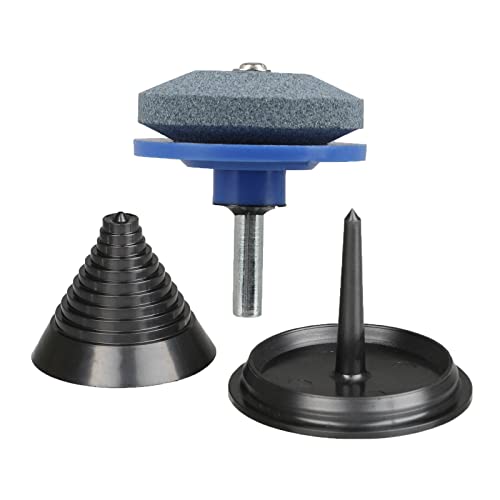
Every sharpening session should conclude with a careful static balance check before reattaching the blade to the mower deck. Multi-tiered cone balancers, such as those included with the jtfrkope and Calsoling kits, provide a quick way to test weight symmetry. You simply place the center hole of the blade onto the appropriate tier of the cone and see if it rests level. If one side dips toward the bench, that wing carries extra mass and requires additional metal removal along the non-cutting sail.
Never attempt to balance a blade by grinding metal away from the sharpened cutting edge itself. Removing material from the edge alters the blade length and bevel angle, leading to uneven cutting performance between the two wings. Instead, grind small amounts of steel from the trailing lift wing or the back edge of the heavier side until the blade rests horizontally. Balancing ensures that your freshly sharpened edge delivers smooth, vibration-free mowing without prematurely wearing your equipment.
Inspection Timing and Edge Maintenance Cycles
A practical rule for residential lawn care is to inspect and sharpen mower blades every twenty to twenty-five hours of mowing. For an average suburban yard, this schedule typically translates to sharpening once in the middle of spring and once in mid-summer. However, properties with sandy topsoil, surface tree roots, or scattered gravel may require more frequent inspections. Checking the cutting edge regularly allows you to smooth out small nicks before they turn into severe gouges.
Before beginning any inspection or sharpening procedure, always disconnect the spark plug boot or remove the safety battery key to prevent accidental engine starts. Following established safety guidelines for removing a mower blade safely ensures you protect your hands while loosening stubborn spindle bolts. Once the blade is removed from the deck, inspect both cutting edges under bright lighting to evaluate the depth of any rock strikes. Minor dents can be filed out during routine sharpening, but severe bends require immediate blade replacement.
Blades do not last forever, and repeated sharpening eventually thins the metal past its safe operating threshold. If the cutting edge has receded more than half an inch from its original factory profile, the blade has reached the end of its service life. Evaluating the cost of a replacement mower blade against the risk of a weakened blade snapping under load makes replacement an easy decision. Retiring worn blades ensures consistent mowing performance and maintains strict deck safety.
Practical Takeaways for Consistent Turf Performance
Maintaining the proper sharpness on your lawn mower blade requires patience and an understanding of edge geometry. Resisting the temptation to hone your blades to razor sharpness will save you time, prevent blade failure, and give you much longer service between maintenance sessions. A durable thirty to forty degree bevel ending in a slight butter-knife flat provides the ideal balance of cutting speed and impact resistance. Paired with regular static balancing, this approach delivers clean, green lawn cuts all season long.


Write Your Review
No reviews yet. Be the first to share your experience!