


Ragged grass tips and uneven turf usually signal that a cutting deck is struggling rather than cutting cleanly. When rotary blades lose their edge, grass blades tear instead of slicing cleanly, leaving brown edges and exposing the lawn to stress. Homeowners often ask what angle should you sharpen lawn mower blades to restore clean cutting action without weakening the cutting edge. Most standard lawn mower blades require a 30-degree bevel, though certain heavy-duty profiles utilize angles between 30 and 35 degrees. Matching the original factory profile ensures the steel remains durable enough to deflect debris while slicing smoothly through thick grass.
Sharpening at the wrong bevel can ruin blade performance and shorten its usable life. Grinding the edge too sharp turns the blade into a fragile knife that chips easily against small pebbles and mulch. Conversely, leaving the bevel too blunt tears turf and places unnecessary strain on the engine and spindle assembly. Before beginning maintenance or checking mower blade sizing for a deck overhaul, understanding the correct bevel geometry is essential. Proper sharpening equipment, steady angle control, and post-grinding balancing keep the cutting system running smoothly throughout the mowing season.

Pros
- Adjustable angle range works with various blade types for custom sharpening
- Solid build with minimal wobble when properly mounted on a workbench
- Quick setup saves time compared to handheld sharpening methods
Cons
- Requires an angle grinder and a stable workbench, which may not be suitable for everyone
- Sharpening results depend on user technique and grinder quality
Keeping your lawn mower blade sharp is one of the simplest ways to ensure a clean, healthy cut. Dull blades tear grass rather than slice it, leaving ragged edges that turn brown and invite disease. The SporGain Lawn Mower Blade Sharpener is designed to make resharpening blades at home straightforward, without needing a professional shop. This jig works with most angle grinders to guide the sharpening stone along your blade at a consistent angle, restoring a keen edge quickly.
This tool is ideal for homeowners who maintain their own mowers, whether you have a push mower, self-propelled model, or even a riding mower with removable blades. If you prefer to handle routine maintenance yourself rather than paying for sharpening service, this jig may be a good fit. Budget-conscious shoppers will also appreciate the long-term savings from sharpening blades multiple times instead of buying new ones. However, it does require a compatible angle grinder and a bench or table where you can clamp the jig down for stability. It is not a standalone sharpener; you need a grinder to use it.
The sharpening jig allows you to set the angle between 15 and 45 degrees, which covers most standard mower blades, including straight blades, mulching blades, and high-lift designs. According to the product info, the included guide pins fit most angle grinders and the bushings help reduce wobble for a more consistent cut. The blade holder accommodates blades from 1.65 to 3.60 inches wide, so it works with many popular residential mower blades.
Setup is fairly simple: you clamp the jig to your workbench, adjust the angle using the thumb screws, place your blade in the holder, and then run the grinder along the blade edge. The jig keeps the grinder at a fixed orientation, helping you maintain the proper angle across the entire blade. This can be easier and more consistent than freehand sharpening, especially for beginners. Once you finish, you can reinstall the sharpened blade on your mower and get back to cutting grass.
Some limitations to keep in mind: the jig needs to be mounted on a sturdy surface, so if you lack a workbench or vice, setup might be less convenient. Also, achieving the best edge is still somewhat dependent on your grinder quality and your experience. Users with no prior sharpening may need a few tries to get a perfect edge. Additionally, this tool only sharpens the cutting edge and does not balance the blade, so you will still want to balance the blade before reinstalling it on your mower to avoid vibration and uneven cutting.
Overall, if you already own an angle grinder and have a place to mount the jig, the SporGain sharpener offers an affordable, repeatable way to maintain your mower blades. It saves money compared to repeated professional sharpening and helps keep your lawn looking its best with clean cuts. For homeowners who like to do their own maintenance and want a simple sharpening guide, this is a practical addition to the garage or shed.

Pros
- Extremely easy to use with any corded or cordless drill
- Consistent sharpening angle for a balanced, sharp edge
- Good value with 5 stones in one pack
- Works on a variety of blade types beyond just mowers
Cons
- Not ideal for heavy-duty or thick commercial blades; may wear out quickly
- Some users report stones spinning on the shaft or breaking under heavy pressure
- Best results require a corded drill for consistent speed and torque
The cenoz Crafts Man Lawn Mower Blade Sharpener is a straightforward accessory that turns your power drill into a handy blade sharpening tool. This 5-pack of corundum sharpening stones is designed for DIY homeowners, lawn care enthusiasts, and light-duty contractors who want to keep their mower blades sharp without investing in a dedicated bench grinder or sending blades out for sharpening.
In real-world use, this sharpener delivers a consistent edge on straight lawn mower blades, especially on push mowers and riding mowers with standard blades. The pre-set angle takes the guesswork out of maintaining the correct bevel. Users who follow the instructions and use a corded drill for steady speed report excellent results, with blades cutting cleanly through grass after just a few passes. The corundum material holds up well at typical drill speeds, though some users have experienced stones spinning on the shaft or cracking under heavy pressure, particularly on thicker commercial blades.
Build quality is acceptable for the price point. The stones are light and compact, and the pack of 5 gives you plenty of backups. Installation takes about 10 seconds just chuck it into your drill and you are ready to go. However, the sharpener works best on blades with a relatively straight cutting edge. Curved blades on some push mowers can be more challenging to sharpen evenly, as noted in a few reviews. For heavy-duty blades from commercial zero-turn mowers, these stones may wear out quickly or fail to achieve a sharp edge.
Overall, this is a practical, budget-friendly tool for routine lawn mower maintenance. If you are a weekend warrior with a standard push mower or a small lawn tractor, this sharpener will save you time and money. For professionals with demanding schedules and thick blades, a bench grinder or professional sharpening service remains a better investment. But for most homeowners, the cenoz 5-pack offers solid value and decent performance.
Material: Corundum
Size per stone: 50 x 47 mm (1.97 x 1.85 inches)
Package includes: 5 sharpeners
Compatibility: Fits most power drills (corded recommended for best results)
Ideal for: Lawn mower blades, tractor blades, rototiller tines, sickle bars, drill bits
Color: Blue
Homeowners: Keep your push mower or riding mower blades sharp for a clean cut and healthier lawn.
DIYers: Sharpen blades on your tiller, sickle bar mower, or even old drill bits.
Light commercial: For small lawn care businesses with a few mowers, this pack provides quick touch-ups between professional sharpenings.
Workshop: Use as a quick backup when you need a sharp edge and your bench grinder is tied up.


Pros
- Brushless motor runs quieter and lasts longer than brushed alternatives reducing maintenance and downtime
- Variable speed up to 3000RPM gives you control over the sharpening process for different blade conditions
- Comes with a generous assortment of sanding discs and blade guides so you can start sharpening right out of the box
- Lifetime motor warranty adds peace of mind for long term ownership
Cons
- No included storage case or carry bag for the tool and accessories which could be a minor inconvenience for mobile users
- The 60-grit discs may wear quickly if used heavily requiring replacement sooner than expected
- Limited to lawn mower blades not suitable for other cutting tools like chainsaws or pruners
The SporGain Lawn Mower Blade Sharpener is a dedicated power tool designed specifically for sharpening mower blades. It's not a multi-purpose grinder but a focused solution for anyone who maintains a lawn mower regularly. Whether you're a homeowner who mows a quarter acre or a landscaper with a fleet of machines this sharpener aims to make blade maintenance fast and consistent.
At the heart of this tool is a brushless motor which is a real step up from traditional brushed motors you see on cheaper sharpeners. Brushless motors run cooler, quieter, and last significantly longer. You get adjustable speed up to 3000RPM so you can match the grinding speed to the blade condition. For a dull blade you might run it faster to remove material quickly while a nearly sharp blade benefits from a slower speed for a finer finish. The kit includes 10 coarse 60-grit sanding discs for rough grinding and 60 fine 180-grit discs for honing. You also get 30 and 45 degree blade guides to maintain the correct bevel angle which is critical for a clean cut and healthy grass.
Assembly is straightforward and the tool is simple to operate. It sits on a workbench or can be mounted for more stability. The compact dimensions 12.01 x 7.48 x 11.81 inches mean it won't dominate your workspace. Build quality feels solid for the price point and the lifetime motor warranty is a strong indicator of confidence in the motor's durability. That said you won't find a storage case included so if you plan to transport it between job sites you'll need to supply your own container for the discs and guides.
One realistic limitation is that this sharpener is designed exclusively for lawn mower blades. It won't handle chainsaw chains, pruners, or other cutting tools. Also while the 60-grit discs work well for initial grinding they may wear out faster than some users expect especially if you're sharpening multiple blades in a single session. Having extra discs on hand is a good idea. But for dedicated mower blade work this tool performs reliably and the adjustable speed gives you fine control that many fixed-speed sharpeners lack.
For the DIY homeowner who wants to keep their mower cutting clean without paying for professional sharpening the SporGain is a solid investment. Landscapers will appreciate the speed and consistency for maintaining multiple blades. The brushless motor and lifetime warranty support long-term value. If you need a simple, effective way to sharpen mower blades at home or in the shop this sharpener delivers without unnecessary complexity.
Color: Black
Dimensions: 12.01 x 7.48 x 11.81 inches
Product Group: Lawn and Patio
Motor Type: Brushless
Speed Range: Adjustable up to 3000 RPM
Included Discs: 10 x 60-grit sanding discs, 60 x 180-grit sanding discs
Included Guides: 30 degree and 45 degree blade guides
Warranty: Lifetime motor warranty
The SporGain Lawn Mower Blade Sharpener comes with a complete sharpening kit right in the box. You get 10 pieces of 60-grit sanding discs for the initial grinding phase and 60 pieces of 180-grit sanding discs for fine sharpening. Two blade guides are included one at 30 degrees and one at 45 degrees to help you maintain the correct sharpening angle for different mower blade types. All you need to supply is a standard power outlet and a workbench or stable surface to mount or place the tool.

Pros
- Adjustable sharpening angle (15°-45°) covers most common mower blades.
- Magnetic balancer is quick to use and provides accurate results.
- Solid build quality with metal components and ball bearings for durability.
- Easy to set up and use, even for beginners with no prior sharpening experience.
Cons
- May not accommodate very large or unusually shaped mower blades due to fixed mounting design.
- Magnetic balancer works best on flat, clean blades; debris or heavy rust can affect accuracy.
- Price is higher than simple sharpening guides, but the combo adds balancing capability.
The SporGain Lawn Mower Blade Sharpener & Balancer Combo Kit is a dual-purpose tool set designed for homeowners and DIYers who want to keep their mower blades in top shape without relying on a shop. This kit includes an adjustable blade sharpener and a high-precision magnetic balancer, both made with solid materials that feel substantial in hand.
For real-world performance, the sharpener’s 15° to 45° adjustment range lets you match the factory bevel on most push mower and riding mower blades. The ball-bearing mechanism allows smooth, controlled strokes, and the enlarged handle gives good leverage. After sharpening, the magnetic balancer quickly shows if the blade is off-center, which helps prevent vibration and uneven cutting. Users typically see a cleaner lawn and less strain on the mower engine after using this combo.
Build quality is a highlight here. The sharpener is made from thick aluminum alloy with sealed ball bearings, and the balancer uses strong N52 magnets to hold the blade securely. Both tools feel rugged enough for regular use in a garage or shed. The magnetic balancer has a hidden magnet design that avoids interference, and the sharpener’s clamping mechanism holds blades firmly without slipping.
One realistic drawback is that the sharpener’s clamping range may not accommodate very wide or oddly shaped aftermarket blades. Also, the magnetic balancer requires a clean, flat blade surface for accurate results; heavy rust or debris should be cleaned off first. These are minor trade-offs for a tool set that otherwise performs very well for its intended audience.
Overall, the SporGain Lawn Mower Blade Sharpener & Balancer Combo Kit is a smart buy for anyone who mows regularly and wants to extend blade life while improving cut quality. It’s especially useful for homeowners with a few acres, or DIYers who maintain multiple mowers. The combination of adjustable sharpening and magnetic balancing saves time and delivers professional-level results without a steep learning curve.

Pros
- Very affordable and easy to install on a standard power drill
- Includes a balancer to help maintain even blade wear
- Versatile for multiple garden cutting tools beyond just mower blades
Cons
- Lower customer rating suggests inconsistent performance or durability issues
- Manual sharpening with a drill still requires careful angle control and may not match factory edge quality
- Best suited for light to moderate sharpening tasks; heavy use may wear the abrasive quickly
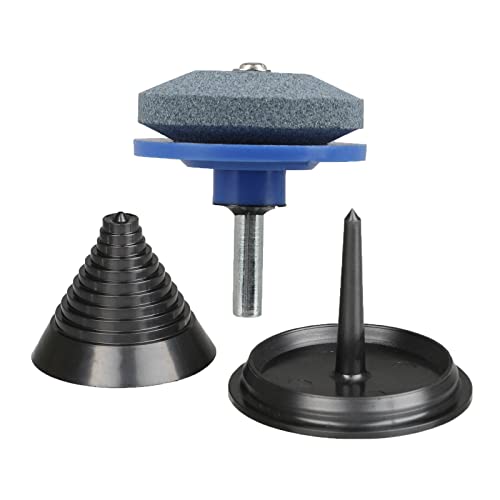
The Calsoling 3-Piece Lawn Mower Blade Sharpener is a straightforward, no-frills accessory designed to help homeowners and DIYers keep their mower blades and other garden cutting tools sharp without investing in expensive sharpening equipment. This set includes three corundum abrasive stones mounted on stainless steel bases, plus a blade balancer, all for a price that makes it easy to try. The concept is simple: chuck one into any standard power drill, touch it to the blade edge, and grind away the dullness. For those who mow a standard suburban lawn once a week, this can be a practical way to extend blade life between professional sharpenings or replacements.
In real-world use, the sharpener works best on blades that are merely dull rather than heavily nicked or damaged. The corundum material handles moderate wear and resists heat buildup, which is important when using a drill at higher RPMs. The included balancer is a nice bonus, letting you check if the blade is still balanced after sharpening, which helps reduce vibration and uneven cuts. However, the sharpening process requires a steady hand and a consistent angle to avoid creating an uneven edge. It's not as precise as a dedicated sharpening jig or a professional grinder, but for quick touch-ups, it gets the job done.
Build quality is adequate for the price point. The steel backing provides some rigidity, but the abrasive stones are relatively small, measuring about 1.97 inches in diameter. This means you'll need to make multiple passes along longer blades. The three-pack is a practical advantage, allowing you to keep one in the garage, one in the shed, and maybe a spare. The 12-month warranty is a nice touch for such an inexpensive item, indicating the manufacturer stands behind it.
On the downside, the overall customer rating is modest, and some users have reported inconsistent performance or the abrasive wearing down faster than expected. This is not a tool for professional landscapers or anyone who sharpens blades daily. It also requires a power drill, which most homeowners already have, but it's an added step if you don't. The lack of a guide or depth stop means you could accidentally remove too much material if you're not careful.
Overall, the Calsoling 3-Piece Lawn Mower Blade Sharpener is a solid budget option for the DIY homeowner who wants a quick, easy way to maintain mower blades and similar tools. It's not a replacement for professional sharpening or high-end sharpening systems, but for the occasional touch-up, it offers good value. If you're a weekend warrior with a modest lawn and a cordless drill, this set is worth considering. Just go in with realistic expectations about its durability and precision.
Product Dimensions: 1.9 x 1.5 x 0.8 inches per stone
Item Weight: 3.53 ounces (total set)
Material: Corundum abrasive with stainless steel backing
Stone Diameter: 50 x 47 mm (1.97 x 1.85 inches)
Package Includes: 3 sharpening stones + 1 blade balancer
Compatibility: Works with power drills and hand drills; fits 99% of mower blade center holes
Warranty: 12 months
This sharpener set is best suited for homeowners and DIYers who need to touch up standard lawn mower blades, sickle bars, rotary tillers, hoes, and drill knives on a regular basis. It's ideal for quick maintenance between professional sharpenings or for those who prefer to keep their blades sharp without the expense of a dedicated sharpening station. Not recommended for heavy-duty or commercial use where blades are heavily damaged or need precise edge geometry.
Blade Sharpening Angles and Maintenance Best Practices
Achieving a healthy lawn depends directly on the cutting edge geometry of your mower blade. Sharpening at the correct angle ensures the blade shears grass cleanly rather than shredding it. While homeowners often assume sharper is always better, mower blades require a balance between sharpness and structural durability. Maintaining the factory bevel angle preserves the steel, extends deck life, and keeps grass tips green after mowing.
The Standard Factory Sharpening Angle for Lawn Mower Blades
The standard sharpening angle for most rotary lawn mower blades is 30 degrees. Original equipment manufacturers grind replacement blades to this specific bevel profile before shipping. A 30-degree bevel provides the ideal balance between a clean shearing cut and impact resistance against lawn debris. Knowing your blade profile helps you choose the right setting on adjustable sharpening jigs.
Blades designed for walk-behind and riding mowers almost universally adhere to this 30-degree benchmark. The bottom face of the blade remains flat, while the top surface slopes down to form the cutting edge. Attempting to alter this angle changes how air flows under the deck and can disrupt clipping discharge. Maintaining the documented factory bevel is the safest and most effective strategy for DIY blade maintenance.
Variations exist primarily when transitioning to demanding commercial cutting conditions. Commercial operators mowing rough terrain often favor a 35-degree angle because thicker bevels resist denting when striking rocks or roots. For standard suburban lawns, exceeding 35 degrees reduces cutting efficiency and increases engine resistance. Keeping your edge at 30 degrees ensures the blade cleanly severs grass stems without dulling prematurely.
Why a Razor-Sharp Edge Causes Premature Blade Damage
A common mistake among DIY lawn care enthusiasts is grinding a mower blade to a razor-sharp edge. Knives require razor edges because they slice through stationary materials under light manual pressure. In contrast, mower blades spin at rotational speeds exceeding 3,000 RPM under heavy aerodynamic forces. At these speeds, a razor edge lacks the mass required to withstand impacts from dirt, twigs, and mulch. Within minutes of mowing, an overly thin edge rolls over or chips into jagged notches.
Instead of bringing the metal to a knife point, technicians recommend leaving a blunt leading edge roughly 1/64 to 1/32 of an inch thick. This flat edge is approximately the thickness of a standard dime. Leaving this small flat surface provides the blade with impact resistance without sacrificing cutting efficiency. High rotational speed provides ample kinetic energy to sever grass cleanly even with this slight blunt front.
Excessive sharpening that creates a razor edge also removes unnecessary steel from the blade body. Aggressive grinding heats up the metal rapidly, which can ruin the heat treatment and temper of the steel. Once the temper is lost, the steel softens and loses its ability to hold an edge. Maintaining a measured bevel with a blunt leading edge preserves heat-treated durability and maximizes blade lifespan.
The Consequences of Sharpening at Incorrect Angles
Grinding a blade at an angle steeper than 30 degrees creates an edge that is too thin and fragile. When an edge drops below 25 degrees, the resulting profile resembles a utility knife. While it feels sharp to the touch, it cannot handle the rough environment beneath a mower deck. Minor contact with twigs or thatch causes the thin edge to chip and mushroom, losing its cutting performance quickly.
Conversely, grinding a blade at an angle flatter than 40 degrees creates a blunt wedge rather than a cutting tool. An excessively blunt edge smashes grass blades instead of slicing them cleanly. This tearing action frays grass tips, which turn brown across the lawn within two days. Torn grass also loses moisture rapidly and becomes more susceptible to turf diseases while increasing engine load.
An improper bevel also disrupts airflow balance inside the cutting deck chamber. High-speed rotation relies on smooth air movement across the blade surface to lift grass before cutting. When bevels are ground inconsistently, aerodynamic turbulence increases beneath the deck. This turbulence can lead to uncut stragglers, uneven stripes, and poor bagging performance. Using guided sharpening jigs eliminates these frustrating cut-quality problems.
Sharpening Angles Across Different Blade Types
Standard straight blades feature a flat body with a simple cutting edge positioned along the outer wings. These blades almost always utilize a uniform 30-degree bevel from the outer tip inward. Because standard blades are straightforward, they are simple to sharpen using manual files or mechanical jigs. Maintaining a flat bottom face and grinding only the top bevel restores original factory performance smoothly.
High-lift blades incorporate aggressive curved sails on the trailing edge to generate powerful lift. Despite their elevated rear wings, the cutting edge itself still requires a consistent 30-degree sharpening bevel. It is critical to sharpen only the designated cutting edge and avoid grinding the aerodynamic sails. Removing metal from the trailing lift wings weakens the blade and reduces upward airflow necessary for clean bagging.
Mulching blades introduce curved cutting edges and toothed rear wings to chop clippings repeatedly. Sharpening these complex profiles requires extra care to maintain the 30-degree bevel along each contour. If you manage electric decks, our guide on brushless electric mower blade maintenance highlights how cutting efficiency directly influences motor battery runtime. Keeping mulching contours properly beveled ensures grass clippings are finely recut before dropping back into turf.
Tools and Jigs for Maintaining Consistent Bevel Angles
Freehand sharpening on a bench grinder often leads to uneven bevel angles. Human error easily causes the operator to vary tilt, producing rounded or inconsistent cutting edges. Using dedicated sharpening jigs, such as metal frames that adjust between 15 and 45 degrees, eliminates guesswork. Brands like SporGain manufacture jigs with guide pins and bushings that lock angle grinders into a fixed orientation. These fixtures hold the grinder rigidly against the blade, guaranteeing a uniform 30-degree bevel.
Drill-mounted sharpening stones offer an accessible solution for routine blade touch-ups at home. Packages from brands like cenoz, jtfrkope, and Calsoling utilize corundum grinding stones with plastic or steel guide backings. These stones attach directly to power drills and self-align against the cutting edge. While drill stones are convenient for quick seasonal freshening, they lack the precise angle adjustment of mechanical jigs. They remain best suited for cleaning up minor dullness rather than reshaping damaged profiles.
Dedicated benchtop blade sharpening machines represent the high-performance tier of blade maintenance equipment. Systems featuring brushless motors with multi-angle guide plates allow users to select preset 30-degree or 45-degree stops. These sharpeners spin sanding discs with speed adjustment up to 3,000 RPM. Lower speeds generate less heat, protecting steel temper while producing an accurate bevel. Dedicated sharpeners provide repeatable results for owners maintaining multiple properties or large acreage.
Step-by-Step Technique to Sharpen at the Correct Angle
Safe blade sharpening begins with proper mower preparation before removing any hardware. Always disconnect the spark plug boot on gas mowers or remove the safety key and battery pack on cordless models. Secure the deck, block the blade with a wooden block, and loosen the retaining bolt with a breaker bar. Once removed, clean dried grass and debris from the blade using a wire brush. Inspect the entire surface for structural cracks, bends, or severe gouges before clamping the blade.
Position the blade horizontally in a workbench vise with the cutting bevel facing upward. Align your grinder or adjustable jig to match the existing 30-degree factory angle. Work in smooth, steady passes from the inside edge outward toward the wing tip. Avoid pressing too hard against the steel, as excessive friction causes overheating and discolors the metal. Light, uniform grinding passes remove just enough material to restore a clean edge without ruining temper.
After sharpening the top bevel, inspect the bottom face of the blade for hanging burrs. Never grind an angle or bevel into the bottom face of a rotary mower blade. Instead, lay your file or grinding disc completely flat against the bottom surface and make a single light pass. This deburring pass knocks off the thin wire edge created during top-bevel grinding. The bottom face must remain flat to ensure proper airflow and clean shearing action against grass.
For DIY owners servicing battery-powered machines, reviewing our Ryobi mower blade setup discussion provides valuable perspective on blade installation and safety alignment. Always reinstall the blade with the cutting bevel facing toward the deck underside and wings pointing upward. Hand-thread the blade bolt, align the mounting holes, and torque the fastener to the manufacturer specification. Double-checking hardware orientation prevents dangerous blade slippage during subsequent mowing sessions.
Preserving Blade Balance After Grinding
Restoring the correct bevel angle is only half of the maintenance equation; balance is equally crucial. As you grind away dull steel, you inevitably remove metal mass from the blade wings. If one wing loses more material than the other, the resulting weight imbalance causes intense vibration at high speeds. This vibration places excessive strain on the spindle assembly, deck bearings, and engine crankshaft. Over time, running an unbalanced blade can crack deck weldments and destroy drive components.
Checking blade balance requires a dedicated testing tool rather than visual estimation. Inexpensive cone balancers feature stepped tiers that support various center hole diameters, allowing the blade to pivot freely. If the blade dips to one side, that end contains excess weight and requires additional grinding. Wall-mounted magnetic balancers offer even higher precision by suspending the blade on a magnetic spindle bearing with minimal friction. Many sharpening kits, such as those from SporGain, bundle balancers to streamline post-sharpening inspection.
Correcting an unbalanced blade must be handled properly without disturbing your freshly ground edge. Never remove weight by grinding the cutting bevel that you just sharpened at 30 degrees. Instead, flip the blade and remove metal from the back trailing edge or non-cutting sail on the heavy wing. Take small passes from the heavy end and retest the blade on the balancer frequently. Continue this process until the blade rests completely horizontal on the balancer spindle before reinstalling it.
When to Sharpen Versus When to Replace a Mower Blade
Sharpening restores blades that suffer from normal seasonal dulling and minor surface nicks. However, every lawn mower blade has a finite service lifespan that grinding cannot extend indefinitely. If a blade has struck a hidden pipe or rock and shows a visible bend, it must be replaced immediately. Straightening a bent blade using heat or a hammer weakens the steel structure and creates a catastrophic safety hazard. A compromised blade can fracture during operation, turning flying metal fragments into dangerous projectiles.
You should also inspect the condition of the trailing sail and the thickness of the blade body. Sandy soil and gritty lawn debris act like a sandblaster against the upturned rear sails of high-lift and mulching blades. Over several seasons, this abrasive action thins the steel until holes or razor-thin edges develop in the sail. Once the sail metal wears thin, the blade can break apart under high centrifugal forces. If the sail shows significant thinning, purchase a new replacement blade.
As a practical rule of thumb, replace a blade if the cutting edge has receded past its original stamped boundary. Grinding past the factory-hardened zone leaves soft steel that will not hold a 30-degree edge for more than a single mowing. Deep gouges deeper than 1/4 inch also require removing too much surrounding metal to balance safely. Retiring heavily worn blades protects your mower deck components and guarantees clean, consistent cuts every spring.
Maintaining a precise 30-degree bevel transforms lawn mowing from a frustrating chore into an efficient routine. By avoiding overly sharp razor edges and preserving the blunt leading edge, your blades remain resilient against everyday lawn debris. Pair consistent angle grinding with accurate dynamic balancing to eliminate spindle wear and prolong deck life. Following these straightforward geometry rules ensures healthy turf and dependable mower performance throughout the growing season.



Write Your Review
No reviews yet. Be the first to share your experience!