


Routine lawn maintenance often requires inspecting cutting edges, yet working underneath a mower deck exposes hands to sharp steel and high torque hardware. Establishing a safer mower blade setup protects the operator during seasonal maintenance while preventing dangerous vibration during operation. Proper equipment matching and secure handling methods eliminate much of the guesswork when loosening stubborn spindle bolts or setting up replacement parts. Homeowners can explore our guide on robotic mower blade setup to observe how automated platforms approach blade alignment.
Mismatched mounting holes, bent components, or unverified adapter plates can compromise spindle integrity and produce uneven grass trimming across the turf. Using dedicated clamping tools and balance verification cones helps maintain stable rotary dynamics without forcing operators to rely on awkward, unstable workarounds. Understanding how hardware dimensions align with manufacturer specifications ensures that blades stay firmly fastened during heavy cutting conditions. Taking the time to verify every clearance measurement creates a reliable cutting system that operates smoothly throughout the mowing season.

Pros
- Extremely affordable and widely compatible with most residential mower blades.
- Simple to use: just chuck it in a drill and run along the blade edge.
- Including both sharpener and balancer means you get a complete blade maintenance solution.
- Lightweight and portable, perfect for small workshops and home garages.
Cons
- Requires a drill to operate, so you need one on hand.
- Manual balancing takes a bit of patience to get right compared to electronic balancers.
- Not ideal for heavy commercial use or high-volume shops where speed is critical.
The Arnold BSK-1 is a straightforward sharpening and balancing kit designed for lawn mower blades. It turns your regular electric drill into a reliable sharpening tool, making it easy to maintain a clean cutting edge without investing in a dedicated grinder. The kit includes a cone-shaped sharpening stone and a simple static balancer, both built to handle blades from walk-behind mowers, lawn tractors, and zero-turn machines.
This kit is best suited for homeowners and DIYers who prefer to handle their own mower maintenance rather than taking blades to a shop. It's also useful for small engine mechanics who need an affordable backup method. But if you're a professional landscaper sharpening dozens of blades a week, you'll likely want a faster, more automated system.
In real-world use, the sharpener works quickly. Chuck it into a drill, run the stone along the blade's edge at a shallow angle, and you'll see burrs form within seconds. The vibration-free claim holds up -- the stone spins smoothly, which helps avoid gouging the blade. The balancer is straightforward: hang the blade on the cone and see which side drops. Rotate a few times to confirm. It's not fancy, but it effectively reveals if the blade is heavy on one side.
Build quality is typical for a budget tool. The sharpening stone is abrasive and should last through several sharpenings. The balancer is made of plastic and a metal cone. It's lightweight (just over two ounces) and stores easily in a drawer. For the price, durability is acceptable for occasional weekend usage. You won't hesitate to toss it in a toolbox or tool bag.
The main drawback is that you need a drill, and the process is manual. Balancing requires patience -- you'll have to grind off material from the heavy side and recheck. It's not as precise as a professional blade balancer, but it's more than enough to get a decently balanced blade. Overall, the Arnold BSK-1 is a smart buy for anyone who wants to keep their mower cutting cleanly on a budget. It's a practical addition to any workshop, especially if you already own a drill.
Color: Black
Dimensions: 3 x 7 x 10 inches
Weight: 0.24 pounds
Product Group: Outdoors
Binding: Lawn & Patio

Pros
- Sturdy metal build that won't crack or warp like plastic balancers.
- Accurately detects even small imbalances for improved cut quality.
- Works with a wide variety of blade center hole sizes thanks to the stepped cone design.
- Easy to use: place blade, watch gravity, and remove material from the heavy side.
Cons
- Some users report that the cone steps may not fit every blade perfectly, though most find a suitable step.
- Requires a bit of trial and error to center the blade precisely on the cone.
- The balancer itself has a narrow base that can tip if bumped during use.
The Oregon Precision Mower Blade Balancer (model 42-100) is a simple, no-fuss tool that belongs in every mower maintenance kit. After you sharpen your blade, tossing it back on the mower without checking balance is a gamble. Even a tiny imbalance can cause excessive vibration, rough cutting, and accelerated wear on your mower's engine and spindle bearings. This compact metal balancer solves that problem with a straightforward gravity-based design.
Best suited for homeowners who sharpen their own blades as well as professional landscapers, the balancer works with virtually any rotary mower blade. The stepped metal cone accommodates different center hole sizes, so it fits push mowers, riding mowers, and zero-turn machines from brands like Stihl, Husqvarna, Troy-Bilt, and more. The zinc die-cast body feels solid and substantial easily outlasting cheap plastic alternatives that can crack or warp over time.
Using the Oregon balancer is refreshingly simple. Place the blade flat on the cone, let it settle, and gravity will tell you if one side is heavier. If the blade dips, grind a bit more material off that side and recheck. The process takes only a minute or two but makes a real difference in how your mower runs. Users consistently report noticeably less vibration and a cleaner, more even cut after balancing.
One realistic limitation is that the cone steps might not align perfectly with every blade's center hole, though most users find a step that works. Also, the balancer has a narrow base, so you'll want to set it on a stable surface to avoid tipping. But these are minor tradeoffs for a tool that costs under ten dollars and can extend the life of your mower's engine and deck.
If you maintain your own mower blades, the Oregon Precision Blade Balancer is a smart, low-cost investment. It helps you get professional-level results at home, reduces vibration that leads to premature wear, and keeps your lawn looking its best. For the price and performance, there's little reason not to add one to your workshop gear.
Brand: Oregon
Model: 42-100
Material: Zinc die-cast metal
Weight: 0.2 pounds
Dimensions: 10 x 6 x 1 inches
Power Source: Manual
Color: Original Version
Compatibility: Fits most push mower and riding mower blades

Pros
- Three-piece set provides complete coverage for standard 3-blade commercial decks
- Precise 90-degree alignment stabilizes stacked mulching and cutting blades
- Standard 5/8-inch round center hole fits a broad range of commercial mower spindles
- Helps prevent blade slippage and unwanted bolt over-tightening during operation
Cons
- Mower blades are not included and must be purchased separately
- Incompatible with star-pattern, splined, or non-5/8-inch spindle shafts
- Additional blade thickness may require verifying spindle bolt length before use
The DECKMAN 3-Piece X-Blade Dual Mulching Blade Adapter set is a dedicated mounting accessory engineered to configure dual cutting blades on standard commercial lawn mowers. Designed with a 2.8-inch width, a 0.12-inch thickness, and a round 5/8-inch center hole, each adapter plate securely positions a primary blade and a secondary cover blade at a precise 90-degree angle. By stacking two blades per spindle in an X-configuration, this setup enables standard commercial decks to grind grass clippings into significantly finer mulch before discharge.
This adapter kit is best suited for commercial landscape contractors, groundskeepers, and property owners operating three-blade commercial zero-turn, stand-on, or walk-behind mowers. The three-piece package corresponds to the manufacturer XB3 designation, making it an appropriate choice for triple-spindle deck layouts. Homeowners and professionals looking to eliminate visible grass windrows, reduce seasonal leaf volume, and avoid frequent bagging will find the dual-blade concept advantageous, provided their machine utilizes standard round 5/8-inch spindle shafts.
From a construction and mechanical standpoint, each bracket is finished in a clean silvery coating and built from rigid 0.12-inch thick material to withstand the rigors of heavy mowing. The manufacturer highlights that the adapter maintains alignment across the spindle assembly, which prevents blade slippage under heavy cutting resistance. Eliminating slippage is critical because slipping blades can over-torque spindle mounting bolts, leading to stripped hardware or frozen bolts that become exceptionally difficult to remove during seasonal sharpening.
Practical ownership requires confirming physical fitment before mounting. Operators must verify that both their spindle shafts and their selected replacement blades share the exact 5/8-inch center hole geometry. Because stacking two commercial blades and an adapter increases the overall mounting stack height, buyers should also inspect spindle bolt length to verify adequate thread engagement. Equipment service should always be performed with the engine disabled, the spark plug disconnected, and in accordance with manufacturer torque specifications.
While the DECKMAN adapters deliver an economical pathway to intensified mulching, realistic limitations remain. The set includes only the three adapter brackets, meaning all primary blades, secondary blades, and spindle bolts must be verified or sourced independently. Furthermore, mowers with proprietary star-shaped or hex center holes cannot accept this standard round mounting design. For operators running commercial equipment with standard 5/8-inch spindles who want cleaner turf without bagging, this three-piece kit offers a durable, practical upgrade.
Compatibility for the DECKMAN X-Blade adapters centers entirely on spindle shaft dimensions and deck configuration. Each adapter features a standard 5/8-inch round center hole and a 2.8-inch width, designed specifically to mount onto commercial-grade spindles that share this hardware diameter. The three-piece quantity aligns directly with three-blade commercial mower decks, matching the manufacturer XB3 configuration.
Equipment owners should inspect both their mower spindles and replacement blades before purchasing. These adapters do not fit proprietary 5-point star, 6-point star, or splined spindle shafts. In addition, because stacking two blades increases the total thickness on the spindle shaft, buyers should ensure their existing spindle bolts provide sufficient thread engagement or acquire appropriate length commercial mounting bolts.
The X-Blade dual-blade concept operates by mounting a standard cutting blade alongside an auxiliary cover blade at a perpendicular 90-degree angle. As the spindle rotates, the primary blade provides the initial cut while the secondary blade recuts the suspended clippings, generating finer organic material that decomposes rapidly back into the turf.
Beyond improving clipping reduction, the DECKMAN adapter physically locks the two blades together to prevent them from rotating out of alignment. This prevents blade slippage against the spindle face, which stabilizes deck balance, reduces unnecessary vibration, and stops the spindle bolt from over-torquing during demanding commercial cutting tasks.
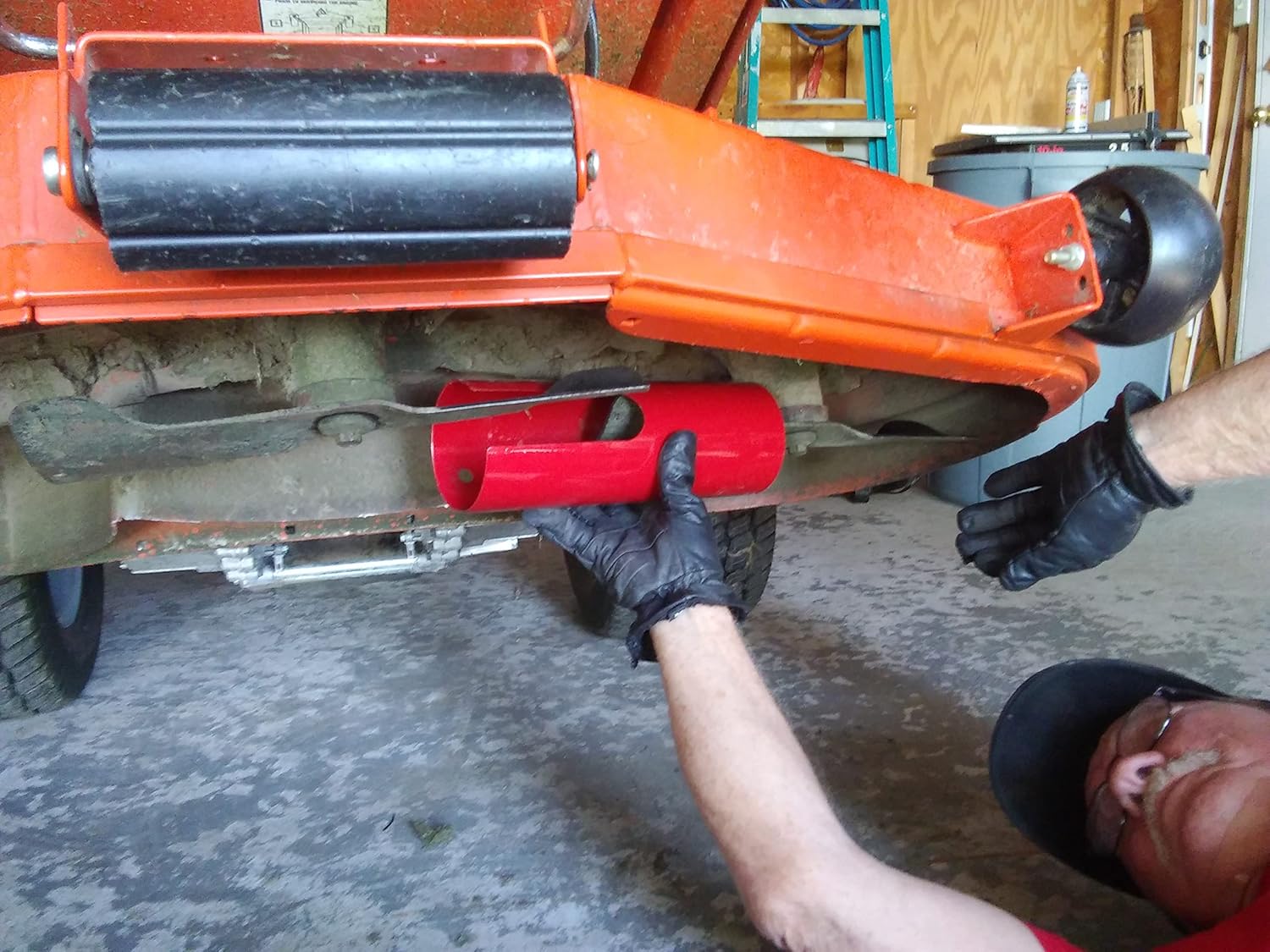
Pros
- Extremely easy to use, even on stubborn bolts
- Saves significant time compared to traditional methods like deck removal or clamps
- Durable build with a thick steel pipe that lasts for years
- Excellent customer support from the manufacturer
Cons
- Price is higher than DIY alternatives or simpler clamp-style tools
- Only compatible with blades 2-3/4 inches wide or wider, not for standard push mower blades
- May not effectively stabilize three-blade decks on some mower models
The BLADZ-LOK XL is a purpose-built blade removal tool for riding lawn mowers, specifically designed for blades that are 2-3/4 inches wide or larger. Unlike generic clamps or the old wood-block trick, this tool locks two blades together, letting you break stubborn bolts loose without removing the mower deck. It's a simple but effective solution for anyone who maintains a zero-turn, garden tractor, or other large mower with wide blades.
This tool is best suited for homeowners and DIYers who sharpen or replace their own blades regularly. If you've ever wrestled with a deck removal just to swap blades, you'll appreciate the time savings. The XL coupler works on wing-tipped blades and standard wide blades alike. Installation takes about 30 seconds: slide it over one blade, rotate to catch the second blade, and tighten the knob. That's it.
In real-world use, the BLADZ-LOK delivers consistent performance. Reviewers report that it holds blades securely even at high torque settings (90 ft-lbs), and it's much faster than clamp-on tools that can slip or strip. The carbon steel construction feels solid, and the powder coating resists rust. At 2.75 pounds, it's heavy enough to feel durable but not cumbersome to handle under the deck.
Build quality is excellent. The tool is made in the USA and backed by a 5-year limited warranty. Customer service gets high marks for responsiveness and fairness. However, the price is a sticking point for some. It's more expensive than a piece of pipe you could cut yourself, but the precision cut and finish justify the cost for most users. A minor drawback: it only works on blades 2-3/4 inches and wider, so it won't help with standard push mower blades. Also, one reviewer noted it didn't stabilize three blades on a Scag Tigercat II, so check your deck configuration.
Overall, the BLADZ-LOK XL is a worthwhile investment for anyone with a large riding mower who values efficiency and safety. If you change blades more than once a season, this tool will pay for itself in saved time and frustration. Just measure your blade width before ordering to ensure compatibility.

Pros
- High-lift wing design creates substantial airflow for clean clipping discharge and reduced deck clumping
- Proudly manufactured in the USA using heavy-duty, wear-resistant steel
- Exact OEM replacement fit for 61-inch Grasshopper zero-turn and front-mount mowers
- Helps prepare a cleaner yard surface for faster post-mow leaf blower cleanup
Cons
- Specifically sized for 61-inch decks and will not fit smaller or larger mower models
- High-lift aerodynamic airflow can kick up extra dust in very dry, sandy soil conditions
- Requires proper safety gear, socket tools, and a torque wrench for correct deck installation
The MaxPower 561177B USA Made 3-Blade Set is a premium replacement cutting set engineered specifically for 61-inch Grasshopper commercial and residential zero-turn mowers. Mower blades are the foundation of any pristine yard care routine, directly influencing how cleanly grass blades are sliced and how efficiently debris is evacuated from beneath the deck. This commercial-grade set directly replaces Grasshopper OEM part number 320245, giving property caretakers an accessible, durable alternative to costly dealership replacements.
This blade set is ideally suited for rural property owners managing multi-acre homesteads, suburban lawn care enthusiasts who take pride in sharp lawn striping, and professional landscape contractors running commercial fleets. If you routinely clear leaves from the front yard on Saturday morning or blow grass clippings off the driveway after mowing, sharp and properly shaped blades make a dramatic difference. The clean shearing action prevents ragged grass tips that turn brown in summer heat, leaving behind a smooth carpet that requires far less cleanup effort.
In terms of cutting performance and aerodynamics, these blades feature an aggressive hi-lift contour that functions like a high-volume fan underneath the cutting chamber. As the blades spin, they pull fallen grass blades and damp debris upward toward the cutting edges, slicing them cleanly before blowing the mulch out through the discharge chute with high air velocity. This robust airflow is especially valuable when handling wet leaves after rain or powering through dense spring growth, as it prevents messy clumping that can smother healthy turf.
Build quality is a clear highlight of this set, manufactured in the United States from thick, heat-treated steel designed to withstand contact with minor yard debris, pine cones, and small twigs. Each blade measures 21 inches in length, 2-1/2 inches in width, and 0.25 inches in thickness, completed by a precise 1/2-inch center mounting hole. The durable black protective coating helps fight rust and oxidation during off-season garage storage, while the balanced weight distribution prevents excessive spindle vibration and reduces wear on mower deck components.
Installation and maintenance follow standard deck service procedures, making it easy for first-time buyers and seasoned DIYers to swap blades in a home garage or workshop. While the high-lift design excels at moving heavy clippings, users in extremely dry or sandy environments should note that aggressive air lift can stir up surface dust. For anyone operating a 61-inch Grasshopper mower across sprawling suburban lawns or expansive acreage, this three-blade set delivers reliable cutting precision, exceptional air movement, and outstanding overall value.
The standout feature of the MaxPower 561177B blade set is its aggressive hi-lift sail profile. Unlike standard or low-lift blades that struggle with heavy growth, hi-lift blades generate substantial aerodynamic suction underneath the mowing deck. This air volume pulls low-lying grass upright so every blade is cut at a uniform height across the entire 61-inch path.
That same powerful airflow acts as an internal blower, launching clippings through the discharge chute in a wide, even spray pattern rather than dumping heavy piles along the cut line. This makes post-mow maintenance with a handheld or backpack leaf blower significantly faster, since grass clippings are thinly dispersed rather than matted down in dense clumps.
Routine blade care ensures optimum cutting quality and extends the working life of your mower spindle bearings. Before installing the MaxPower 561177B set, always disconnect the mower spark plug wire or safety key, inspect the spindle hardware, and torque mounting bolts according to your Grasshopper owner manual specifications.
Homeowners and lawn care specialists should check blade sharpness periodically throughout the mowing season, especially after clearing overgrown fields or storm-strewn lawns. To store the blades over the winter, simply clean away dried grass sap, apply a light coat of protective lubricant to the bare cutting edges, and hang them in a dry shed or garage until spring prep begins.

Pros
- Quiet operation lets you mow early morning or late evening without disturbing neighbors.
- Tool-free assembly and simple height adjustment make setup a breeze.
- Small footprint and lightweight design make storage easy in tight garages or sheds.
- Consistent, clean cut that many lawn enthusiasts prefer over rotary mowers.
Cons
- Not ideal for tall or thick grass over 4 inches; you'll need to make multiple passes or trim first.
- Requires a flat, even lawn to work best; hills or bumpy terrain can make pushing harder.
- Manual effort means it's not suitable for large lawns or users with physical limitations.
The American Lawn Mower Company 1815-18 is a traditional push reel mower that brings a century-old design into the modern era. This 18-inch, 5-blade manual mower is perfect for homeowners who prioritize a clean, precise cut and want to eliminate gas, oil, and noise from their lawn care routine. Unlike typical rotary mowers that shred grass, this reel mower snips each blade like a pair of scissors, resulting in a healthier lawn with less stress on the turf.
This mower is best suited for small to medium-sized, flat lawns. If you have a yard under a quarter acre and don't mind providing the power yourself, the 1815-18 delivers a satisfying workout while keeping your grass manicured. The cutting height adjusts easily from 1/2 inch to 2-1/4 inches using a wing nut on the cast iron roller brackets, so you can adapt to seasonal growth or personal preference. The 10-inch composite wheels with radial tread tires offer good traction on dry grass, and the lightweight 27-pound frame makes it easy to turn and maneuver around obstacles.
Build quality is solid for the price. The heat-treated alloy steel blades stay sharp for multiple seasons, and the plated loop handle with a full-length foam grip provides a comfortable push. Assembly is tool-free and takes under 10 minutes out of the box. One realistic limitation is that this mower struggles with grass taller than 4 inches or wet, thick turf. You may need to cut twice or use a trimmer first on overgrown areas. Also, on uneven ground, the mower can bounce, leaving uncut patches.
Overall, the American Lawn Mower 1815-18 is a reliable, eco-friendly choice for the DIY homeowner who values a quiet, emissions-free mowing experience. It's low maintenance and built to last, making it a smart buy for anyone with a modest, flat lawn who wants to reduce their carbon footprint and enjoy a cleaner cut.
Brand: American Lawn Mower Company
Model: 1815-18
Cutting Width: 18 inches
Number of Blades: 5
Cutting Height Range: 0.5 to 2.75 inches
Wheel Size: 10 inches
Weight: 27 pounds
Handle Type: Loop handle with foam grip
Material: Tempered alloy steel reel and bed knife
Assembly Required: No (tool-free)
Power Source: Manual (self-propelled by pushing)
This reel mower excels on small, flat lawns where you want a precise, striped look without the noise and fumes of a gas mower. It's ideal for eco-conscious homeowners who enjoy a bit of exercise while mowing. Use it for regular weekly cuts to keep grass at its healthiest. Avoid using it on wet grass or when the lawn is overgrown beyond 4 inches, as it may clog or require extra passes. It also works well for shops and garages that need to maintain a small patch of grass with minimal upkeep.
Essential Practices for a Safer Mower Blade Setup
A secure blade configuration relies on systematic preparation, exact mechanical matching, and proper rotational balance before the engine ever starts. Sharp steel rotating at thousands of revolutions per minute creates severe hazards if mounting hardware loosens or an unbalanced blade destabilizes the spindle assembly. Taking the time to understand each phase of mower maintenance prevents hand injuries during servicing and protects the deck hardware from destructive operating stresses. Homeowners and commercial operators alike achieve cleaner cuts and greater equipment longevity when every component is verified against manufacturer standards.
De-Energizing Equipment and Preparing the Work Area
Accidental engine ignition poses the greatest physical hazard during any under-deck maintenance procedure. Gas-powered walk-behind mowers and riding tractors must have their spark plug boots pulled and grounded away from the terminal before hands approach the cutting chamber. Electric and battery-powered mowers require battery removal or key disengagement to prevent accidental circuit completion while manipulating the blade. Taking these preliminary isolation steps guarantees that rotational energy cannot engage unexpectedly while wrenches and hands apply force to the spindle bolts.
Positioning the mower safely prevents hazardous fuel and oil leaks onto the surrounding workspace. Walk-behind mowers should generally be tilted with the air filter and carburetor facing upward so oil does not drain into the intake tract or exhaust muffler. Riding tractors and zero-turn mowers require secure deck lifting mechanisms, heavy-duty jack stands, or commercial ramps rather than temporary hydraulic jacks alone. A stable machine foundation prevents sudden shifts while loosening fasteners that may have seized from grass moisture and seasonal residue buildup.
Immobilizing Blades Without Improvised Scrap Wood
Loosening factory-torqued spindle bolts demands substantial leverage, which frequently causes unrestrained blades to spin rapidly toward the operator. Improvised wooden blocks often split, slip, or dislodge under the high torque required by long breaker bars. The patented BLADZ-LOK XL tool illustrates a mechanical approach engineered specifically for wider blades measuring over 2-3/4 inches across. Clamping two adjacent blades together with a purpose-built coupler immobilizes the assembly across the deck without forcing users to drop the entire cutting deck.
Wider cutting profiles such as commercial wing-tipped designs demand tools built to match their exact physical dimensions. Specialized locking couplers distribute loosening torque evenly between two separate spindles, minimizing lateral bending force on a single shaft. Using an undersized tool or wedging soft lumber against the deck skirt risks distorting the sheet metal housing or denting the inner baffling. Selecting an immobilization tool designed for your blade width ensures that high rotational resistance stays controlled throughout bolt removal and installation.
Verifying Center-Hole Geometry and Spindle Fitment
Replacement blades must match the spindle shaft interface exactly to ensure concentric rotation and uniform clamping pressure. Rotary blades use a variety of center hole configurations, including round bores of 1/2-inch, 5/8-inch, and specialized star patterns. The MaxPower 561177B three-blade set, for instance, provides a 21-inch length, 2-1/2-inch width, and a dedicated 1/2-inch center hole diameter engineered to replace OEM number 320245 on 61-inch Grasshopper mowers. Installing a blade with an oversized center hole allows eccentric mounting, which introduces dangerous vibration and rapidly damages spindle bearings.
Physical similarity in length or finish does not guarantee safe operational alignment on a specific mower model. Blades designed for a riding tractor cannot simply be swapped onto a walk-behind unit, even if the nominal cutting radius appears identical. Deck clearance requires proper offset, lift-wing height, and blade thickness so the cutting edge clears the deck walls and internal baffles. Always confirm OEM part numbers in your operator manual before seating a new blade against the spindle face.
Multi-Blade Configurations and Dual Mulching Adapters
Multi-spindle commercial decks and specialized mulching systems require precise alignment between overlapping or stacked cutting planes. Commercial setups frequently employ dual-blade arrangements to pulverize clippings into finer particles before discharging them across the lawn surface. Operators managing multi-spindle commercial units often review commercial lawn mower blades to understand how different lift profiles affect clipping dispersal and airflow dynamics. Incorrectly positioned dual blades can strike each other or create excessive drag on the spindle drive belts during heavy cutting cycles.
The DECKMAN X-Blade adapters demonstrate the structural hardware needed to secure dual blades at an exact 90-degree crossing angle. These 2.8-inch wide, 0.12-inch thick adapters feature a 5/8-inch center hole to hold the primary blade and secondary cover blade firmly in place. Proper adapter geometry prevents blade slippage under load, which would otherwise lead to bolt over-torquing and make future removal exceptionally difficult. Verifying that the spindle bolt length accommodates the added thickness of an adapter plate ensures full thread engagement in the spindle shaft.
Dynamic Balance Verification with Conical Balancers
Uneven blade wear and aggressive sharpening remove steel irregularly, shifting the center of gravity away from the rotational axis. An unbalanced blade spinning at typical engine operating speeds generates harmonic vibrations that loosen deck mounting hardware, fatigue operator hands, and crack spindle housings. Precision balancers provide a reliable, low-friction method to verify weight distribution before remounting cutting steel to the mower deck. Dedicated balancers isolate minor imbalances that visual inspection alone will completely fail to detect.
Static balancing tools range from compact stepped plastic cones to heavy zinc die-cast balancing stations. The Oregon 42-100 precision blade balancer utilizes a zinc die-cast cone design with universal sizing to verify rotary blade balance across push and riding models. Basic alternatives like the static balancer included in the Arnold BSK-1 kit provide a functional entry-level method for general lawn tractor and walk-behind blades. Placing the blade horizontally on the cone allows gravity to reveal the heavier wing, which must be carefully ground on the back edge until the blade rests level.
Drill-Mounted Sharpening Safety and Edge Profiles
Sharpening cutting edges restores clean clipping performance, but improper grinding technique creates structural weaknesses along the blade wing. Tool kits such as the Arnold BSK-1 include a drill-mounted grinding stone designed to fit standard 1/4-inch or 3/8-inch chucks for controlled edge touch-ups. Grinding stones guide the bevel to maintain the original cutting angle without grinding away excessive steel from the support structure. Operators should always wear heavy work gloves and impact-resistant eye protection while handling rotary sharpening tools.
Grinding too much metal from the cutting tip or overheating the steel alters the heat-treated temper of the component. A razor-thin cutting edge may look appealing, but it quickly rolls, chips, or fractures when encountering small stones or yard debris. A dull butter-knife edge measuring roughly 1/32-inch thick provides superior structural durability and resists impact fractures during normal operation. Inspecting the metal for hairline stress cracks around the center hole and outer lift sail is essential before deciding to sharpen or discard worn steel.
Fastener Integrity and Spindle Hardware Inspection
Spindle hardware sustains extreme rotational forces, cyclical vibration, and thermal expansion during extended mowing sessions. Factory mounting bolts, cupped Belleville washers, and retention nuts must be inspected for stretched threads, rounded corners, and corrosion pitting. Reusing damaged fasteners or substituting soft hardware-store bolts creates a catastrophic failure risk under sudden impact. When reviewing durable replacement mower blades, property owners should also assess whether fresh OEM-grade hardware is needed to maintain rated clamping forces.
Belleville conical spring washers must be installed with the curved convex crown facing the bolt head and the concave hollow facing the blade surface. Incorrect washer orientation flattens the spring steel prematurely, drastically reducing the dynamic tension required to absorb grass shock loads. Tightening spindle hardware requires a calibrated torque wrench rather than an unmetered impact gun to achieve manufacturer-specified clamping force. Under-tightened hardware can back out during operation, while over-tightening risks snapping the bolt shank or stripping internal spindle threads.
Manual Reel Mowers and Rotary Comparison
Manual push reel mowers operate on entirely different mechanical principles compared to high-speed rotary cutting decks. The American Lawn Mower Company 1815-18 push reel mower features an 18-inch cutting width with a 5-blade heat-treated alloy steel reel shearing grass against a stationary bed knife. This scissor-cut mechanism does not rely on engine horsepower, reducing catastrophic projectile hazards while demanding precise contact adjustment between the rotating reel and bed knife. Setting the bed knife clearance properly prevents blade binding and keeps the manual cutting action light and smooth.
Servicing push reel assemblies involves unique safety considerations regarding scissor pinch points along the cutting cylinder. Rotating the reel by hand to inspect cutting contact requires keeping fingers completely clear of the bed knife intersection at all times. The welded shrub bar and composite wheel hubs on the American Lawn Mower Company 1815-18 help shield the rotating blades from low garden obstructions. Verifying that the cutting height roller adjusts evenly from 1/2-inch to 2-1/4 inches prevents the reel from bottoming out on uneven ground.
Post-Installation Clearance and Operational Checks
Completing mechanical installation requires a comprehensive manual inspection before reconnecting spark plug boots or battery packs. Operators should slowly rotate each blade by hand beneath the deck to confirm that tips clear the discharge chute, baffles, and adjacent blade paths. On multi-blade decks, blades must never make contact or pinch against internal deck baffles at any point in their rotational arc. Inspecting belt tension across the spindle pulleys ensures that drive belts track true and will not throw under initial startup torque.
Initial operational testing should always be conducted on a clear, flat surface away from spectators and pets. Engage the blade clutch or electric PTO switch at low throttle initially, listening carefully for unusual clicking, scraping, or heavy harmonic rumbling. Any immediate vibration indicates an improper center hole seating, an unbalanced blade wing, or loose mounting hardware that demands immediate shutdown. Following a systematic re-verification protocol ensures that your mowing equipment runs smoothly, safely, and cleanly across the entire cutting season.
Safe Storage, Handling, and Seasonal Replacement Protocols
Handling replacement mower blades requires heavy leather work gloves to prevent lacerations from both factory-ground and weathered steel edges. Spare blades should be stored in dry, clean workshop areas away from moisture to avoid surface oxidation and pitting across the mounting surfaces. Stacking loose blades without protective wrapping creates burrs along cutting edges and damages precision center holes needed for clean spindle seating. Inspecting spare blade sets before the busy mowing season ensures that replacement parts are ready for immediate, trouble-free installation.
Replacing blades on a regular schedule prevents severe fatigue failures caused by repeated impacts with rocks, roots, and hidden lawn obstacles. Thinning blade sails lose aerodynamic lift and can eventually break away at high operational speeds, creating dangerous projectiles beneath the deck. Checking blade straightness against a known flat surface reveals hidden bends along the blade spine that no balancer or sharpener can rectify. Retiring compromised blades promptly protects both property and machinery while preserving the clean cutting performance of your mower.





Write Your Review
No reviews yet. Be the first to share your experience!