


Excessive deck vibration and ragged grass tips often trace back to uneven rotary cutting edges rather than internal engine trouble. After sharpening lawn mower blades on an angle grinder or bench stone, slight weight variations between the cutting wings can accelerate spindle bearing wear and degrade cut quality across your turf. Installing a dedicated wall mounted mower blade setup gives homeowners and groundskeepers an immediate, gravity-true method to verify balance before reinstalling blades under the deck. Whether you manage standard residential rotary blades or review our dedicated mower blade setup guide for specialized robotic setups, having a stable testing fixture mounted at eye level takes the guesswork out of seasonal maintenance.
A proper workshop station keeps essential tools accessible while protecting delicate magnetic bearings from metal grinding dust and workbench clutter. Modern fixtures frequently pair heavy-duty steel wall brackets with high-strength neodymium magnets, holding blade center holes securely to verify horizontal alignment without cumbersome clamps. Choosing between classic cone balancers, adjustable multi-magnet brackets, and combined angle grinder jigs comes down to your deck configurations, center-hole geometries, and routine maintenance volume. Reviewing the available wall-mount balancing hardware and compatible workshop accessories can help you configure a dependable workstation tailored to your lawn care needs.

Pros
- Powerful eight-magnet N52 embedded array provides secure blade retention without exposed pinch points
- Infinitely adjustable centering mechanism accommodates various center-hole diameters without loose rings
- Compact 6.5 x 5.31 x 4.25-inch footprint mounts easily in home garages and maintenance sheds
- Helps prevent spindle bearing wear and deck vibration by verifying even blade balance after sharpening
Cons
- Listing does not detail specific base metal composition or total unit weight
- Maximum blade weight capacity and commercial heavy-duty blade limits are not explicitly stated
- Requires a stable, level mounting setup to achieve accurate balance verification readings
The SporGain Precision Magnetic Lawn Mower Blade Balancer is a dedicated blade-maintenance tool designed to verify static balance on rotary mower blades after sharpening or routine service. Operating on the principle that unbalanced cutting blades cause severe spindle vibration and premature deck wear, this unit uses an array of eight embedded N52 neodymium magnets to hold blades securely during alignment checks. Measuring 6.5 by 5.31 by 4.25 inches with a dark finish, it is engineered to serve as a steady workshop station for homeowners, property owners, and DIY lawn-care operators looking to preserve their equipment.
This balancing tool is best suited for DIY mower owners, lawn-tractor operators, and zero-turn equipment users who handle their own blade sharpening. Whether servicing push mowers, self-propelled walk-behinds, or commercial-style multi-blade decks, maintaining an even weight profile across cutting wings is essential for a clean cut and smooth deck operation. First-time blade maintenance buyers will appreciate that the setup requires no advanced mechanical training, while seasoned equipment owners will benefit from eliminating uneven blade wobble that strains bearings, belts, and engine crankshafts.
Central to the design is the hidden magnetic interface, which incorporates eight powerful N52 magnets built directly into the housing. This embedded configuration secures the blade firmly while minimizing snag points or surface wear during rotation checks. Complementing the magnetic retention is an infinitely adjustable centering mechanism. Rather than relying on discrete step rings or loose adapter bushings that can be misplaced, the tool adjusts continuously to fit mower blades featuring most common round center-hole sizes, streamlining blade placement across varying deck models.
The balancer features a precision-machined structure built for stable benchtop or wall-adjacent workshop mounting. The dark finish gives it a clean, low-glare appearance suited for garage environments. Because it does not require auxiliary adapter rings or complicated calibrating hardware, ongoing ownership and maintenance are straightforward. Keeping the magnetic face wiped free of metal shavings and grinding dust after blade sharpening is all that is typically required to maintain accurate centering and magnetic grip over many seasons.
While the infinitely adjustable mechanism fits a broad spectrum of standard mower blades, buyers should verify center-hole geometry before purchase. Specialty star-shaped, proprietary curved, or unusually thick heavy-duty commercial blades may seat differently than conventional round-hole designs. Additionally, the manufacturer specifications do not state the exact base alloy material or a maximum certified blade weight, meaning users with extra-heavy brush-clearing blades should ensure the unit remains securely mounted and level during testing.
For homeowners and property maintenance buyers seeking to protect their lawn tractor or push mower from harmful vibration, the SporGain Magnetic Blade Balancer delivers practical utility at an accessible entry point. The combination of eight embedded N52 magnets, continuous center-hole adjustability, and a compact 6.5 x 5.31 x 4.25-inch footprint makes routine blade servicing both quicker and more reliable. Supported by manufacturer customer service with stated 24-hour response times, this balancing accessory is a sensible addition to any mower maintenance kit.
The SporGain blade balancer features an infinitely adjustable center mechanism engineered to fit mower blades with most standard round center-hole sizes without extra adapters. This makes it compatible with blades from popular push mowers, lawn tractors, and zero-turn decks that utilize conventional circular mounting bores.
Buyers should verify the center mounting hole style of their replacement or OEM blades prior to setup. While the continuous adjustment accommodates various circular diameters, blades with proprietary splines, six-point star patterns, or specialized hub configurations should be checked carefully to ensure flush contact with the magnetic face.
Maintaining the SporGain Magnetic Blade Balancer requires minimal effort between sharpening sessions. Because the unit houses eight strong N52 magnets, fine metallic dust from grinding or filing can collect on the face over time. Regularly wiping down the surface with a clean cloth or soft brush keeps the magnetic contact area smooth and ensures true blade seating.
With physical dimensions of 6.5 by 5.31 by 4.25 inches, the tool stores easily on a tool board, shelf, or workbench. Storing the unit away from sensitive electronics and keeping the adjustable cone mechanism free of grit will preserve its smooth movement and accurate balance readings.

Pros
- Direct cross-reference replacement for OEM numbers 339075B and 42-047
- Six strong magnets provide secure blade retention during balance checks
- Accommodates center holes up to 1-1/2 inches across various mower blade types
- Wall-mounted orientation keeps work surfaces uncluttered and ready for maintenance
- Backed by a 1-year product service commitment from the manufacturer
Cons
- Requires a plumb, secure vertical surface or wall for accurate balancing operation
- Center hole fit is limited to blade openings up to 1-1/2 inches
- Mounting fasteners and installation hardware are not specified in the listing
The XunDong Magnetic Wall Mount Lawn Mower Blade Balancer is a specialized maintenance fixture engineered to verify balance on sharpened or replacement cutting blades. Built as a direct replacement option for common OEM numbers 339075B and 42-047, this red wall-mount balancer offers a static reference system to check horizontal equilibrium. It is primarily suited for DIY homeowners, lawn-care enthusiasts, and landscape maintenance operators who sharpen their own mower blades and want to avoid high-vibration operation.
According to the product specifications, this balancer accommodates any mower blade equipped with a center hole measuring up to 1-1/2 inches in diameter. This sizing encompasses a large variety of residential walk-behind, push, and self-propelled mower blades, as well as lawn tractor and commercial zero-turn blades that adhere to that center-hole ceiling. By seating the blade flush against the center magnetic hub, users can observe whether either blade wing tips downward, indicating excess material that requires further dressing.
The unit incorporates six strong magnets designed to grip the steel blade securely during testing. This magnetic retention stabilizes the blade without the friction of mechanical clamps, allowing gravity to reveal heavy spots naturally. The wall-mounted setup is ideal for tool sheds, garages, or workshop posts, providing a permanent balancing station that keeps bench tops open for sharpening equipment and hand tools.
In practical ownership, verifying mower blade dimensions is essential, as center holes larger than 1-1/2 inches or non-flat center mounting patterns may not mount cleanly. Additionally, the accuracy of any magnetic wall balancer relies on a plumb installation, meaning the mounting post or wall surface must be strictly vertical. While the manufacturer identifies this model as a replacement for 339075B and 42-047, mounting screws are not listed as included, so buyers should plan to provide suitable hardware for their specific wall material.
Maintaining proper blade balance is a critical step in lawn equipment care, as operating an unbalanced blade can accelerate spindle wear, cause deck cracking, and produce rough turf cuts. Backed by a 1-year product service policy, the XunDong Magnetic Blade Balancer delivers a functional, budget-friendly shop solution for owners seeking to preserve their mower deck and ensure smooth cutting performance.
The XunDong blade balancer is designed to handle mower blades featuring a center hole diameter up to 1-1/2 inches. This broad threshold covers many common residential and commercial blades, including standard round-hole designs found on push mowers, lawn tractors, and zero-turn decks.
The listing explicitly references direct replacement compatibility for OEM part numbers 339075B and 42-047. Buyers should inspect their current blades to ensure the center hole does not exceed the 1-1/2-inch maximum specification before installation.
Featuring a red powder-coated body, this tool integrates six powerful magnets that hold the mower blade firmly against the hub. The magnetic design eliminates the need for manual clamping, letting the blade hang freely so gravity can indicate weight discrepancies between the cutting ends.
Because this is a wall-mount unit, ensuring a level and plumb mounting surface is essential for true balancing readings. Installing the balancer onto a sturdy wall stud or solid post ensures reliable, repeatable checks after every sharpening session.

Pros
- Magnetic hold is strong and secure, eliminating fumbling during blade mounting
- Ball bearing spins freely for accurate balancing, as confirmed by multiple reviewers
- Works with a wide variety of blade center hole shapes, including non-round holes
- Durable build quality at a fraction of the cost of premium brands like Oregon
Cons
- The steel rod is slightly smaller in diameter than some competitor models, which may affect fitment with very large center holes
- A few users reported that the instructions could be clearer, especially regarding the embedded magnets
- The bearing can feel a bit rough if not handled carefully; tapping the wall improves accuracy
If you sharpen your own lawn mower blades, you know that balancing them is just as important as getting the edge right. An unbalanced blade shakes the mower, wears out the spindle bearings, and leaves a ragged cut. The DPHXF Magnetic Wall Mount Blade Balancer is a simple but effective tool that makes this job far more reliable than balancing on a nail or a cone.
This balancer is ideal for homeowners and DIYers who maintain a few mowers, as well as small landscaping crews. It hangs on your wall, always ready to use. The strong magnet holds the blade firmly in place, and the ball bearing spindle allows the blade to rotate with almost no friction. That smooth rotation is key: you can clearly see which side is heavy and grind it down until the blade sits perfectly horizontal.
Build quality is solid. The housing is heavy-duty steel with a red powder coat that resists corrosion. The improved version addressed earlier complaints about bearing slop, and reviews confirm that this one spins freely and repeats well. It fits blades with center holes up to 1.5 inches, including the star-shaped or S-shaped holes found on many residential decks. This versatility means you can use it on different mowers without buying adapters.
One potential drawback: the steel rod that centers the blade is a bit smaller than what you might find on the expensive Oregon model. For most home-size blades, this isn't an issue, but if you have a very large or heavy commercial blade, it might not seat as snugly. Also, the magnets are embedded beneath the plastic housing, so don't expect to see them like in some older designs. A light tap on the wall can help settle the blade for a more accurate reading.
Overall, the DPHXF Magnetic Wall Mount Blade Balancer delivers impressive precision for the price. It saves you time and protects your mower from vibration damage. If you sharpen your own blades and want a reliable, easy-to-use balancing tool that stays put on the wall, this is a smart buy. Just make sure you have enough clearance on either side so the blades can spin a full 360 degrees without hitting anything.
Product Dimensions: 7 x 4.5 x 6.5 inches
Item Weight: 2.38 pounds
Manufacturer: DPHXF
ASIN: B0F2F46C7H
Item Model Number: 42-047
Compatible Blade Center Holes: Up to 1-1/2 inches
Mounting: Wall-mount with included hardware

Pros
- Sturdy metal build that won't crack or warp like plastic balancers.
- Accurately detects even small imbalances for improved cut quality.
- Works with a wide variety of blade center hole sizes thanks to the stepped cone design.
- Easy to use: place blade, watch gravity, and remove material from the heavy side.
Cons
- Some users report that the cone steps may not fit every blade perfectly, though most find a suitable step.
- Requires a bit of trial and error to center the blade precisely on the cone.
- The balancer itself has a narrow base that can tip if bumped during use.
The Oregon Precision Mower Blade Balancer (model 42-100) is a simple, no-fuss tool that belongs in every mower maintenance kit. After you sharpen your blade, tossing it back on the mower without checking balance is a gamble. Even a tiny imbalance can cause excessive vibration, rough cutting, and accelerated wear on your mower's engine and spindle bearings. This compact metal balancer solves that problem with a straightforward gravity-based design.
Best suited for homeowners who sharpen their own blades as well as professional landscapers, the balancer works with virtually any rotary mower blade. The stepped metal cone accommodates different center hole sizes, so it fits push mowers, riding mowers, and zero-turn machines from brands like Stihl, Husqvarna, Troy-Bilt, and more. The zinc die-cast body feels solid and substantial easily outlasting cheap plastic alternatives that can crack or warp over time.
Using the Oregon balancer is refreshingly simple. Place the blade flat on the cone, let it settle, and gravity will tell you if one side is heavier. If the blade dips, grind a bit more material off that side and recheck. The process takes only a minute or two but makes a real difference in how your mower runs. Users consistently report noticeably less vibration and a cleaner, more even cut after balancing.
One realistic limitation is that the cone steps might not align perfectly with every blade's center hole, though most users find a step that works. Also, the balancer has a narrow base, so you'll want to set it on a stable surface to avoid tipping. But these are minor tradeoffs for a tool that costs under ten dollars and can extend the life of your mower's engine and deck.
If you maintain your own mower blades, the Oregon Precision Blade Balancer is a smart, low-cost investment. It helps you get professional-level results at home, reduces vibration that leads to premature wear, and keeps your lawn looking its best. For the price and performance, there's little reason not to add one to your workshop gear.
Brand: Oregon
Model: 42-100
Material: Zinc die-cast metal
Weight: 0.2 pounds
Dimensions: 10 x 6 x 1 inches
Power Source: Manual
Color: Original Version
Compatibility: Fits most push mower and riding mower blades
Pros
- Eight internal N52 magnets provide strong magnetic retention for steel mower blades
- Infinitely adjustable interface fits a wide variety of blade center holes without extra tools
- Hidden magnet design prevents debris collection on the magnetic surface
- Compact 6.5 x 4.25 x 5.31-inch frame fits conveniently on any level work surface
- Manufacturer offers customer service support with replies within 24 hours
Cons
- Requires a flat, level bench or mounting platform to ensure accurate static balancing
- Specific minimum and maximum center-hole diameter limits are not documented in the listing
- Balancing tool only; does not include blade-removal or blade-sharpening equipment
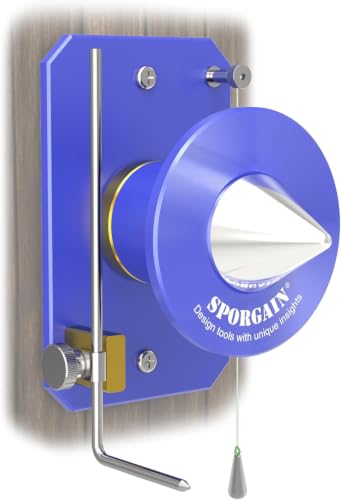
The SporGain Lawn Mower Blade Balancer is a dedicated benchtop blade-care tool designed to verify static balance across a wide range of rotary mower blades. Measuring 6.5 by 4.25 by 5.31 inches and finished in Denim Blue, the unit relies on an internal magnetic alignment system to suspend and check blades after grinding or regular seasonal maintenance. By incorporating eight powerful N52 magnets into an enclosed housing, this tool helps DIYers and equipment owners confirm that their replacement, mulching, or high-lift blades are evenly weighted prior to reinstallation.
This balancer is primarily suited for homeowners, property managers, and DIY small-engine maintenance enthusiasts who service their own push mowers, lawn tractors, or zero-turn mowers. Imbalanced blades frequently create severe deck vibration, which can lead to premature wear on spindle bearings, deck welds, and engine components. For buyers who sharpen their blades at home, an accessible magnetic balancer provides a critical quality-check step before mounting hardware is torqued back into place.
A notable design feature is the tool's hidden magnetic structure, which nests eight N52 magnets securely inside the alignment hub. Rather than exposing bare magnetic surfaces to metal shavings, filings, and abrasive grit from sharpening, the enclosed configuration protects the magnets while maintaining sufficient magnetic pull to support the blade. Paired with this is an infinitely adjustable centering mechanism, which the manufacturer states fits blades of most center-hole dimensions without needing distinct stepped adapters or loose plastic rings.
Practical ownership of the SporGain balancer requires minimal preparation, but buyers should ensure the device sits on a completely level, vibration-free surface during inspection. In standard operation, a clean, deburred blade is positioned onto the adjustable hub where the magnets engage the steel core. If one side dips, material must be incrementally removed from the heavy side until horizontal equilibrium is achieved. Blades should always be inspected when disengaged and disconnected from the mower, adhering strictly to machine safety guidelines.
While the infinitely adjustable hub provides broad versatility, the product documentation does not specify the precise minimum or maximum inner-diameter tolerances for uncommon or proprietary center holes. Prospective buyers with oversized commercial hubs or unusual star patterns should double-check physical compatibility before purchasing. Overall, for operators seeking an accessible, magnet-assisted balance tool for standard residential and light-duty commercial blades, the SporGain balancer offers practical workshop utility at a modest profile.
The SporGain balancer relies on an internal array of eight N52 neodymium magnets to hold mower blades securely on the alignment axis. Neodymium magnets of the N52 grade provide a dense magnetic field, ensuring that standard carbon steel and hardened mower blades remain firmly seated while pivoting freely for static balance checks.
By enclosing the magnets within a hidden design, the tool minimizes direct exposure to abrasive grinding dust, metal filings, and ambient moisture. This design choice helps protect the magnets from physical chipping and ensures smooth rotation when assessing horizontal level across the blade wings.
Unlike static cone balancers that require specific stepped increments, the SporGain tool features an infinitely adjustable alignment mechanism. This setup is designed to accommodate various center-hole configurations found across walk-behind, lawn tractor, and zero-turn mower decks without relying on interchangeable adapter bushings.
While the mechanism is engineered to seat most common round and shaped center holes, buyers should note that exact diameter boundaries are not listed by the manufacturer. Ensuring that the blade is cleaned of caked grass, dirt, and loose paint before mounting is essential for obtaining smooth, repeatable balance readings on the adjustable spindle.
Using a blade balancer is a vital safety and maintenance procedure that prevents rotational imbalance from damaging spindle assemblies, mower decks, and engine crankshafts. Blades should only be balanced after the lawn mower has been completely shut down, the spark plug boot disconnected, and the blade safely removed following manufacturer torque and safety procedures.
Care for the SporGain balancer itself involves keeping the unit clean and storing it in a dry workshop environment. Wiping away fine steel filings with a non-magnetic cloth after each sharpening session prevents buildup around the hub, preserving the smooth movement of the balancing mechanism over time.

Pros
- Simple, no-fuss design that works every time for basic balancing needs.
- Metal build feels solid and should hold up to years of garage use.
- Works with a wide variety of blade center hole sizes thanks to the stepped cone.
- Costs less than a coffee and delivers real performance improvement.
Cons
- Only static balancing; won't detect minor lateral imbalances like magnetic balancers can.
- May not fit blades with non-circular or odd-shaped center holes (e.g., some mulching or gator blades).
- Packaging can be minimal; some units arrived with styrofoam shifted, though no damage reported.
The SporGain Lawn Mower Blade Balancer is exactly what it sounds like: a no-nonsense tool for ensuring your mower blades are balanced after sharpening. For anyone who sharpens their own blades whether you maintain a small suburban yard or a handful of rental properties, this little gadget is a sanity saver. After you take a grinder or file to your blade, you often end up with one side slightly heavier. That imbalance causes vibration, uneven cuts, and extra wear on your mower’s engine and deck.
This balancer solves that problem simply. You set the blade on the tapered metal cone, and the heavy side drops down. Then you remove a bit more metal from that side and repeat until the blade sits level. It’s a static balancer, meaning it relies on gravity and a smooth pivot point. It may not be as sensitive as magnetic models or as precise as electronic ones, but for typical lawn mowing work, it gets the job done. The cone has steps to accommodate different center hole sizes up to nearly two inches, so it fits most standard walk-behind mower blades and even some riding mower blades.
Build quality is impressive for the price. The base and cone are made of metal, not plastic, so they won’t crack or warp. It’s small enough to toss in a tool bag or leave in a drawer. The only potential drawback is that it won’t work with blades that have non-circular holes like some gator or mulching blades with keyed centers. Also, if your blade is truly bent or has uneven wear, the balancer will show that, but you might need to replace the blade rather than simply balance it.
In real-world use, this balancer makes a noticeable difference. Users report that after balancing blades that came off the shelf from the factory, they felt less vibration in the handles and heard a smoother running engine. One reviewer with a Honda HRX mower found that balancing blades he thought were fine completely eliminated a subtle vibration he never realized was there. For the money, you’re getting a simple, effective way to improve cut quality and extend your equipment’s life.
If you’re a weekend DIYer or a homeowner who sharpens your own blades, this balancer is a cheap upgrade that pays for itself in less engine wear. Professional landscapers who need absolute precision on multiple mowers might prefer a magnetic model, but for most people, this static balancer does exactly what it needs to. A solid buy.
Product Dimensions: 2.4 x 2.4 x 2.1 inches
Item Weight: 3.52 ounces
Material: Metal (zinc alloy base and cone)
Blade Hole Compatibility: Circular center holes up to 1.97 inches (largest step)
Base Diameter: 2.36 inches
Color: Silver
Includes: One blade balancer only
Pros
- Adjustable 15-degree to 45-degree sharpening range matches factory bevel specifications on diverse mower blades
- Accommodates standard blade widths from 1.65 inches up to 3.60 inches
- Includes a dedicated zinc alloy blade balancer to inspect rotational balance before reinstallation
- Sturdy high-density aluminum alloy jig with four guide pins for angle grinder adaptability
- Thumb-screw adjustments allow fast angle and clamp setup without specialized tools
Cons
- Requires an external angle grinder and compatible grinding or flap discs that are not included
- Sharpening jig setup and grinding technique require user attention to maintain uniform material removal
- Listing does not specify curved or complex mulching blade contour clearance limits
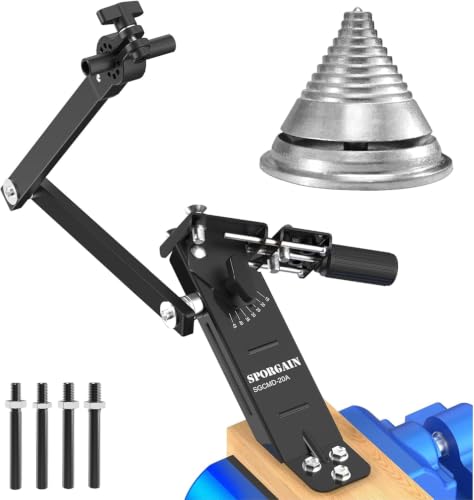
The SporGain Lawn Mower Blade Sharpener and Blade Balancer Kit is a specialized blade-care station designed for homeowners, DIY mower mechanics, and property maintenance operators who want to sharpen and inspect their own cutting decks. Rather than relying on freehand grinding or bench stones, this kit combines an angle-grinder sharpening jig with a dedicated cone-style balancer. It is particularly well suited for operators maintaining walk-behind push mowers, commercial zero-turn decks, lawn tractors, or riding mowers who already own a compatible angle grinder and prefer maintaining OEM blade bevel angles in their own garage or workshop.
At the core of the setup is an aluminum alloy sharpening guide equipped with 15-degree to 45-degree angle adjustability. This wide angle range allows users to match original factory bevel specifications across different mower blade styles, whether servicing high-lift bagging blades, standard side-discharge blades, or low-lift configurations. The jig secures blades ranging from 1.65 inches to 3.60 inches in width, holding the steel firmly in place while an angle grinder tracks smoothly along precision-machined bushings. By utilizing knurled thumb screws, the clamp and guide bushing can be adjusted by hand, eliminating the need to search for separate hex keys or wrenches during setup.
Complementing the sharpener is a standalone zinc alloy lawn mower blade balancer tool. Checking static balance is essential after removing steel during the grinding process, as an uneven blade can introduce excessive vibration, leading to premature spindle bearing wear, cracked decks, or engine fatigue. To support varied workshop gear, the kit includes four separate guide pins designed to fit the mounting collars of most standard angle grinders. This broad guide-pin compatibility ensures the tool can interface with widely available commercial and DIY grinding tools without specialized adapters.
Constructed from high-density aluminum alloy, the guide fixture is engineered to resist flexing while maintaining low assembly weight. Its package dimensions measure 8.86 by 3.46 by 13.58 inches, making it easy to store on a workshop shelf or mount to a workbench corner. While the fixture significantly reduces guide wobble compared to handheld freehand grinding, buyers must note that it does not include the angle grinder, abrasive flap discs, or grinding wheels. Additionally, while flat cutting edges are easily indexed within the 1.65-inch to 3.60-inch clamp, highly curved or multi-stepped mulching blades may require careful positioning to ensure full bevel contact along the entire cutting edge.
For property owners and lawn-care enthusiasts seeking consistent edge geometry without the steep cost of a commercial dedicated blade grinder, the SporGain combo kit delivers sensible functionality. Routine mower maintenance is made substantially safer and more predictable when blades are properly beveled and verified for balance before reinstallation. Buyers should always observe proper lawn-equipment safety by disconnecting spark plug wires or battery packs before removing blades, wearing suitable eye and hearing protection during grinding, and following mower manufacturer torque specifications when mounting freshly sharpened blades back onto the spindle assembly.
The SporGain sharpener features an adjustable tilt mechanism that operates across a 15-degree to 45-degree angle spectrum. This range allows DIY users to closely duplicate original factory edge angles recommended by lawn mower manufacturers. Most standard lawn mower blades utilize a 30-degree cutting bevel, but specialized commercial or low-lift models can vary significantly.
Blade retention is managed via an adjustable clamp that supports blade widths between 1.65 inches and 3.60 inches. Tool-free thumb screws secure both the blade stock and the angle grinder bushing guide, enabling swift adjustments between successive blade edges without requiring shop wrenches.
Included alongside the sharpening jig is a precision-molded zinc alloy static blade balancer. After grinding cutting edges to remove nicks and restore sharpness, balancing the blade on the center cone verifies equal weight distribution across both cutting wings. A balanced blade prevents rotational vibration that can otherwise damage deck spindles and engine crankshafts.
Routine maintenance of the fixture requires wiping down metal shavings and debris from the guide bushings after each use. Applying a light machine lubricant to the sliding surfaces helps prevent friction wear and keeps adjustments moving smoothly over extended seasonal service.

Pros
- Adjustable sharpening angle (15°-45°) covers most common mower blades.
- Magnetic balancer is quick to use and provides accurate results.
- Solid build quality with metal components and ball bearings for durability.
- Easy to set up and use, even for beginners with no prior sharpening experience.
Cons
- May not accommodate very large or unusually shaped mower blades due to fixed mounting design.
- Magnetic balancer works best on flat, clean blades; debris or heavy rust can affect accuracy.
- Price is higher than simple sharpening guides, but the combo adds balancing capability.
The SporGain Lawn Mower Blade Sharpener & Balancer Combo Kit is a dual-purpose tool set designed for homeowners and DIYers who want to keep their mower blades in top shape without relying on a shop. This kit includes an adjustable blade sharpener and a high-precision magnetic balancer, both made with solid materials that feel substantial in hand.
For real-world performance, the sharpener’s 15° to 45° adjustment range lets you match the factory bevel on most push mower and riding mower blades. The ball-bearing mechanism allows smooth, controlled strokes, and the enlarged handle gives good leverage. After sharpening, the magnetic balancer quickly shows if the blade is off-center, which helps prevent vibration and uneven cutting. Users typically see a cleaner lawn and less strain on the mower engine after using this combo.
Build quality is a highlight here. The sharpener is made from thick aluminum alloy with sealed ball bearings, and the balancer uses strong N52 magnets to hold the blade securely. Both tools feel rugged enough for regular use in a garage or shed. The magnetic balancer has a hidden magnet design that avoids interference, and the sharpener’s clamping mechanism holds blades firmly without slipping.
One realistic drawback is that the sharpener’s clamping range may not accommodate very wide or oddly shaped aftermarket blades. Also, the magnetic balancer requires a clean, flat blade surface for accurate results; heavy rust or debris should be cleaned off first. These are minor trade-offs for a tool set that otherwise performs very well for its intended audience.
Overall, the SporGain Lawn Mower Blade Sharpener & Balancer Combo Kit is a smart buy for anyone who mows regularly and wants to extend blade life while improving cut quality. It’s especially useful for homeowners with a few acres, or DIYers who maintain multiple mowers. The combination of adjustable sharpening and magnetic balancing saves time and delivers professional-level results without a steep learning curve.
Pros
- Highly precise balancing improves mower performance and extends blade life
- Hidden magnets enhance safety during use and storage
- Adjustable design works with a wide range of mower blade types
- Simple operation suitable for beginners and experienced users alike
- Compact size for easy storage in a garage or shed
Cons
- May require careful handling to ensure magnets don't attract metal debris
- Not suitable for blades with non-standard or very small hole sizes
- Price point may be higher than basic blade balancers
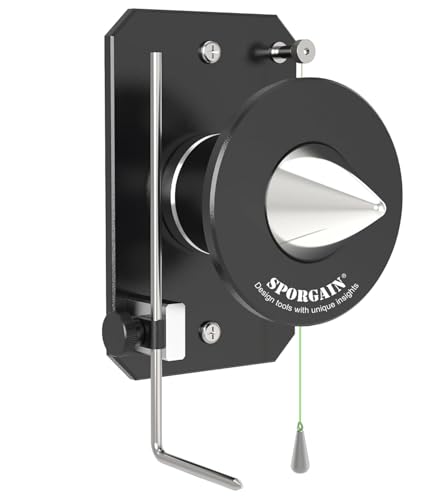
The SporGain Lawn Mower Blade Balancer is a precision tool designed for homeowners, suburban lawn owners, and DIY enthusiasts who want to keep their mower blades in top condition. This balancer uses advanced finishing processes to ensure extreme accuracy, helping reduce vibration and improve cutting performance on push mowers, self-propelled mowers, and riding mowers. It is particularly well-suited for budget-conscious shoppers and first-time mower buyers who want a reliable blade maintenance solution without complicated setup.
In terms of lawn care performance, this balancer focuses on blade sharpness and balance, which directly affects cutting quality and grass handling. A well-balanced blade reduces mower vibration, leading to a cleaner cut and less stress on the engine. While the balancer itself doesn't handle mulching, bagging, or side discharge, it supports these functions by ensuring the blade operates optimally. The hidden magnetic design with 8 N52 magnets allows for safe and efficient blade alignment, making it easy to check and correct balance before each mowing session.
Build quality is a strong point for this product. The SporGain balancer features precision craftsmanship with durable materials, and the magnets are embedded to prevent interference with other tools. The infinitely adjustable mechanism fits blades with most hole sizes, eliminating the need for adapters or extra tools. This design is practical for homeowners who maintain multiple mowers or different blade types. The compact dimensions (6.5 x 4.25 x 5.31 inches) make it easy to store in a garage or shed.
Ease of use is a key advantage. The operation process is straightforward, requiring no specialized technical knowledge. Users simply place the blade on the balancer, adjust the mechanism to fit the hole, and check for balance. This simplicity is ideal for elderly users or those new to lawn care maintenance. The tool also comes with responsive customer support, with the company committed to answering questions within 24 hours.
Realistic limitations include the need to keep the balancer clean and free of metal debris, as the strong magnets can attract particles. Additionally, some users with very small or non-standard blade holes may find the adjustment range insufficient. The price point is higher than basic balancers, but the precision and adjustability may justify the cost for regular users.
Overall, the SporGain Lawn Mower Blade Balancer is a practical investment for homeowners and lawn care enthusiasts who value cutting performance and mower longevity. It works well for suburban lawn maintenance, rural property upkeep, and seasonal blade care. For those seeking a reliable, user-friendly tool to maintain blade balance without extra hassle, this product offers solid value.

Pros
- Hands-free magnetic retention simplifies blade balance checks without cumbersome clamps
- Sturdy all-steel body with a durable powder-coated finish resists shop wear
- Functions as a direct aftermarket alternative to standard 42-047 and 339075B balancing tools
- Wall-mounted configuration keeps testing surfaces elevated and clear of benchtop debris
Cons
- Requires a plumb and rigid vertical mounting surface to deliver an accurate balancing read
- Mounting fasteners and wall-attachment hardware are not explicitly documented in the product specifications
- Blades with non-ferrous composition or specialized non-standard center geometries may not mount properly
The muge racing Red Magnetic Wall Mount Lawn Mower Blade Balancer is a workshop maintenance fixture engineered to check the dynamic balance and straightness of rotary mower blades. Serving as a functional replacement for standard shop balancer models 42-047 and 339075B, this wall-mounted unit provides a dedicated station for evaluating blades after routine sharpening, edge dressing, or debris impacts.
This balancing fixture is best suited for DIY homeowners, residential property maintainers, and commercial landscape operators who maintain their own cutting equipment. Whether servicing blades from walk-behind push mowers, lawn tractors, or zero-turn riding mowers, maintaining equal weight distribution along the cutting plane is essential for clean turf clipping and smooth machinery operation.
Constructed from heavy-duty steel with a red powder-coated exterior, the fixture measures 8.27 inches long, 6.3 inches wide, and 4.72 inches deep. The central operational feature is its magnetic holding mechanism. When a blade is positioned on the centering cone shaft, the magnetic assembly slides forward to retain the blade firmly in place. This allows the operator to release the blade entirely to observe whether one cutting wing dips lower than the other due to uneven material removal during sharpening.
Proper blade balancing directly protects spindle bearings, deck housings, and engine crankshafts from destructive high-speed harmonics. Operating an out-of-balance blade introduces continuous vibration that accelerates mechanical fatigue and causes uneven lawn cutting heights. By replacing makeshift nail-in-the-wall checks or plastic tabletop cones with a magnetically secured steel cone, users can verify balance quickly and repeatably before reinstalling the cutting deck.
When planning workshop installation, buyers should note that this unit requires a secure, perfectly plumb vertical wall or post mount to provide accurate balance readings. Fastener details are not explicitly itemized in the listing specifications, so users should supply appropriate heavy-duty screws or lag bolts suited for their specific wall structure. Always follow mower manufacturer safety guidelines when removing, sharpening, and reinstalling blades, including disconnecting the spark plug and adhering to recommended fastener torque specifications.
The manufacturer identifies broad compatibility for this balancer across major residential and commercial lawn mower blade brands, including Stihl, Troy-Bilt, Husqvarna, and similar standard rotary configurations. It matches the functional pattern of industry-standard replacement models 42-047 and 339075B, making it familiar to anyone accustomed to commercial shop service tools.
Operating the fixture follows a simple mechanical sequence. Once the balancer is firmly anchored to a vertical surface, the mower blade center hole is aligned over the cone shaft. Pulling the magnetic center forward locks the steel blade against the mounting plate, allowing hands-free visual assessment of levelness and blade straightness without needing supplemental clamps.
Featuring a heavy-duty steel body treated with a red powder coat, this balancer is built to withstand workshop and utility shed environments. The coated finish helps protect the underlying steel from surface rust and workshop grime commonly encountered around lawn equipment maintenance areas.
With physical dimensions of 8.27 x 6.3 x 4.72 inches, the unit maintains a compact profile that does not obstruct tool movement. Installing the balancer at eye level on a sturdy wall stud provides an optimal viewing angle for detecting subtle blade tilts while keeping heavy cutting blades safely off crowded workbenches.
Assembling and Optimizing a Wall Mounted Mower Blade Station
A dedicated wall mounted mower blade setup provides a permanent, gravity-referenced inspection station that streamlines rotary blade maintenance for residential yards and commercial properties alike. Mounting the balancing fixture securely to a workshop wall eliminates workbench wobble, isolates precision bearings from loose metal grit, and allows you to read blade level at exact eye height. By incorporating heavy-duty magnetic brackets, adjustable cone shafts, and nearby sharpening jigs, you create an organized workflow that prevents vibration-related spindle damage and delivers cleaner turf cuts.
The Mechanics of Wall-Mounted Magnetic Balancers
Magnetic wall balancers rely on permanent magnets and precision ball bearings to support rotary blades with minimal rotational friction. Traditional static cones rest on a bench pin where surface drag can obscure subtle weight differences between cutting wings. In contrast, wall-mounted units such as those replacing OEM numbers 339075B and 42-047 utilize strong embedded magnets to hold the blade firmly against a floating collar. This suspended orientation isolates the blade center point, allowing gravity to pull the heavier side downward without mechanical drag.
When a rotary blade achieves proper balance, it settles into an exact horizontal plane on the magnetic face. If one cutting wing carries excess steel or uneven weld material, that heavier end rotates downward toward the floor. Advanced magnetic designs incorporate hidden N52 magnets housed behind protective faceplates to ensure consistent magnetic pull across the hub area. Because the center spindle floats on low-friction bearings, slight differences in metal weight create visible deflection, helping you identify which wing requires additional grinding.
Balancing fixtures are typically fabricated from heavy-duty steel and finished with corrosion-resistant powder coatings. The central cone shaft must remain concentric with the bearing housing to prevent false runout readings during inspection. Some specialized setups also feature infinitely adjustable centering mechanisms that seat securely into varying hub diameters without loose adapters. Understanding this mechanical foundation ensures that your shop measurements reflect actual blade dynamics rather than mounting errors.
Selecting the Proper Wall Location and Mounting Sequence
Choosing the right physical spot in your workshop or shed directly influences measurement accuracy and tool longevity. The mounting surface must be completely plumb in both vertical axes, as an inclined wall will cause blades to tilt or slip away from the magnetic faceplate. Solid wood wall studs, thick plywood tool boards, or concrete masonry walls provide the necessary rigidity to support heavy commercial blades without flexing. Installing the fixture approximately at eye level allows you to sight across the horizontal cutting plane without straining your neck.
Proximity to grinding equipment requires careful consideration during workstation planning. While keeping your balancer near your sharpening bench speeds up balancing cycles, grinding sparks and airborne steel filings present a serious hazard to magnetic components. Strong magnets naturally draw metallic grinding dust, which can migrate into bearing races or coat the magnetic face, throwing off calibration. Positioning the wall bracket a few feet away from direct grinding streams or using a simple protective cover preserves smooth bearing rotation.
Securing the base plate firmly requires heavy-duty fasteners matched to your specific wall construction. Most commercial-style replacement brackets feature pre-drilled mounting flanges that accept standard wood lag screws or masonry anchors. Before driving fasteners home, place a spirit level against the balancer mounting plate to confirm vertical alignment. Tightening the hardware securely prevents minor shifting during blade attachment and ensures that every balancing test operates from an identical baseline.
Center-Hole Geometries and Spindle Compatibility
Rotary mower blades feature a wide variety of mounting hole patterns depending on deck manufacture, brand, and spindle design. Standard wall-mounted magnetic fixtures are engineered to support circular center holes measuring from 5/16 of an inch up to 1-1/2 inches in diameter. The tapered cone shaft centers round openings automatically, positioning the blade mass over the internal ball-bearing assembly. This broad dimensional compatibility makes standard magnetic fixtures suitable for common walk-behind mowers, lawn tractors, and commercial zero-turn equipment.
Proprietary mounting patterns present distinct considerations for magnetic wall fixtures. Many residential mowers utilize 5-point star, 6-point star, or irregular keyed mounting holes to prevent blade slippage on the mower deck spindle. While these non-circular patterns may not seat fully down a conical arbor, the flat face of the magnetic collar often grips the surrounding hub plate securely. As long as the centering cone stabilizes the blade concentric to the rotational axis, magnetic retention allows accurate level readings across non-standard center shapes.
When mounting specialty blades, verifying contact between the hub surface and the magnetic faceplate is vital. Some heavily contoured mulching blades feature raised reinforcing ribs or offset center hubs that prevent flush contact with flat magnetic plates. In such instances, stepped cone balancers or adjustable centering mechanisms may provide a more reliable physical index than flat magnetic surfaces. Always verify that the blade sits perpendicular to the balancer shaft before relying on horizontal alignment readings.
Magnetic Wall Balancers Compared to Static Cone Balancers
Benchtop static cone balancers represent a simple and economical way to check blade balance after sharpening. These tools employ a tiered metal or plastic cone resting on a vertical pivot pin, relying on gravity to tilt the blade toward the heavy side. While static cones are portable and occupy minimal space, they require a completely level workbench and are susceptible to friction drag where the center pivot meets the cone cup. Light imbalances may not overcome this pivot friction, leading users to believe an uneven blade is balanced.
Wall-mounted magnetic setups eliminate pivot friction by utilizing precision radial ball bearings that spin freely under the weight of heavy steel blades. Suspending the blade vertically against a magnetic face also makes horizontal alignment obvious at a glance against horizontal room references. Furthermore, wall brackets remain permanently fixed in an exact vertical plane, eliminating the need to re-level a portable cone fixture each time you clear space on a crowded work table.
The primary tradeoff between the two designs involves installation effort and shop space allocation. Static cone balancers require zero installation and store easily inside a standard toolbox drawer between seasonal tune-ups. A magnetic wall bracket demands dedicated wall real estate and permanent mounting hardware. For property owners maintaining multiple mower decks or sharpening blades frequently, the speed, sensitivity, and repeatable accuracy of a wall setup justify the dedicated mounting space.
Integrating Sharpening Jigs into Your Maintenance Workflow
Balancing forms only one half of comprehensive blade reconditioning, making the pairing of sharpening jigs and wall balancers highly practical. Dedicated sharpening assemblies holding an angle grinder or file at fixed bevels between 15 and 45 degrees ensure consistent cutting angles along the entire edge. By maintaining a uniform grinding angle, you avoid creating uneven bevel profiles that complicate weight distribution across the blade wings. Sharpening jigs designed for blade widths between 1.65 and 3.60 inches accommodate everything from lightweight push mower blades to extra-thick commercial cutters.
A disciplined workflow involves alternating between the sharpening jig and the magnetic wall balancer in rapid stages. After establishing a clean cutting bevel on both wings, place the blade onto the wall mount to identify the heavier end. Rather than grinding away the freshly sharpened cutting edge, correct the imbalance by removing metal from the rear sail or trailing edge of the heavy wing. This technique preserves your newly formed cutting geometry while bringing the overall blade mass into precise horizontal balance.
Maintaining heavy-duty commercial equipment highlights the value of this integrated setup. Operators servicing rugged configurations like commercial scag replacement blades frequently encounter thick steel profiles that demand substantial stock removal after striking turf debris. Having a rigid wall mount directly adjacent to your grinding jig allows you to perform incremental material checks in seconds. This prevents aggressive over-grinding, extends blade service life, and guarantees smooth deck operation before you ever bolt the hardware back into place.
Diagnosing Imbalance Symptoms and Structural Blade Defects
Operating an unbalanced mower blade introduces severe harmonic vibrations that resonate through the spindle housing, deck shell, and drive belts. Over time, these cyclic shock loads accelerate bearing play, loosen mounting bolts, and can even cause metal fatigue cracking in the mower deck stamping. Uneven cutting edges also create inconsistent tip speeds and irregular airflow lift beneath the deck, resulting in patchy turf appearance and straggling uncut grass blades. Regularly verifying blade balance on a wall mount eliminates these preventable mechanical stresses.
A magnetic balancer also serves as a quick diagnostic gauge for detecting bent or warped blades. When you place a blade on the arbor and rotate it 180 degrees, the cutting tips should track through the exact same vertical plane against an adjacent wall reference line. If one tip tracks visibly higher or lower than the opposite end, the blade has suffered vertical bending from an impact with a rock or root. Bent blades create dangerous deck interference and uneven cutting heights, and they cannot be corrected simply by grinding away surface steel.
Recognizing when a blade has reached the end of its serviceable lifespan is an essential safety responsibility. Excessive thinning of the lift sail from sandy soil abrasion, deep impact gouges, or cracks radiating from the center hole indicate structural compromise. In those situations, attempting to balance the blade is hazardous, and installing trusted aftermarket mower blades is the appropriate remedy. Routine wall balancer checks allow you to monitor ongoing metal loss and retire compromised blades before structural failure occurs.
Maintenance and Care for Magnetic Balancer Fixtures
Maintaining a wall-mounted blade balancer ensures that the tool delivers sensitive, trustworthy readings across multiple mowing seasons. Because powerful magnets attract stray steel shavings, you should periodically wipe the magnetic faceplate clean with a stiff brush or shop rag. Allowing metal debris to accumulate on the magnetic poles creates an uneven seating surface, causing blades to sit crookedly on the spindle shaft and producing inaccurate balance indications.
The internal ball bearings require occasional inspection to guarantee friction-free rotation. Avoid spraying standard penetrants or heavy greases into open bearing gaps, as wet lubricants tend to trap fine grinding dust and eventually turn into abrasive sludge. If bearing motion feels gritty or hesitates during free rotation, clean the assembly using compressed air or an electrical contact cleaner that evaporates cleanly. A freely spinning bearing assembly is essential for detecting the subtle weight differences that separate an acceptable blade from a truly balanced one.
Inspect the mounting fasteners and structural bracket annually to confirm that seasonal temperature shifts have not loosened the assembly. Powder-coated steel brackets resist rust effectively in unconditioned garages, but bare metal contact pins benefit from a very light dry-film lubricant wipe. Keeping the fixture rigid, clean, and properly calibrated ensures that every blade passing through your shop returns to service in optimal mechanical condition.
Workshop Safety and Proper Blade Handling Procedures
Servicing mower blades involves sharp cutting edges, substantial magnetic clamping forces, and high-speed rotary tools, making safety protocols imperative. Before removing blades from your mower, always disconnect the spark plug boot or remove the electric safety key to prevent accidental engine starting. Use a dedicated blade lock clamp or wooden block to immobilize the cutter bar while breaking loose stubborn spindle bolts with a heavy socket.
Handling sharpened steel around high-strength neodymium magnets requires deliberate physical control. The magnetic pull of modern commercial wall balancers snaps heavy blades firmly onto the arbor, which can pinch unprotected fingers if you guide the blade carelessly. Wear heavy leather work gloves and grip the center body of the blade rather than placing hands near the sharp outer cutting wings during placement and removal.
Once balanced, reinstall the blade onto your mower spindle following the equipment manufacturer’s exact hardware orientation and torque specifications. Ensure that curved lift wings face upward toward the underside of the mower deck, and tighten spindle fasteners using a calibrated torque wrench rather than guessing tightness. A properly balanced blade mounted securely to a clean spindle adapter protects your outdoor equipment investment and delivers dependable cutting performance all season long.
Establishing a dedicated wall mounted mower blade setup transforms routine blade maintenance from an uncertain chore into a precise, repeatable workshop routine. By pairing a rigidly mounted magnetic balancer with disciplined sharpening techniques, you protect mower spindles from destructive vibration and promote crisp, healthy turf growth. Taking the time to verify center-hole fitment, keep magnetic contact surfaces clean, and follow conservative safety practices ensures your cutting deck operates smoothly through every pass across the yard.



Write Your Review
No reviews yet. Be the first to share your experience!