


Clearing a blanket of soaked autumn leaves off a lawn requires substantial physical force, yet blower specifications often leave property owners puzzled by competing numbers. Manufacturers routinely advertise high airflow volume alongside rapid airspeed, forcing buyers to ask what’s more important in a leaf blower cfm or mph before making an investment. Air volume, measured in cubic feet per minute (CFM), indicates the total quantity of air exiting the nozzle, while miles per hour (MPH) measures how fast that air stream travels. Balancing these two measurements determines whether a handheld or backpack machine pushes massive piles or merely scatters loose twigs across the driveway. Selecting the right combination ensures that seasonal yard cleanup finishes quickly without stalling out against dense, matted ground cover.
Property owners tackling expansive turf often consult a guide on choosing a leaf blower for larger properties to understand how airflow ratings translate to physical workload. While rapid airspeed scours stubborn dirt and wet debris off hardscape surfaces, broad air volume sustains the momentum needed to herd wide swaths of foliage into collection rows. Cordless battery platforms from brands like Greenworks, POIFL, and Seesii now combine high CFM ratings with multi-speed controls to handle both delicate flowerbeds and heavy debris mats. Reviewing the core mechanical trade-offs between air volume and air speed allows you to match your equipment directly to your property layout and seasonal foliage demands.


Pros
- Gas-equivalent power in a cordless package - no fumes, no pull cords, no maintenance.
- Lightweight and well-balanced at 5.29 pounds, making it easy to handle for long jobs.
- Quiet enough for residential use without disturbing the peace.
- Fast charging (5A) and solid 50-minute runtime on a single battery pack.
- Variable-speed trigger with turbo boost gives you on-demand power for tough spots.
Cons
- Only one 2.5Ah battery included - for very large properties, you may want an extra battery for uninterrupted work.
- The 5.29-pound weight is light, but the blower's power might feel a bit much for smaller or elderly users on extended sessions.
- No mention of a shoulder strap or harness included, which could help reduce fatigue during long cleanups.
The Greenworks 60V cordless leaf blower is a serious contender for anyone looking to ditch the gas can and still get real power on their property. This isn't a toy blower - with 610 CFM of airflow and a 130 MPH turbo mode, it's right up there with 26cc gas models in terms of raw clearing ability. The brushless motor is the key here: it's quieter, lighter, and way more efficient than a gas engine, plus you never have to mess with fuel or pull cords.
For the DIY homeowner or property manager who deals with wet leaves, dense gravel, or packed-down debris on driveways and sidewalks, this blower is a solid pick. The variable-speed trigger gives you fine control for lighter tasks like blowing off grass clippings, while the turbo button kicks in that extra 30% power for the nasty stuff. And the cruise control lock is a nice touch for long stretches of cleanup without holding down the trigger.
At 5.29 pounds, it's genuinely lightweight - you can hold it one-handed without much fatigue. The ergonomic design is noticeable, especially compared to some bulkier gas blowers. Runtime is solid at about 50 minutes on the included 2.5Ah battery, though if you have a big yard with heavy debris, you'll probably want a second battery to keep going. The 5A rapid charger is fast, so you're not waiting long between packs.
Build quality feels good for the price point - the plastic housing is tough, and the concentrator nozzle is a nice bonus for getting into tight spots or blasting through wet leaves. The only real downside is that it's a single-battery kit, so for larger properties, you might want to grab an extra 60V battery from the Greenworks ecosystem. Also, while it's quiet for a gas blower, it's still a leaf blower - so don't expect whisper-quite operation on turbo.
Overall, this is a solid buy for homeowners, DIYers, and anyone who wants gas-level power without the gas hassle. It's easy to start, easy to use, and easy to maintain. If you're already in the Greenworks 60V platform, it's a no-brainer. If not, it's still a great entry point for a powerful cordless yard tool.

Pros
- Strong airflow rivaling many gas blowers but without the noise, fumes, or pull-start hassle.
- Lightweight and well-balanced design makes one-handed operation easy and comfortable for long sessions.
- Dual battery setup means you can swap packs and keep working with minimal downtime.
- Turbo mode provides instant extra power for stubborn debris without needing to change settings.
Cons
- Batteries and charger are proprietary to the SEESII platform, so you can't share packs with other major brand tools.
- Runtime on high or turbo mode is notably shorter than the advertised 90 minutes; heavy use may require careful battery management.
- No variable-speed trigger; you must use preset speed levels, which can limit fine control for delicate tasks.
The SEESII 40V cordless leaf blower is a battery-powered tool designed for homeowners and DIYers who want gas-like performance without the hassle of mixing fuel or dealing with exhaust. It pairs a brushless motor with a 650 CFM and 160 MPH output, putting it in the upper tier of cordless blowers for residential use. Whether you are clearing wet oak leaves from a lawn, blowing light snow off a driveway, or tidying up a garage, this blower aims to handle it all.
Real-world performance is strong for a battery-powered unit. On low speed you get steady airflow for sweeping patios or blowing grass clippings, while high mode easily moves wet leaves and small debris. The turbo button kicks out a surge of power that dislodges packed pine needles and even pebbles from gravel paths. The dual 5.2Ah batteries provide about 90 minutes on low, but expect around 20-25 minutes on turbo. Having two batteries and two chargers means you can keep one pack charging while you work, which is practical for larger yards.
Build quality is decent for the price point. The plastic housing feels solid enough for occasional drops, and the brushless motor should last many seasons. At 4.6 pounds it is notably lightweight, and the ergonomic handle with rubber grip reduces hand fatigue. The included shoulder strap helps distribute weight for longer use. The only ergonomic miss is the lack of a variable-speed trigger instead of preset buttons, but the touch-pad style controls are easy to use with gloves on.
Drawbacks are realistic. The battery platform is proprietary, so you cannot share packs with other brand tools. The runtime on high settings is limited, meaning you may need to plan your work around battery swaps. Also, while the blower handles light snow okay, it is not a substitute for a dedicated snow shovel. But for its intended purpose -- leaf and debris cleanup -- it performs well above its cost.
Recommendation: If you are a homeowner with a half-acre or smaller lot and want a cordless blower that can handle wet leaves, light snow, and general yard tidying, the SEESII 40V offers excellent value. DIYers who appreciate a lightweight tool with plenty of power and a practical dual-battery system will find it a solid addition to their garage. For contractors needing all-day runtime or a shared battery ecosystem, a premium brand may be better, but for most residential work, this blower gets the job done without breaking the bank.
Voltage: 40V (two 20V batteries in series)
Motor: Brushless
Max Airflow: 650 CFM
Max Air Speed: 160 MPH
Speeds: 3 preset levels plus turbo boost
Batteries Included: 2 x 5.2Ah
Chargers Included: 2
Runtime (low): Up to 90 minutes
Weight: 4.6 lbs
Dimensions: 17.32 x 10.63 x 7.68 inches
Color: Blue
Two 5.2Ah 20V batteries (used in series for 40V operation)
Two battery chargers
Shoulder strap (adjustable)
Nozzle (integrated)
User manual
Pros
- Powerful enough to move wet, heavy leaves and packed debris with ease, matching many corded or gas models.
- Long runtime with two large-capacity batteries allows you to tackle sizable yards without frequent recharging.
- Ergonomic rotating handle reduces fatigue during extended use and makes overhead or one-handed operation more comfortable.
- Brushless motor ensures durability and consistent power output over time, with less noise and vibration than brushed alternatives.
- Versatile attachment system lets you adapt quickly between open-area clearing and precision detailing work.
Cons
- Turbo mode drains a battery in about 15 minutes, so you may need to swap packs frequently for big jobs or heavy cleaning.
- Weight of 5.2 pounds can feel heavy after extended use, especially when working overhead or with one hand.
- Lacks a variable speed trigger; fixed speed modes may not offer the fine control some users want for delicate cleanup tasks.
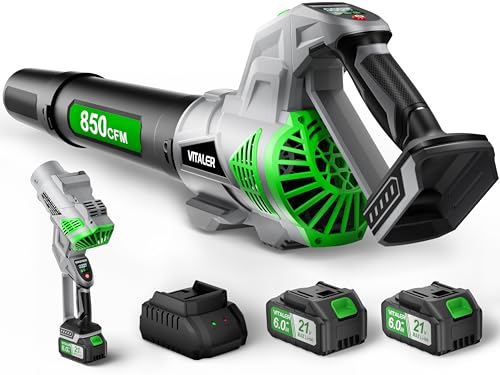
The Vitaler cordless leaf blower is a powerful handheld tool designed for homeowners, DIYers, and light contractor use who need a cordless alternative to gas blowers. With an 850 CFM airflow and 250 MPH top speed, it handles wet leaves, grass clippings, light snow, and even stubborn dirt on driveways and patios. The brushless motor is a key upgrade, offering longer life and better efficiency than older brushed designs.
In real-world use, the blower performs best in turbo mode for heavy debris, but the runtime at that setting is limited to around 15 minutes per battery pack. Fortunately, the included two 6.0Ah batteries and fast charger keep downtime minimal, allowing you to swap packs and continue. The lower speed settings are more than adequate for daily leaf clearing or drying off a car, and they significantly extend runtime up to 90 minutes total.
Build quality feels solid, with a durable plastic housing and rubberized grip sections. The 180-degree rotating handle is a genuinely useful feature, making it easy to switch from wide sweeping to vertical corners without wrist strain. The snap-on nozzles are quick to change, though they don't lock with a positive click, so they can come loose if bumped. At 5.2 pounds, it's not the lightest blower, but the balanced weight distribution helps reduce fatigue during longer sessions.
A realistic drawback is the lack of variable speed control. You get three preset modes, but no trigger to fine-tune airflow between those steps. Also, the turbo mode runtime is a limitation for large properties; you'll want to plan battery swaps. For most suburban yards and weekend tasks, however, the combination of power and convenience is impressive.
Overall, the Vitaler cordless leaf blower offers strong value for the price. It suits homeowners who want gas-like power without the noise and maintenance, and DIYers who need a reliable tool for seasonal leaf cleanup and light snow removal. The included extras and warranty make it a compelling choice for anyone in the market for a high-performance cordless blower.
Color: Silver Green
Dimensions: 17.5 x 10.6 x 5.5 inches
Weight: 5.21 pounds
Airflow: Up to 850 CFM (Turbo mode)
Speed: Up to 250 MPH
Motor: Brushless
Battery: 2 x 21V 6.0Ah
Charger: Fast charger included
Speeds: Low (500 CFM/150 MPH), Medium (750 CFM/200 MPH), Turbo (850 CFM/250 MPH)
Handle: 180-degree rotating
Warranty: 3 years
1 Blower body
1 Blower tube
1 Extension nozzle
1 Flat nozzle
2 Batteries (21V 6.0Ah)
1 Fast charger
2 Drying earplugs
1 Quick-start guide
1 User manual
Deciding Between CFM and MPH for Yard Maintenance
Determining whether cubic feet per minute or miles per hour matters more depends entirely on the type of debris covering your property. While high airspeed breaks stubborn matter free from hard surfaces, high air volume carries wide piles across turfgrass without stalling. Both ratings work together to produce total clearing force, meaning that prioritizing one metric over the other without considering your specific yard conditions can lead to frustrating cleanup sessions.
The Direct Answer: Matching Air Volume and Speed to the Task
If forced to choose a primary metric for broad residential lawn clearing, cubic feet per minute generally proves more valuable than miles per hour. A blower with high air volume moves a substantially wider swath of leaves with every sweeping pass, allowing you to herd large piles toward a compost zone or tarp quickly. When a machine produces excessive velocity but lacks volume, it punches narrow holes through leaf piles rather than sliding the entire mass forward.
Miles per hour becomes the critical specification when debris adheres tightly to flat ground or damp pavement. Soaked foliage, wet pine needles, and compacted mud require high velocity to break their surface tension before any air volume can relocate them. For driveways, paver patios, and asphalt walkways, a concentrated air stream with high velocity strips debris away cleanly where a wide, gentle breeze would simply flutter past.
Most homeowners achieve the best results by selecting a tool that maintains balanced numbers across both categories. Models like the Greenworks 60V blower pair 610 CFM with 130 MPH, providing enough speed to scrape wet surfaces alongside sufficient volume to push autumn mounds across thick lawn turf. Evaluating your dominant cleanup tasks ensures that you select equipment built for your specific physical environment.
Understanding CFM: Why Air Volume Governs Foliage Sweeping
Cubic feet per minute measures the volumetric flow of air generated by the blower fan during operation. This metric indicates how much physical air mass exits the nozzle tube every sixty seconds, creating a wide aerodynamic curtain across the lawn. A larger air curtain contacts more leaves simultaneously, which significantly reduces the total number of sweeping passes required to clear an open section of turf.
When managing expansive yards covered by mature oak or maple trees, high air volume prevents the machine from choking against deep leaf accumulation. Low volume units force the operator to work within a tight, narrow corridor, which drastically slows down seasonal property cleanup. Machines delivering between 650 CFM and 850 CFM, such as the Vitaler cordless model, provide the expansive air displacement needed to move deep autumn blankets across uneven ground.
Air volume also dictates how effectively a blower operates around sensitive landscape borders. By utilizing variable speed controls on a high-volume unit, you can float fallen leaves out of delicate perennial beds without blasting away topsoil or decorative wood chips. Modulating volumetric airflow offers the gentle pushing action necessary for precision landscaping work that extreme velocity would otherwise ruin.
Understanding MPH: Why Air Velocity Scours Stuck Surfaces
Miles per hour measures the exit speed of the air column as it leaves the blower nozzle. This speed directly influences the kinetic energy delivered to individual debris particles resting on the ground. When autumn rain drenches deciduous leaves, moisture creates a natural suction between the leaf surface and the underlying asphalt, concrete, or turf thatch.
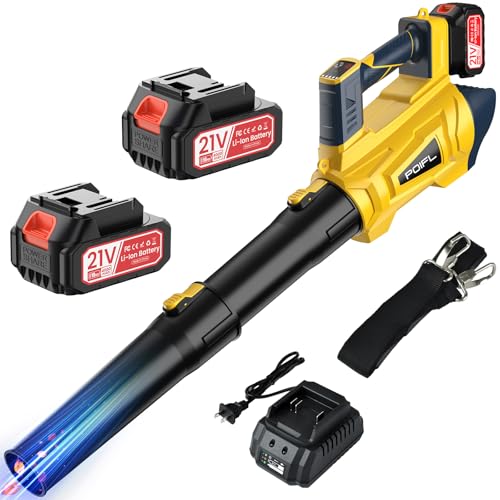
High air velocity acts like an invisible scraper, shearing underneath waterlogged foliage to break the adhesion between leaves and hardscapes. Handheld blowers engineered with speeds reaching 160 MPH to 240 MPH, such as the POIFL cordless blower, excel at stripping stubborn debris out of concrete expansion joints and textured brick pavers. Without adequate velocity, even a massive volume of air will slide over the top of stuck debris without dislodging it.
Air speed also determines how far the air stream can project before atmospheric resistance disperses its energy. A high-velocity jet maintains its structural cohesion over a longer operating distance, letting you sweep garage corners, patio furniture, and vehicle beds without standing immediately adjacent to the dirt. This projection capability adds significant utility during routine property maintenance throughout all four seasons.
The Newton Equation: Calculating True Blowing Force
Evaluating blowers by looking at air volume or airspeed alone provides an incomplete picture of actual working performance. The outdoor power equipment industry relies on blowing force, measured in Newtons, as the definitive scientific metric combining both volume and velocity. Newton force represents the true mass acceleration delivered by the airstream, calculated from the air mass flow rate multiplied by its exit speed.
A machine advertising astronomical velocity often achieves that figure through a severely restricted nozzle tip, which strangles total air volume. Conversely, an extra-wide blower tube can inflate volumetric flow figures while dropping air speed down to an ineffective crawl. Balanced commercial-grade engineering optimizes the impeller design and motor torque to sustain both high volume and high speed under load.
When comparing modern cordless handheld units, examining the motor platform clarifies how dynamic force is sustained. Brushless electric motors, such as those found in the SEESII 40V blower delivering 650 CFM and 160 MPH, produce steady torque without generating excessive internal heat. This mechanical efficiency delivers dependable clearing force across standard operating speeds, allowing users to finish extensive yard work without experiencing premature motor strain.
Wet Leaves Versus Dry Turf: Performance Under Real Yard Conditions
The texture, density, and moisture level of your yard debris dictate whether you lean on air volume or velocity during cleanup. Dry lawn clippings, dormant thatch, and crisp autumn leaves offer very little aerodynamic resistance, meaning high air volume can sweep them into neat piles effortlessly. In these dry conditions, a high-CFM setting allows you to cover wide swaths of turf quickly while running the motor at lower throttle.
Damp conditions alter yard physics dramatically by multiplying the physical weight of fallen foliage by several times. Waterlogged leaves mat together into thick, rubbery sheets that resist movement, requiring sharp bursts of velocity to break the sheet apart into manageable fragments. Once the high-speed jet fractures the mat, broad volumetric airflow must take over to push the sodden weight toward your collection boundary.
Managing complex yards with mixed ground covers also requires fine throttle modulation to prevent property damage. Blasting gravel walkways or bark mulch with peak airspeed will scatter expensive stones and bedding across the pristine turf. Using multi-speed blowers with variable triggers allows operators to dial back air speed around delicate landscaping features while reserving full velocity for resilient concrete driveways and open lawns.
Nozzle Geometry: Shifting CFM and MPH on the Fly
The shape and diameter of the blower tube play an active role in governing output airflow dynamics. Physics dictates that forcing air through a constricted opening increases its speed while reducing the total volume that can pass through each second. Many modern cordless packages include interchangeable tube attachments, giving operators the freedom to tailor the blower stream to specific outdoor chores.
Flat concentrator nozzles narrow the exit orifice, compressing the air stream to produce higher airspeed for stubborn tasks. This configuration proves ideal for scraping damp pine needles off stone steps or blowing packed leaves out of narrow gutter channels. The Greenworks 60V platform includes a dedicated concentrator nozzle that boosts velocity to 130 MPH for dislodging packed gravel debris and wet sidewalk buildup.
Wide cylindrical sweep tubes produce the opposite effect by allowing the motor to discharge maximum air volume with minimal backpressure. This wide-bore setup provides the expansive air curtain necessary for sweeping dry clippings across broad lawns after mowing. Switching between modular extension tubes, such as the two-hose system supplied with the POIFL blower, lets you shift seamlessly between focused scraping and broad property clearing.
Battery Platforms and Power Demands Under Turbo Operation
Cordless leaf blowers demand substantial electrical current from their battery packs, especially when operating at peak airflow settings. Running a blower in maximum turbo mode draws heavy amperage, which can deplete compact battery packs in ten to fifteen minutes of continuous sweeping. Understanding the relationship between battery capacity, measured in amp-hours, and motor voltage helps set realistic operational expectations.
Manufacturers frequently package multiple rechargeable packs with cordless units to provide continuous yard clearing capability. The FAOGO cordless blower incorporates two 21V batteries with a dedicated charger, enabling operators to swap packs whenever the primary cell runs low. Similarly, dual-battery systems operating in series, like the 40V SEESII platform utilizing two 5.2Ah batteries, supply the steady electrical current required to drive high-output brushless motors across extensive residential lots.
Managing battery temperature remains essential when using sustained turbo modes during demanding cleanups. Drawing high current generates heat within the lithium-ion cells, which can trigger automatic thermal protection circuits that shut down the tool temporarily to prevent cell degradation. Alternating between standard cruising speeds for routine lawn clearing and saving turbo bursts for stubborn leaf mats protects battery longevity and maximizes runtime per charge.
Equipment Maintenance and Mechanical Longevity
Maintaining consistent airflow performance across multiple seasons requires basic preventative care regardless of whether your blower uses battery power or a small gasoline engine. Electric blowers rely on unobstructed intake grates to draw ambient air into the axial fan assembly. Dust, grass clippings, and loose twigs that stick to the outer intake housing restrict air intake, which drops both CFM and airspeed while forcing the motor to run hotter.
Gasoline-powered equipment involves additional mechanical systems that require periodic seasonal servicing. Operators utilizing gas handheld or backpack units often rely on a leaf blower tune up kit to replace worn spark plugs, refresh contaminated fuel filters, and install clean air filters before autumn arrives. Stale ethanol-blended gasoline can gum up tiny carburetor passages, causing small engines to hesitate or bog down when you open the throttle for maximum blowing force.
Proper storage practices during the off-season preserve both mechanical and electrical components from premature failure. Lithium-ion batteries should be stored in a dry, temperature-controlled environment at roughly fifty percent charge rather than left fully depleted on a freezing garage shelf. Inspecting the impeller housing for cracked fan blades or compacted leaf residue before packing the tool away ensures smooth, vibration-free operation when spring yard maintenance resumes.
Ergonomics, Weight Distribution, and Operating Fatigue
Blowing large yards clear of debris often takes over an hour of continuous walking and sweeping, making tool ergonomics just as critical as raw performance metrics. Handheld blowers exert rotational torque on the operator’s wrist as the motor accelerates, which can cause significant forearm strain during long sessions. Manufacturers address this challenge by refining the center of gravity and designing handles that align with the natural angle of the arm.
Total tool weight directly impacts how comfortably an operator can maneuver around obstacles and landscape contours. Lightweight options like the POIFL model weigh only 2.2 pounds, allowing effortless one-handed control for clearing decks, porches, and patios. Heavier high-capacity tools, such as the SEESII 40V blower at 4.6 pounds or multi-battery setups, incorporate padded shoulder straps to distribute operational weight evenly across the torso and reduce shoulder tension.
Coordinating your seasonal equipment purchases with a broader lawn mower investment guide helps establish a balanced, efficient lawn care routine that minimizes physical fatigue across every weekend chore. Features like cruise control locks eliminate the need to squeeze the throttle trigger continuously, preventing hand cramps when blowing large open lawns. Ergonomic enhancements like the 180-degree rotating handle on the Vitaler blower let operators shift grip angles effortlessly when transitioning between flat driveways and awkward garden corners.
Ultimately, deciding whether CFM or MPH matters more comes down to the primary landscape challenges you face each season. For expansive lawns smothered in heavy deciduous leaf falls, prioritize air volume to sweep broad swathes of turf in fewer passes. If your routine focuses on scouring wet leaves, damp pine needles, and stuck dirt from driveways, patios, and hard surfaces, favor air velocity and focused nozzle attachments to lift stubborn debris with ease.


Write Your Review
No reviews yet. Be the first to share your experience!