


Dull cutting teeth transform an efficient timber-clearing session into a frustrating, hazardous chore that bogs down the powerhead and burns bar oil. Woodcutters processing firewood or clearing storm blowdown often notice fine wood powder instead of clean, fibrous chips when the cutters lose their edge. Learning how to sharpen a stihl chainsaw blade correctly restores cutting speed, reduces physical fatigue, and prevents severe guide bar rail scoring. Proper tooth filing also reduces the mechanical strain placed on internal engine components, which is critical for long-term two-stroke chainsaw engine maintenance during heavy bucking tasks.
A chainsaw does not use a solid rotary disc, but rather an articulated loop of drive links, tie straps, and specialized cutting teeth riding along the guide bar. Maintaining these teeth requires matching the exact round file diameter to your chain pitch, maintaining consistent filing angles, and lowering the depth gauges accurately. Operators can maintain their cutting assemblies using manual file guides, high-speed rotary stones, or dedicated bench-mounted electric grinders. Understanding the proper setup and file geometry ensures clean, straight wood cuts while significantly extending the operational lifespan of your saw chain.


Pros
- Simplifies chain sharpening by combining cutter and depth gauge filing in one step.
- Compact and easy to store in a chainsaw case or toolbox.
- Durable build quality from a trusted brand in outdoor power equipment.
- Helps maintain consistent chain performance for firewood cutting and storm cleanup.
Cons
- Only compatible with .325 pitch chains, limiting use with other chain sizes.
- Requires some practice to achieve proper filing angle and pressure.
- May not be as fast as a powered sharpener for heavy-duty or frequent sharpening needs.
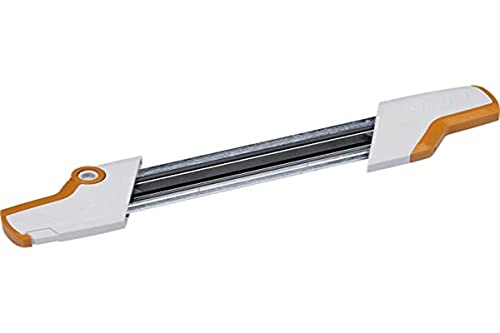
The Stihl 2 IN 1 EASY FILE CHAINSAW CHAIN SHARPENER for .325 pitch chains is a handy accessory for anyone who owns a chainsaw. This tool is designed to make chain sharpening simpler and more consistent, which is a big plus for homeowners, firewood cutters, and property owners who rely on their saw for tree trimming, storm cleanup, or pruning. Instead of using separate files for cutters and depth gauges, this 2-in-1 tool does both at once, helping you maintain a sharp chain without removing it from the bar.
For practical use, this sharpener helps keep your chain cutting efficiently. A sharp chain reduces cutting time and strain on the saw, which is especially important during longer sessions like firewood cutting or clearing storm debris. The tool is compact and easy to store in a toolbox or chainsaw case, so you can take it along for on-the-go sharpening. Many users find it straightforward to use, though beginners may need a few tries to get the filing angle right.
Build quality is solid, as expected from Stihl, a well-known brand in the chainsaw world. The tool feels durable and should hold up to regular use. It is designed for .325 pitch chains, which are common on many homeowner and farm chainsaws, making it a versatile addition to your maintenance kit. The ergonomic handle provides a comfortable grip, reducing hand fatigue during sharpening.
One limitation is that this sharpener only works with .325 pitch chains, so if you have saws with other pitches, you will need a different tool. Also, while it simplifies the process, it still requires some manual effort and practice to achieve consistent results. For heavy-duty or frequent sharpening, a powered sharpener might be faster, but for most homeowners and occasional users, this manual tool is a practical choice.
Overall, the Stihl 2 IN 1 EASY FILE is a reliable option for maintaining your chainsaw chain. It is best suited for homeowners, firewood cutters, and DIY yard workers who want an easy way to keep their saw cutting well. If you have a .325 pitch chain and want to extend its life and performance, this sharpener is worth considering. It is a practical investment for anyone who values a sharp chain for efficient yard cleanup, storm cleanup, or farm chores.
Practical Techniques and Tools for Sharpening Stihl Chainsaw Chains
Achieving a razor edge on a Stihl saw chain requires understanding cutter geometry, applying consistent stroke pressure, and maintaining precise depth gauge clearance. Casual operators frequently refer to the cutting loop as a blade, yet proper maintenance focuses on the individual chrome-plated cutting teeth linked along the guide bar. Restoring these components by hand or with dedicated workshop machinery eliminates crooked cuts and minimizes operator fatigue in the woods. Careful attention to tooth angles protects your equipment investment and keeps your saw cutting smoothly through seasoned timber.
Anatomy of a Stihl Saw Chain and Cutter Geometry
Each cutter on a modern saw chain functions like a miniature wood chisel mounted to a moving drive link. The tooth assembly consists of a curved top plate, a side plate cutting edge, a working corner where both plates intersect, and a curved gullet that channels wood chips away. When the chain rotates at high speed, the top plate slices timber fibers horizontally while the side plate severs the severed chip vertically. A sharp working corner initiates the cut cleanly, meaning even minor contact with soil or dirty bark blunts the leading edge immediately.
Timber cut with blunted teeth produces fine, powdery sawdust and excessive friction rather than thick, fibrous wood shavings. This thermal friction quickly discolors the guide bar rails and burns through bar and chain lubricant. Forcing a dull chain through a cut puts unnecessary strain on the crankshaft, clutch drum bearings, and anti-vibration rubber mounts. Maintaining sharp, evenly filed cutters allows the saw to pull itself through the timber naturally without requiring excess downward pressure from the operator.
Matching File Diameter to Chain Pitch
Stihl manufactures saw chains across distinct pitch classifications that dictate the exact round file diameter required for routine maintenance. Chain pitch represents the distance between any three consecutive rivets divided by two, commonly stamped directly on the guide bar body or the drive link tangs. Using an incorrect file diameter ruins the cutting tooth profile by creating either a deep back-cut hook or a blunt, forward-sloping face. Operators must identify their exact chain specifications before touching a file to the cutter steel.
Smaller Stihl chains, such as the 3/8-inch Picco or low-profile designs found on compact residential saws, require a 5/32-inch (4.0 mm) round file. Mid-sized powerheads operating a .325-inch pitch chain require a 3/16-inch (4.8 mm) round file to maintain the correct gullet radius. Standard 3/8-inch pitch professional chains generally call for a 13/64-inch (5.2 mm) file, while heavy-duty .404-inch chains require a 7/32-inch (5.5 mm) file. Selecting the correct diameter allows the file to sit with roughly one-tenth of its diameter extending above the top plate, establishing the ideal cutting angle naturally.
Essential Preparation and Safety Protocols Before Filing
Safe chain maintenance begins with securing the powerhead and preventing accidental engine engagement. Operators working on gasoline saws must shut off the motor, set the master control switch to the stop position, and let the muffler cool completely. If servicing modern battery-powered cordless chainsaws, remove the battery pack entirely from the housing before touching the cutting loop. Sturdy leather or cut-retardant work gloves protect hands from sharp metal burrs and razor edges while rotating the loop manually around the bar nose.
Clamping the guide bar securely in a workshop vise or a portable field stump vise provides the rigidity needed for uniform filing strokes. Operators should tighten the chain tensioning screw slightly beyond standard operating tension to prevent the cutters from rocking sideways under file pressure. Locate the shortest or most heavily damaged cutter tooth on the chain loop to serve as your master reference tooth. Marking this initial cutter with a grease pencil or chalk provides a clear reference point as you work around the bar rails.
All remaining cutters must eventually be filed down to match the overall length of this master tooth. Maintaining uniform tooth lengths prevents uneven cutting loads and eliminates chatter during high-speed bucking cuts. Skipping this step often leaves uneven teeth that cause the guide bar to bounce or pull off the intended cut line. Taking the time to establish a uniform master length ensures smooth, predictable cutting performance across the entire loop.
Manual Sharpening with Hand Files and 2-in-1 Systems
Manual filing remains the most practical method for field maintenance because it requires no electrical cords, generators, or charging stations. Position the round file inside the gullet of the master cutter, holding the file handle with both hands for maximum directional control. Standard Stihl chains generally require a 30-degree top-plate filing angle, which aligns with the witness marks laser-etched into the tooth surface. Maintain a level stroke perpendicular to the guide bar, pushing the file firmly from the inside of the tooth outward toward the cutting edge.
Lift the file cleanly away from the steel during the return stroke because dragging the file teeth backward dulls the tool quickly. Apply smooth, even pressure across two or three forward strokes, observing the chrome edge until all shiny, rounded wear marks disappear. Complete all cutters facing one direction before turning the saw around to file the opposing side. Maintaining an identical stroke count and identical pressure on both left-hand and right-hand cutters prevents the saw from drifting during crosscut bucking.
Woodcutters seeking faster manual results often utilize combined filing frames such as the Stihl 2 IN 1 EASY FILE CHAINSAW CHAIN SHARPENER. This dedicated tool houses two round files alongside a flat file within a rigid guide frame sized specifically for .325-inch pitch chains. As the operator pushes the tool across the cutter tooth, the round file sharpens the top and side plates while the flat file trims the depth gauge simultaneously. Eliminating the separate step of depth gauge measuring saves considerable time during busy firewood harvesting sessions.
Adjusting Depth Gauges for Proper Wood Penetration
The depth gauge, commonly called the raker, sits directly in front of each cutting tooth to regulate the thickness of the wood chip. As the cutting tooth is filed back over its service life, its top plate slopes downward, reducing the vertical distance between the cutting edge and the raker. If this gap becomes too shallow, the cutter cannot bite into the timber fibers, resulting in powdery dust and slow cutting progress. Standard Stihl chains require a depth gauge clearance of approximately .025 inches (0.65 mm) for general-purpose wood cutting.
Checking this clearance requires placing a progressive depth gauge tool flat across adjacent cutters along the guide bar. Any portion of the steel raker protruding through the tool slot must be filed flush using a standard flat mill bastard file. After filing the raker flat, use the file to round the leading edge of the depth gauge back to its original contoured profile. A rounded raker nose ensures smooth entry into the cut without grabbing the timber grain, which reduces kickback potential and mechanical vibration.
Rotary Attachments and Quick Field Touch-Ups
High-speed rotary tools offer a motorized alternative to hand filing for operators who want rapid material removal in a workshop or service truck. Kits like the Chainsaw Sharpening Guide with Ruler screw directly onto standard rotary tool housings to provide a fixed angle reference plate. High-speed steel grinding heads or abrasive stones spin at high velocity to regrind blunted cutters in a matter of seconds. The built-in angle guides assist the user in maintaining the correct 30-degree top-plate angle without freehand guesswork.
Operating rotary tools requires a steady hand and a gentle touch to avoid overheating the delicate cutter teeth. Excessive grinding pressure or lingering on a single tooth creates friction that discolors the metal, turning the chrome blue or black. This thermal discoloration indicates that the steel has lost its temper, leaving the cutter soft and prone to rapid dulling. Light, pulsed contact with the spinning stone clears damaged metal effectively while preserving the structural hardness of the cutting tooth.
High-Volume Chain Restoration with Bench Grinders
Processing large volumes of timber or salvaging chains that have struck rocks often overwhelms manual filing methods. Bench-mounted electric sharpeners provide the rigidity and repeatable accuracy required to restore heavily damaged loops to factory geometry. The VEVOR Electric Chainsaw Sharpener is designed for this high-volume role, utilizing a 230W motor running at 3000 RPM alongside a large 5.5-inch grinding wheel. Its universal vise mechanism secures chains ranging from 1/4-inch and .325-inch up to 3/8-inch and .404-inch pitch with adjustable indexing stops.
Setting up a bench grinder requires aligning the vise swivel angle with the specific top-plate requirement of your chain, typically 30 or 35 degrees. The depth limiter screw on the grinder head must be adjusted so the spinning wheel kisses the cutter gullet without cutting into the structural tie straps. Lowering the spinning abrasive wheel into the tooth with quick, light taps removes burrs without building up damaging heat. Once all teeth on one side are ground to uniform length, reverse the vise angle to dress the opposing cutters with identical settings.
Heavy bench-mounted grinders are particularly valuable when managing fleets of equipment or maintaining larger displacement saws. Landowners operating older equipment such as vintage John Deere chainsaws often run heavier 3/8-inch or .404-inch pitch chains that require substantial material removal after encountering dirty fenceline wood. Establishing repeatable depth stops and vise angles on an electric grinder ensures every drive link and cutter glides evenly through hardwood logs without binding.
Cutter Profiles: Full-Chisel Versus Semi-Chisel Design
Stihl manufactures two primary cutter configurations across its Oilomatic chain line, designated as Rapid Super and Rapid Micro. Rapid Super chains utilize a full-chisel profile with a sharp, square corner that severs clean timber fibers with exceptional cutting speed. Professional loggers and firewood processors cutting clean, debarked timber prefer full-chisel teeth for their high severing efficiency. However, the delicate square working corner dulls almost instantly if it encounters soil, frozen bark, or abrasive sand.
Rapid Micro chains feature a semi-chisel profile with a rounded radius connecting the top and side plates. This rounded corner sacrifices a small amount of raw cutting speed in exchange for substantial edge durability in dirty, sandy, or dry wood. Semi-chisel cutters are also significantly more forgiving of minor filing angle errors during manual sharpening. Choosing the right cutter style for your typical cutting environment minimizes the frequency of sharpening sessions and preserves chain longevity.
Diagnosing Crooked Cuts and Guide Bar Rail Wear
Chainsaws that pull to one side or bind inside straight cuts almost always suffer from uneven sharpening rather than engine or guide bar misalignment. If cutters on the right side of the loop are filed shorter than cutters on the left, the chain pulls toward the longer, more aggressive teeth. Uneven filing angles produce the same defect by altering how deeply each side of the chain penetrates the wood fibers. Equalizing cutter lengths and maintaining matching angles across both sides restores a straight, effortless kerf.
Persistent cutting issues can also stem from worn, flared guide bar rails that allow the chain drive links to tilt during the cut. Inspect the bar rails regularly for flat spots, mushroomed edges, or uneven groove wear caused by excessive downward cutting pressure. Dressing the edges square with a flat bar file and checking groove depth with a scrench gauge ensures proper chain support. If the guide bar groove has widened excessively or the rail depths are uneven, the chain will tilt regardless of how sharp the cutters are.
Operational Verification and Post-Filing Checks
Complete your sharpening routine by resetting the saw chain to its correct operational tension. Loosen the guide bar mounting nuts, lift the nose of the bar upward, and turn the side-access tensioner screw until the chain tie straps seat firmly against the underside of the bar rails. Release the bar nose and tighten the bar nuts securely using your combination scrench. A properly tensioned chain pulls freely along the guide bar by a gloved hand and snaps back instantly into the rail groove when pulled downward.
Before plunging the saw back into timber, start the engine or insert the battery pack to confirm proper chain lubrication and brake operation. Hold the guide bar tip a few inches above a clean stump or wood surface and run the throttle for a few seconds to verify oil scatter. A fine line of thrown bar oil proves that the oiler passages and chain drive links are clear of metal filings and debris. Tripping the front hand guard confirms that the inertia chain brake halts the spinning chain immediately, ensuring safe operation during your next woodcutting task.




Write Your Review
No reviews yet. Be the first to share your experience!