


Most standard lawn mower blade bolts use right-hand threads, but the retaining nut or washer that secures the blade to the spindle is typically reverse threaded. This specific design choice is not arbitrary; it serves a critical safety function to prevent the fastener from loosening due to the rotational forces generated during mowing. Understanding this distinction is vital for homeowners performing DIY maintenance to avoid the common frustration of a fastener that seems to tighten when turned in the direction expected for loosening.
The confusion often arises because the bolt itself, which passes through the blade and into the spindle, usually has standard right-hand threads. However, the nut or integrated washer on the opposite side of the blade is left-hand threaded. If you are preparing to replace a worn blade or check for vibration issues, knowing which component has which thread direction saves time and prevents damage to the spindle threads. For those looking for related maintenance tasks, our guide on sharpening mower blades explains how to maintain the cutting edge before reassembly. Ensuring the correct fasteners are used is just as important as the blade condition itself for safe operation.

Pros
- Noticeably improves grass bagging and side discharge compared to standard flat blades
- Accurate 5-point star arbor matches OEM spindle shafts cleanly
- Thick, heavy steel body provides reliable impact resistance and resists bending
- Direct fit replacement requires no modification on compatible 42-inch decks
Cons
- High-lift design demands more engine horsepower in tall or damp turf
- Protective orange paint covers the cutting bevel and benefits from a light initial touch-up
- Incompatible with 6-point star or round arbor spindle setups
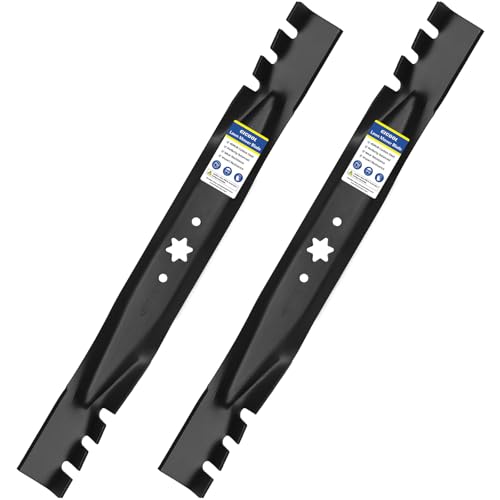
The Antanker 134149 high-lift blade set is a direct replacement accessory designed for 42-inch cutting decks on popular riding mowers and lawn tractors. High-lift blades are specifically crafted with upturned rear sails that create a heavy vacuum beneath the mower deck. This pair is built for homeowners, rural property owners, and DIY lawn mechanics who want reliable grass clearing, better bagging efficiency, and clean discharge without paying dealership markup prices.
In real-world yard upkeep, blade geometry dictates how clean your lawn looks after every pass. Standard mulching blades often lack the suction required to pull flattened grass upright, especially when the grass is thick or slightly damp. These high-lift blades push substantial air volume upward and outward, lifting the blades of grass just before the cutting edge strikes. The resulting clippings are shot firmly into collection bags or thrown well clear of the side chute, preventing messy clumping on manicured lawns.
Build quality is rock solid for routine residential and light commercial property maintenance. The set weighs approximately 4.3 pounds, pointing to a thick gauge steel construction that resists warping when striking small branches, pinecones, or hidden surface roots. The center features a standard 5-point star cutout that mounts cleanly over OEM spindles. Swapping them out in the workshop takes minimal effort using a block of wood to brace the blade and a standard breaker bar to break loose the spindle bolts.
There are a few practical considerations to keep in mind before ordering. The pronounced lift wings increase aerodynamic drag under the deck, which asks more from your tractor engine. If you are operating a lower-horsepower machine through overgrown, wet turf, you will want to slow your ground speed to avoid bogging down the motor. In addition, the factory applies a thick protective coat of orange paint over the entire blade, including the edge bevel, so taking a file across the cutting edge before mounting pays dividends in cut clarity.
For owners of 42-inch Husqvarna, Craftsman, or Poulan riding mowers needing to restore clean bagging and sharp cutting performance, the Antanker 134149 two-pack provides dependable steel quality and accurate fitment at an accessible price point.
These 21-inch replacement blades are designed for standard 42-inch twin-blade mower decks featuring a 5-point star center hole pattern. Before ordering, verify that your mower spindles utilize the 5-point star configuration rather than circular or 6-point star shafts.
This pair directly replaces OEM part numbers: Ariens 21546095, 532138971; AYP 127843, 134149, 138498, 138971, 532134149, 532138971; Craftsman 127843, 134149, 138498, 138971, CMXGZAM110136; Husqvarna 113312X, 521981601, 532127843, 532134149, 532138498, 532138971, 777134149; Poulan 531307224, 532138971, PP24004; and Snapper 704429.
Fits popular tractor models including Husqvarna 2042LS, LT125, LT130, LT152, LT16542, LT18542, LTH140, LTH1542, LTH1742, and LTH2042, along with Poulan PB155G42, PB17542LT, PB195H42LT, and PP175G42.


Pros
- Exact fit for a wide range of popular mower brands, confirmed by user reviews on Husqvarna and Craftsman models.
- Heavy-duty steel construction with an integrated washer design that prevents loosening and thread damage over time.
- Excellent value compared to OEM parts, with many users reporting they work just as well as the originals.
- Simple to install, no special tools required, and the three-pack covers an entire mower deck.
Cons
- Not compatible with older Craftsman 22-inch walk-behind mowers, as noted by one reviewer, so always verify fitment before purchasing.
- The bolt head edges can round off over time if not checked periodically, especially on mowers with heavy use or vibration.
- Some users may prefer a separate washer design for easier replacement, but the integrated washer is a deliberate upgrade for reliability.
The Sporthfish 532193003 Blade Bolt Washer set is a practical replacement part for anyone maintaining a riding or zero-turn lawn mower. These bolts are designed to secure the blade to the spindle under the deck, and they come as a three-pack so you can replace all the fasteners on a typical mower at once. The upgraded arc top integrated washer is a nice touch, it helps prevent the washer from separating and getting lost, and it reduces thread wear over time.
This set is best suited for homeowners, DIYers, and small engine hobbyists who own compatible mowers from Husqvarna, Craftsman, AYP, Poulan, Weed Eater, or Sears. If you are already comfortable changing blades, swapping these bolts is a straightforward job with basic hand tools. The bolts are made from quality steel and feel solid in hand, they are not flimsy or prone to stripping during installation.
In real-world use, these bolts hold blades securely even on rough terrain. Several reviewers mention they are an exact fit for their mowers, including Husqvarna YTH23V48 and various zero-turn models, and they report no issues with loosening or vibration after installation. The black finish resists rust well, which matters when you are working under the deck where moisture and grass clippings accumulate.
One limitation to note: these bolts do not fit older Craftsman 22-inch walk-behind mowers, so double-check your mower model or OEM part number before ordering. Also, like any blade bolt, the head edges can become rounded over years of use, so it is wise to inspect them every few seasons and replace if needed. That is standard maintenance advice, not a flaw specific to this set.
Overall, the Sporthfish blade bolt washer set delivers reliable performance at a great price. If you need to replace stripped or worn bolts on a compatible mower, this three-pack is a smart buy. It saves you money compared to OEM parts, and the integrated washer design is a genuine improvement over older flat washer styles. For DIY mower maintenance, these bolts are a solid choice.
Product Name: Sporthfish 532193003 Blade Bolt Washer Set
Quantity: 3 bolts with integrated washers
Bolt Size: 1-1/4 inch x 7/16 inch - 20 thread
Material: Quality steel with black finish
Compatible OEM Part Numbers: 532193003, 532193003-A, 14457, 174365, 193003, 193003-A, 532-1930-03, 532174365, 539107522
Brand Compatibility: Husqvarna, Craftsman, AYP, Poulan, Poulan PRO, Weed Eater, Roper, Sears, and others
Product Dimensions: 1.5 x 1.4 x 1.4 inches
Item Weight: 9.6 ounces
These blade bolts are ideal for routine mower deck maintenance. Replace them whenever you swap out blades or notice wear on the bolt head edges. They work great on zero-turn mowers and riding mowers with three-blade decks, giving you a complete set of fasteners in one pack.
For DIY homeowners, this set is a cost-effective way to keep your mower safe and efficient without a trip to the dealer. The integrated washer design also makes installation faster, since you do not have to fumble with a separate washer.
If you own a Husqvarna, Craftsman, or AYP mower from the long list of compatible models, these bolts are a direct replacement. They are also handy to keep as spares in your workshop, especially if you maintain multiple mowers.


Understanding Mower Blade Thread Direction and Safety
The primary reason for using reverse threads on the retaining side of mower blade hardware is physics. As the blade spins at high speeds, the rotational force creates a torque that naturally tries to unscrew a standard right-hand threaded nut. By using a left-hand (reverse) thread, the rotational force actually tightens the nut against the blade, securing it more firmly as the mower operates. This design significantly reduces the risk of the blade becoming loose, which is a major safety hazard that can lead to blade detachment or severe vibration.
| Component | Typical Thread Direction | Function |
|---|---|---|
| Spindle Bolt | Right-Hand (Clockwise tightens) | Passes through blade and into spindle |
| Retaining Nut/Washer | Left-Hand (Counter-clockwise tightens) | Secures blade to spindle, prevents loosening |
It is crucial to distinguish between the bolt and the nut when servicing the mower. Many modern mower designs use an integrated washer-bolt assembly where the washer is non-detachable and has the reverse threads. In these cases, the entire assembly must be removed and replaced as a unit.
Older or specific models might use a separate nut, but the principle remains the same: the side of the blade that faces the direction of rotation must have reverse threads to counteract the loosening torque. Misidentifying this can lead to cross-threading or, worse, installing a standard nut that will work itself loose during the first mow.
When purchasing replacement hardware, always verify the thread direction specified in the manufacturer’s manual or by inspecting the old part. The supplied specifications for various brands often list the specific part numbers for these assemblies. For example, some bolt-washer sets are designed to replace outdated flat washers with integrated reverse-thread components. Using the correct part number ensures that the thread pitch and diameter match the spindle exactly. If you are unsure, a simple visual check of the old nut’s thread angle can confirm the direction before you buy new parts.
Identifying Left-Hand vs. Right-Hand Threads
Distinguishing between left-hand and right-hand threads is a simple visual task if you know what to look for. The most reliable method is the “clockwise rule.” For a standard right-hand thread, turning the fastener clockwise tightens it. For a left-hand (reverse) thread, turning it clockwise loosens it. You can verify this by placing a flat-head screwdriver or wrench on the fastener and attempting to turn it slightly while observing the movement. If it moves upward (loosening) when turned clockwise, it is reverse threaded.
Another visual cue is the angle of the thread ridges. On a right-hand thread, the ridges slope upward from left to right. On a left-hand thread, they slope upward from right to left. This is similar to the threading on a bicycle pedal or a light bulb, where reverse threads are used to prevent loosening due to rotational force.
In the context of mower blades, the retaining nut almost always follows this reverse pattern. Homeowners should develop the habit of checking the thread direction every time they remove a blade, as this knowledge prevents costly mistakes during reassembly.
It is also important to note that some mower manufacturers use a different method entirely, such as a locking washer or a specific spindle design that does not rely on reverse threads for security. However, the majority of riding mowers, lawn tractors, and zero-turn mowers use the reverse-thread nut system.
Always consult the owner’s manual for your specific model to confirm the hardware type. If the manual is unavailable, inspecting the old hardware is the best way to determine the correct replacement. Do not assume that all mower blades use the same fastening system, as designs vary by brand and model generation.
Common Mistakes When Replacing Blade Hardware
The most frequent error during blade replacement is assuming that all fasteners are standard right-hand threaded, which leads to frustration or insecure installation.
- If a nut tightens when turned counter-clockwise, you are dealing with a reverse thread rather than a standard one.
- Trying to tighten a reverse thread clockwise actually loosens it, resulting in the blade being under-tightened.
- Under-tightening leads to vibration, uneven cutting, and potential damage to the spindle bearings during operation.
Another common mistake is mixing hardware from different mower models. Even if the diameter looks similar, the thread pitch (the distance between threads) may differ. Using a bolt with the wrong pitch can strip the threads in the spindle, which is an expensive repair. Always match the OEM part number or the exact dimensions of the old hardware.
The product descriptions for replacement parts often list the specific compatibility with brands like Husqvarna, Craftsman, or AYP, which helps ensure the correct thread specification is used. Never force a fastener that does not thread in smoothly; back it out and check for compatibility.
Additionally, neglecting to replace worn bolts and washers is a significant oversight. Over time, the threads on the bolt and nut can wear down, reducing their clamping force. Even if the old hardware looks intact, replacing it with a new set is recommended when installing a new blade.
This ensures a secure fit and prevents the blade from shifting during operation. Some integrated washer-bolt assemblies are designed to prevent thread wear and part loss, offering a more reliable solution than separate components. Investing in quality hardware is a small cost that contributes significantly to the overall safety and longevity of the mower.
Here is a checklist to verify before reassembling the blade:
- Confirm the thread direction of the retaining nut or washer.
- Check that the bolt threads into the spindle smoothly without forcing.
- Ensure the washer is positioned correctly against the blade.
- Verify that the blade is balanced and not cracked or bent.
- Use the correct torque specification if provided in the manual.
- Inspect the spindle for any signs of wear or damage.
Hardware Compatibility and Part Number Matching
Matching the correct part number is the most reliable way to ensure compatibility for mower blade hardware. Manufacturers assign specific OEM numbers to bolts, nuts, and washers that correspond to their thread specifications, dimensions, and material. When purchasing replacement parts, always cross-reference these numbers with the existing hardware on your mower. For instance, a bolt-washer set might be listed as compatible with specific Husqvarna or Craftsman models, indicating that it meets the required thread standards for those machines.
Some products are marketed as universal or compatible with a wide range of brands, but it is essential to verify the specific dimensions. A “universal” nut may fit the diameter but not the thread pitch, leading to a poor fit.
The supplied specifications for products like the 532193003 blade bolt washer list multiple OEM replacement numbers, which helps buyers identify the exact match for their mower. Using a part that is listed as compatible with your specific model reduces the risk of installation errors and ensures that the reverse-thread design is correctly implemented.
It is also worth noting that some mower models use a combination of right-hand and left-hand threads in different positions. For example, the bolt might be right-hand threaded, while the nut is left-hand. In other designs, both might be standard, relying on a locking mechanism instead.
The key is to follow the manufacturer’s instructions for your specific model. If you are replacing the entire spindle assembly, the thread specifications may differ from the original, so always check the new assembly’s documentation. This attention to detail ensures that the blade remains secure during high-speed operation.
Safety Considerations During Blade Service
Safety is paramount when working on mower blades, especially when dealing with fasteners that may be under tension. Always disconnect the spark plug wire before starting any blade service to prevent accidental starting. This simple step eliminates the risk of the blade spinning while your hands are near it.
Use appropriate tools, such as a breaker bar or impact wrench, to remove stubborn bolts, but never use excessive force that could damage the spindle or the blade mounting holes. If a bolt is stuck, penetrating oil can help, but avoid heating the area, as this can affect the blade’s temper.
When tightening the new hardware, ensure that the blade is properly seated against the spindle and the washer. The reverse-threaded nut should be tightened securely, but do not over-tighten, as this can strip the threads or warp the blade. Refer to the manufacturer’s torque specification if available.
After installation, spin the blade by hand to ensure it rotates freely and does not rub against the deck. Check the fastener again after the first mowing session, as the blade may shift slightly during the initial run. This final check is a crucial part of the maintenance process.
Regular inspection of the blade hardware is recommended as part of routine mower maintenance. Look for signs of wear, corrosion, or deformation on the bolts and nuts. If the threads are damaged, replace the hardware immediately. Using damaged fasteners can lead to blade failure, which is a serious safety hazard.
By understanding the role of reverse threads and following proper installation procedures, homeowners can ensure that their mower blades remain secure and their mowing experience is safe and efficient. For more tips on maintaining your mower, consider reading our guide on loosening stuck blade bolts, which offers practical techniques for difficult removals.
Properly securing the mower blade with the correct reverse-threaded hardware is a fundamental aspect of safe lawn care. By identifying the thread direction, matching the correct part numbers, and following safety protocols, you can prevent common issues like loosening and vibration. This knowledge not only extends the life of your mower but also ensures a consistent cut and a safer mowing experience for you and your family.






Write Your Review
No reviews yet. Be the first to share your experience!