


Attaching a snowplow directly to a standard lawn mower deck is not a standard or supported procedure for most residential mowers. The how to put a snowplow on a lawn mower query usually stems from a desire to use existing equipment for winter tasks, but the structural design of mower spindles and deck frames is optimized for cutting grass, not for the heavy, uneven loads created by snow.
While some niche attachments exist for string trimmers, they are not designed for the high-torque output of a mower engine.
- Attempting to force a fit can damage the mower’s transmission, bend the deck, or create severe safety hazards.
- This article clarifies the mechanical limitations and provides practical, safe alternatives for clearing snow.
- These alternatives help you avoid risking your equipment or personal safety during the snow clearing process.
Pros
- Quickly transforms a standard string trimmer into a winter snow clearing tool
- Ergonomic offset support handle substantially improves balance and control
- Compact and lightweight enough for decks, porch steps, and tight walkways
- Eliminates the cost and maintenance of owning a separate motorized snow thrower
Cons
- Fixed forward discharge lacks a directional chute for angling thrown snow
- Not built for deep snowdrifts or dense, ice-packed plow berms at the end of driveways
- Runtime depends entirely on your power head battery platform or fuel capacity
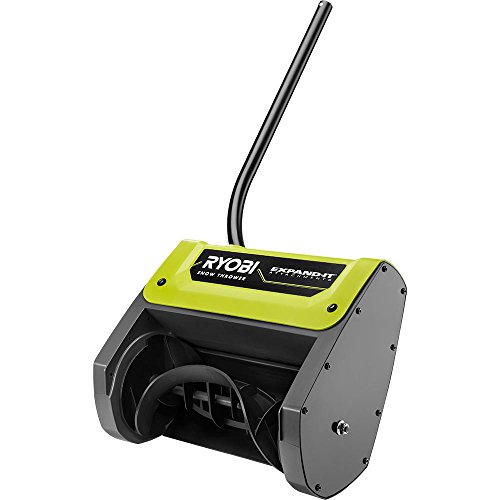
The RYOBI Expand-It Snow Thrower Attachment (model RYSNW00) is a dedicated winter accessory engineered to snap directly onto universal split-shaft power heads. Instead of dealing with the expense and storage hassle of a full-sized snow blower, this attachment offers homeowners and DIYers an affordable way to repurpose the cordless or gas string trimmer equipment already hanging in their garage.
Functioning much like an electric power shovel, this unit handles light to moderate snow up to 6 inches deep with dependable efficiency. Mating it to a robust cordless or gas power head provides plenty of paddle speed to fling powder straight ahead and off your walkways. Because the scraper clears close to the surface, you get clean results on flat concrete, stone walkways, and wooden decks without having to repeatedly scrape by hand.
At roughly 8 pounds, the attachment keeps the overall tool weight low enough to prevent shoulder fatigue during extended clearing sessions. RYOBI includes an offset handle with the attachment, which attaches higher up the shaft to provide proper leverage and reduce strain on your lower back. The composite housing and sturdy internal rotor hold up fine in freezing temperatures, ensuring the tool can take repeated bumps against curbs and steps without trouble.
Keep expectations realistic regarding heavy, water-logged slush and major winter blizzards. Because the unit throws snow directly forward without an adjustable discharge chute, you have to plan your clearing passes to account for wind and keep from blowing snow onto previously cleared ground. For standard residential walkways, entry porches, and small driveway clearings, the RYSNW00 is a smart, space-saving tool that spares your back every winter.
Clearing elevated wooden decks and porches where heavy two-stage gas snow blowers are too bulky or risky to run.
Routine clearing of residential sidewalks, garden paths, and entry steps after moderate snowfalls up to 6 inches.
Homeowners with limited garage or shed space who want motorized snow removal without storing another standalone engine.
Engineered for full compatibility with all RYOBI Expand-It power heads across both 18V ONE+ and 40V cordless lineups, as well as RYOBI gas trimmer bases.
Utilizes a standard universal split-shaft coupler, allowing it to connect securely to most other major outdoor power brands that accept universal string trimmer attachments.
Why Snowplows Do Not Fit Standard Mower Decks
The primary reason a snowplow cannot be attached to a lawn mower is the fundamental difference in mechanical load and attachment points. Mower blades are mounted to a spindle that rotates at high speeds to cut vegetation. This spindle is not designed to support a static, heavy load like a plow blade, nor does it have the mounting geometry required to secure a plow frame securely.
Snowplows require a robust hitch or mounting bracket that can withstand lateral forces, vertical compression, and rotational torque from snow accumulation. Mower decks are typically made of stamped steel or cast aluminum, which may not have the structural integrity to handle these forces without warping. Additionally, the low ground clearance of most mower decks makes it difficult to maneuver through deep snow without the deck clogging or the engine stalling.
| Component | Mower Design Purpose | Snowplow Requirement |
|---|---|---|
| Spindle/Drive | High-speed rotation for cutting | Static load support and directional control |
| Frame Material | Lightweight for maneuverability | Heavy-duty steel for impact resistance |
| Ground Clearance | Low for clean cutting | Adjustable for varying snow depth |
| Mounting Points | Blade-specific bolt patterns | Universal hitch or heavy-duty brackets |
Understanding these mechanical mismatches is crucial before attempting any modification. The following points highlight the specific incompatibilities that make this attachment unsafe and impractical:
- Mower spindles are not rated for static heavy loads like snowplows.
- Deck frames lack the reinforced mounting points needed for plow brackets.
- Low ground clearance causes snow to clog the mower deck and engine.
- Engine torque is optimized for cutting, not for pushing dense snowpacks.
Structural Integrity and Load Limits
Lawn mower decks are engineered to distribute the centrifugal force of rotating blades evenly. When you attach a heavy object like a snowplow, the weight distribution shifts dramatically. This can cause the mower to tip forward or to the side, especially on uneven terrain. The mounting bolts on the mower deck are typically sized for blade retention, not for the shear forces generated by a plow pushing against resistance.
If the bolts strip or the deck cracks under load, the mower becomes unsafe to operate. The risk of injury from a detached plow or a collapsing deck is significant. Manufacturers do not design mower decks to act as snow removal platforms, and doing so voids any warranty and ignores basic engineering principles of load-bearing structures.
Engine and Transmission Strain
Mower engines are designed to operate at specific RPM ranges for optimal cutting performance. Pushing snow requires significantly more torque at lower speeds, which can overheat the engine or damage the transmission. The belt drive systems in many mowers are not designed to handle the sudden, high-resistance loads that occur when a plow hits a hard object or deep snow. This can lead to belt slippage, breakage, or transmission failure.
Additionally, the exhaust system of a mower may be obstructed by snow, leading to carbon monoxide buildup in enclosed areas. The lack of a proper exhaust shield for snow removal operations creates a hazardous environment. These mechanical strains make the mower unreliable and potentially dangerous for winter use.
Readers working through this often check how to change blades on a lawn mower next.
Safe Alternatives for Snow Removal
Instead of modifying a mower, consider using equipment designed for snow removal. A dedicated snow blower or snow plow attachment for a utility vehicle is the safest and most effective option. These tools are engineered to handle the specific loads and conditions of snow removal, ensuring both efficiency and safety.
If you are interested in using a string trimmer for light snow, some brands offer specific attachments for this purpose. For example, the RYOBI Tools Expand-It Snow Thrower Attachment is designed for string trimmers, not mowers. It clears up to 6 inches of snow and includes an offset handle for convenience. This is a much safer and more practical option for light snowfall compared to attempting to modify a mower.
For heavier snow, a manual snow shovel or a dedicated electric snow blower is recommended. These tools provide the necessary power and maneuverability without risking damage to your lawn mower. Investing in the right tool for the job saves time and money in the long run.
Understanding Attachment Compatibility
When looking for attachments for your power equipment, always check the manufacturer’s specifications. Not all attachments are compatible with every model, even within the same brand. For instance, a snow thrower attachment for a string trimmer will not fit a lawn mower, as the mounting interfaces are completely different.
Review the product description and compatibility list before purchasing any attachment. If the manufacturer does not explicitly state that the attachment is compatible with your specific mower model, assume it is not. Attempting to force a fit can result in damage to both the attachment and the mower, as well as potential safety hazards.
If you are unsure about compatibility, consult the user manual for your mower or contact the manufacturer directly. They can provide accurate information on whether a specific attachment is safe to use with your equipment. This step ensures that you are using your tools as intended and maintaining their warranty coverage.
Maintenance and Safety Considerations
Using a mower for snow removal can lead to corrosion and rust due to exposure to salt and moisture. This can shorten the lifespan of your mower and increase maintenance costs. If you must use your mower in winter conditions, ensure that it is thoroughly cleaned and dried after each use to prevent rust.
Always prioritize safety when operating any power equipment in winter conditions. Wear appropriate protective gear, including eye protection, gloves, and non-slip footwear. Ensure that the area is clear of obstacles and that you have a safe path for maneuvering. Never operate a modified mower in enclosed spaces or near people and pets.
Regular maintenance of your mower is essential, regardless of its intended use. Check the oil, air filter, and spark plug before each season. A well-maintained mower is less likely to fail under stress, but it is still not designed for snow removal. Stick to the manufacturer’s guidelines for use and maintenance to ensure long-term reliability.
Practical Decision Making for Homeowners
Homeowners often look for creative ways to use existing equipment for multiple tasks. While this can be cost-effective, it is essential to consider the risks and limitations. Modifying a lawn mower for snow removal is not a recommended practice due to the potential for damage and safety hazards.
Consider the cost of repairing a damaged mower versus the cost of purchasing a dedicated snow removal tool. In most cases, the latter is a better investment. A dedicated snow blower or plow will perform better and last longer than a modified mower, which is not designed for the task.
Make an informed decision based on your specific needs and the condition of your equipment. If your mower is old or in poor condition, it is even more important to avoid using it for tasks it was not designed for. Prioritize safety and efficiency by choosing the right tool for the job.
For those interested in maintaining their mower blades for the next season, understanding proper blade care is essential. You can find detailed information on blade maintenance in our guide on filing lawn mower blades. This ensures that your mower is ready for spring use and performs optimally when the weather warms up.
In summary, attaching a snowplow to a lawn mower is not a safe or practical solution. Use dedicated snow removal equipment for the best results and to protect your investment in your lawn mower.
For more on a connected point, our page on craftsman 22 lawn mower blade goes into it separately.





Write Your Review
No reviews yet. Be the first to share your experience!