


Many homeowners assume that a 3 in 1 mower blade is a single, special piece of metal that automatically switches functions. In reality, the term usually refers to a specific blade profile, a multi-blade deck configuration, or a convertible tool system that allows one machine to handle mulching, bagging, and side-discharge tasks. Understanding this distinction is critical before purchasing a replacement part, as buying a single “3-in-1” blade for a standard single-blade deck will not work. The functionality depends entirely on the mower’s deck design and the specific blade geometry installed.
For most standard walk-behind and riding mowers, “3 in 1” capability is achieved through a combination blade or a dual-blade setup, not a magic single blade. The blade profile features a high-lift edge for bagging and discharge, along with specialized mulching fins or notches that recut clippings. If you are looking to restore these functions to an older mower, you need to verify if your deck supports the required airflow and blade path.
Our guide on mower blade costs can help you budget for the correct replacement type, whether it is a standard high-lift or a specialized combination profile. This ensures you invest in hardware that matches your specific deck configuration rather than a generic term that might lead to a mismatched purchase.

Pros
- Direct dimensional replacement for John Deere OEM part UC22008
- Supplied as a matched 2-pack for complete dual-blade deck replacement
- Substantial 0.157-inch thickness and 3-inch width provide solid cutting durability
- Rolled foil ultra high-lift design enhances air velocity for clean discharge and bagging
Cons
- Restricted to specific 42-inch John Deere decks featuring a 13/16-inch round center hole
- Mounting hardware such as spindle bolts, washers, and nuts are not included
- High-lift design is tailored for bagging and discharge rather than fine mulching
The 8TEN LawnRAZOR 2-Pack is a dedicated pair of ultra high-lift replacement mower blades engineered specifically for John Deere lawn tractors and residential zero-turn mowers equipped with 42-inch cutting decks. Matching OEM part number UC22008, each blade measures 21.5 inches in length and 3 inches in width to deliver complete deck coverage. This matched replacement set directly services popular John Deere models including the X330, X350, X354, X370, Z335E, Z335M, Z345M, and Z345R without requiring deck modifications.
This replacement set is best suited for John Deere equipment owners who prioritize efficient bagging or clean side discharge over standard mulching. The rolled foil design creates an ultra high-lift contour that generates increased airflow beneath the mowing deck. For homeowners managing lush turf, dense spring growth, or routine leaf cleanup, the added suction helps lift grass blades upright for an even cut while driving clippings forcefully through discharge chutes and collection systems.
In terms of physical construction, 8TEN builds these blades with a substantial 0.157-inch steel thickness and a finished green protective coating. The two-blade package lists a combined weight of 5.6 pounds, reflecting durable material density across both cutting components. A critical engineering specification is the 13/16-inch round center hole, which matches the spindle interface on supported 42-inch John Deere assemblies to maintain balance and proper rotational seating.
Successful installation requires verifying your existing deck size and mounting configuration prior to purchase. While these blades correspond to OEM part UC22008, John Deere utilizes different center-hole styles and blade lengths across various deck sizes and model years. Additionally, this package contains the two cutting blades only, meaning you will need to inspect and reuse your existing factory spindle bolts and washers or obtain new OEM-spec mounting hardware.
For owners of compatible 42-inch John Deere riding mowers and zero-turns, the 8TEN LawnRAZOR 2-Pack represents a dependable, budget-conscious maintenance solution. To ensure smooth operation and long service life, users should always adhere to manufacturer service instructions, verify recommended spindle bolt torque settings, and check blade balance before tightening. Overall, this set provides an accurate physical fit, robust steel construction, and strong high-lift performance for routine lawn care.
This 8TEN LawnRAZOR blade set is designed as a direct replacement for John Deere OEM part number UC22008. It is engineered to fit John Deere Select Series lawn tractors equipped with 42-inch decks, including the X330, X350, X354, and X370 models.
The set also supports John Deere residential zero-turn mowers featuring 42-inch decks, such as the Z335E, Z335M, Z345M, and Z345R. Because deck designs and spindle patterns can vary across model years and deck widths, buyers should confirm their deck width and verify their existing blade center hole matches the 13/16-inch circular specification before ordering.
Each blade in this 2-pack measures 21-1/2 inches in length and 3 inches in width, creating the proper cutting overlap and clearance required inside a 42-inch dual-spindle deck. The blades are formed from 0.157-inch thick steel to provide resilience against regular lawn impact and abrasive wear.
Featuring a 13/16-inch round center hole, these blades mount directly onto compatible John Deere round spindles. The integrated rolled foil provides an ultra high-lift aerodynamic edge, maximizing upward airflow to reduce deck buildup and improve collection performance in bagging systems.

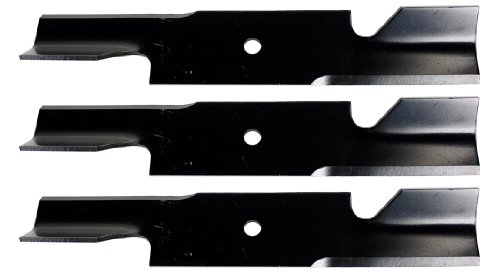
Pros
- High airflow design clears out dense turf with minimal deck clumping
- Thick steel stock stands up to small debris without nicking or warping easily
- Drop-in replacement for widely used Scag and Toro OEM part numbers
- Broad cutting surface allows for multiple sharpens before replacement
Cons
- Extra high lift demands slightly more engine horsepower in tall grass
- Generates noticeable dust blow-by when operating over dry, sandy soil
This 3-pack of USA Mower Blades U11185BP high-lift replacement blades is built specifically for commercial zero-turn mowers and heavy-duty walk-behinds. Measuring 18 inches in length, 3 inches in width, and featuring a 5/8-inch center hole, this set replaces common OEM part numbers across Scag, Toro, and Simplicity platforms. The aggressive sail design generates the high-velocity airflow needed to keep decks clear during heavy mowing cycles.
These blades are best suited for commercial landscapers, municipal groundskeepers, and acreage owners running 52-inch or 54-inch decks (or 36-inch dual-blade setups). In overgrown lawns or wet morning grass, standard low-lift blades often leave clumps and uneven streaks behind. The extra high-lift profile creates strong vacuum pressure under the deck, standing bent grass upright right before the cutting edge strikes for an even, clean sweep.
Durability is right where it needs to be for tough jobsite conditions. At .203 inches thick, this steel stock provides substantial heft to resist gouging from hidden roots, scalping, or stray yard debris. In the workshop, the blades balance easily on standard cone balancers and take a clean bevel on a bench grinder or flap disc, ensuring fast turnaround times during maintenance intervals.
One practical consideration is deck horsepower. The aggressive wing tips draw extra engine power to spin up, so smaller horsepower engines might feel the drag in overgrown fields. The extra suction will also whip up dust on loose, sandy topsoil. For standard turf cutting, bagger setups, and broad side discharge on commercial rigs, this blade pack provides rugged reliability and dependable cut quality all season long.
Compatible Deck Sizes: Standard 36-inch (2-blade decks), 52-inch (3-blade decks), and 54-inch (3-blade decks).
Simplicity Cross-Reference: Replaces OEM part number 5021227ASM.
Scag Cross-Reference: Replaces OEM part numbers 48108, 481707, and 481711.
Toro Cross-Reference: Replaces OEM part number 1-633482.
Hardware Specs: 18-inch length, 3-inch width, 0.203-inch thickness, and 5/8-inch round center mounting hole.

Pros
- Dual-blade design pairs an upper mulching blade with a lower high-lift blade for versatile mulching and bagging
- Direct two-blade replacement set matching OEM specifications for HRR216 and HRX217 walk-behind decks
- Heavy-duty hardened steel construction with pre-sharpened cutting edges ready for installation
- Clearly documented fitment measurements including center hole, outer hole, and air-lift height
Cons
- Mounting hardware such as blade bolts and washers are not included in the package
- Compatibility is restricted to specific 21-inch walk-behind models matching the exact hole pattern and dimensions
- The protective black finish wears away quickly along the cutting edge during initial lawn mowing
The NOIWEOPIEN 21-Inch Lawn Mower Mulching Blade Set is a two-pack replacement kit engineered for select 21-inch walk-behind lawn mowers. Specifically targeted at DIY homeowners, property maintenance caretakers, and lawn equipment owners, this set provides a direct replacement for OEM part numbers 72531-VH7-000 (upper blade) and 72511-VH7-000 (lower blade). It is best suited for operators of compatible Honda HRR216 and HRX217 series walk-behind mowers who need to replace dull, worn, or nicked cutting edges to maintain consistent turf health.
This set utilizes a specialized twin-blade architecture that combines an upper mulching blade with a lower high-lift blade. According to the manufacturer, the upper blade is configured with a 6-25/32 inch cutting edge to chop grass clippings into fine mulch, while the lower blade features a 3-15/32 inch cutting edge with a 13/16 inch air lift. This dual-action design helps generate the airflow required to lift grass blades upright for an even cut, while simultaneously supporting cleaner clipping discharge and bagging efficiency.
Fitment verification is essential before ordering or installing replacement blades. The blades measure 20-13/16 inches (528mm) in length, 3-5/32 inches (80mm) in width, and 1/8 inch (3mm) in thickness. The mounting interface features a 13/16-inch (20.8mm) center hole diameter paired with 13/32-inch (10.3mm) outer hole diameters. Documented model compatibility covers numerous HRR216 configurations ranging from K5 through K11 suffixes, as well as select HRX217 models such as HRX217HMA and HRX217HXA. Buyers should confirm their deck diameter and existing hole pattern, as a 21-inch deck designation alone does not guarantee universal fit across different mower brands or deck designs.
Constructed from heavy-duty hardened steel, these replacement blades are built to withstand standard residential turf conditions, impact from minor debris, and general operational wear. The manufacturer notes that each blade arrives pre-sharpened and treated with a protective black coating intended to protect the metal during transit and storage. This surface coating naturally wears off along the friction zones during initial mowing sessions. In addition, the balanced structural design helps minimize deck vibration during operation, supporting smoother mechanical performance.
Practical ownership requires routine attention to maintenance guidelines. Installation hardware such as replacement bolts and washers is not included, requiring owners to inspect and reuse their existing hardware or source new factory-spec fasteners. When mounting or servicing blades, users should always ensure the mower engine is completely shut off and the spark plug boot is disconnected in accordance with manufacturer safety procedures. Overall, this NOIWEOPIEN twin-blade replacement set represents a practical, value-oriented solution for residential mower owners seeking to restore cutting performance with accurately sized replacement components.
Direct fitment depends on matching mower model series, deck size, and mounting hole geometry. This blade set is designed for 21-inch walk-behind decks and serves as a direct cross-reference for OEM numbers 72531-VH7-000 and 72511-VH7-000. Compatible walk-behind models listed by the manufacturer include Honda HRR216 series (HRR216K5VXAA, HRR216K6VKAA, HRR216K6VXAA, HRR216K7VKAA, HRR216K7VXAA, HRR216K8PKAA, HRR216K8VKAA, HRR216K9VKAA, HRR216K9VLAA, HRR216K9VYAA, HRR216K10VKAA, HRR216K10VLAA, HRR216K10VYAA, HRR216K11PKAA, HRR216K11VKAA, HRR216K11VLAA, HRR216K11VYAA) and HRX217 series (HRX217HMA, HRX217HXA).
Physical dimensions must match the host mower deck setup. Each blade measures 20-13/16 inches (528mm) long, 3-5/32 inches (80mm) wide, and 1/8 inch (3mm) thick, with a 13/16-inch (20.8mm) center hole and 13/32-inch (10.3mm) outer holes. Matching both the center hole and outer alignment holes is critical to ensure proper mounting onto the mower spindle assembly.
Safe handling and routine blade maintenance are critical for personal safety and optimal equipment performance. Before inspecting, removing, or installing mower blades, always ensure the engine is fully turned off, the ignition key is removed if applicable, and the spark plug wire is disconnected to prevent accidental starting. Heavy-duty work gloves should always be worn when handling mower blades to protect against sharp cutting edges.
Owners should inspect blades periodically for nicks, severe dulling, cracks, or bends caused by hidden yard obstacles. If reusing original mounting hardware, inspect the blade bolts and washers for thread wear or distortion, and tighten all fasteners according to the mower manufacturer specified torque ratings using an appropriate blade-blocking tool.

Pros
- Lightweight and easy to maneuver, especially for seniors or those with physical limitations.
- No gas or cords required; batteries are easy to swap and charge.
- Converts quickly between trimmer, edger, and mower modes for versatile yard care.
- Automatic line feed keeps you working without stopping to adjust the string.
- Great value for small lawns and light trimming duties.
Cons
- Battery runtime is limited (about 20 minutes per battery) and the included charger is slow (4+ hours), so plan for breaks or buy a fast charger.
- Not powerful enough for tall, thick grass or large lawns; best kept for maintenance mowing of already short grass.
- The mower deck can detach accidentally if not locked in properly, and some users report durability concerns after heavy use.
The Black+Decker MTC220 3-in-1 Combo is a cordless lawn care tool that combines a string trimmer, edger, and small push mower into one lightweight package. It runs on a 20V MAX lithium-ion battery system and comes with two batteries plus a charger, making it a ready-to-use solution for homeowners with small yards, slopes, or tricky spots where a full-size mower doesn't fit.
This tool is best suited for DIYers and homeowners who need to maintain a postage-stamp lawn, trim around flower beds, or edge along walkways. It's especially popular with older users and those with back issues because it's so light (under 10 pounds with the deck) and easy to push or carry. The 3-in-1 design is genuinely handy: you can mow a small patch, then pop off the deck and use it as a standard string trimmer for edging or reaching under shrubs.
In real-world use, the MTC220 handles routine maintenance well on grass that's already short or moderately tall. The PowerDrive transmission provides enough torque to chew through light weeds and thin grass without stalling. However, it struggles with thick, wet, or overgrown vegetation; you'll need multiple passes and the battery drains faster. The automatic feed spool works smoothly, so you don't have to bump the head to advance the line. Two included batteries give you roughly 40 minutes of total run time, which is enough for a small yard, but the included charger takes 4+ hours to fully charge a battery. Many users upgrade to a fast charger for quicker turnaround.
Build quality is mixed: the plastic deck and trimmer head are adequate for light use, but some users report the mower deck can pop off if not secured tightly, and the overall durability isn't suited for heavy-duty or commercial work. On the plus side, assembly is straightforward, and the adjustable handle and cutting height let you customize the feel. Storage is easy because the tool breaks down into compact pieces.
Drawbacks include the slow charger, limited runtime for larger areas, and the fact that it's really a glorified trimmer on a wheelbase rather than a proper mower. If you have more than a quarter-acre or thick grass, you'll want a more powerful machine. For its price, though, the MTC220 offers excellent convenience for small-scale lawn care. Final recommendation: buy this if you have a tiny lawn, need an easy-to-use trimmer/edger combo, and don't mind swapping batteries. It's not for heavy jobs, but for light maintenance it's a solid, affordable choice.
Brand: Black+Decker
Model: MTC220
Power Source: 20V MAX Lithium-Ion Battery (2 included)
Cutting Width: 12 inches (mower deck)
Item Weight: 9.9 pounds (with deck)
Product Dimensions: 40.5 x 15.25 inches
Assembly: Required (easy)
Warranty: 2-Year Limited
Included: Trimmer/Edger, Detachable Mower Deck, 2 Batteries (LBXR2020), Charger, Spool, Auxiliary Handle, Guard
This 3-in-1 combo shines in small yards (under 0.25 acre) where you need to mow a tiny patch of grass, trim edges, and clean up around obstacles. It's also great for maintaining slopes, uneven terrain, and narrow side yards that a big mower can't reach. Seniors and those with physical limitations love the lightweight design. Use it for weekly touch-ups rather than heavy overgrowth.
Defining the 3 in 1 Mower Blade Concept
The phrase “3 in 1 mower blade” is often used loosely in marketing, but mechanically, it describes a system that handles three distinct mowing modes: mulching, bagging, and side-discharge. A standard high-lift blade is excellent for bagging and discharge but often fails to mulch effectively because it lacks the aerodynamic fins needed to recut clippings. A dedicated mulching blade, conversely, may not lift clippings high enough for efficient bagging. A true 3-in-1 setup bridges this gap, either through a single combination blade or a twin-blade assembly.
It is crucial to distinguish between a combination blade and a convertible mower tool, as many modern walk-behind mowers from major brands use a single blade with a specific profile that allows for all three functions.
- Some smaller or convertible tools, like certain cordless 3-in-1 kits, use a removable deck to switch between a mower, a trimmer, and an edger.
- In the context of blade replacement, we are focusing on the cutting component: the steel blade that sits on the spindle.
- The 3 in 1 label here implies that the blade’s geometry supports the airflow and cutting path required for all three modes without needing to swap hardware for each task.
| Blade Type | Mulching Capability | Bagging/Discharge Lift | Best For |
|---|---|---|---|
| Standard High-Lift | Poor | High | Bagging and Side Discharge |
| Dedicated Mulching | Excellent | Low | Mulching Only |
| Combination (3-in-1) | Good | Good | All Three Modes |
| Twin-Blade Set | Excellent | High | High-Volume Mulching and Bagging |
The table above highlights why the specific blade profile matters. A standard high-lift blade creates significant airflow to push clippings into the bag, but it does not chop them into fine pieces. A dedicated mulching blade has notches or fins that create a vortex to recut clippings, but it may not generate enough lift to throw them into a bag efficiently.
The combination blade attempts to balance these two aerodynamic needs. When shopping for a replacement, you must identify which of these profiles your mower deck is designed to use. Using a high-lift blade in a mulching mode will result in long, stringy clippings that can clog the deck and damage the grass, while using a pure mulching blade for bagging will likely result in uncollected clippings blowing out the side.
How the Blade Profile Enables Multiple Modes
The aerodynamic design of a 3-in-1 blade is a compromise between lift and recutting. The leading edge of the blade is angled to create lift, which is necessary for bagging and side-discharge. Simultaneously, the trailing edge or the underside of the blade often features a raised fin or a scalloped edge. This design creates a low-pressure zone that pulls clippings back into the cutting path for a second cut.
This recutting process is what defines mulching performance. For the blade to function as a true 3-in-1, the lift must be strong enough to clear the deck for bagging, but the recutting action must be effective enough to shred clippings for mulching. This balance is delicate and varies significantly between manufacturers.
Some mowers achieve this functionality through a twin-blade configuration. In this setup, two blades are mounted on the spindle, one above the other. The lower blade typically provides the high lift for bagging and discharge, while the upper blade focuses on mulching. This design is common in larger walk-behind mowers and some riding mowers.
If your mower originally came with a twin-blade set, you cannot simply replace it with a single combination blade. The spindle and deck geometry are designed to handle the weight and airflow of two blades. Installing a single blade in a twin-blade deck will result in poor performance in all three modes. Always check your owner’s manual or the existing hardware to determine if your mower requires a single or double blade setup.
Another variation is the convertible deck. Some mowers allow you to physically remove the deck and replace it with a different one designed for specific tasks. For example, a standard deck for bagging and discharge might be swapped for a mulching deck that has a different blade path and airflow. In these cases, the “3 in 1” capability comes from the deck system, not the blade itself.
The blades may be identical, but the deck changes the airflow dynamics. If you are buying a blade for a mower with a convertible deck, ensure you know which deck you are using at the time of mowing. The blade specifications might differ slightly between decks, or the same blade might perform differently due to the deck’s geometry.
Identifying Your Current Blade Configuration
Before purchasing a replacement, you need to identify what type of blade is currently on your mower by removing it carefully following the manufacturer’s safety instructions and inspecting the profile.
- Look for specific features where a smooth, angled edge indicates a high-lift blade on your equipment.
- A blade with distinct notches or fins on the underside is likely a mulching or combination blade type.
- If you see two blades stacked on the spindle, you have a twin-blade setup configuration installed.
- Measure the blade length, width, and thickness, and note the center hole diameter and any outer holes.
- These dimensions are critical for finding a compatible replacement for your specific mower model requirements.
- Do not assume that a blade labeled “3 in 1” will fit your mower just because the term sounds generic.
- Fitment is determined by physical dimensions and mounting patterns, not marketing labels or generic descriptions.
Check the OEM part number on the existing blade or in your mower’s manual. This number is the most reliable way to find a compatible replacement. If the part number is worn off, use the measurements you took. Cross-reference these measurements with the specifications of potential replacement blades. Pay close attention to the center hole geometry and the outer hole pattern.
Some blades have a simple round center hole, while others have a tapered or keyed hole that locks into the spindle. Mismatching the hole geometry can lead to a blade that spins loosely or does not balance correctly. The outer holes, if present, must align with the deck’s mounting pins or bolts. A mismatch here can prevent the blade from installing or cause it to shift during operation, leading to uneven cutting and potential damage.
If you are unsure whether your mower supports a 3-in-1 blade, check the mower’s model number and look up the factory specifications. Many manufacturers list the blade type in the manual or on their website. If the manual specifies a “high-lift” blade, your mower is likely not designed for effective mulching, even if you install a combination blade.
The deck may lack the necessary airflow channels or baffles to support mulching. In this case, buying a 3-in-1 blade may not yield the results you expect. It is better to stick with the blade type recommended by the manufacturer to ensure optimal performance and avoid straining the mower’s engine or drive system.
Common Misconceptions About 3-in-1 Blades
One common misconception is that a 3-in-1 blade will perform as well as a dedicated blade in each mode. While it offers versatility, it is a compromise. In bagging mode, a dedicated high-lift blade will generally provide better airflow and cleaner bagging. In mulching mode, a dedicated mulching blade will produce finer clippings.
The 3-in-1 blade provides a good balance, but it may not excel in any single mode. If you primarily bag your grass, a high-lift blade might be a better choice. If you primarily mulch, a dedicated mulching blade may be superior. The 3-in-1 blade is best for users who switch between modes frequently and want the convenience of not swapping blades.
Another misconception is that all mowers can use a 3-in-1 blade. As mentioned, this depends on the deck design. Some older or budget mowers have simple decks that are not optimized for mulching. Installing a mulching-capable blade on these decks may not result in effective mulching because the deck does not create the necessary airflow vortex.
Additionally, some mowers have a single-spindle design that is not compatible with twin-blade sets. Always verify compatibility before purchasing. The term “3 in 1” is a marketing term, not a universal standard. It does not guarantee that a blade will fit every mower or that it will perform well in all three modes on your specific machine.
Finally, some buyers confuse the blade with the mower tool itself. A “3-in-1 mower” often refers to a convertible tool that can be used as a mower, trimmer, and edger. This is a different product category from a mower blade. If you are looking for a blade, ensure you are shopping in the correct category.
A convertible tool’s mower deck may use a standard blade, not a special “3-in-1” blade. The versatility comes from the tool’s design, not the blade’s geometry. Clarifying this distinction helps avoid purchasing the wrong product type, which can be a costly and frustrating error for DIY homeowners.
Choosing the Right Replacement for Your Deck
When selecting a replacement blade, prioritize fitment over marketing labels. Start with the OEM part number if available. If not, use the measurements: blade length, width, thickness, and hole diameters. Ensure the new blade matches these dimensions exactly. A blade that is even slightly longer or wider can hit the deck or the ground, causing damage.
A blade that is thinner may not provide enough rigidity, leading to vibration and poor cutting. The material and construction also matter. Look for blades made from high-strength steel that is heat-treated for durability. A blade that bends easily will not cut efficiently and may damage the mower. Some blades come with a protective coating to prevent rust, which is beneficial for storage in damp garages or sheds.
Consider the mounting hardware included with the blade. Some blades come with the necessary bolts, washers, and nuts, while others do not. If your old hardware is worn or damaged, replace it along with the blade. Using worn hardware can lead to the blade loosening during operation, which is a serious safety hazard.
Always use the correct torque specifications when tightening the blade bolt. Overtightening can strip the threads, while undertightening can allow the blade to spin. Follow the manufacturer’s instructions for torque values. If you do not have a torque wrench, use a standard wrench and tighten firmly, but do not force it. The goal is a secure fit that allows the blade to spin freely without wobble.
Balancing is another critical factor. A new blade should be balanced, but it is a good idea to check it after installation. An unbalanced blade causes vibration, which can damage the mower’s bearings and engine. If you notice excessive vibration, stop the mower and re-check the blade’s balance and mounting. You may need to replace the blade if it is out of balance.
Some blades come with a balancing tool, but many do not. If you do not have a balancer, you can check for balance by placing the blade on a flat, horizontal surface. It should sit level without tipping to one side. If it tips, it is out of balance and should be replaced. This simple check can save you from costly repairs down the line.
Maintenance Tips for 3-in-1 Blades
Regular maintenance extends the life of your mower blade and ensures consistent performance. Clean the blade after each use to remove grass clippings, dirt, and sap. These materials can accumulate on the blade’s surface and affect its balance and cutting efficiency.
Use a brush or a damp cloth to clean the blade, and dry it thoroughly to prevent rust. If you notice rust spots, remove them with a wire brush or sandpaper and apply a light coat of oil to protect the metal. Storing the blade in a dry place is essential for preventing corrosion, especially in humid climates.
Sharpen the blade at least once a season, or more frequently if you mow wet grass or tough terrain. A dull blade tears the grass rather than cutting it, leading to brown tips and slower healing. This can make your lawn more susceptible to disease. Use a file or a grinder to sharpen the blade, maintaining the original angle.
Be careful not to remove too much metal, as this can affect the blade’s balance. After sharpening, clean the blade again and check the balance. If the blade becomes too short or thin from sharpening, it is time to replace it. Do not attempt to modify the blade’s geometry, as this can compromise its structural integrity and safety.
Inspect the blade for cracks, bends, or excessive wear before each mowing season. A cracked or bent blade is unsafe and should be replaced immediately. Do not attempt to straighten a bent blade, as this weakens the metal and can lead to failure during operation. If you find a crack, discard the blade and purchase a new one.
Regular inspections help you catch issues early and prevent more serious damage to the mower. By following these maintenance tips, you can ensure that your 3-in-1 blade continues to perform well for many seasons, providing versatile mowing options for your lawn care routine.
For more detailed information on blade materials, our guide on mower blade steel types explains the differences between high-carbon steel and other alloys. Understanding the material composition helps you choose a blade that offers the right balance of durability and sharpness for your specific mowing conditions. This knowledge is particularly useful when deciding between a budget option and a premium blade, as the material quality often correlates with long-term performance and longevity.
Ultimately, the choice of a 3-in-1 mower blade depends on your mower’s deck design and your mowing habits. If your mower supports a combination blade or twin-blade set, this option offers the convenience of handling mulching, bagging, and discharge tasks without swapping hardware. However, always verify compatibility using OEM part numbers and physical measurements.
Do not rely solely on marketing terms. By understanding the mechanics of blade profiles and deck configurations, you can make an informed decision that ensures optimal performance and longevity for your mower. This approach saves time and money by avoiding mismatched purchases and ensuring that your mower operates efficiently in all three modes.




Write Your Review
No reviews yet. Be the first to share your experience!