


Seasonal lawn care often comes down to clean cutting performance, and dull blades can turn routine yard upkeep into a frustrating chore. When loosening stubborn mounting hardware under the cutting deck, homeowners frequently question whether are lawn mower blades left hand threaded or if standard rotational rules apply. For most single-spindle push mowers and lawn tractors, the retaining bolt uses standard right-hand threads that turn counterclockwise to loosen. However, multi-spindle finish mowers and specialized cutting machines frequently rely on left-hand reverse threads to prevent hardware from backing out during operation. Understanding this distinction saves stripped bolt heads, broken spindles, and costly deck repairs before you begin work.
Tackling deck maintenance requires knowing exactly how your spindle turns and what fastening hardware secures the cutting assembly. If you are preparing for seasonal blade service, our step-by-step guide on removing a lawn mower blade safely outlines the physical blocking techniques needed to inspect deck hardware without damaging internal components. Finish mowers from brands like King Kutter and Sovema, along with various clearing heads, depend on dedicated left-hand fasteners to maintain proper clamping pressure. Checking your equipment manual, spindle rotation, and replacement bolt part numbers guarantees you turn your wrench in the right direction every single time.



Understanding Mower Blade Thread Direction and Mounting Hardware
Most standard walk-behind mowers and basic residential lawn tractors do not use left-hand threaded blade bolts. Instead, the vast majority of standard push mowers use traditional right-hand threads, meaning you turn the bolt counterclockwise to loosen it and clockwise to tighten it. Left-hand reverse threads are primarily found on multi-spindle commercial decks, pull-behind finish mowers, and specialized clearing heads where spindle rotation would otherwise cause standard hardware to loosen during cutting. Brands such as King Kutter and Sovema routinely employ left-hand threaded mounting hardware on specific spindles to counteract rotational forces. Knowing whether your machine uses standard or reverse threads is critical before applying heavy leverage with a breaker bar.
The Engineering Principle Behind Left-Hand Mower Blade Hardware
Rotational inertia plays a massive role in how mower manufacturers choose blade fastening hardware. As an engine or power take-off shaft spins a mower spindle, the cutting blade encounters substantial resistance from dense turf, debris, and air friction. If a spindle turns clockwise when viewed from underneath, the inertia of a striking blade pushes backward against the bolt head. Under standard right-hand threading, that backward force naturally tightens the bolt into the spindle shaft. If the spindle turns counterclockwise, however, standard threads would loosen under that same resistance, creating a severe operating hazard.
Engineers solve this rotational challenge by matching fastener thread direction to the operational rotation of each individual spindle. When a spindle rotates counterclockwise, manufacturers specify left-hand threaded bolts or nuts that turn clockwise to loosen and counterclockwise to tighten. This engineering setup guarantees that cutting resistance continuously works to keep the mounting hardware seated against the spindle face. The design prevents bolts from backing out during sudden impacts with overgrown clumps of grass or hidden yard obstacles. Proper clamping tension remains intact across long mowing cycles because rotational forces reinforce fastener security.
Single-Spindle vs. Multi-Spindle Cutting Decks
Single-spindle walk-behind mowers almost universally rotate in a clockwise direction when viewed from underneath the deck. Because the blade turns clockwise, discharge chutes are positioned on the right side of the deck housing to direct clippings cleanly outward. Standard right-hand bolts function reliably on these machines because the rotational direction naturally resists unthreading. Homeowners servicing a typical 21-inch push mower or self-propelled unit can generally expect the blade bolt to loosen in the standard counterclockwise direction. Exceptions on single-blade residential mowers are exceedingly rare across modern equipment brands.
Multi-blade decks introduce a very different mechanical layout, especially on pull-behind finish mowers and commercial tractors. Wide finish mowers that cover four-foot to seven-foot paths often employ three synchronized or staggered spindles to manage grass discharge across the cutting width. In these larger configurations, center and outboard spindles may rotate in opposite directions to funnel clippings toward a specific discharge tunnel. Whenever a spindle rotates in a counterclockwise direction, the manufacturer installs a dedicated left-hand fastener on that specific hub. Mower operators working on three-spindle decks must check each individual spindle rather than assuming all three bolts turn the same way.
Identifying Left-Hand Fasteners on Finish Mowers and Lawn Tractors
Finish mower decks manufactured for agricultural and large property maintenance frequently require dedicated reverse-thread hardware. For example, King Kutter finish mowers across the RFM series, including FM48, FM60, and FM72 models, rely on part number 502310 left-hand blade bolts. These specific fasteners measure one-half inch in diameter by one and one-half inches long with fine threads. Replacing these fasteners with standard hardware will strip the spindle threads immediately or fail to thread into the hub altogether. Brands such as Brooks AG Parts and Repl Lawn M Parts provide direct replacement kits specifically designed around these fine-thread left-hand specifications.
Sovema finish mowers present another notable example where left-hand mounting hardware is an essential engineering component. Sovema models utilize specialized left-hand threaded blade mounting bolts under manufacturer part number 900.102.254 to secure cutting assemblies. Because finish mowers operate behind tractors via power take-off shafts, spindle speeds and torque loads are substantially higher than typical residential push mowers. When servicing tractor finish mowers from King Kutter, Sovema, or Country Line, inspecting the bolt markings or parts manual is an essential first step. Forcing an unknown bolt with an impact wrench before verifying thread orientation can ruin an expensive spindle assembly.
Left-Hand Thread Flange Nuts for Trimmer Blades and Cutting Heads
Beyond multi-spindle tractor decks, left-hand threading is standard on heavy-duty brush cutters, trimmer blade conversions, and grass-clearing machines. Equipment utilizing an M10 by 1.25 left-hand thread pattern requires specialized flange nuts to lock steel clearing blades securely to the gear head. Packages from brands like Caoncctg and Enafu feature M10 by 1.25 left-hand nuts specifically engineered for trimmers and cutting machines. These fasteners feature a larger flange design with an outer diameter of approximately 22 millimeters to distribute clamping force over a broader surface area. Attempting to install standard metric nuts on these trimmer heads will damage the arbor spindle beyond repair.
Vibration resistance is critical on high-rpm cutting heads, which is why quality left-hand replacement nuts incorporate integrated nylon locking rings. As the cutting head spins counterclockwise, the reverse threading keeps the nut tight against the blade washer assembly. The nylon insert inside the nut absorbs high-frequency vibrations from trimming thick brush, preventing gradual loosening during extended yard cleanup. Generic multi-pack blade nuts, such as ten-piece universal reverse thread kits, offer compatible replacements for Husqvarna cutter gear mechanisms and similar equipment. Checking both the 10-millimeter thread diameter and the 1.25-millimeter thread pitch ensures compatibility with your specific trimmer gear casing.
How Spindle Rotation Dictates Bolt Loosening Direction
Homeowners can easily determine bolt thread direction by identifying the operational spin of the mower blade. Disconnect the spark plug wire or battery pack completely before reaching under the deck to inspect cutting components. Look closely at the blade to find the sharp cutting edge and the raised lift sail on the trailing side. The blade always rotates in the direction that leads with the sharpened cutting edge. If the blade spins clockwise when looking up from underneath, the retaining bolt is almost certainly right-hand threaded.
When inspecting blades, evaluating lawn mower blade steel types helps you understand how durable edges resist impact stress without deforming near the center mounting hole. If the sharpened cutting edge reveals that the blade spins counterclockwise, you are looking at a reverse-threaded spindle. On counterclockwise spindles, turning the bolt clockwise loosens the fastener, while turning it counterclockwise tightens it down. Some manufacturers stamp rotational arrows directly into the underside of the deck housing or spindle pulleys to guide maintenance. Checking these directional indicators eliminates guesswork before you place a socket onto the bolt head.
Essential Hardware Considerations: Belleville Washers and Thread Pitch
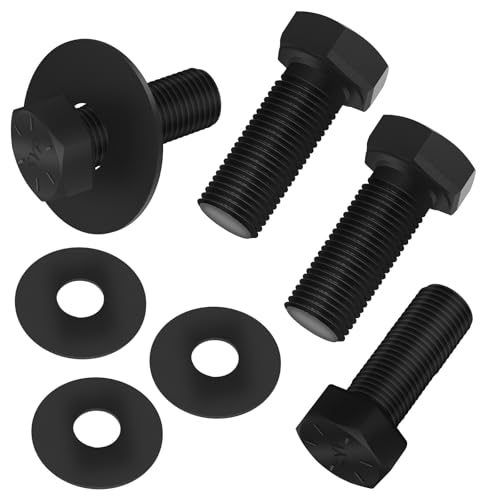
Securing a lawn mower blade requires more than simply choosing the correct thread direction. High-performance finish mower setups, such as King Kutter bolt kits, pair one-half-inch left-hand bolts with heavy-duty Belleville concave spring washers. These conical washers measure approximately one and one-half inches in diameter and function like a continuous mechanical spring. When torqued down, the concave shape flattens slightly, exerting persistent tension against the blade face to prevent slip. Reusing worn or flattened spring washers compromises holding tension, even when the bolt itself is threaded properly.
Thread pitch represents another vital dimension that property owners must verify before purchasing replacement hardware. Fasteners like the King Kutter 502310 replacement bolts utilize fine threads rather than standard coarse threads. A fine-thread bolt provides greater tensile strength and resistance to vibrational loosening than a coarse-thread equivalent. If a replacement listing states that the bolts are fine thread, attempting to force coarse-threaded hardware into the spindle hub will destroy the internal tapping. Always compare thread pitch, bolt length, and washer curvature with your original hardware before completing an installation.
Safe Removal and Installation Practices for Reverse-Threaded Blades
Removing a reverse-threaded mower blade requires steady mechanical leverage and strict safety precautions. Always disconnect the power source, whether that means pulling the spark plug boot, removing the safety key, or disconnecting the tractor power take-off shaft. Secure the blade firmly in place using a dedicated blade-locking clamp or a heavy wooden block wedged tightly against the deck wall. Never attempt to hold the sharp steel blade with your bare hand or a thin rag while applying leverage to a breaker bar. Once the blade is immobilized, turn the left-hand bolt clockwise to break the initial thread tension.
When installing replacement hardware or mounting fresh pre-sharpened mower blades, inspect the spindle face thoroughly for dirt, packed grass, and corrosion. Clean the mounting area with a stiff wire brush so the blade seats completely flat against the spindle hub. Thread the left-hand bolt or flange nut counterclockwise by hand for several turns to confirm the threads engage smoothly without cross-threading. Tighten the fastener to the manufacturer’s specified torque rating using a calibrated torque wrench rather than guessing with an impact gun. Proper torque prevents overtightening, which can stretch bolt shanks and warp delicate spindle flanges.
Common Mistakes When Servicing Unknown Spindle Threads
The most frequent mistake homeowners make is assuming every lawn mower uses standard right-hand threads. When a left-hand bolt resists loosening under normal counterclockwise pressure, operators often reach for longer cheater pipes or pneumatic impact wrenches. Applying extreme counterclockwise force to a left-hand bolt actually tightens the fastener past its yield strength, resulting in sheared bolt heads or cracked spindle castings. If a bolt refuses to budge after reasonable effort, pause and verify whether the spindle might be reverse-threaded. Checking the user manual or inspecting the other spindles on a multi-blade deck can prevent catastrophic hardware failure.
Another common pitfall involves confusing fine and coarse thread patterns when ordering replacement hardware online. Finish mower bolts with the same diameter and length can feature entirely different thread counts per inch. Forcing a mismatched thread pitch into a spindle tears away internal metal threads, requiring a costly spindle replacement. Property owners also frequently discard the concave Belleville washer or install it upside down against the blade. The concave side must face toward the blade surface to maintain dynamic spring pressure during heavy mowing conditions.
Verifying Replacement Part Numbers and Deck Compatibility
Purchasing replacement hardware requires matching exact manufacturer part numbers rather than relying on visual approximations. Part numbers like King Kutter 502310 and Sovema 900.102.254 identify specific dimensional tolerances, heat-treated grades, and thread orientations. Aftermarket sets from trusted suppliers provide exact replacements for four-foot, five-foot, six-foot, and seven-foot finish mowers across models like the FM5, FM6, CL075, and RFM series. Verifying that the replacement bolt matches your mower model suffix guarantees that the shank length seats properly through the blade center hole.
Taking a few minutes to inspect spindle rotation, verify part numbers, and confirm thread pitch ensures a trouble-free blade replacement process. Whether you are servicing a residential push mower with standard threads or a commercial finish mower utilizing left-hand fasteners, using the correct hardware protects both your equipment and your safety. Always double-check thread direction before applying heavy wrenching pressure under the deck. Reliable mowing performance starts with a securely fastened blade that stays tight through every seasonal yard maintenance task.





Write Your Review
No reviews yet. Be the first to share your experience!