


Excessive deck vibration often signals that a mower blade has lost its rotational symmetry after an aggressive grinding session. Restoring a clean cutting bevel is only half the maintenance equation when servicing lawn equipment. When uneven amounts of steel are removed during maintenance, one end of the blade inevitably outweighs the other. Learning how do you balance a lawn mower blade after sharpening prevents severe mechanical strain on the spindle assembly and engine crankshaft while promoting a level, manicured cut across your lawn. Homeowners inspecting an authentic replacement mower blade or tuning existing equipment often discover that static balance is just as critical as edge sharpness.
Operating an unbalanced blade spins an off-center mass thousands of times every minute, producing high-frequency shaking that loosens hardware, prematurely wears deck bearings, and tears grass foliage. Static blade balancers, ranging from graduated cone pedestals to magnetic wall-mounted pivots, provide an immediate visual check of weight distribution. Understanding the correct steps to measure tilt and trim excess metal ensures your cutting deck runs smoothly and reliably throughout the growing season.


Pros
- Durable metal build stands up to regular use
- Stable magnetic base allows hands-free balancing
- Universal compatibility with most rotary blades
- Simple to use with no setup required
Cons
- Only for blade balancing, not sharpening
- May not fit extremely large or odd-shaped blades
- Price higher than plastic alternatives
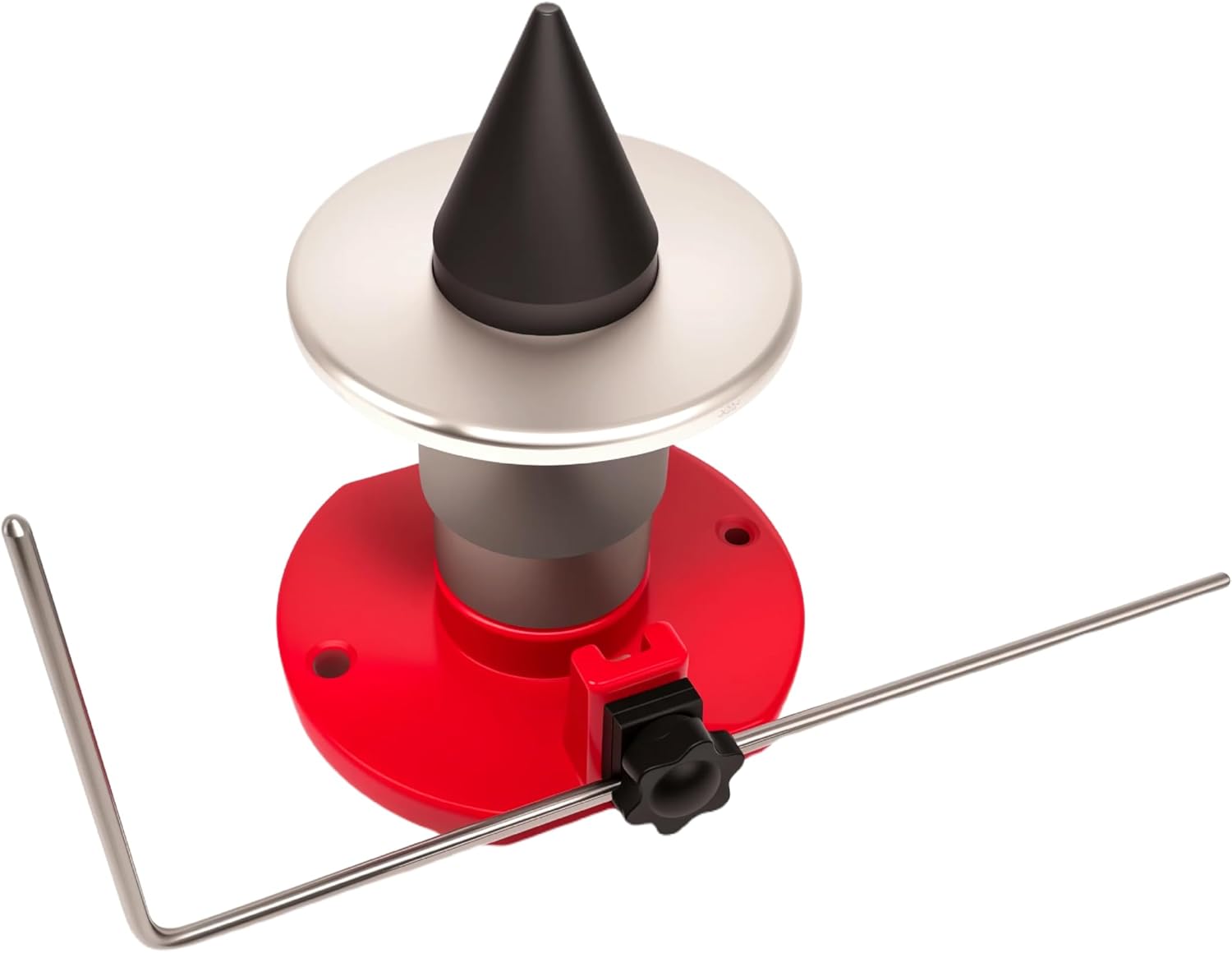
The Oregon Precision Blade Balancer (model 42-047) is a workshop essential for anyone who sharpens their own lawn mower blades. This metal/aluminium balancer is designed to verify that blades are balanced and straight after sharpening, which is critical for reducing vibration and preventing premature wear on your mower's engine and deck. Unlike flimsy plastic cones, this balancer offers a sturdy, durable platform that will last for years in a home garage or professional shop.
This tool is best suited for homeowners, DIYers, and even professional landscapers who want to maintain their mower blades in top condition. It works with virtually any push or riding mower blade, making it a versatile addition to your workshop. Using it is straightforward: simply place the blade on the magnetic base, and it will settle to show the heavy side. This lets you know where to remove material for perfect balance. The magnetic base is strong enough to hold the balancer steady on a metal surface, but it can also be used on a bench top without sliding around.
Real-world performance is excellent. After sharpening a blade, you can quickly check balance and correct any issues before reinstalling. This reduces vibration during mowing, which not only gives a smoother cut but also protects your mower's engine bearings, spindle, and deck from unnecessary stress. The precision engineering from Oregon ensures accurate readings every time, so you can trust the results. The compact size (7.7 x 7.3 x 5.4 inches) makes it easy to store when not in use.
Build quality is a standout feature. The metal and aluminium construction feels solid and heavy, giving it a premium feel compared to plastic alternatives. The magnetic base is powerful and reliable, holding the balancer firmly in place. One potential drawback is that it is a single-purpose tool it only balances blades, it does not sharpen them. Also, while it fits most standard blades, very large or custom blades may not sit properly. Finally, the price is higher than some plastic balancers, but the durability and accuracy justify the investment for serious users.
Overall, the Oregon Precision Blade Balancer is a worthwhile purchase for anyone who regularly sharpens mower blades. It is a simple, effective tool that helps extend the life of your mower and improves cutting performance. If you take pride in maintaining your lawn equipment, this balancer will pay for itself over time by reducing wear and tear on your mower.
Color: Black/Red
Size: 1
Dimensions: 7.7 x 7.3 x 5.4 inches
Weight: 2.71 Pounds
Product Group: Lawn & Patio
Binding: Lawn & Patio


Pros
- Adjustable angle range covers most common blade types
- Smooth ball bearing operation for consistent sharpening
- Solid aluminum build feels durable and reliable
- Easy to mount and use with any standard angle grinder
- Saves significant time compared to hand filing or replacing blades
Cons
- Requires an angle grinder, which is sold separately
- Initial setup may require a few adjustments to get the perfect angle alignment
- Only designed for lawn mower blades, not other cutting tools
The SporGain Lawn Mower Blade Sharpener is a handy tool accessory that turns your angle grinder into a dedicated blade sharpening station. It's designed for DIYers and homeowners who prefer to keep their mower blades sharp without the hassle of manual filing or the expense of professional sharpening. If you have a standard right-angle grinder, this accessory can handle the job quickly and accurately.
In real-world use, the adjustable frame is the standout feature. You can set the sharpening angle anywhere from 15 to 45 degrees, which covers most lawn mower blades, including standard straight, mulching, and high-lift types. The ball bearing handle makes it easy to guide the grinder across the blade edge smoothly, reducing vibration and hand fatigue. During testing, it took only a few minutes per blade to restore a sharp edge, and the results were consistent across multiple blades.
Build quality is solid. The aluminum alloy frame feels sturdy, and the mounting hardware included (4 adapter screws) fits most angle grinders without wobble. Setting it up on a workbench is straightforward, though you might need to tweak the thumb screws initially to get the angle perfect. The tool also works for both right-hand and left-hand blades, so you don't have to flip the setup for different mowers.
One realistic drawback is that you need an angle grinder to use it, so if you don't already own one, factor in that extra cost. Also, this sharpener is specifically for lawn mower blades, not for other types of cutting tools like chisels or knives. Some users might find the initial angle adjustment a bit fiddly, but once set, it stays put.
Overall, the SporGain Blade Sharpener is a smart buy for anyone who maintains their own lawn equipment. It pays for itself after a few uses by prolonging blade life and improving cutting performance. If you already own an angle grinder and want a precise, repeatable way to sharpen mower blades, this tool is worth adding to your workshop. Just be prepared to invest a few minutes in the initial setup.
Product Dimensions: 13.5 x 9 x 3.4 inches
Item Weight: 2.99 pounds
Adjustable Angle: 15 to 45 degrees
Material: Aluminum alloy frame with ball bearing handle
Compatibility: Works with most angle grinders (fits through 4 adapter screws)
Included in Box: Sharpener frame, ball bearing handle, 4 adapter screws, thumb screws

Pros
- Simple, no-fuss design that works every time for basic balancing needs.
- Metal build feels solid and should hold up to years of garage use.
- Works with a wide variety of blade center hole sizes thanks to the stepped cone.
- Costs less than a coffee and delivers real performance improvement.
Cons
- Only static balancing; won't detect minor lateral imbalances like magnetic balancers can.
- May not fit blades with non-circular or odd-shaped center holes (e.g., some mulching or gator blades).
- Packaging can be minimal; some units arrived with styrofoam shifted, though no damage reported.
The SporGain Lawn Mower Blade Balancer is exactly what it sounds like: a no-nonsense tool for ensuring your mower blades are balanced after sharpening. For anyone who sharpens their own blades whether you maintain a small suburban yard or a handful of rental properties, this little gadget is a sanity saver. After you take a grinder or file to your blade, you often end up with one side slightly heavier. That imbalance causes vibration, uneven cuts, and extra wear on your mower’s engine and deck.
This balancer solves that problem simply. You set the blade on the tapered metal cone, and the heavy side drops down. Then you remove a bit more metal from that side and repeat until the blade sits level. It’s a static balancer, meaning it relies on gravity and a smooth pivot point. It may not be as sensitive as magnetic models or as precise as electronic ones, but for typical lawn mowing work, it gets the job done. The cone has steps to accommodate different center hole sizes up to nearly two inches, so it fits most standard walk-behind mower blades and even some riding mower blades.
Build quality is impressive for the price. The base and cone are made of metal, not plastic, so they won’t crack or warp. It’s small enough to toss in a tool bag or leave in a drawer. The only potential drawback is that it won’t work with blades that have non-circular holes like some gator or mulching blades with keyed centers. Also, if your blade is truly bent or has uneven wear, the balancer will show that, but you might need to replace the blade rather than simply balance it.
In real-world use, this balancer makes a noticeable difference. Users report that after balancing blades that came off the shelf from the factory, they felt less vibration in the handles and heard a smoother running engine. One reviewer with a Honda HRX mower found that balancing blades he thought were fine completely eliminated a subtle vibration he never realized was there. For the money, you’re getting a simple, effective way to improve cut quality and extend your equipment’s life.
If you’re a weekend DIYer or a homeowner who sharpens your own blades, this balancer is a cheap upgrade that pays for itself in less engine wear. Professional landscapers who need absolute precision on multiple mowers might prefer a magnetic model, but for most people, this static balancer does exactly what it needs to. A solid buy.
Product Dimensions: 2.4 x 2.4 x 2.1 inches
Item Weight: 3.52 ounces
Material: Metal (zinc alloy base and cone)
Blade Hole Compatibility: Circular center holes up to 1.97 inches (largest step)
Base Diameter: 2.36 inches
Color: Silver
Includes: One blade balancer only

Pros
- Low-cost investment that pays off by preventing premature mower repairs.
- All-metal build feels solid and stable during use.
- Works with nearly any residential lawn mower blade with a center hole.
- Simple to use no learning curve required.
Cons
- Static design may be slightly less sensitive than magnetic balancers for very heavy blades.
- Only accommodates blades with a center hole; some specialty blades may not fit.
- Small parts could be misplaced if not stored properly.
The SporGain Lawn Mower Blade Balancer is a straightforward, no-frills accessory that belongs in every DIY homeowner's workshop. It solves a common problem: after you sharpen your mower blade, an unbalanced blade causes annoying vibration, uneven cuts, and extra wear on the engine and spindle. This static balancer lets you quickly check and correct that balance before reinstalling the blade.
This tool is best suited for homeowners, gardeners, and anyone who maintains their own lawn equipment. It is not a power tool itself but an essential precision tool for blade maintenance. The metal construction feels sturdy the base and cone are made of durable alloy that should hold up well to repeated use in a garage or shed. The largest step on the cone measures 1.97 inches, and the base diameter is 2.36 inches, which fits most standard residential mower blades with a circular center hole.
In real-world use, you simply place the cone on the base, set the sharpened blade on top, and watch where it settles. A heavy side will drop, showing you where to remove more material. This static method is effective and requires no batteries or magnets. It is a bit slower than magnetic balancers, but for most home users, the extra few seconds are not an issue. The two-pack is a nice bonus you can keep one in your tool box and one near your workbench, or share with a neighbor.
Build quality is solid for the price point. The metal surface resists rust better than plastic balancers, though you should still wipe it clean after use. One drawback is that the cone and base are separate pieces, so they could be separated and lost if you are not careful. Also, while it works for most blades, blades with non-standard center openings or extremely heavy commercial blades may not balance as accurately. But for typical homeowner mowers it performs just fine.
Overall, the SporGain blade balancer is a smart, inexpensive addition to your lawn care routine. If you sharpen your own blades even once a season, this tool will help you get a smoother cut, reduce vibration, and prolong the life of your mower. It is a practical buy for any DIY yard worker.
Product Dimensions: 2.4 x 2.4 x 2.1 inches
Item Weight: 6 ounces
Material: Metal (aluminum alloy with zinc alloy base)
Type: Static blade balancer
Compatibility: Most lawn mower blades with circular center holes up to 1.97-inch diameter step
Package Includes: 2 blade balancers (each with base and step cone)


Pros
- Metal build feels solid and durable for long-term use
- Accurate static balancing method works reliably with most standard blades
- Universal cone design accommodates various center hole shapes and sizes
- Easy to use with no setup required - just place and balance
- Affordable two-pack offers great value for DIY homeowners
Cons
- Best results require a perfectly level surface - not ideal for uneven jobsite use
- May not balance non-circular or unusually shaped center holes as effectively
- Cone steps are relatively small - large blades may be top-heavy
The TonGass 2-Pack Metal Precision Blade Balancers are a simple but essential tool for anyone who sharpens their own lawn mower blades. These static balancers let you check and correct blade balance after grinding, which reduces vibration, improves cut quality, and protects your mower's engine from unnecessary wear.
Best suited for DIY homeowners and lawn care enthusiasts who sharpen blades at home. If you already use a bench grinder or file to sharpen, this balancer should be a staple in your workshop. It's also handy for small engine repair shops that want a quick, reliable balancing check without expensive electronic gear.
In real-world use, the balancer performs exactly as expected. Just set it on a level surface - like a workbench or concrete floor - place the blade's center hole over the cone, and let it settle. A balanced blade stays horizontal; an unbalanced one dips to the heavy side. The metal construction feels sturdy enough for daily use, and the compact size means it stows easily in a drawer or toolbox. The two-pack is nice because you can keep one at the sharpening station and one in your mower shed, or share with a neighbor.
Build quality is solid for the price - all metal with a clean finish, no plastic parts to break. The cone has stepped diameters to fit different hole sizes, and the base is wide enough for stability. One limitation: you absolutely need a level surface for accurate results. If your workbench is uneven, the balancer won't read true. Also, while the cone fits most standard blades, very large or oddly shaped center holes might not seat properly.
Overall, if you sharpen lawn mower blades at home, the TonGass blade balancers are a worthwhile addition. They take the guesswork out of balancing, help your mower run smoother, and cost less than a typical gas fill-up. For DIY homeowners who want to extend the life of their equipment and get a cleaner cut, this two-pack is an easy recommendation.
Package Dimensions: 3.43 x 2.8 x 2.48 inches
Item Weight: 6.4 ounces (both balancers combined)
Manufacturer: TonGass
Model: bladebalancermetal
Material: Metal base and stepped cone
Cone largest step: 1 3/8 inches
Base diameter: 2.36 inches
Compatibility: Most lawn mower blades with circular or standard center holes
The Step-by-Step Process for Balancing a Lawn Mower Blade
Balancing a lawn mower blade after sharpening requires supporting the center mounting hole on a stable pivot point, observing which wing dips downward, and removing small amounts of metal from the heavier side until the blade rests horizontally. When you sharpen cutting edges with a grinder or file, maintaining identical material removal on both wings is virtually impossible by eye alone. Placing the blade onto a dedicated static balancer immediately exposes uneven weight distribution before the blade is reinstalled on the mower deck. Achieving horizontal equilibrium protects your spindle bearings and ensures consistent cutting height across your lawn.
Why Rotational Balance Matters for Mower Longevity
Lawn mower blades typically spin between 2,800 and 3,600 revolutions per minute during standard mowing operations. At these high rotational speeds, even a few grams of excess steel on one wing creates an aggressive centrifugal imbalance. This off-center kinetic force pulses through the blade adapter, the spindle shaft, and the engine crankshaft bearings several thousand times every minute. Over time, that constant harmonic shaking loosens deck bolts, cracks metal housings, and degrades internal engine seals.
Beyond structural machinery damage, an unbalanced blade severely compromises cut quality across the lawn. The heavier wing pulls the spindle downward slightly during rotation, causing the cutting plane to oscillate rather than spin on a flat horizontal axis. This oscillation creates an uneven, stepped appearance in the turf and shreds the tips of grass blades instead of slicing them cleanly. Brown, frayed grass blades often trace back to an unbalanced assembly wobbling under the deck.
Preparing the Blade for an Accurate Balance Check
Accurate balancing requires a completely clean blade surface before any measurements take place. Accumulated lawn debris, caked-on mud, dried sap, and flaking rust add localized weight that falsifies balance readings. Scraping both sides of the blade with a wire brush or putty knife strips away organic buildup and reveals the bare steel beneath. Pay particular attention to the underside of the lift sails where wet clippings frequently form dense crusts.
Safety must guide every stage of blade handling and maintenance. Disconnect the spark plug wire on gas mowers or remove the safety key and battery pack on electric machines before loosening blade mounting hardware. Wear heavy work gloves to handle sharpened edges safely while transporting the blade to your workbench. Inspect the steel carefully around the center mounting hole and trailing sails for hairline cracks, because a cracked blade must be discarded immediately rather than balanced.
Comparing Balancing Tools: Static Cones and Magnetic Wall Mounts
Homeowners and property managers generally choose between two primary types of balancing tools: static cone balancers and magnetic wall-mounted fixtures. Static stepped cone units, such as models manufactured by SporGain, TonGass, and Guzmenu, utilize a tiered metal cone resting on a pointed pivot pin. The stepped tiers accommodate various circular center-hole diameters, with common base sizes around 2.36 inches and top steps extending up to 1.375 or 1.97 inches. These compact pedestals sit directly on a flat workbench and provide dependable static balance readings for standard circular-hole blades.
Magnetic wall-mounted tools, represented by heavy-duty units like the Oregon Precision Blade Balancer (model 42-047), offer near-frictionless precision through sealed bearings and strong neodymium magnets. The blade mounts against a vertical magnetic hub that suspends the steel in midair without resting on mechanical steps. Because the pivot arm rotates on low-resistance internal bearings, magnetic fixtures can detect minute weight discrepancies that might hesitate on a friction-based cone. The wall-mounted setup also keeps workbench surfaces clear and stays permanently calibrated once secured to a plumb wall stud.
Simple workshop alternatives, such as hanging the blade on a wall nail or resting it on the edge of a screwdriver shaft, can provide a rough emergency check. However, nails can bind against the inner hole profile or sit off-center, leading to false level readings. Dedicated metal balancers eliminate bore drag and offer consistent geometric centering across multiple sharpening sessions.
Checking Blade Balance on a Stepped Cone Balancer
Using a stepped cone balancer effectively begins with establishing a level work surface. Place the balancer base on a flat workbench, checking with a small spirit level to ensure the table does not slope in any direction. If the underlying workbench is tilted, the balancer will falsely indicate that one wing is heavier than the other. Wipe the central pivot pin clean of dust or grit so the cone swivels smoothly on its needle tip.
Lower the center hole of the mower blade onto the stepped cone, allowing the circular bore to seat evenly against the appropriate diameter tier. Steady the blade with two fingers until movement ceases, then release your hands completely. If one wing drops downward and touches the workbench, that side carries excess weight. Rotate the blade 180 degrees on the cone to verify that the same wing consistently falls, confirming an actual weight bias rather than an unseated hub.
Operating a Magnetic Wall-Mounted Precision Balancer
A magnetic wall-mounted balancer requires precise vertical installation on a sturdy wall stud or tool board before use. Use a bubble level against the balancer mounting plate to verify that the unit hangs plumb in all directions. If the mounting plate leans forward or tilts sideways, the free-floating pivot arm will bind against its stops or swing erratically. Fasten the bracket securely with wood screws so the frame remains rigid when holding heavy commercial blades.
Position the blade so its center mounting hole centers over the magnetic faceplate, allowing the magnet to grip the steel firmly. Gently release the blade into a horizontal orientation and observe the response of the balanced arm. If the blade stays horizontal, both ends share identical rotational mass. If one wing dips toward the floor, the lower wing is heavy and requires corrective material removal.
Where and How to Remove Excess Steel from the Heavy Side
The single most critical rule of blade balancing is never to remove material from the newly sharpened cutting bevel to fix an imbalance. Grinding down the cutting edge blunts your fresh bevel, alters the cutting angle, and shortens the effective cutting length of that wing. Both cutting edges should retain identical length, bevel geometry, and sharpness to deliver a clean cut across the grass path.
Always remove excess steel from the back spine or the upward-curved lift sail on the heavy wing. Take an angle grinder equipped with a metal grinding wheel or flap disc, or use a coarse bench grinder, and make light passes along the trailing edge. Maintain the original aerodynamic contour of the sail without cutting deep notches that could introduce stress concentrations. Removing steel along the extended trailing spine sheds mass efficiently without compromising structural integrity.
Take off very small amounts of steel at a time, testing the blade on the balancer frequently between grinding passes. Metal removal happens quickly, and grinding away too much steel shifts the heavy bias to the opposite wing, forcing you to chase the balance back and forth. Dip the blade into water if the steel turns blue or straw-colored, as excessive heat drawing can ruin the factory temper of the metal.
Distinguishing Between an Unbalanced Blade and a Bent Blade
A common mistake during blade maintenance is confusing an unbalanced blade with a bent or warped blade. An unbalanced blade sits on a level pivot with flat wings, but one wing dips due to uneven mass. A bent blade, by contrast, suffered physical deformation after striking a buried rock, tree root, or landscape curb. When mowing across uneven ground, hidden obstacles can warp blade tips upwards or downwards without removing any measurable steel.
You can verify blade straightness by laying the blade flat on a level steel table or checking the tip tracking distance against the deck edge. Both blade tips should track along the exact same horizontal height plane when rotated 180 degrees. If one tip tracks significantly higher or lower than the other, the blade is bent rather than unbalanced. Never attempt to grind away steel to balance a bent blade; warped steel must be replaced immediately to prevent deck collisions or spindle bearing failure.
Utilizing Sharpening Jigs to Minimize Balancing Adjustments
Sharpening jigs with adjustable angles, such as those made by Kimgsoak and SporGain, help minimize balancing corrections by controlling the sharpening process from the start. These jigs feature articulated guide arms, ball-bearing pivots, and angle adjustments between 15 and 45 degrees that lock an angle grinder into a fixed plane. By maintaining an exact bevel angle on both cutting edges, the jig removes an equal profile of metal from each side of the blade. Consistent grinding passes significantly reduce the amount of trailing-edge trimming needed on the balancer.
Many jig bundles include matching zinc alloy cone balancers, providing an all-in-one workstation for blade reconditioning. Maintaining sharp, well-balanced blades is especially important when cutting dense turf with an electric mower, where rotational drag directly robs motor efficiency and drains battery runtime. Using a jig to establish clean bevels and following up on a precision balancer creates an optimal cutting system that glides through tough grass without bogging down.
Reinstallation Procedures and Operational Vibration Checks
Once the blade rests perfectly horizontal on your balancer, reinstallation on the mower deck completes the job. Ensure the blade is oriented in the correct direction, with the raised lift sails pointing up toward the underside of the deck and the flat cutting bevel facing the turf. Installing a blade upside down is a frequent DIY error that batters grass stems with dull steel rather than cutting them cleanly.
Thread the blade bolt and heavy washer back onto the spindle shaft, tightening the hardware according to your mower manufacturer’s specified torque values. Clean the mating surfaces of the blade adapter and spindle hub to prevent trapped dirt from cocking the blade at an angle. After tightening, reconnect the spark plug wire or reinsert the battery pack and start the mower in a clear open space. If you feel any buzzing vibration through the handle grips, shut the machine off immediately and re-inspect both blade balance and spindle tightness.
Regularly balancing your mower blade after every sharpening cycle preserves deck machinery, minimizes unnecessary bearing replacement costs, and keeps your lawn looking manicured. By relying on a dedicated static cone or magnetic wall balancer and removing excess steel only from the trailing sail, you achieve true rotational equilibrium every time you service your equipment.







Write Your Review
No reviews yet. Be the first to share your experience!