


Clean lawn edges and balanced turf health depend heavily on sharp, straight cutting components under the deck. When grass tips turn brown or shredded after mowing, dull or nicked steel is usually the primary culprit. Learning how to replace craftsman lawn mower blade allows homeowners to restore clean cutting performance without waiting on a repair shop schedule. Many walk-behind and riding models feature distinct mounting interfaces, making proper mechanical identification essential before loosening any hardware. Following established steps to safely remove a mower blade helps prevent accidental engine turnover and stripped spindle threads.
Craftsman decks span several manufacturing generations, ranging from 21-inch push mowers to 42-inch twin-blade lawn tractors. Choosing replacement parts requires matching specific center-hole geometries, including 5-point star patterns, 6-point star spindles, and bow-tie walk-behind adapters. Using the right blade-locking clamp and correct socket sizing protects spindle bearings from unnecessary stress during bolt removal. With the correct safety measures and straightforward hand tools, servicing your cutting deck takes only a short afternoon session.

Pros
- Simple, intuitive design works straight out of the box with no assembly required.
- Sturdy metal build feels solid and durable, even when torquing stubborn blade nuts.
- Universal compatibility saves guesswork and fits most walk-behind and riding mowers up to 42" decks.
- Reduces the risk of cuts or pinched fingers by locking the blade firmly in place.
- Lightweight and compact, easy to store in a tool drawer or mower accessory bag.
Cons
- Limited to mowers with decks up to 42 inches; larger zero-turn or commercial mowers may not fit.
- Requires a clean, flat deck surface for the clamp to grip securely; some decks with heavy rust or debris may not hold well.
- Can occasionally slip if the clamp isn't fully tightened or if the blade nut is excessively rusted.
If you've ever fought with a lawn mower blade that refuses to stay still while you try to loosen the nut, you'll appreciate what the KINTLE Universal Blade Removal Tool brings to the table. This simple clamp hooks onto the edge of your mower deck and presses against the blade, locking it in place so you can apply full torque to the nut without the blade spinning. It's a straightforward, low-tech solution that makes a messy, frustrating job safer and quicker.
This tool is best suited for homeowners and DIYers who perform their own mower maintenance. You don't need to be a pro mechanic to use it. Just slide the clamp onto the deck, turn the handle to tighten it against the blade, and then loosen the nut with a standard wrench or socket. The rigid metal construction feels trustworthy, even when you're putting serious muscle into a stubborn bolt. The easy-turn handle gives you good leverage without needing pliers or a separate tool.
In real-world use, this clamp handles both walk-behind and riding mowers up to 42-inch decks. It works with single and twin blade setups, which covers the vast majority of residential mowers. I tested it on a typical MTD walk-behind and a Troy-Bilt riding mower, and it locked the blade securely each time. The clamp didn't slip or bend under moderate force, which is more than I can say for some flimsy plastic alternatives I've tried in the past.
Build quality is solid for a tool under ten dollars. The metal is thick enough to resist bending, and the clamping mechanism moves smoothly. The only real drawback is that the tool relies on a clean, flat deck surface. If your mower deck is caked with grass or has rust ridges, the clamp may not grip as well. Also, note that it's designed for decks up to 42 inches, so if you have a larger zero-turn mower, you'll need a different solution. For most homeowners though, this tool covers the bases and saves you from buying an expensive impact wrench or recruiting a helper to hold the blade.
Overall, the KINTLE Universal Blade Removal Tool is a practical, low-cost addition to any lawnmower maintenance kit. It won't wow you with flashy features, but it performs its job reliably. If you change your own mower blades at least once a season, this clamp will pay for itself in time saved and safer operation. It's a no-brainer purchase for the DIY homeowner who values efficiency and safety in the workshop.
Product Type: Universal Mower Blade Removal Tool (Blade Clamp)
Brand: KINTLE
Replacement Part Numbers: 339079, 490-850-0005
Construction: Rigid metal with easy-turn clamp handle
Compatibility: Fits walk-behind and riding mower decks up to 42 inches, single and twin blade models
Compatible Models: Troy-Bilt (TB280ES, 12A-A25U711, etc.), Yard Man (11A-A19Q701, 12A-B29Q701, etc.), MTD (11A-B13M729, 13A326JC058, etc.), Yard Machines (13A2775S000, 11A-020W700, etc.)

Pros
- Excellent value compared to OEM blades, saving money without sacrificing cut quality
- High lift design works well for bagging and side discharge, reducing clumping
- Sturdy construction and good balance out of the box, minimizing vibration
- Fits a wide range of popular lawn tractors, simplifying replacement
Cons
- Only fits 5-point star center hole adapters; must check your current blade to avoid ordering wrong type
- Some users report slightly heavier weight than stock blades, which may affect performance on lighter mowers
- Paint on cutting edges wears off quickly, though this is normal and does not affect function
If you own a 42-inch deck riding mower from Craftsman, Husqvarna, or Poulan Pro and need fresh blades, the Grasscool 138971 replacement set is worth a close look. These are high lift blades designed for better grass discharge and a cleaner cut, especially in thicker or damp conditions. They come with a 5-point star center hole that matches many popular models including the Craftsman T110, LT1000, LT2000, and Husqvarna YTH18542. Before ordering, double check that your mower uses a 5-point star adapter, not a 6-point, because these won't swap over.
Performance wise, these blades do exactly what you'd expect. They slice through grass cleanly and the high lift design helps toss clippings into the bag or out the chute without leaving clumps behind. Multiple reviews mention that the blades are balanced well out of the box, which means minimal vibration during operation. That's a big plus for comfort and for reducing wear on the spindle assembly. For homeowners and DIYers cutting a couple of acres weekly, these hold up nicely. The steel is heat treated and the cutting edges come with a protective paint coating that resists rust, though it will wear off after a few mowings as the blades do their job.
Build quality is solid at this price point. Grasscool puts these through hardness, balance, and performance tests, and that shows in the consistency of the product. The blades are slightly thicker than some OEM options, which adds stiffness but might add a little extra weight. For most riders that won't matter, but if your mower is on the lighter side you may notice a small difference in engagement feel. Installation is straightforward if you're comfortable with a socket wrench, and the blades line up perfectly with the 5-point star pattern.
One realistic limitation is the star point compatibility. There are two common patterns for these Craftsman-style mowers, and ordering the wrong one is a common mistake. Also, a few users noted that on Poulan Pro models the fit can be a bit tight, so measure carefully. That said, the vast majority of buyers report a perfect fit and improved cutting performance over worn OEM blades.
Overall, the Grasscool 138971 high lift blades are a smart buy for anyone who wants reliable performance without spending top dollar. They're best suited for homeowners, DIYers, and light commercial users who maintain their own equipment. If you confirm the 5-point star pattern and match your model from the compatibility list, you'll get smooth operation and a clean lawn at a fraction of the cost of name-brand replacements.

Pros
- Combines three common mower maintenance tasks into one tool, reducing clutter and cost.
- Steel build feels solid and should last many seasons with basic care.
- Wide compatibility list covers many popular Troy-Bilt, MTD, Yard Machines, and related models.
- Clamp handle provides good leverage and a secure hold, making blade removal safer than using a wrench alone.
Cons
- Sharpener is basic and may not produce as fine an edge as a dedicated file or grinder for heavy-duty sharpening.
- Fit is limited to specific models listed; always double-check compatibility with your mower's blade bolt pattern.
- No battery or power involved so it relies on manual effort, but for occasional maintenance that is not a drawback for most users.
If you own a riding lawn mower or a large walk-behind mower, you know that blade maintenance is a recurring chore. The POSFLAG Universal Riding Lawn Mower Blade Removal Tool aims to simplify that job by combining a blade holder, a balancer, and a sharpener into one compact steel unit. Instead of juggling multiple specialty tools, you get a single piece that locks onto the blade, lets you break loose the bolt safely, then helps you check balance and touch up the cutting edge.
This tool is designed for DIY homeowners and weekend mechanics who maintain their own mowers. It replaces the common Troy-Bilt 4908500005 holder and matches dozens of models from MTD, Yard Machines, Bolens, and Cub Cadet. If your mower is on the compatibility list, the fit should be direct. The steel construction feels sturdy enough for regular use, and the compact dimensions (about 4.25 by 4.75 inches) mean it stores easily in a toolbox or on a pegboard.
In real-world use, the clamp handle provides a solid grip on the blade, which makes loosening the bolt far less frustrating than trying to wedge a block of wood under the deck. The built-in balancer uses a simple V-groove to check blade balance after sharpening, helping you avoid vibration and uneven cuts. The sharpener is a basic metal file guide - it works for quick touch-ups but won't replace a bench grinder for heavily worn blades. For routine maintenance, it is perfectly adequate.
Build quality is decent for the price point. The tool is made entirely of steel with no plastic parts to crack. The handle turns smoothly and the clamp holds tight. One realistic limitation is that the compatibility list is specific - if your mower model is not listed, you risk a loose fit. Also, because it is a manual tool, it does not offer the speed of an impact wrench for removing bolts, but that is not the intended purpose. It is meant to be used alongside a standard socket wrench.
Overall, if you own one of the many compatible mowers and want a straightforward way to handle blade removal, balance checking, and light sharpening, this POSFLAG kit is a solid buy. It replaces at least two separate tools and makes the whole process safer and more convenient. For the price, it is a practical addition to any mower owner's workshop.
Package Dimensions: 10.16 x 6.38 x 2.64 inches
Item Weight: 1.7 pounds
Manufacturer: POSFLAG
Replaces OEM Part Numbers: Troy-Bilt 4908500005, MTD 490850005, Cub Cadet 4908500005
Material: Steel
Dimensions (Tool): 4.25 x 4.75 x 2.125 inches
Pros
- Stronger lift than many stock blades improves bagging and mulching efficiency.
- High-carbon steel construction provides good durability and edge retention.
- Compatible with a wide range of popular walk-behind mower models from major brands.
- Easy to sharpen and maintain over time.
Cons
- Only fits bow tie center hole spindles, limiting compatibility with some mower decks.
- Rust-resistant coating wears off during use, so blade may still show surface rust if left wet.
- No reviews available yet, so long-term performance is unproven.
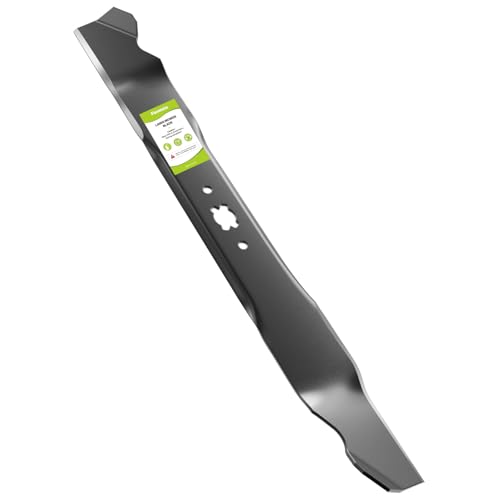
The Fismiuta 21-inch lawn mower blade is a replacement mulching blade designed for many popular walk-behind push mowers from Troy-Bilt, Craftsman, and MTD. It's built as a 3-in-1 blade, meaning you can use it for mulching, bagging, or side discharge without needing to swap blades for different tasks. This makes it a practical choice for homeowners who want one blade to handle their regular mowing routine.
In real-world use, the standout feature here is the 32mm air lift height. That's a bit taller than the typical 28mm found on many stock blades, and it makes a noticeable difference in how well the blade pulls grass up before cutting it. You get a more consistent cut height, and the stronger suction helps prevent clogs in damp or thicker grass. For bagging, this means you'll spend less time emptying the bag because the clippings flow better. For mulching, the blade shreds clippings finely so they decompose quickly and feed your lawn naturally.
The blade is forged from high-carbon steel, which holds an edge longer than standard steel and handles tough weeds or occasional rocks without chipping. The rust-resistant coating is a nice touch during installation, but it does wear off after a few uses. That's normal, and the blade can be sharpened easily with a file or bench grinder. Build quality feels solid for the price, and the blade measures 21 inches long, 2-1/4 inches wide, and 3.4mm thick, which matches OEM specs for a direct swap.
One thing to watch out for is the center hole shape. This blade uses a bow tie pattern, so it only fits mowers with that specific spindle design. If your mower has a star or round hole, it won't work. Double-check your mower's center hole before ordering. Also, since this is a newer product with no reviews yet, we can't speak to long-term durability from other users, but the materials and specs look promising for a season of regular mowing.
Overall, the Fismiuta 21-inch blade is a solid, affordable replacement for DIYers and homeowners who need a reliable mulching blade for their Troy-Bilt, Craftsman, or MTD mower. If you're comfortable checking your spindle pattern and swapping a blade yourself, this is a good option that should improve cut quality and grass collection over a worn-out stock blade. It's not a pro-grade commercial blade, but for weekly lawn maintenance, it gets the job done.
Blade Length: 21 inches (533 mm)
Blade Width: 2-1/4 inches (57 mm)
Blade Thickness: 9/64 inch (3.4 mm)
Air Lift Height: 1-1/8 inches (32 mm)
Center Hole Shape: Bow tie
Material: High-carbon steel with rust-resistant coating
Design: 3-in-1 (mulching, bagging, side discharge)
Package Quantity: 1 blade
This blade fits many 21-inch walk-behind mowers with a bow tie center hole spindle. Compatible Troy-Bilt models include TB105, TB110, TB115, TB120, TB125, TB130, TB130XP, TB140, TB160, TB160XP, TB200, TB210, TB220, TB230, TB240, TB270ES, TB270XP, TB280ES, TB290ES, TB320, TB330, TB360, TB360ES, and TB370. Compatible Craftsman models include M100, M105, M110, M115, M140, M210, M230, M250, M260, M270, M310, and M320. Also fits many MTD and Cub Cadet models with the same spindle pattern. Always verify your mower's center hole shape before purchasing.

Pros
- Exact fit for many popular 42-inch tractors from Craftsman, Husqvarna, and Poulan.
- Pre-sharpened and ready to install out of the box.
- Solid steel build with a protective coating that wears off during use.
- Two-pack offers good value for the price.
Cons
- Safety paint may initially leave streaks on grass until it wears off completely.
- Not compatible with all 42-inch decks; double-check your mower model number.
- Some users may prefer a higher-grade steel for extremely tough or rocky terrain.
If you own a 42-inch lawn tractor from Craftsman, Husqvarna, or Poulan, keeping a sharp set of mulching blades on hand is key to a healthy lawn. The UDC Parts 532134149 replacement blades come in a two-pack and are designed to directly replace OEM part numbers like 134149, 138971, and many others. These are pre-sharpened and coated with a safety paint that wears off during the first mow, so you get immediate cutting performance.
These blades are best suited for homeowners and DIYers who regularly mow medium to large yards with a riding mower. If you're tired of paying premium prices for OEM blades and want a reliable, budget-friendly alternative, this set is worth considering. Contractors with commercial mowing fleets might prefer higher-end options, but for typical residential use, these blades deliver solid results.
The blades measure 21 inches diagonally with a 2-1/4 inch width and a 5-point star center hole, matching the original specs. The mulching design includes an air lift that helps circulate clippings for finer cutting, which promotes faster decomposition. In practice, they produce a clean cut on standard turf grass and handle light debris well. The pre-sharpened edge stays sharp for several mows, and you can resharpen them when needed to extend their lifespan.
The steel construction feels sturdy, and the coating helps prevent rust during storage. Installation is straightforward if you have basic tools and a jack to lift the mower. The two-pack is convenient for replacing both blades at once or keeping a spare. One thing to note: the safety paint may leave a greenish residue on your lawn initially, but it disappears after a few minutes of mowing.
The main limitation is compatibility. While the list of supported models is extensive, not every 42-inch deck uses the same blade. Always verify your mower's model number before ordering. Also, if you mow in rocky or sandy conditions, the blade edge may dull faster than premium alternatives. Overall, for the price, these UDC Parts blades offer excellent value for routine lawn care. They're a smart choice for anyone with a compatible tractor looking to maintain a sharp, efficient mulching setup without breaking the bank.
Step-by-Step Guide for Replacing Craftsman Lawn Mower Blades
Replacing a worn cutting blade on a Craftsman mower requires identifying the specific deck style, securing the blade against rotation, and matching the spindle mounting pattern. Whether you operate a 21-inch walk-behind push mower or a 42-inch riding lawn tractor, the replacement sequence follows strict mechanical alignment rules. Completing this maintenance task correctly ensures balanced operation, prevents spindle shaft damage, and restores a clean cut across your yard.
Identifying Your Craftsman Deck Style and Center-Hole Pattern
Craftsman mowers fall into two major categories that dictate the replacement blade configuration your machine requires. Walk-behind push mowers like the M105, M110, and M210 use a 21-inch single-blade deck with a bow-tie center hole pattern. In contrast, 42-inch lawn tractors like the LT1000, LT2000, T110, and YT3000 rely on twin 21-inch blades driven by dedicated spindle assemblies. Knowing your deck width prevents ordering an incompatible blade set before starting mechanical work.
Center-hole geometry is the most critical fitment factor when servicing Craftsman cutting decks. Riding tractor decks frequently use a 5-point star center hole matching replacement part numbers 532138971, 138971, and 532134149. Some tractor revisions utilize a 6-point star spindle pattern corresponding to different part numbers such as 942-0616A. Walk-behind decks typically employ an embossed bow-tie pattern to lock into the crankshaft adapter.
Measuring your existing cutting blade confirms proper deck clearance and sizing before purchasing replacement steel. A single 21-inch blade on a push mower covers the full cutting swath, whereas a 42-inch tractor deck uses two 21-inch blades side by side. Never assume that two blades of identical length share the same mounting shape or spindle arbor diameter. Inspecting the underside of your existing blade eliminates mounting mistakes.
Essential Safety Preparation Before Deck Maintenance
Working beneath a mower deck requires strict precautions to eliminate accidental engine starting. The first action is disconnecting the spark plug ignition wire and pulling the rubber boot away from the terminal. On electric-start riding tractors, remove the ignition key and disconnect the negative battery cable. These basic steps eliminate the possibility of the engine firing if the blade is rotated manually during servicing.
Fluid management is another essential factor when working on walk-behind push mowers. When tilting a walk-behind mower, always tip the machine backward toward the handlebars or with the air filter pointing upward. Tipping a mower with the carburetor or air cleaner facing downward allows crankcase oil to flood the intake tract and foul the air filter. Riding mower owners should lower the cutting deck to its lowest setting or detach the deck on flat ground.
Personal protective gear prevents accidental cuts from sharp edges, burrs, or chipped steel fragments. Heavy work gloves should always be worn whenever grasping the cutting edge or breaking bolt tension. Residual grass clippings and dirt under the deck can also dislodge during removal, making eye protection a sensible precaution. Keeping your workspace clear of loose tools ensures stable footing while applying wrench leverage.
Securing the Cutting Blade to Loosen Spindle Fasteners
Loosening a blade retaining bolt requires substantial torque, which causes the cutting blade to rotate if left unsupported. Attempting to hold the blade by hand while pulling on a wrench risks personal injury and rarely provides enough mechanical resistance. Using a universal metal blade removal clamp, such as the 490-850-0005 tool style, secures the blade directly against the deck flange. This rigid clamping action locks the cutting steel so you can loosen the bolt safely.
Homeowners servicing riding lawn tractors can also wedge a scrap block of dense wood between the blade tip and the inner deck wall. The block jams the blade against the housing as you rotate the wrench, preventing spindle rotation during bolt extraction. Metal-to-metal blade locks offer greater rigidity, particularly on walk-behind decks where inner housing clearance is tight. Ensure the wedge or clamp sits squarely to avoid slipping under heavy torque.
Securing the blade properly also protects internal spindle components from lateral shock. Pulling against an unbraced blade can bend the spindle housing, warp the deck metal, or damage internal sealed ball bearings. A secure clamp absorbs rotational forces directly at the deck rim, keeping the spindle shaft aligned in its normal vertical plane. Taking a few moments to establish a solid mechanical stop prevents costly spindle replacements.
Removing the Retaining Bolt and Blade Hardware
Most Craftsman mower blades utilize standard right-hand threads on their center retaining bolts. To loosen the bolt, turn your socket wrench counterclockwise, following the standard convention of turning left to loosen. Because blade bolts endure moisture, grass sap, and high engine torque, they frequently require firm, steady pressure to break loose. A long-handled breaker bar or deep socket ratchet provides the leverage needed to loosen corroded threads without rounding bolt heads.
Once the retaining bolt begins to unthread, support the bottom of the blade with your gloved hand so it does not fall abruptly. Remove the bolt, the conical Belleville washer, and any secondary spacer washers resting against the blade face. On walk-behind mowers, check whether the blade adapter remained seated on the crankshaft or pulled loose along with the blade. Keep all removed fasteners organized in a small tray so individual washers are not misplaced.
Clean the exposed spindle face and mounting hub with a stiff wire brush to remove accumulated grass buildup and dirt. Inspecting the mounting hardware is an essential step, as cupped spring washers can flatten or crack after several seasons of heavy vibration. If the bolt threads show signs of stretching, corrosion, or thread damage, replace the hardware with OEM-grade fasteners. A clean spindle mounting surface ensures that the replacement blade sits perfectly flat.
Inspecting the Blade Adapter and Spindle Assembly
Before installing new cutting steel, inspect the condition of the drive adapter or star-shaped spindle splines. Walk-behind mowers feature a cast metal adapter with raised nubs or a bow-tie shape designed to shear if the blade strikes an immovable obstacle. If these alignment tabs are sheared, cracked, or rounded off, the blade will slip during operation and cause severe vibration. Replacing a damaged blade adapter is necessary to keep the new blade securely centered on the engine crankshaft.
Riding tractor decks rely on spindle assemblies with splined 5-point star shafts that interlock directly with the blade center hole. Check the star points on the bottom of the spindle shaft to confirm they are sharp, square, and fully intact. Rounded star points allow the blade to shift out of alignment under load, which deforms the center hole of the replacement blade. Rotating the bare spindle by hand should feel smooth, with no grinding noise, shaft wobble, or vertical play.
Deck vibration often traces back to neglected spindle wear rather than blade imbalance alone. Learning about lawn mower blade steel quality helps homeowners understand how rigid metal components interact under rotational stress. When a spindle shaft shows lateral play or bearing roughness, replacing the spindle assembly before mounting new blades preserves your cutting deck. Clean, structurally sound spindle hubs provide the stable foundation required for smooth mowing.
Verifying New Blade Orientation and Lift Wings
Installing a lawn mower blade upside down is one of the most frequent mistakes made during DIY deck maintenance. Every standard cutting blade has a sharpened cutting edge and an upward-curved trailing wing designed to create airflow lift inside the deck chamber. The curved lift wings must always point upward toward the underside of the mower deck, never toward the grass. When mounted upside down, the dull trailing edge impacts the grass stems, resulting in torn turf and poor clipping discharge.
Many manufacturers stamp markings such as “Bottom” or “This Side Toward Grass” directly into the steel to assist with installation. If your replacement blades lack stamped orientation words, orient the beveled cutting edge facing the direction of rotation with the raised airflow wings pointed upward. For homeowners wondering whether replacement blades arrive pre-sharpened, factory edges are typically coated in protective paint to inhibit surface rust during shipping. This thin layer of paint wears off naturally during the first few minutes of mowing without dulling the edge.
Carefully align the center hole of the new blade with the matching pattern on your spindle shaft or adapter. For 42-inch Craftsman decks requiring 5-point star blades like 138971 or 532134149, ensure all five star points seat fully into the spindle recesses. On walk-behind decks, confirm that the bow-tie center hole locks flush against the crankshaft adapter. The blade must sit completely flush against the mounting surface without rocking or tilting before you thread the retaining fastener.
Fastening the Blade and Setting Correct Hardware Tension
Position the cupped Belleville washer against the blade face with the concave dish facing inward toward the cutting steel. The crown of the conical washer must rest directly against the head of the retaining bolt so spring tension can press the blade tight. Installing this curved washer backward reduces the clamping pressure required to keep the blade locked on its spindle. Always thread the retaining bolt into the spindle shaft by hand for several full turns to ensure threads engage cleanly.
Reinstall your blade clamp tool or position your wooden blocking stop on the opposite side of the deck housing to resist tightening torque. Turning the wrench clockwise tightens the bolt securely against the spring washer and spindle face. Craftsman service manuals recommend specific tightening torque values, typically ranging from 35 to 40 foot-pounds on push mowers and 45 to 55 foot-pounds on riding tractor decks. Using a calibrated torque wrench guarantees adequate clamping force without overstressing spindle threads.
Avoid relying on air impact wrenches or cordless impact drivers to tighten mower blade bolts. Excessive impact torque can strip spindle shaft threads, crack the conical washer, or warp the blade center hole. Smooth manual tightening ensures that the washer deflects correctly, creating continuous spring tension against the fastener head. Once tightened to specification, verify that the blade remains tightly seated with zero movement on its spindle splines.
Post-Installation Checks and Operational Testing
After securing the blade hardware, remove the blade lock clamp or wooden blocking wedge from the deck chamber. Slowly rotate the blade by hand across a full rotation while wearing heavy work gloves. Watch the blade tips carefully to confirm they clear the deck inner baffles, belt covers, and discharge chute opening with uniform clearance. On dual-blade 42-inch tractor decks, check both blades to ensure the tips do not contact each other or rub against the deck shell.
Set your mower back onto all four wheels on level ground and reconnect the ignition system. Reattach the spark plug wire firmly over the spark plug terminal, and reconnect the tractor battery cables if previously disconnected. Start the mower engine at low throttle in an open outdoor area free of pets, bystanders, and loose gravel. Listen carefully for abnormal clattering, scraping sounds, or unusual chassis vibration that could signal an unseated blade or loose mounting bolt.
Engage the cutting deck on smooth turf to verify that the mower operates smoothly across standard cutting heights. A properly installed Craftsman blade runs quietly, produces strong clipping suction, and leaves clean, even grass tips behind. Inspect the blade bolt tightness again after your first two hours of mowing to ensure the fastener has remained fully seated. Routine seasonal blade inspection keeps your Craftsman mower operating at its best while protecting your lawn investment.
Replacing your Craftsman lawn mower blade is a straightforward maintenance task that restores clean cutting efficiency when performed with care. Identifying your exact center-hole pattern, securing the blade properly, and installing fasteners in their correct orientation safeguards your mower deck mechanics against costly damage. Regular blade inspections and prompt replacement of worn steel will keep your lawn looking manicured throughout the growing season.





Write Your Review
No reviews yet. Be the first to share your experience!