


Uneven cutting and excessive deck vibration often trace back to uneven weight distribution across the cutting edges after routine sharpening. Understanding how to balance your lawn mower blades allows homeowners to protect engine crankshafts, deck spindles, and mower bearings from destructive harmonic rattling. When one cutting wing carries even a fraction of an ounce more steel than the opposing side, high rotational velocity magnifies that weight difference into noticeable deck shake. Reviewing a detailed Craftsman lawn mower blade guide can help clarify physical deck dimensions before starting any maintenance routine.
Proper balance verification ensures that the cutting assembly spins on a true, level horizontal axis inside the mower deck. Removing metal evenly during maintenance restores smooth operation, clean grass shearing, and efficient clipping discharge across lawn tractors, walk-behind units, and zero-turn platforms. Routine inspection also helps operators identify structural damage, bent blade ends, or severe metal fatigue before reattaching hardware. Similar care applies whether maintaining standard gas tractor blades or modern brushless electric mower blade options designed for clean residential trimming.

Pros
- Fast 10-second chuck installation works with standard drill chucks
- Double-layer corundum grinds steel evenly with minimal pressure
- Four-pack setup delivers excellent spare backup value for the shop
- Lightweight and compact enough to store inside any field tool tote
Cons
- Guide disc can get scored if pressed too aggressively against sharp metal
- Not intended for heavily gouged, warped, or cracked commercial blades
- Requires high drill RPM to achieve smooth, chatter-free grinding
The Bneykrir 4-Piece Lawn Mower Blade Sharpener is a specialized drill attachment designed to take the headache out of seasonal lawn equipment maintenance. Instead of wrestling blades on a heavy stationary bench grinder or risking uneven hand-filing, this tool uses a double-layer corundum wheel that mounts right into your drill chuck. It is aimed squarely at homeowners, DIYers, and small-property groundskeepers who want clean, healthy grass cuts without spending shop fees on blade balancing and sharpening.
In practical workshop use, setting up the sharpener takes only a few seconds. Chuck the metal shaft into an 18V or 20V cordless drill, clamp your lawn mower blade securely into a bench vise, and bring the drill up to speed. The abrasive corundum stone cuts through mild surface oxidation, dull bevels, and small turf nicks smoothly. The plastic guide disc rests along the flat underside of the blade, keeping the abrasive angled against the factory bevel without demanding pinpoint freehand steadying.
Build quality is suited well for light to medium maintenance runs. The corundum material holds up to standard lawn tractor and push mower steel, though users should avoid leaning too heavily into the work. Applying steady, moderate passes keeps heat buildup low and avoids burning the temper on thin steel. The four-pack arrangement is practical, giving you plenty of abrasive material to work through multiple seasonal tune-ups, tiller blades, and utility yard tools.
There are a few trade-offs to keep in mind. The plastic collar can wear down if it drags forcefully against jagged metal edges, and deep gouges from rocks will still require an angle grinder with a flap disc first. That said, for routine seasonal maintenance and quick edge touch-ups, this four-piece kit provides straightforward functionality and solid value for any home garage.
Routine edge touch-ups on standard residential walk-behind and riding lawn mower blades.
Cleaning and sharpening curved garden tools, rototiller tines, sickle cutters, and axes.
Pre-season garage tune-ups where removing the blade for quick bench vise work is preferred.
Home toolkits where space or budget does not justify a dedicated stationary grinder.

Pros
- Extremely affordable and widely compatible with most residential mower blades.
- Simple to use: just chuck it in a drill and run along the blade edge.
- Including both sharpener and balancer means you get a complete blade maintenance solution.
- Lightweight and portable, perfect for small workshops and home garages.
Cons
- Requires a drill to operate, so you need one on hand.
- Manual balancing takes a bit of patience to get right compared to electronic balancers.
- Not ideal for heavy commercial use or high-volume shops where speed is critical.
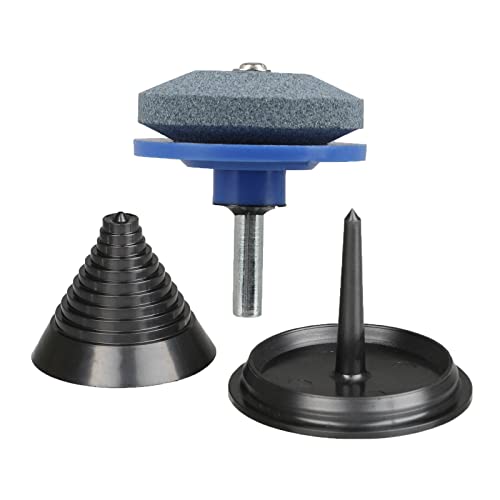
The Arnold BSK-1 is a straightforward sharpening and balancing kit designed for lawn mower blades. It turns your regular electric drill into a reliable sharpening tool, making it easy to maintain a clean cutting edge without investing in a dedicated grinder. The kit includes a cone-shaped sharpening stone and a simple static balancer, both built to handle blades from walk-behind mowers, lawn tractors, and zero-turn machines.
This kit is best suited for homeowners and DIYers who prefer to handle their own mower maintenance rather than taking blades to a shop. It's also useful for small engine mechanics who need an affordable backup method. But if you're a professional landscaper sharpening dozens of blades a week, you'll likely want a faster, more automated system.
In real-world use, the sharpener works quickly. Chuck it into a drill, run the stone along the blade's edge at a shallow angle, and you'll see burrs form within seconds. The vibration-free claim holds up -- the stone spins smoothly, which helps avoid gouging the blade. The balancer is straightforward: hang the blade on the cone and see which side drops. Rotate a few times to confirm. It's not fancy, but it effectively reveals if the blade is heavy on one side.
Build quality is typical for a budget tool. The sharpening stone is abrasive and should last through several sharpenings. The balancer is made of plastic and a metal cone. It's lightweight (just over two ounces) and stores easily in a drawer. For the price, durability is acceptable for occasional weekend usage. You won't hesitate to toss it in a toolbox or tool bag.
The main drawback is that you need a drill, and the process is manual. Balancing requires patience -- you'll have to grind off material from the heavy side and recheck. It's not as precise as a professional blade balancer, but it's more than enough to get a decently balanced blade. Overall, the Arnold BSK-1 is a smart buy for anyone who wants to keep their mower cutting cleanly on a budget. It's a practical addition to any workshop, especially if you already own a drill.
Color: Black
Dimensions: 3 x 7 x 10 inches
Weight: 0.24 pounds
Product Group: Outdoors
Binding: Lawn & Patio

Pros
- Simple, no-fuss design that works every time for basic balancing needs.
- Metal build feels solid and should hold up to years of garage use.
- Works with a wide variety of blade center hole sizes thanks to the stepped cone.
- Costs less than a coffee and delivers real performance improvement.
Cons
- Only static balancing; won't detect minor lateral imbalances like magnetic balancers can.
- May not fit blades with non-circular or odd-shaped center holes (e.g., some mulching or gator blades).
- Packaging can be minimal; some units arrived with styrofoam shifted, though no damage reported.
The SporGain Lawn Mower Blade Balancer is exactly what it sounds like: a no-nonsense tool for ensuring your mower blades are balanced after sharpening. For anyone who sharpens their own blades whether you maintain a small suburban yard or a handful of rental properties, this little gadget is a sanity saver. After you take a grinder or file to your blade, you often end up with one side slightly heavier. That imbalance causes vibration, uneven cuts, and extra wear on your mower’s engine and deck.
This balancer solves that problem simply. You set the blade on the tapered metal cone, and the heavy side drops down. Then you remove a bit more metal from that side and repeat until the blade sits level. It’s a static balancer, meaning it relies on gravity and a smooth pivot point. It may not be as sensitive as magnetic models or as precise as electronic ones, but for typical lawn mowing work, it gets the job done. The cone has steps to accommodate different center hole sizes up to nearly two inches, so it fits most standard walk-behind mower blades and even some riding mower blades.
Build quality is impressive for the price. The base and cone are made of metal, not plastic, so they won’t crack or warp. It’s small enough to toss in a tool bag or leave in a drawer. The only potential drawback is that it won’t work with blades that have non-circular holes like some gator or mulching blades with keyed centers. Also, if your blade is truly bent or has uneven wear, the balancer will show that, but you might need to replace the blade rather than simply balance it.
In real-world use, this balancer makes a noticeable difference. Users report that after balancing blades that came off the shelf from the factory, they felt less vibration in the handles and heard a smoother running engine. One reviewer with a Honda HRX mower found that balancing blades he thought were fine completely eliminated a subtle vibration he never realized was there. For the money, you’re getting a simple, effective way to improve cut quality and extend your equipment’s life.
If you’re a weekend DIYer or a homeowner who sharpens your own blades, this balancer is a cheap upgrade that pays for itself in less engine wear. Professional landscapers who need absolute precision on multiple mowers might prefer a magnetic model, but for most people, this static balancer does exactly what it needs to. A solid buy.
Product Dimensions: 2.4 x 2.4 x 2.1 inches
Item Weight: 3.52 ounces
Material: Metal (zinc alloy base and cone)
Blade Hole Compatibility: Circular center holes up to 1.97 inches (largest step)
Base Diameter: 2.36 inches
Color: Silver
Includes: One blade balancer only

Pros
- Low-cost investment that pays off by preventing premature mower repairs.
- All-metal build feels solid and stable during use.
- Works with nearly any residential lawn mower blade with a center hole.
- Simple to use no learning curve required.
Cons
- Static design may be slightly less sensitive than magnetic balancers for very heavy blades.
- Only accommodates blades with a center hole; some specialty blades may not fit.
- Small parts could be misplaced if not stored properly.
The SporGain Lawn Mower Blade Balancer is a straightforward, no-frills accessory that belongs in every DIY homeowner's workshop. It solves a common problem: after you sharpen your mower blade, an unbalanced blade causes annoying vibration, uneven cuts, and extra wear on the engine and spindle. This static balancer lets you quickly check and correct that balance before reinstalling the blade.
This tool is best suited for homeowners, gardeners, and anyone who maintains their own lawn equipment. It is not a power tool itself but an essential precision tool for blade maintenance. The metal construction feels sturdy the base and cone are made of durable alloy that should hold up well to repeated use in a garage or shed. The largest step on the cone measures 1.97 inches, and the base diameter is 2.36 inches, which fits most standard residential mower blades with a circular center hole.
In real-world use, you simply place the cone on the base, set the sharpened blade on top, and watch where it settles. A heavy side will drop, showing you where to remove more material. This static method is effective and requires no batteries or magnets. It is a bit slower than magnetic balancers, but for most home users, the extra few seconds are not an issue. The two-pack is a nice bonus you can keep one in your tool box and one near your workbench, or share with a neighbor.
Build quality is solid for the price point. The metal surface resists rust better than plastic balancers, though you should still wipe it clean after use. One drawback is that the cone and base are separate pieces, so they could be separated and lost if you are not careful. Also, while it works for most blades, blades with non-standard center openings or extremely heavy commercial blades may not balance as accurately. But for typical homeowner mowers it performs just fine.
Overall, the SporGain blade balancer is a smart, inexpensive addition to your lawn care routine. If you sharpen your own blades even once a season, this tool will help you get a smoother cut, reduce vibration, and prolong the life of your mower. It is a practical buy for any DIY yard worker.
Product Dimensions: 2.4 x 2.4 x 2.1 inches
Item Weight: 6 ounces
Material: Metal (aluminum alloy with zinc alloy base)
Type: Static blade balancer
Compatibility: Most lawn mower blades with circular center holes up to 1.97-inch diameter step
Package Includes: 2 blade balancers (each with base and step cone)

Pros
- Metal build feels solid and durable for long-term use
- Accurate static balancing method works reliably with most standard blades
- Universal cone design accommodates various center hole shapes and sizes
- Easy to use with no setup required - just place and balance
- Affordable two-pack offers great value for DIY homeowners
Cons
- Best results require a perfectly level surface - not ideal for uneven jobsite use
- May not balance non-circular or unusually shaped center holes as effectively
- Cone steps are relatively small - large blades may be top-heavy
The TonGass 2-Pack Metal Precision Blade Balancers are a simple but essential tool for anyone who sharpens their own lawn mower blades. These static balancers let you check and correct blade balance after grinding, which reduces vibration, improves cut quality, and protects your mower's engine from unnecessary wear.
Best suited for DIY homeowners and lawn care enthusiasts who sharpen blades at home. If you already use a bench grinder or file to sharpen, this balancer should be a staple in your workshop. It's also handy for small engine repair shops that want a quick, reliable balancing check without expensive electronic gear.
In real-world use, the balancer performs exactly as expected. Just set it on a level surface - like a workbench or concrete floor - place the blade's center hole over the cone, and let it settle. A balanced blade stays horizontal; an unbalanced one dips to the heavy side. The metal construction feels sturdy enough for daily use, and the compact size means it stows easily in a drawer or toolbox. The two-pack is nice because you can keep one at the sharpening station and one in your mower shed, or share with a neighbor.
Build quality is solid for the price - all metal with a clean finish, no plastic parts to break. The cone has stepped diameters to fit different hole sizes, and the base is wide enough for stability. One limitation: you absolutely need a level surface for accurate results. If your workbench is uneven, the balancer won't read true. Also, while the cone fits most standard blades, very large or oddly shaped center holes might not seat properly.
Overall, if you sharpen lawn mower blades at home, the TonGass blade balancers are a worthwhile addition. They take the guesswork out of balancing, help your mower run smoother, and cost less than a typical gas fill-up. For DIY homeowners who want to extend the life of their equipment and get a cleaner cut, this two-pack is an easy recommendation.
Package Dimensions: 3.43 x 2.8 x 2.48 inches
Item Weight: 6.4 ounces (both balancers combined)
Manufacturer: TonGass
Model: bladebalancermetal
Material: Metal base and stepped cone
Cone largest step: 1 3/8 inches
Base diameter: 2.36 inches
Compatibility: Most lawn mower blades with circular or standard center holes

Pros
- Wide compatibility with multiple blade hole types and brands
- Helps achieve smoother cutting and less vibration after sharpening
- Lightweight and easy to store in any workshop or garage
- Affordable price point for hobbyists and homeowners
Cons
- Plastic adapters may fit loosely on some balancer spindles, affecting precision
- Requires a level surface and careful visual inspection for accurate results
- Not as robust as metal balancing tools for heavy-duty commercial use
The LIZEWEI Lawn Mower Blade Balance Adapter Set is a practical accessory for anyone who sharpens their own mower blades. It includes a universal precision blade balancer plus five plastic adapters designed to fit different blade hole patterns: 5-point star, 6-point star, 7-point star, T-shirt holes, and bowtie holes (which also fit rectangular openings). This solves the common frustration of blades that won't center properly on the balancer's rounded steps, allowing for accurate balancing after sharpening.
This set is best suited for DIY homeowners, weekend lawn care enthusiasts, and small-scale property maintainers. If you regularly sharpen your reel or rotary mower blades and want to reduce vibration and engine wear, this kit provides a straightforward solution. It is not designed for high-frequency commercial use but handles typical residential lawn maintenance tasks with ease.
In real-world use, the system works as intended on a level surface. Place the appropriate adapter on the balancer spindle, set the blade on top, and observe if one end drops lower than the other. That indicates the heavier side needs more material removed. Several verified buyers report success balancing blades for brands like John Deere, Troy-Bilt, and Cub Cadet. The adapters effectively center the blade, making the process faster than balancing on a nail or screw.
Build quality is adequate for the price. The balancer is a simple tapered cone, and the plastic adapters feel reasonably sturdy. However, some users note that the adapters can have a slight slop on the balancer spindle, which may introduce minor inaccuracies. For the average homeowner, these tolerances are acceptable, but perfectionists might want to check fitment before purchase. The compact size (3.4 x 3.4 x 2.5 inches) makes it easy to store in a tool bag or drawer.
Overall, the LIZEWEI set offers good value for money. It addresses a specific pain point in blade maintenance and delivers on its promise of easier, more consistent balancing. If you are tired of guessing the center or using improvised methods, this inexpensive kit is a worthwhile addition to your workshop. Just be sure to use it on a stable, level workbench for best results.
Package Dimensions: 3.43 x 3.43 x 2.52 inches
Item Weight: 5 ounces
Manufacturer: LIZEWEI
ASIN: B0CHDH1QPL
Compatible Brands: Stihl, Oregon, Troy-Bilt, Cub Cadet, Honda, Lawn-Boy, Lawnmaster, Scotts, Snapper, Toro, and more
1 x 5-point star adapter
1 x 6-point star adapter
1 x 7-point star adapter
1 x T-shirt hole adapter
1 x Bowtie hole adapter (also fits rectangular holes)
1 x Universal precision mower blade balancer
Complete Guide to Balancing Lawn Mower Blades
Balancing a lawn mower blade restores equal weight across both cutting wings so the blade spins level on its center axis. When an unbalanced blade spins at thousands of revolutions per minute, uneven centrifugal force creates continuous high-frequency vibration throughout the cutting deck. Addressing this weight disparity requires removing small amounts of metal from the heavy side until both ends rest horizontally on a balance point. Learning the correct inspection, sharpening, and leveling sequence ensures smooth mower operation and prevents costly mechanical failure.
Routine blade balancing should accompany every sharpening session before the blade returns to the mower deck. Even minor sharpening errors, such as taking two extra passes with a grinder on one cutting edge, can tip the physical balance of the steel bar. Homeowners who perform their own yard maintenance can achieve reliable results using basic hand tools and dedicated static balancers. Exploring compatible mower blade setup options helps ensure that replacement components and maintenance practices align with manufacturer requirements.
Why Rotational Balance Matters for Deck and Engine Longevity
Lawn mower blades rotate at speeds between 2,800 and 3,600 revolutions per minute during standard mowing conditions. At these high velocities, an imbalance of merely an eighth of an ounce generates substantial dynamic force that shakes the entire spindle assembly. Over time, this chronic vibration loosens deck fasteners, degrades spindle bearings, and fractures deck housing brackets. In walk-behind push mowers, the blade mounts directly to the engine crankshaft, making an unbalanced blade a direct threat to engine seals and main bearings.
Beyond equipment wear, an unbalanced blade severely diminishes turf quality across your property. As the blade wobbles through its rotational plane, the cutting tips travel at inconsistent heights relative to the ground. This vertical variation produces uneven cutting lines, stepped turf patterns, and ragged grass leaf tips that turn brown after mowing. Maintaining balanced cutting wings ensures crisp, level shearing that allows the lawn to recover quickly and retain its green color.
Fuel consumption and electric power draw also rise when operating an out-of-balance cutting assembly. The oscillating mass wastes mechanical energy as the motor fights continuous torsional resistance within the deck cavity. Smooth rotational dynamics reduce internal engine strain and preserve battery runtime on cordless electric platforms. Keeping the cutting edges balanced preserves the mechanical balance engineered into the mower deck drive system.
Inspecting Blades for Structural Bends and Metal Fatigue
Before checking the balance of any mower blade, operators must verify that the blade is structurally sound and straight. Balancing a bent or cracked blade is dangerous and will not resolve deck vibration issues. Lay the removed blade on a flat workbench or level table surface to inspect both cutting wings. Look closely at the blade tips, the trailing lift sails, and the center mounting hole for signs of warping, hairline cracks, or severe gouges.
Impact with rocks or tree roots often bends one wing upward or downward without cracking the steel. A blade with one wing bent higher will cut unevenly even if its static weight matches on a balancer stand. You can measure from the table surface to each blade tip to confirm that both ends sit at identical elevations. If either cutting wing is bent or twisted near the trailing sail, the blade must be replaced rather than balanced.
Metal fatigue presents another critical hazard that requires careful visual examination under good lighting. Pay close attention to the area surrounding the center hole, where mounting torque and rotational stress concentrate during operation. Any visible fracture or circular elongation around the bolt hole compromise structural integrity. Attempting to balance or run a cracked blade risks catastrophic blade failure while the engine runs at full throttle.
Safe Blade Removal and Workspace Preparation
Safety preparation must precede any mower maintenance to prevent accidental engine starting or serious hand injuries. For gasoline-powered mowers, disconnect the spark plug wire and tuck the boot securely away from the spark plug terminal. On battery-powered electric mowers, remove the safety key and take out the main battery pack before touching the underside of the deck. Always put on heavy leather work gloves to protect your hands from sharp cutting edges and metal burrs.
When tilting a walk-behind mower to access the blade bolt, position the machine so the carburetor and air filter face upward. Tilting a gas mower with the air filter facing downward allows engine oil to flood the carburetor and saturate the filter. Riding mowers and zero-turn machines typically require raising the cutting deck to its highest pin setting or driving onto service ramps. Secure the equipment on solid ground with the parking brake firmly engaged before reaching underneath.
Loosening the blade bolt requires immobilizing the blade so it cannot rotate while applying wrench force. Wedge a wooden block between the blade wing and the inner deck wall. Use a properly sized socket wrench to turn the retaining bolt counterclockwise on standard right-hand threaded spindles. Keep track of all mounting hardware, including conical washers and friction plates, noting their exact orientation for later assembly.
Cleaning Built-Up Debris and Sharpening Evenly
Accurate balancing cannot occur until the blade is completely clean of caked grass, dried mud, and sap build-up. Accumulated organic matter on the underside of a cutting wing adds deceptive weight that skews any balance reading. Use a stiff wire brush or putty knife to scrape both sides of the steel bar down to bare metal. Wipe away remaining residue with a clean rag so that the physical weight represents the steel alone.
Sharpening should always take place immediately before checking blade balance. Maintain the original factory bevel angle, which typically sits between thirty and thirty-five degrees on residential mower blades. Count your grinding strokes or file passes to remove roughly equal amounts of steel from each cutting edge. Sharpening accessories like the Bneykrir rotary corundum wheel or the jtfrkope sharpener attachment chuck into standard power drills to help guide stone contact across the cutting edge.
Never sharpen the flat underside of the blade, as this alters the cutting geometry and weakens the edge. Lightly deburr the bottom surface with a single pass of a hand file to knock down any wire edge formed during sharpening. If one side suffered deep rock nicks, grind out the damage smoothly along the entire cutting edge rather than creating a localized divot. Understanding proper edge maintenance aligns well with broader Ryobi mower blade setup recommendations where balanced wings preserve electric motor efficiency.
Static Cone Balancers Versus Improvised Balancing Methods
Homeowners historically tested blade balance by hanging the center hole over a horizontal nail driven into a workshop wall. While a wall nail offers a rough check, friction between the nail shank and the blade hole often masks slight weight differences. A nail also fails to center blades that feature stepped or non-circular mounting holes, leading to false leveling indications. Professional-style static cone balancers offer far greater sensitivity by resting the blade on a low-friction pivot point.
Dedicated static balancers, such as the Arnold BSK-1 kit or all-metal stands from SporGain and TonGass, utilize tiered concentric cones. The stepped cone rests atop a vertical needle-point bearing, allowing the blade to pivot freely in three dimensions. The tiered steps seat firmly inside common circular center holes measuring from roughly one half inch up to nearly two inches across. This stepped design automatically centers the blade over the pivot pin, ensuring that only gravitational pull determines horizontal alignment.
Handling Star Patterns and Specialty Center Mounting Holes
Many modern lawn tractors and residential riding mowers use specialized center holes rather than standard round circles. Common patterns include five-point stars, six-point stars, seven-point stars, bowtie cutouts, and rectangular t-shirt profiles. When placed directly on a standard conical balancer, these irregular shapes fail to seat squarely on the rounded steps. An off-center blade produces a false heavy side because the pivot point does not match the actual center of rotation.
To overcome this centering mismatch, dedicated adapter kits provide custom-machined inserts that lock into proprietary center hole cutouts. The LIZEWEI balance adapter set provides distinct inserts for five-point, six-point, and seven-point stars, as well as bowtie and t-shirt apertures. The adapter fits tightly inside the blade hole while presenting a clean circular seat for the universal cone balancer. This configuration guarantees that the blade pivots around the precise axis used by the mower spindle shaft.
Step-by-Step Balancing Procedure and Metal Removal
Begin the balancing process by placing your clean, sharpened blade onto the static balancer cone on a level work surface. Ensure the cutting edges face upward or horizontally so the blade can tilt freely without contacting the table. Release the blade gently and observe its behavior for several seconds until all movement ceases. If the blade remains level and parallel to the workbench, both cutting wings carry equal weight and the blade is ready for service.
If one wing dips downward while the opposing wing rises into the air, the downward-tilted wing is heavy. Mark the heavy wing with a piece of chalk or pencil near the trailing sail so you do not lose track during grinding. Remove the blade from the balancer stand and clamp it securely in a bench vise to prepare for corrective material removal. Never remove material from the light wing, as doing so will only exaggerate the weight imbalance.
When removing weight from the heavy side, grind metal exclusively from the back edge of the blade wing or the trailing lift sail. Never grind away metal from the cutting bevel or shorten the blade length to correct an imbalance. Grinding the cutting edge alters the sharpness angle, reduces cutting reach, and creates an uneven clearance gap inside the deck baffle. Take light, uniform passes along the rear unsharpened edge with a hand file or angle grinder to shave off small amounts of steel.
Return the blade to the balancer cone after every few passes to recheck horizontal alignment. Continue this incremental process of grinding and testing until the blade rests completely level on the cone without tipping. Patience is essential because steel removed too quickly cannot be put back onto the blade bar. Once the blade balances horizontally on the pivot, wipe away any fresh grinding dust and prepare the mounting area.
Reinstallation, Hardware Torque, and Vibration Testing
Reinstalling the balanced blade requires correct positioning relative to the mower deck underside. Position the blade with the sharp cutting edge facing the direction of spindle rotation and the curved lift sails pointing toward the deck ceiling. Installing a blade upside down causes the blunt back edge to smash grass blades while ruining turf discharge and suction. Seat the center hole squarely onto the spindle star or round flange before threading the mounting bolt.
Inspect the retaining bolt, washer, and hardware stack for worn threads, rounding, or rust before tightening. Reassemble washers in their documented factory orientation, placing convex or cupped spring washers with the dished side facing toward the blade. Block the blade with a wooden block against the deck housing and tighten the bolt with a torque wrench. Always consult your mower operator manual for exact torque specifications, which commonly range between thirty-five and sixty foot-pounds on residential equipment.
After securing all mounting hardware, conduct a safe operational check to verify that deck vibration has subsided. Reconnect the spark plug wire or reinsert the safety key and battery pack. Start the mower on a smooth, level driveway or flat lawn away from rocks and debris, engaging the cutting blades at half throttle before moving to full speed. A properly balanced blade assembly runs smoothly with minimal deck vibration, ensuring quiet operation and a clean, even cut across your yard.
Mastering regular blade balancing protects your outdoor power equipment investment while delivering manicured lawn results all season long. Combining a careful visual check for structural straightness with precise static cone balancing prevents excessive mechanical wear on spindles, bearings, and engine parts. Investing in reliable balance cones and adapter sets eliminates guesswork after every sharpening session. Taking time to balance blades properly keeps mower decks running quietly, reliably, and efficiently through years of tough mowing duty.


Write Your Review
No reviews yet. Be the first to share your experience!